April 28, 2026
There is no single best private jet. The aircraft that transforms one executive’s travel experience may be completely wrong for another. What matters is matching the right jet to your specific mission profile, passenger requirements, and annual flight hours.
When taking into account the popularity and features of private jets, selection and appeal in the private aviation market are key considerations. The best private jets currently on the market include the Gulfstream G700, Bombardier Global 7500/8000, and Dassault Falcon 8X/10X. For ultra-long-range capability, the Bombardier Global 8000 leads with its exceptional range and top speed. For light jet efficiency on shorter routes, the Embraer Phenom 300 dominates. For turboprop versatility on unimproved runways, the Pilatus PC-12 remains unmatched. Each excels in different contexts. Economy, in terms of operational costs and affordability, is also an important factor for families or buyers seeking a balance between luxury and practicality.
This article evaluates both aircraft and access models—fractional jet ownership, membership programs, and charter—from the perspective of BlackJet Fractional Jet Ownership. With the Global 8000 entering service in the mid-2020s and the Dassault Falcon 10X expected around 2026, the private aviation landscape offers more capable options than ever for high-net-worth individuals and corporate buyers across North and South America and globally.
Before selecting a specific aircraft, clarify what “best” means for your travel patterns. Here are the critical factors:
Range: Ultra-long-range jets cover 6,000–8,000 nautical miles for routes like New York to Hong Kong. Super midsize jets handle 3,000–3,500 nm for transcontinental flights. Light jets manage 1,800–2,500 nm for regional hops. Aircraft weight is a key factor influencing maximum range and operational capacity, directly affecting how far the jet can fly and how many passengers it can accommodate. Range figures are typically calculated assuming NBAA IFR reserves, which are official fuel reserves mandated for business aviation safety and compliance.
Passenger capacity: Very light jets seat four passengers comfortably, while larger jets like the Global 7500 accommodate 14–19 passengers across multiple living areas.
Speed: Modern jets are designed to fly faster (up to Mach 0.94) and further without refueling. The fastest civil aircraft since the Concorde reaches Mach 0.95.
Airport access: Certain jets, such as the Dassault Falcon series and the Pilatus PC-24, can operate on shorter runways, allowing access to more airports and remote locations.
Cabin comfort: The cabin altitude in some private jets can be as low as 2,691 feet, which helps reduce the effects of jet lag. Many private jets feature advanced air filtration systems, such as hospital-grade HEPA filters, which can capture up to 99.99% of airborne particles, including viruses and allergens.
Connectivity: Innovative cabin technologies in modern private jets are engineered to enhance connectivity and productivity, allowing passengers to stay connected while in flight via Starlink, Gogo Galileo, or JetWave systems.
Your flight profile dramatically changes. Which aircraft is optimal? A CEO flying from New York to Los Angeles needs different capabilities than a family connecting London to Singapore.

This category suits clients regularly flying 10–17-hour legs between city pairs like New York to Hong Kong, Los Angeles to Singapore, or London to Buenos Aires, where understanding fractional jet ownership terminology and program structures becomes critical before committing capital. These large cabin jets are designed for long-range, spacious travel, offering enhanced comfort and the ability to access restricted airports, making them ideal for high-end business and leisure travel. Ultra-long-range jets provide non-stop transcontinental flights and maximum comfort with multiple zones and luxurious amenities.
Aircraft | Max Range (nm) | Top Speed (Mach) | Passenger Capacity | Key Features |
|---|---|---|---|---|
Bombardier Global 8000 | 8,000 | 0.95 | Varies | World's fastest business jet, four true living spaces, Soleil circadian lighting, Nuage seats |
Bombardier Global 7500 | 7,700 | 0.94 | 14–19 | Apex of private aviation, four-zone cabin, low cabin altitude, long-range luxury |
Gulfstream G700 | ~7,500 | 0.925 | Up to 19 | Five living areas, Symmetry Flight Deck, and advanced connectivity |
Dassault Falcon 10X | ~7,500 (est.) | N/A | N/A | Widest cabin in class, enhanced comfort, low noise and vibration (expected 2026) |
Bombardier Global 8000: The Bombardier Global 8000 is recognized as the world’s fastest business jet, with a top speed of Mach 0.95. With 8,000 nautical miles of maximum range and four true living spaces, it redefines transglobal travel. The Soleil lighting system is the first circadian rhythm-based cabin lighting fully integrated with the Flight Management System, designed to help combat jet lag. The Nuage seat offers zero-gravity positioning for rest during extended flight time.
Bombardier Global 7500: The Bombardier Global 7500 is often described as the apex of private aviation, featuring a range of 7,700 nautical miles and a luxurious four-zone cabin. The Bombardier Global 7500 features a top speed of Mach 0.94, making it one of the fastest long-range private jets in the market. Typical missions include New York to Johannesburg or Los Angeles to Sydney with 14–19 passengers.
Gulfstream G700: With approximately 7,500 nm range and up to five living areas, the Gulfstream G700 has a top speed of Mach 0.925, positioning it among the fastest private jets available today. The Symmetry Flight Deck provides enhanced pilot situational awareness for nonstop routes like London to Perth or Dubai to New York.
Dassault Falcon 10X: Expected around 2026 with a planned 7,500 nm range, this upcoming competitor features the widest cabin in its class and prioritizes comfort through lower noise and vibration levels.
Many fractional owners at BlackJet gravitate to this segment when they fly more than 150 hours per year on intercontinental routes, often favoring floating fleet fractional ownership models that optimize aircraft utilization across long-haul missions. Shared access to Global 7500 or Global 8000 aircraft through the Equity Fleet provides guaranteed availability without the $75 million acquisition cost of sole ownership.
These jets balance spacious cabin dimensions, operating cost, and range for frequent US to Europe, US to South America, and intra-Asia routes spanning 6–12 hour flights.
Aircraft | Max Range (nm) | Passenger Capacity | Key Features |
|---|---|---|---|
Gulfstream G550 | 6,750 | 14–19 | High performance, cabin sophistication, popular for nonstop transcontinental flights |
Bombardier Global Express XRS | 6,000 | 14 | Three or four-zone cabin, advanced wing design, smooth ride technology |
Dassault Falcon 8X | ~6,450 | Varies | Tri-jet design, 25% better fuel efficiency, steep-approach for short runways |
Embraer Lineage 1000E | Varies | Varies | “Flying residence,” five zones, walk-in shower, king bed, residential amenities |
Fractional buyers considering long-range tri-jet options often evaluate the Falcon 8X alongside the Falcon 900LX fractional ownership program to balance range, runway performance, and operating cost.
Gulfstream G550: The Gulfstream G550 has a maximum range of 6,750 nautical miles, making it a popular choice for transcontinental travel. The Gulfstream G550 is one of the most chartered ultra-long-range jets, known for its high performance and cabin sophistication, accommodating 14-19 passengers. It handles New York to Tokyo or London to Los Angeles nonstop with strong resale value.
Bombardier Global Express XRS: The Bombardier Global Express XRS offers a range of 6,000 nautical miles, suitable for long-haul flights between major global cities. The three or four-zone cabin separates work and rest areas, making it popular for corporate roadshows and C-suite tours across Europe and the Middle East.
Dassault Falcon 8X: With approximately 6,450 nm range, this tri-jet design delivers 25% better fuel efficiency than comparable twins. Its steep-approach capability enables access to challenging airports like London City with runways as short as 3,500 feet.
Embraer Lineage 1000E: This “flying residence” offers up to five zones with a walk-in shower, a king bed, and residential amenities. Best for clients prioritizing onboard living space for extended South America connections over runway versatility.
BlackJet’s Equity Fleet and Reserve Fleet commonly include aircraft in this range for clients needing 25–150 hours per year of long-haul travel without full ownership complexity, and tools that compare fractional jet ownership programs can help refine which structure best fits those needs.
This category often represents the winning combination for US-based executives flying 2–7 hour legs like Chicago to San Francisco, Dallas to New York, Miami to Los Angeles, or intra-Europe itineraries.
Aircraft | Max Range (nm) | Passenger Capacity | Key Features |
|---|---|---|---|
Bombardier Challenger 350/3500 | ~3,400 | 9–10 | Wide cabin, quiet interior, Nuage seating system, ideal for multi-stop business roadshows |
Embraer Praetor 500/600 | 3,340–4,018 | Varies | Advanced avionics, high-speed connectivity, transatlantic potential at a lower acquisition cost |
Cessna Citation Latitude/Longitude | 2,850–3,500 | Varies | Flat-floor design, standing headroom, customizable interiors, popular in the charter market |
Midsize and super-midsize jets have a performance range of 3,000–4,500 nm and can accommodate 8-12 passengers, suitable for coast-to-coast or regional flights, with options such as fractional ownership of a Falcon 2000EX super midsize jet appealing to frequent business travelers.
These aircraft classes fit typical BlackJet Fractional Jet Ownership clients who average 25–75 flight hours per year, prioritizing predictable availability, lower cost per hour than heavy jets, and access to smaller regional airports, while some buyers also look at emerging long-range models like the Falcon 6X fractional share option for additional cabin comfort and reach.
For flights under 3 hours—New York to Boston, Los Angeles to Las Vegas, or short hops across European city pairs—light jets and turboprops deliver the most cost-effective performance.
Aircraft | Max Range (nm) | Passenger Capacity | Key Features |
|---|---|---|---|
Embraer Phenom 300 | ~1,970–2,100 | 6–8 | World's best-selling light jet, single-pilot certified, ideal for 2–3 hour sectors |
Embraer Phenom 100 | ~1,178 | 4–6 | Very light jet, compact, efficient for 1–2 hour missions |
Cessna Citation Mustang | ~1,150 | 4–5 | Air taxi reputation, cost-effective, ample luggage space |
Pilatus PC-12 NGX | ~1,800 | 6–9 | Leading single-engine turboprop, short-field capability, versatile runway access |
Beechcraft King Air 250/350 | ~1,800 | 6–9 | Twin turboprop, reliable, lower fuel burn, popular for regional routes |
Light jets have a performance range of approximately 2,500 nm, ideal for 4–6 passengers, and they offer the lowest operating costs and fuel consumption, making models like the HondaJet fractional ownership option attractive for efficient regional travel.
Understanding these categories helps clients determine when a light jet or turboprop accessed via membership or charter may be more rational than owning a share in an ultra-long-range aircraft, or when a high-performance turboprop such as a TBM 850 fractional ownership option can deliver jet-like speeds with lower operating costs.
The best jet fits 80–90% of your actual missions—not edge-case trips taken once a year. Popular private jets range from economical light jets for short trips to ultra-long-range, high-comfort models. Here’s how BlackJet advisors walk clients through the decision:
Scenario 1: US CEO flying New York to Miami and Dallas twice monthly — a flight profile similar to many clients using fractional jet ownership programs in Atlanta, fractional jet ownership in Austin, and other major business hubs.
Flight hours: 50–75 per year
Passengers: 4–6
Optimal: Super midsize jets like Challenger 350 or Praetor 600 via fractional ownership
Access model: Equity Fleet share providing guaranteed availability and multi-leg efficiency
Scenario 2: Global family with homes in London and Los Angeles
Flight hours: 100+ per year
Passengers: 6–8, including family
Optimal: Bombardier Global 7500 or Gulfstream G700 with bedroom and multiple living spaces, potentially structured around a 1/8th fractional jet ownership share for families flying around 100 hours per year
Access model: Fractional share in ultra-long-range fleet
Scenario 3: European entrepreneur flying from London to Geneva to Milan day trips — a pattern comparable to regional executives leveraging fractional jet ownership solutions based in Orlando, fractional jet ownership in Nashville, or other gateway cities for frequent short sectors.
Flight hours: 40 per year
Passengers: 3–4
Optimal: Phenom 300 for quick turns and efficient short-field access
Access model: Reserve Fleet or jet cards for flexibility
Scenario 4: Resource company with operations across secondary airports — similar to industrial users adopting fractional jet ownership in Pittsburgh or fractional jet ownership in Phoenix to link secondary and tertiary markets efficiently.
Flight hours: Variable, approximately 60 per year
Passengers: 8
Optimal: PC-12 turboprop blended with flexible jet access for longer routes
Access model: Hybrid membership allowing turboprop and jet access
When a client requests a Global 8000 for prestige but data shows 70% of their flights are domestic under 1,500 nm, BlackJet advisors redirect toward a Global 5500 or super-midsize solution—saving millions while matching actual usage.

Selecting the ideal aircraft is only half the decision. How you access it can save or waste millions over a decade, and how you structure coverage for liability and insurance in fractional jet ownership can materially affect long-term risk and cost.
Access Model | Description | Ideal Flight Hours Per Year | Key Benefits | Considerations |
|---|---|---|---|---|
Full ownership | Sole ownership with full control and branding | 200–300+ | Complete control, customization, branding | The highest capital and operating costs |
Fractional ownership | Proportional share in an aircraft with guaranteed availability | 25–150 | Predictable costs, professional management, shared expenses | Commitment term, equity investment |
Reserve Fleet/Membership | Pay-as-you-go access without equity commitment | Variable | Flexibility, no capital outlay, and testing private aviation | Availability varies, less control |
Ad-hoc charter | On-demand charter flights without long-term commitment | Under 25 | No commitment, access to various aircraft | Price volatility, limited scheduling reliability |
Full ownership: Highest control and branding with complete capital outlay ($20–75 million), annual fixed costs of $2–5 million for crew, maintenance, and depreciation. Suitable only above 200–300 hours per year.
Fractional jet ownership (Equity Fleet): A proportional share (1/16 to 1/2) in aircraft like a Challenger 350 or Global 7500. Predictable guaranteed availability, professional fleet management, and costs spread across multiple owners. Ideal for 25–150 hours per year with lower effective costs than sole ownership, especially when compared with private jet membership program alternatives.
Reserve Fleet/Membership: Pay-as-you-go options without equity commitment. Useful for companies wanting flexibility without long contracts or those testing private aviation before committing capital.
Ad-hoc charter: Good for occasional flyers under 25 hours annually but features volatile pricing (20–50% peak surcharges), variable aircraft quality, and limited predictability for busy executives.
The best private jet experience for most readers comes from pairing a correctly sized aircraft class with a fractional or membership model tailored to their hours and routes.
For HNWIs and corporations flying 25–150 hours per year who want access to Global 7500, G550, Challenger 350, or similar aircraft, fractional ownership often delivers superior value as a private aviation investment structure compared with outright ownership.
The Equity Fleet provides proportional aircraft ownership with guaranteed availability, predictable monthly and hourly costs, and access to a managed fleet rather than being tied to a single tail number, all of which are codified in a detailed aircraft fractional ownership contract. Typical cost components include acquisition cost for equity programs, monthly management fees ($50,000–150,000 for 1/16 share), and occupied hourly rates ($6,000–10,000), all of which are central to fractional jet ownership financing considerations.
The Reserve Fleet option serves as a non-equity program ideal for variable travel needs or businesses testing private aviation before committing capital, and it can also provide a flexible bridge for owners who are selling an existing fractional jet share and reassessing their long-term strategy.
Potential US tax advantages include bonus depreciation for qualifying business use and Section 179 considerations, but these benefits only make sense in light of the total cost of fractional jet ownership, including acquisition, management, and operating expenses, and a clear grasp of the tax implications for fractional jet owners. BlackJet advises clients to consult aviation-savvy tax professionals to maximize these benefits and to review essential fractional jet ownership contract terms with legal counsel before signing.
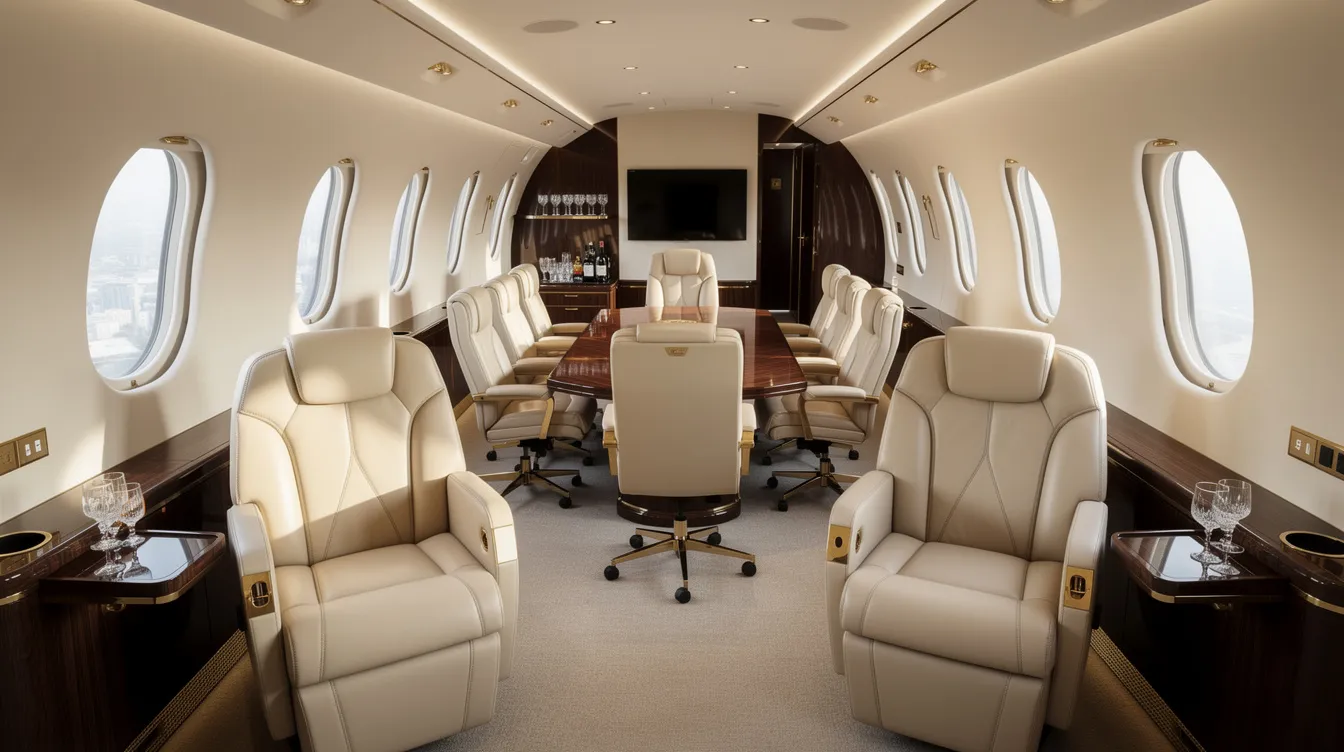
Top-tier jets offer customized cabin layouts, including full-service galleys, conference rooms, and master bedrooms with showers, features that appeal to owners flying from resort and coastal gateways such as Fernandina Beach private jet facilities. Modern aircraft prioritize passenger comfort through features like whisper-quiet cabins, panoramic windows, circadian lighting, and advanced entertainment systems, making them ideal for leisure-heavy markets such as Ibiza private jet access and ownership. Fractional access delivers these experiences without the burden of sole ownership.
Even the best jet is only as good as the scheduling, crew, and support behind it, including highly trained pilots and cabin crews dedicated to safety and service.
Typical hourly cost ranges by class help frame the overall cost of fractional jet ownership when combined with acquisition and management fees, whether you’re flying from major hubs or regional gateways like Atlantic Municipal. Private jet access options:
Jet Class | Hourly Cost Range (USD) |
|---|---|
Light jets | $3,000–5,000 |
Super midsize jets | $5,000–7,000 |
Ultra-long-range | $10,000–15,000 |
Real-world costs increase 10–20% with repositioning, de-icing, and international fees, particularly when operating from specialized fields such as Avord AB private jet access hubs.
Guaranteed availability in fractional programs contrasts sharply with charter uncertainty during peak periods, a distinction that becomes obvious for travelers using bases like Calgary International fractional jet services. The Gulfstream G650ER can cover a distance of 7,500 nautical miles, setting a high standard for performance in business aviation—but access means nothing without scheduling reliability, whether you fly out of major hubs or regional centers such as Kelowna, with private jet access options.
BlackJet’s operational benefits include 24/7 scheduling, optimized aircraft selection per trip, access to both Equity Fleet and Reserve Fleet, and backup aircraft during maintenance events, positioning it competitively among the top fractional jet ownership programs for discerning flyers for clients flying from a wide range of airports, including lifestyle destinations like the Bay of Islands private jet access hub. For corporate users, consistent reliability and on-time performance usually matter more than owning the absolute top-spec flagship.
The Bombardier Pũr Air system features a hospital-grade HEPA filter that captures up to 99.99% of particles, including viruses and allergens, ensuring cleaner air in the cabin. Top-tier models in the private jet market are increasingly focused on reducing traveler fatigue through lower cabin altitudes and circadian lighting. Private jets often include innovative cabin lighting systems that simulate natural daylight patterns, helping to combat jet lag and enhance passenger comfort during flights.
The private jet market is increasingly focused on ultra-long-range capabilities, bespoke cabin luxury, and advanced safety technology like autonomous landing systems, trends that are visible even at emerging hubs such as Bhubaneswar, private jet access, and ownership options. Aircraft with advanced aerodynamics and efficiencies can improve operational performance by enhancing range compared to their predecessors, which is particularly valuable for regional bases adopting fractional solutions, such as Kaohsiung fractional jet ownership programs.
The Bombardier Global 8000 and Gulfstream G700/800 lead as top all-around contenders for speed, range, and cabin sophistication. However, mission-specific fit matters more than absolute rankings. A Phenom 300 is the “best” for a client flying 90% short domestic routes.
Aircraft with multi-zone cabins and low cabin altitude reduce fatigue for all passengers. The Global 7500, G700, and Falcon 8X excel for long family trips with dedicated dining, entertainment, and room for rest. For shorter family travel, the Phenom 300 and Citation Latitude offer comfortable solutions.
For executives based near key West Coast gateways, fractional jet ownership in Seattle can pair productive cabin layouts with convenient regional access.
Focus on cabin connectivity (Starlink, Gogo Galileo), conference layouts with space for presentations, quiet cabins below 50 dB, and long uninterrupted ranges. The Global 7500, G550, and Challenger 350 deliver high-performance environments for work in the air.
For many regional travelers, especially those considering fractional jet ownership in Portland, the economics tilt toward fractional when annual usage climbs into the 25–150 hour range.
For 25–150 hours per year on comparable aircraft, fractional typically yields lower effective cost per hour and greater reliability. Charter can be cheaper for very occasional flyers under 25 hours annually, but it brings scheduling uncertainty.
Coastal markets like Virginia Beach fractional jet ownership often see owners plan commitments around evolving business cycles and family needs.
Typical terms run 3–5 years with exit options. BlackJet tailors program length and share size to changing travel patterns, ensuring the commitment aligns with evolving business and family needs.

The best private jet is not a single model but a combination of the right aircraft category—from Pilatus PC-12 and Phenom 300 up to Global 8000 and Gulfstream G700—and the right access model for your specific travel patterns.
Fractional jet ownership and membership-style programs often provide the smartest path to flying on top-tier aircraft without the full-ownership burden. For clients in the industry flying 25–150 hours per year, these solutions connect you with the world’s finest private jets while maintaining predictable costs and guaranteed scheduling.
Before committing to any specific aircraft, review your actual routes, trip frequency, and budget with an expert advisor. The goal is to transform travel from a logistical challenge into a predictable, efficient advantage for business and family life.
Ready to explore the smarter way to fly private? Visit FractionalJetOwnership.com to learn how BlackJet Fractional Jet Ownership’s Equity Fleet and Reserve Fleet options can create a personalized private aviation plan matched to your real-world needs.
