January 19, 2026
Business aviation continues to play a critical role in how companies, executives, and high-net-worth individuals travel worldwide. As global commerce accelerates and time becomes an increasingly valuable asset, private jets and business aircraft offer tailored solutions that commercial airlines simply cannot match. From efficient light jets designed for regional missions to ultra-long-range aircraft capable of nonstop intercontinental travel, the sector continues to evolve with range, performance, and reliability at the forefront.
The industry is led by manufacturers such as Cessna, Bombardier, and Gulfstream Aerospace, each competing through continuous innovation in aerodynamics, materials, avionics, and cabin design. Their collective focus extends beyond comfort, emphasizing operational efficiency, safety, and adaptability to changing travel patterns.
One of the defining advantages of business aviation is access. Private aircraft can operate from thousands of smaller airports worldwide—over 5,000 airports in the U.S. alone—compared to around 500 served by commercial airlines. This significantly reduces ground travel time and opens direct routes that eliminate layovers, improving productivity. Custom schedules for business jets allow for last-minute changes and multiple stops in different cities in a single day, offering flexibility not present in commercial timetables.
Business jets also experience higher reliability with fewer delays and cancellations compared to commercial travel. Travelers typically arrive at private terminals just 15-30 minutes before departure, avoiding standard commercial airport procedures. The controlled cabin environment safeguards against eavesdropping and data breaches, ensuring confidentiality for sensitive discussions. Quiet cabins provide an ideal setting for confidential meetings and uninterrupted work, turning travel time into productive time.
A business jet is designed for transporting small groups of people, typically business executives and high-ranking associates. However, these versatile aircraft may also be adapted for specialized roles such as casualty evacuation or express parcel deliveries. Business jets are used by public bodies, government officials, VIPs, and even the military.
Flight departments are corporate-owned operators that manage the aircraft of a specific company. Charter operators own or manage private jets for multiple clients and handle all aspects of aircraft operation and maintenance.
Business jets span a wide spectrum, offering solutions that align with different mission profiles, passenger counts, and range requirements. From compact, high-efficiency light jets to large-cabin aircraft designed for nonstop global travel, the modern business jet market offers remarkable flexibility.
Popular platforms such as the Cessna Citation family and Bombardier’s Global series are known for balancing performance with operating efficiency. These aircraft combine advanced avionics, aerodynamic refinements, and passenger-centric cabin layouts that support productivity in flight.
The Cessna Citation I, an early model in the Citation family, has a maximum takeoff weight of 11,850 lb and is powered by two 2,200 lbf Pratt & Whitney Canada JT15D turbofans. The Learjet 23, recognized as the first light jet, has a maximum takeoff weight of 12,500 lb and is powered by two 2,850 lbf General Electric CJ610 engines.
Private jets also offer tailored configurations, allowing owners and fractional participants to prioritize seating, connectivity, and onboard amenities based on their travel needs. As a result, business aviation continues to attract customers who value control, privacy, and time savings rather than luxury alone.
Innovation remains a driving force. Manufacturers continue to introduce new models and upgrades that improve fuel efficiency, extend range, and enhance passenger comfort—ensuring business jets remain aligned with evolving expectations.
Light jets remain one of the most popular segments in business aviation due to their efficiency, versatility, and relatively lower operating costs. These aircraft are well-suited for short to medium-haul missions, offering a balance of speed and comfort without the complexity of larger platforms.
Models such as the Cessna Citation M2 and CJ4 are in high demand, thanks to their reliable performance, modern avionics, and comfortable cabins. Their ability to operate from shorter runways allows access to smaller airports, enabling nonstop travel between regional destinations.
For business travelers, light jets support productive missions by reducing door-to-door travel time. They also appeal to organizations seeking a cost-effective entry point into private aviation, as operating and maintenance costs are typically lower than those of midsize or large-cabin aircraft.
As technology improves, newer light jets continue to narrow the gap between efficiency and capability, reinforcing their role as a practical solution for frequent regional travel.
Midsize business jets typically accommodate up to 8 passengers and offer a range of approximately 2,540 nautical miles. They provide superior cabin space compared to light jets, with spacious interiors featuring handstitched leather seats, flat floors, and generous headroom for enhanced comfort.
Midsize jets often include advanced amenities such as in-flight internet technology, Wi-Fi calling, full refreshment centers, and in-flight dining options. These jets are capable of nonstop flights between major cities like Washington, D.C., and San Jose, California, making them ideal for both business and leisure travel.
Popular midsize models, including the Cessna Citation Latitude and Citation Ascend, combine outstanding runway performance and luxurious interiors with advanced avionics and connectivity.
Ultra long-range jets are designed for intercontinental travel and luxury, often featuring private suites and spacious cabins that accommodate 8 to 16 or more passengers. These aircraft set new benchmarks for nonstop global connectivity, enabling direct flights between distant hubs.
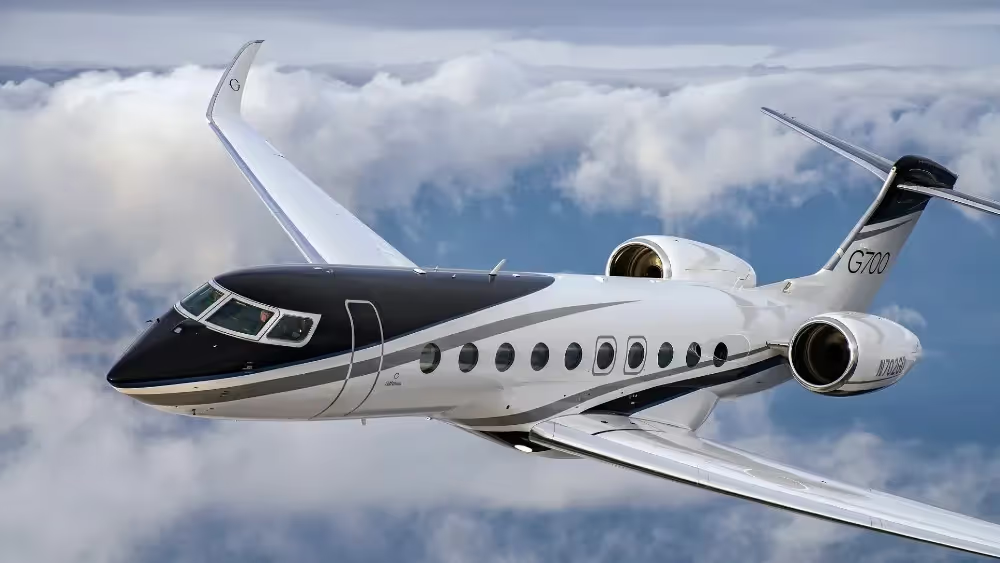
Examples include the Gulfstream G800, with a maximum range of 8,200 nautical miles and a cruise speed of Mach 0.85, and the Bombardier Global 8000, which reaches a top speed of Mach 0.95 and offers access to 30% more airports than its closest competitor. These jets feature advanced cabin technologies such as low cabin altitude to combat jet lag, 100% fresh air with plasma ionization for purification, and customizable lighting to enhance passenger comfort.
The first flight of a new business jet represents a critical milestone in aircraft development. It marks the transition from design and simulation to real-world validation, launching a rigorous testing and certification process.
Manufacturers such as Cessna and Bombardier invest heavily in research and development to refine aerodynamics, systems integration, and performance metrics before the first flight. Once airborne, test programs evaluate everything from handling characteristics and fuel efficiency to avionics reliability and safety systems.
Certification requires close coordination with aviation authorities to ensure that every system meets strict regulatory requirements. This process not only verifies compliance but also ensures the aircraft delivers consistent performance under real-world operating conditions.
First flight and testing phases ultimately protect operators and passengers alike, reinforcing the industry’s commitment to safety, reliability, and operational excellence.
Modern business jets are built using advanced materials and construction techniques designed to maximize strength while minimizing weight. Composite materials, high-strength aluminum alloys, and precision manufacturing processes all contribute to improved performance and fuel efficiency.
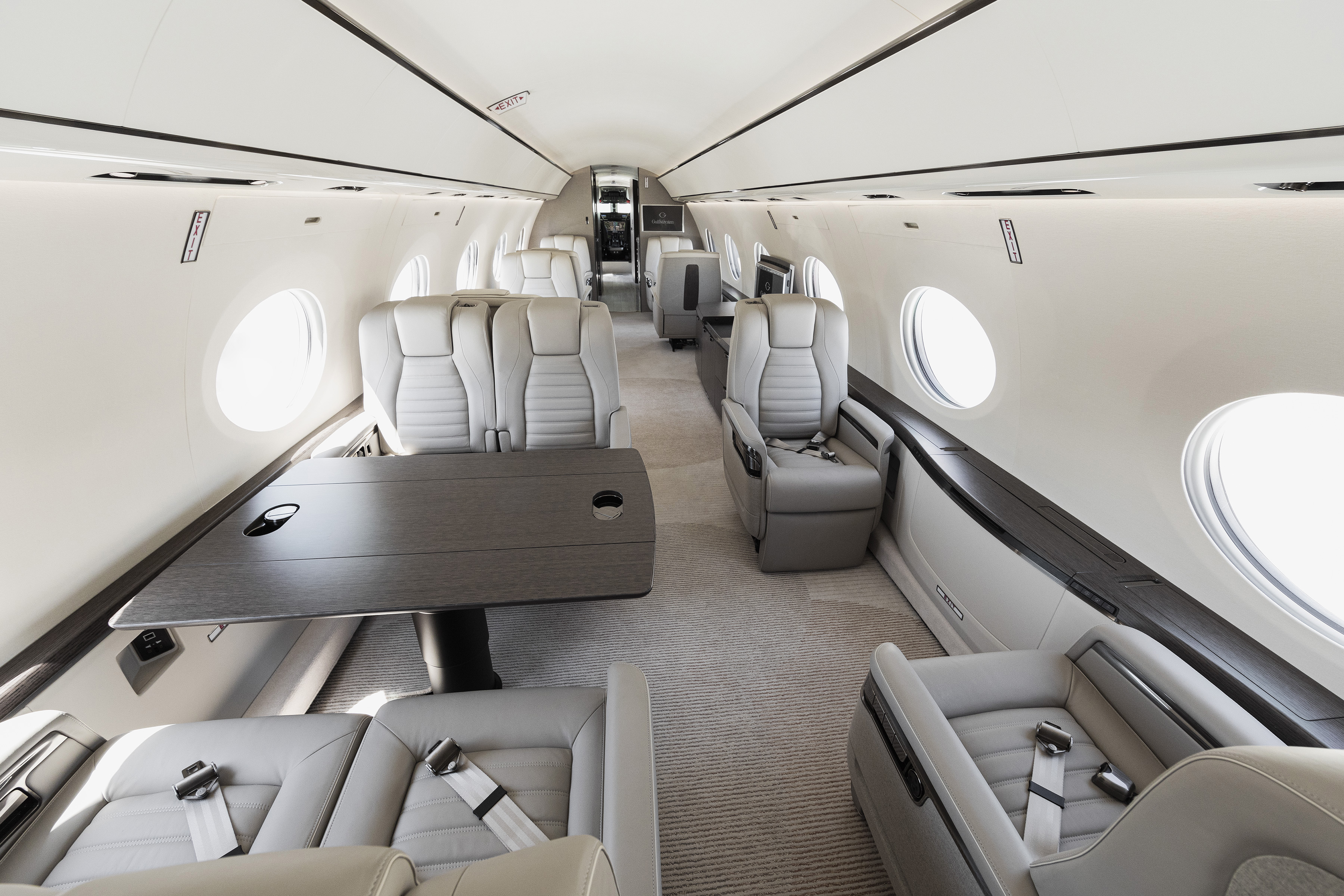
Cabin construction has also evolved significantly. Large windows flood the cabin with natural light, enhancing comfort and ambiance, while refined soundproofing and carefully engineered airflow systems create a quieter, more comfortable environment that supports work and rest during flight. Flexible layouts allow operators to configure cabins for meetings, relaxation, or extended travel.
Advanced manufacturing methods, including automation and additive manufacturing, help reduce production variability and enhance quality control. These techniques ensure tighter tolerances and longer service life across key components.
Materials and construction decisions directly influence range, payload, and operating efficiency—making them central to the continued evolution of business aviation.
Ultra-long-range business jets have redefined what is possible in private aviation. When you compare the G800's ultralong-range performance to other Gulfstream aircraft, it stands out for its superior maximum range and advanced features. Aircraft such as the Gulfstream G800 and Bombardier Global 8000 set new benchmarks for nonstop intercontinental travel, enabling direct flights between distant global hubs.
These jets offer exceptional maximum range without sacrificing speed or comfort. For example, the Gulfstream G800 has a maximum range of 8,200 nautical miles and can cruise at Mach 0.85, while the Bombardier Global 8000 offers a maximum range of 8,000 nautical miles and reaches a top speed of Mach 0.95, making it the fastest business jet ever conceived. The Global 8000 can access 30% more airports than its closest competitor, and its Smooth Flĕx Wing enhances ride smoothness and performance. It also features the industry's lowest cabin altitude at 2,691 feet, helping to combat jet lag, and supports advanced internet connectivity options like Ka-band and Starlink.
The G800 features the award-winning Symmetry Flight Deck with active control sidesticks and ten touch-screen displays. Its cabin environment provides 100% fresh air, renewed every two to three minutes, and a plasma ionization system for purification. Passengers benefit from high-definition LED lighting and the option for circadian rhythm technology, ensuring comfort on the longest flights.
On long-range flights, these jets can save several hours compared to traditional aircraft, minimizing travel hours and maximizing efficiency and convenience for business travelers.
Other notable business jets include the Cessna Citation Latitude, known for its outstanding runway performance and range, making it suitable for longer journeys; the Embraer Praetor 500, recognized for its best-in-class range and industry-leading speed; and the Cessna Citation XLS, one of the bestselling private jets, valued for its midsize comforts and light-jet flexibility. The Dassault Falcon 50 features a trijet configuration powered by three 3,700-lbf TFE731 engines and a maximum takeoff weight of 40,000 lb, while the Lockheed JetStar was designed to meet USAF requirements and has a maximum takeoff weight of 44,500 lb. The Cessna Citation Ascend offers a luxurious interior and advanced avionics, marking its entry into service as a midsize business jet.
For global organizations, the ability to travel nonstop across continents translates into significant productivity gains. Reduced travel time, fewer crew changes, and minimized fatigue all contribute to more efficient operations.
Long-range business jets also support flexible scheduling, making them ideal for time-sensitive missions that require reliability across diverse geographic regions.
Speed and efficiency remain core priorities in business aviation. Aircraft such as the Cessna Citation X+ and Bombardier Challenger 350 demonstrate how modern engineering, especially the power of advanced jet engines, delivers high cruise speeds and superior efficiency. Business jets are generally designed for faster air travel and more personal comfort than commercial aircraft.
Higher cruise speeds shorten travel time, enabling executives to complete multiple meetings across regions in a single day. At the same time, efficiency improvements reduce fuel burn and operating costs, supporting long-term sustainability goals.
Advanced avionics and flight management systems optimize routing and altitude selection, further enhancing efficiency. These systems help crews adapt to weather conditions and air traffic constraints in real time.
By balancing speed with reliability, modern business jets continue to meet the demands of a globalized business environment.
The evolution of avionics and electronics has transformed the landscape of business aviation, delivering unprecedented levels of safety, efficiency, and connectivity for business aircraft of all sizes. Today’s private jets, including popular light jets and Cessna Citation models, are equipped with state-of-the-art flight decks featuring intuitive high-definition displays and advanced navigation systems. These innovations empower pilots with real-time situational awareness, streamlined workflows, and precise control, all of which contribute to safer and more efficient flights.
Digital avionics systems now enable continuous data analysis, allowing operators to monitor aircraft performance and anticipate maintenance needs before they become issues. This proactive approach reduces downtime and enhances the reliability of every flight. In addition, the integration of satellite communications and high-speed internet ensures that both crew and passengers remain connected, with seamless access to critical information and business resources throughout the journey.
As the business aviation industry continues to advance, the role of avionics and electronics will only grow, supporting faster decision-making, improved operational efficiency, and a superior in-flight experience for customers worldwide.
Sustainability is becoming an increasingly important focus in business aviation. Manufacturers are investing in technologies to reduce emissions, improve fuel efficiency, and support the broader transition to sustainable aviation practices.
Electric and hybrid-electric propulsion concepts are under active development, alongside improvements in compatibility with sustainable aviation fuel. These initiatives help reduce environmental impact while maintaining performance and safety standards.
Operational efficiencies also play a role. Optimized flight planning, lighter materials, and improved aerodynamics collectively reduce fuel consumption and emissions over time.
Business jets currently leave a disproportionate carbon footprint compared to commercial jetliners, with some individuals generating thousands of tons of CO2 emissions annually. The European Commission aims for a net reduction of at least 55% in greenhouse gas emissions by 2030, including aviation regulations. Projects tracking private jet movements have gained attention due to their disproportionate emissions, highlighting the need for sustainable solutions.
As sustainability expectations evolve, business aviation is positioning itself to remain viable and responsible within a changing regulatory and environmental landscape.
Safety remains the foundation of business aviation. Continuous improvements in avionics, automation, and pilot training programs enhance situational awareness and reduce operational risk.
Advanced simulators enable crews to train across a wide range of scenarios, ensuring readiness for routine operations and unexpected conditions. Ongoing training requirements help maintain consistent standards across operators.
Safety management systems and data-driven insights further strengthen risk mitigation strategies, reinforcing confidence in private aviation as a reliable mode of transport.
A comprehensive maintenance and support infrastructure is essential to business aviation reliability. Predictive maintenance technologies now allow operators to monitor aircraft health in real time, identifying potential issues before they impact operations.
Manufacturer support networks provide access to certified service centers and technical expertise worldwide. This global reach ensures consistent maintenance standards regardless of where the aircraft operates.
Reliable support minimizes downtime, protects asset value, and ensures aircraft remain mission-ready throughout their service life.
Fractional ownership has emerged as a practical and flexible alternative to full private jet ownership. It allows customers to purchase a share of an aircraft, gaining access to private aviation benefits without assuming the full cost and operational responsibility of ownership.
Fractional programs offer predictable costs, professional management, and access to modern fleets. Participants benefit from guaranteed availability, standardized service levels, and reduced administrative burden.
For many individuals and organizations, fractional ownership involves an individual or corporation paying an upfront equity share for the cost of an aircraft. This arrangement provides an efficient balance between access and cost, making private aviation more attainable and scalable.
As demand grows, fractional ownership continues to evolve with enhanced scheduling tools, fleet flexibility, and operational transparency. Discover the latest advancements, features, and experiences available through fractional ownership programs. Please note that the specifications and features described in fractional ownership marketing materials do not represent a formal offer or guarantee; actual aircraft details and terms are defined in the final purchase agreement.
Charter and rental services have become essential components of the business aviation industry, offering unparalleled flexibility and access to private jets without the long-term commitment of ownership. For businesses and individuals seeking tailored travel solutions, charter operators provide a diverse fleet of business aircraft, from nimble light jets to spacious large-cabin models, ensuring the right fit for every mission—whether it’s a quick regional flight or a transcontinental journey.
These services are governed by strict operating rules and maintenance standards, ensuring that every aircraft meets the highest levels of safety and reliability. Customers benefit from the freedom to select the ideal cabin configuration and range for each trip, while operators handle all aspects of flight planning, crew management, and regulatory compliance.
Rental options further expand access, allowing clients to lease an aircraft for a specific period and experience the advantages of private aviation on their own terms. As demand for business aviation grows, the charter and rental market continues to evolve, providing more opportunities for customers to enjoy the world of private jets with maximum convenience and peace of mind.
The business aviation industry is experiencing a dynamic period of innovation and transformation, driven by evolving customer expectations and rapid technological progress. One of the most exciting developments is the pursuit of supersonic business jets, with manufacturers racing to deliver aircraft capable of flying at unprecedented speeds and connecting more destinations in less time. This push for speed is matched by a relentless focus on efficiency, as new designs prioritize fuel savings, reduced emissions, and lower operating costs.
Sustainability is also at the forefront, with the introduction of electric and hybrid-electric propulsion systems promising a greener future for private jets and light jets alike. These advancements will enable business aircraft to access more small airports, expanding the range of destinations available to passengers and further enhancing the flexibility that defines business aviation.
The continued growth of the charter and rental market reflects a broader trend toward customer-centric solutions, offering greater access and tailored experiences for a diverse range of travelers. As the industry looks ahead, innovation, efficiency, and sustainability will remain the cornerstones of progress, enabling business aviation to lead the way in global mobility and connect the world’s cities with unmatched speed and precision.
The outlook for business aviation remains strong, driven by global economic activity, evolving travel preferences, and ongoing technological advancements. Manufacturers continue to invest in innovation to meet customer demand for efficiency, reliability, and flexibility.
The global private jet market benefits from increased awareness of time efficiency and productivity advantages, particularly among executives and business owners. As travel patterns shift, private aviation offers resilience and adaptability.
Emerging technologies, sustainability initiatives, and new ownership models are shaping the future landscape of business aviation. These trends reinforce the industry’s critical role in modern global mobility.
The future of business jets is defined by innovation, efficiency, and adaptability. From advanced materials and long-range capabilities to sustainable aviation initiatives and flexible ownership models, business aviation continues to evolve in response to global travel demands.
Fractional jet ownership is a strategic option for those seeking the benefits of private aviation without the complexity of full ownership. By combining access, efficiency, and professional management, it aligns with the priorities of modern business travelers.
Ready to explore the smarter way to fly private? Visit https://www.fractionaljetownership.com/ to learn how fractional ownership can support your long-term travel strategy and unlock new possibilities in private aviation.
