January 10, 2026
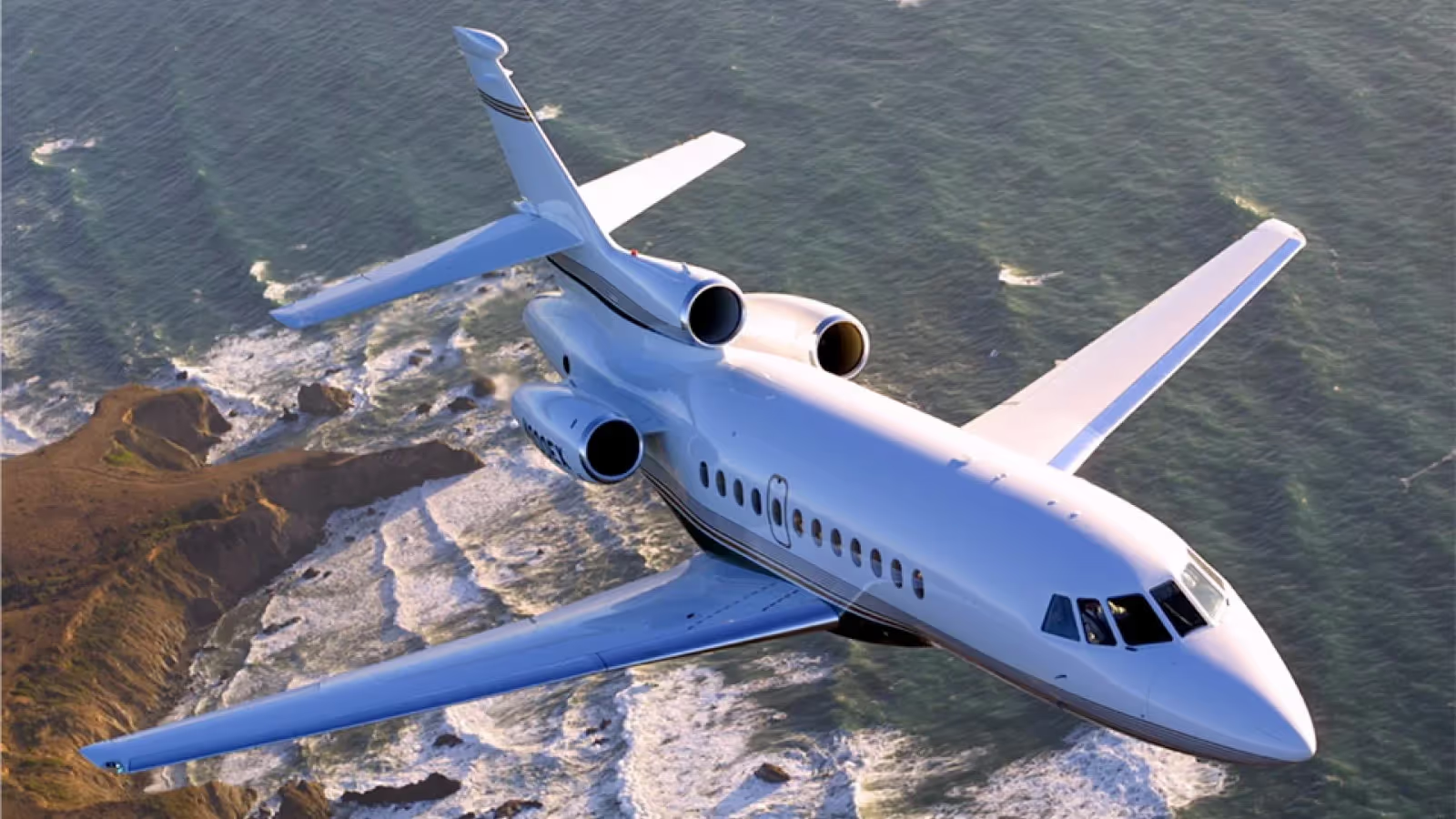
In the world of private aviation, few aircraft have earned the reputation, longevity, and respect of the Dassault Aviation Falcon 900. Designed to meet the demands of executives, entrepreneurs, and global travelers, this large-cabin, long-range business jet combines performance, reliability, and refined comfort, continuing to set industry benchmarks.
The Falcon 900 family has become synonymous with efficient long-haul capability, operational flexibility, and a cabin environment that supports both productivity and relaxation. For travelers evaluating private jet ownership or fractional ownership, the Falcon 900 offers a strategic balance of range, operating efficiency, and long-term value.
This guide explores the Falcon 900 series in depth—covering its history, long-range performance, design philosophy, and why it remains a compelling option in today’s global private aviation market.
The Dassault Falcon lineage reflects decades of aerospace engineering expertise rooted in military and commercial aviation. Founded by Marcel Bloch, later known as Marcel Dassault, the company has a rich history dating back to the dawn of aviation. Dassault’s approach to business jet design has always emphasized aerodynamic efficiency, safety, and operational flexibility—principles that are clearly evident in the Falcon 900 family.
Introduced as a tri-jet platform, the Falcon 900 is a French-built corporate aircraft developed from the Falcon 50, which itself evolved from the earlier Falcon 20. Its airframe design incorporates composite materials, enhancing strength and reducing weight. The Falcon 900 was designed to deliver extended range while maintaining strong short-field and high-altitude airport performance. This configuration allows the aircraft to access a wider range of airports than many long-range jets, making it particularly attractive to business travelers who value schedule control and direct routing. Notably, the Falcon 900 is the only large-cabin business jet FAA-certified for operations at London City Airport, enhancing its operational flexibility.
Over time, the platform evolved into advanced variants such as the Falcon 900B (produced from 1991 to 1999 with more powerful and fuel-efficient engines), the Falcon 900EX, and the Falcon 900LX, each offering incremental improvements in efficiency, avionics, and overall capability. The Falcon 900C later replaced the 900B, while the 900LX was certified in 2010 and modernized in 2016 with features like high-mach blended winglets designed by Aviation Partners Inc.
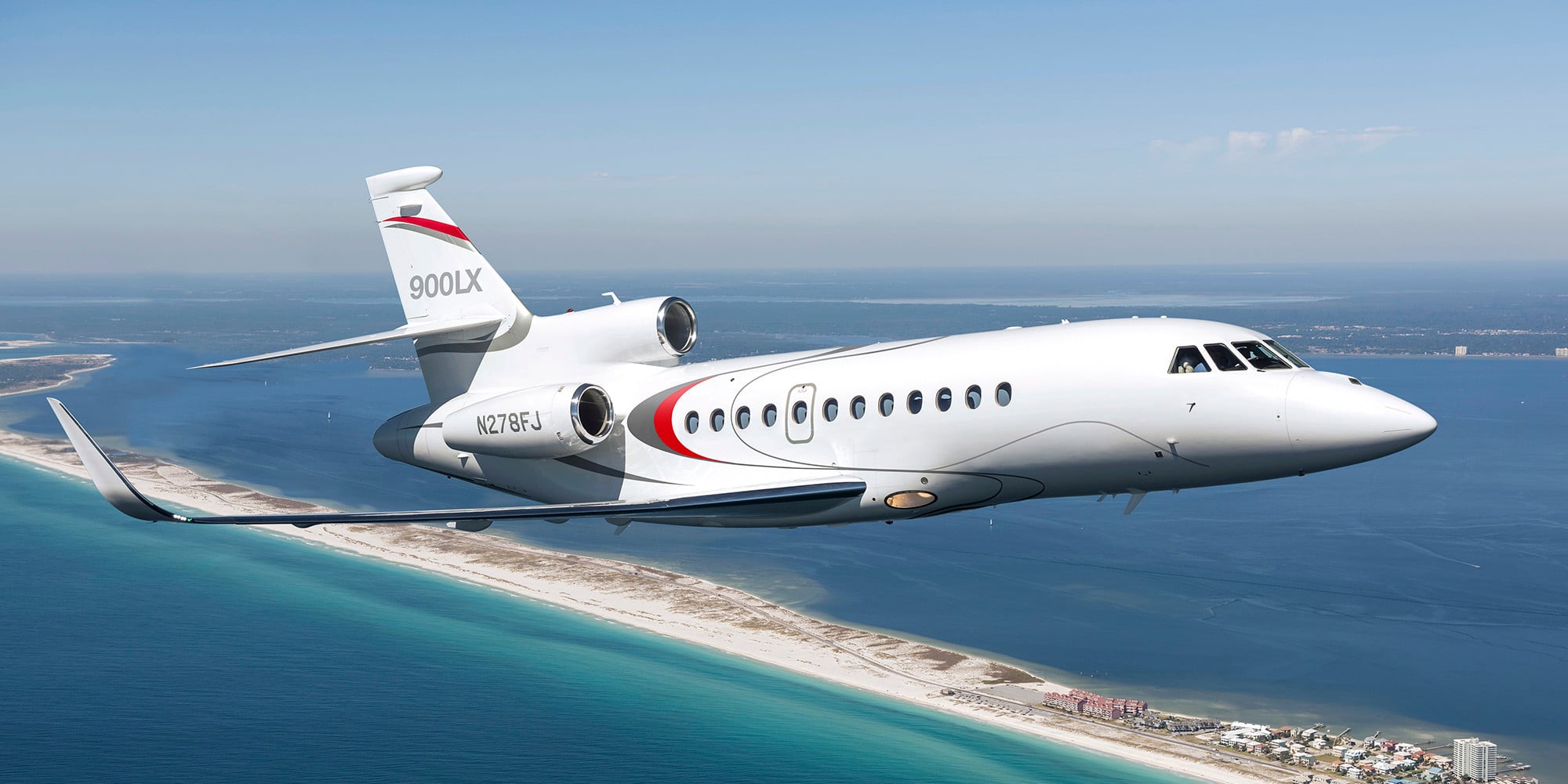
One of the defining characteristics of the Falcon 900LX is its exceptional range. With a maximum range of approximately 4,750 nautical miles (8,800 kilometers), the aircraft is well-suited for nonstop transcontinental and transoceanic missions.
This capability enables city pairs such as:
New York to London
Los Angeles to Paris
Chicago to Tokyo (with optimal conditions and routing)
The Falcon 900LX achieves this range through a combination of aerodynamic efficiency, optimized fuel capacity, and advanced engine performance. Its maximum takeoff weight of approximately 48,300 pounds (21,908 kg) allows it to carry passengers, baggage, and fuel without compromising cabin comfort. The aircraft is powered by three Honeywell TFE731-60 engines, delivering reliable thrust and strong climb performance.
The Falcon 900 typically accommodates 12 passengers and can cruise at speeds up to 482 knots true airspeed (893 km/h), with a maximum cruise altitude of 51,000 feet (15,545 m). Its takeoff distance is approximately 5,050 feet (1,539 m), and landing distance is about 2,250 feet (686 m), allowing access to shorter runways and high-altitude airports.
For fractional jet ownership participants, this range translates into fewer fuel stops, more direct routing, and reduced total travel time—key advantages for executives operating on demanding schedules.
The Falcon 900LX cockpit reflects Dassault’s commitment to pilot situational awareness and operational safety. Central to this is the Honeywell Primus 2000 flight deck, which integrates navigation, flight management, and aircraft monitoring into a cohesive digital environment.
Key cockpit features include:
A fully integrated electronic flight instrument system
Advanced flight management capabilities
Enhanced vision and combined vision systems for improved low-visibility operations
Fly-by-wire flight control technology adapted from Dassault’s military aircraft expertise
These systems not only enhance safety but also improve operational efficiency, allowing the aircraft to operate confidently in congested airspace and challenging weather conditions.
The Falcon 900EX, an important variant, includes improvements in engines, range, and an all-glass flight deck, further enhancing pilot interface and operational capability.
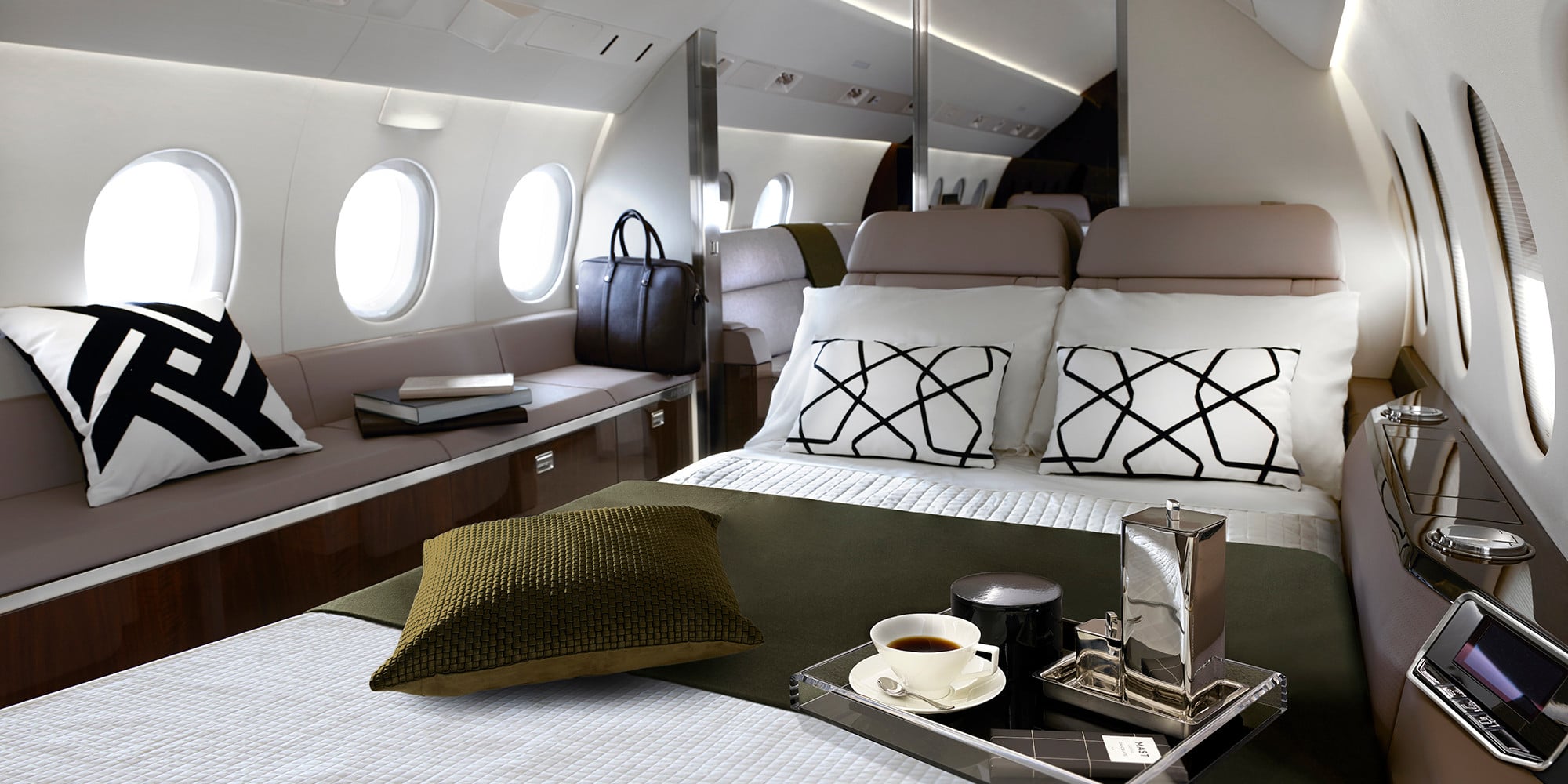
Inside the Falcon 900LX, the cabin is designed to support both work and relaxation during long-haul flights. Seating for up to 14 passengers can be configured in multiple layouts, allowing owners and fractional operators to tailor the space to their travel profiles.
Common cabin features include:
Fully equipped galley suitable for long-duration flights
Enclosed lavatory with premium finishes
Advanced cabin management and in-flight entertainment systems, including WiFi and the Airshow® moving maps system
Generous baggage capacity is accessible during the flight
The Falcon 900’s spacious cabin features a flat floor approximately 33 feet long with a stand-up height of 6'2", often arranged in three distinct zones for privacy and comfort. The Falcon 900B cabin typically features a double-club configuration with a three-person divan, and seats that swivel, recline, and in some layouts, combine to form a full-length bed.
The Falcon 900LX cabin is equipped with advanced acoustical insulation, making it the quietest in the 900 series, and includes three separate lounge areas designed for work, dining, and relaxation.
The Falcon 900LX incorporates advanced aerodynamics and structural innovation. Its wingspan of approximately 63 feet 4 inches contributes to exceptional stability, while the aircraft’s length of 66 feet 4 inches supports a spacious cabin without compromising performance.
Dassault’s use of composite materials and refined wing design, including high-mach blended winglets designed by Aviation Partners Inc., improves fuel efficiency and handling characteristics. These design choices also contribute to the aircraft’s strong performance on short runways and at high-altitude airports—an advantage for accessing business hubs and resort destinations alike.
For operators in the United States and across the global private jet market, the Falcon 900 offers notable operational advantages. Its ability to operate from shorter runways expands airport access, helping travelers avoid congested commercial hubs and land closer to final destinations.
This flexibility is especially valuable for business owners and executives who prioritize time efficiency. The Falcon 900’s fleet size of 118 aircraft reflects its popularity among corporate users, governments, charter operators, and private owners worldwide. Over 500 Falcon 900 aircraft have been delivered to date, establishing the series as an industry benchmark for reliability.
A wide range of private owners, businesses, and small airlines operate Falcon 900s, benefiting from the aircraft’s operational flexibility and strong service support.
The Falcon 900 series holds its value better than any other business jet, retaining up to 10% more value over a 10-year period than its closest competitors. This strong resale market features high demand for second-hand models, which tend to sell faster than competitors' jets.
Pricing varies across models and market conditions:
In 2023, the equipped price of the Falcon 900LX was approximately $44.7 million USD.
The typical purchase price for a Falcon 900 is around $8,975,000 USD.
Asking prices for Falcon 900s range from $7,200,000 to $10,750,000 USD.
The Falcon 900B originally cost about $26 million USD, but now pre-owned models are available for around $9 million USD.
Operating costs are predictable and manageable for fractional ownership or sole operators:
Annual fixed costs average approximately $801,633 USD based on 300 hours of operation per year.
Variable hourly costs average about $5,363.36 USD.
Total annual operating costs are estimated at $3,052,353.50 USD for 300 hours of flight time.
Despite newer aircraft entering the market, the Falcon 900 series continues to hold strong appeal. Its proven airframe, continuous avionics upgrades, and Dassault’s global support network ensure long-term reliability and resale value.
While the Falcon 900 may have a higher acquisition cost compared to some competitors and typically lower cruise speeds, its unique combination of a large, quiet cabin, operational flexibility, and tri-engine safety advantages makes it a preferred choice for many operators.
The aircraft’s balance of performance, comfort, and operational efficiency aligns well with modern expectations in private aviation—particularly for travelers who value capability over excess.
The Dassault Falcon 900 family represents a thoughtful approach to long-range private aviation. By combining global reach, refined cabin design, and proven engineering, it delivers consistent value for high-net-worth individuals and corporate travelers alike.
For those evaluating fractional jet ownership or exploring private aviation options, the Falcon 900 remains a compelling platform—capable, comfortable, and trusted across the global business jet community.
Ready to explore the smarter way to fly private?
Visit https://www.fractionaljetownership.com/ to learn how fractional ownership of aircraft like the Falcon 900 can elevate travel efficiency while maintaining flexibility and control.
