
April 28, 2026
For executives and business owners searching for midsize jets for sale, 2026 presents a market defined by strong demand, limited new production slots, and rising pre-owned values. But purchasing an entire aircraft is only one path to private aviation—and for many, it’s not the most efficient one.
The 2026 midsize jet market spans approximately $5 million to $20 million or more, depending on model year, total airframe hours, and program enrollment. The purchase price for these aircraft varies based on factors such as age, model, and additional amenities, and can influence the total cost of ownership and future resale value. These aircraft typically seat 6 to 9 passengers and cover ranges of 2,000 to 3,500 nautical miles nonstop—ideal for routes like New York to Dallas, Chicago to San Francisco, or Miami to Denver. Midsize jets typically have a range of 2,000 to 3,500 nautical miles, making them suitable for routes like New York–Dallas or Toronto–Vancouver. Midsize jets are in high demand in the pre-owned market, often selling faster than larger cabin types due to their versatile mission envelope, strong fleet support, and suitability for a wide variety of mission profiles.
However, many buyers who initially search for jets for sale discover that fractional ownership or membership programs better match their actual flying patterns. The mid-market for midsize jets is characterized by strong demand for fractional ownership programs, which have increased over 65% since 2019. Prospective owners often benefit from reviewing a glossary of essential fractional jet ownership terms to understand how these structures work. BlackJet Fractional Jet Ownership offers two primary models designed around this reality.
Typical missions include 2 to 5-hour flights covering most major US city pairs without refueling stops. Midsize jets can accommodate between 6 and 9 passengers and are designed for missions that typically last 2 to 5 hours, making them ideal for corporate travel across North America and Europe, and fitting well within the midsize jet mission envelope.
Whole ownership: Full capital outlay ($7M–$20M+), complete operational responsibility, justifiable above 250 annual hours
BlackJet Equity Fleet: Fractional share with guaranteed availability, priority booking, and shared fixed costs—ideal for 50–150 hours annually
BlackJet Reserve Fleet: Pay-as-you-go hours with no equity commitment, suitable for variable or seasonal travel needs
Ad-hoc charter: No commitment, but unpredictable pricing and availability
Popular models currently available include the Cessna Citation XLS+, Cessna Citation Latitude, Hawker 800XP/900XP, Embraer Praetor 500, and Bombardier Challenger 300/350.
Midsize jets occupy the middle tier in private aviation, positioned between light jets (such as the Phenom 300 or Citation CJ4) and super midsize jets like the Gulfstream G280 or Challenger 350. Midsize jets are categorized as aircraft weighing between 20,001 lbs and 40,000 lbs, providing a balance of comfort and efficiency for corporate travel across North America and Europe.
Key specifications define this category:
Specification | Typical Range |
|---|---|
Passenger count | 6–9 |
Cabin height | 5.8–6.0 feet |
Range | 2,000–3,500 nautical miles |
Cruise speed | 430–480 knots |
The majority of midsize jets have a top cruise speed between 430 knots and 480 knots, with the Cessna Citation X being a notable exception at 525 knots. Models like the Cessna Citation XLS+ and Hawker 800XP exemplify this category’s balance of cabin space and operational efficiency.
Super midsize jets such as the Gulfstream G280 and Bombardier Challenger 350 extend ranges to 3,000–3,800 nautical miles with larger cabins, but come with higher acquisition and hourly operating costs. In 2026, mid-size jets will remain the workhorse for domestic US and short transcontinental missions.
BlackJet structures its Equity Fleet and Reserve Fleet programs around these high-demand mission profiles, maximizing value for fractional owners and members who don’t need heavy jets or intercontinental flights, and offers tools to compare private aviation program options across its core offerings, including route-specific availability insights for one-way and round-trip private flights to or from Mississauga YYZ.

The 2026 market reflects continued strong demand, limited new aircraft production slots from manufacturers like Textron and Embraer, and pre-owned values running 10–15% above 2023–2024 averages. New midsize jets typically cost between $9.5 million and $30 million, while pre-owned models can range from $5 million to $15 million, depending on age and condition. The purchase price is a key factor influencing the total cost of ownership and future resale value, as it varies based on aircraft age, model, and included amenities.
Current price brackets for midsize private jets break down approximately as follows:
Aircraft | Year Range | Typical Price |
|---|---|---|
Hawker 800A/800XP | 2000–2008 | $2M–$4.5M |
Citation XLS | 2006–2012 | $6M–$9M |
Citation XLS+ | 2013–2020 | $8M–$12M |
Citation Latitude | 2019–2025 | $12M–$20M+ |
The average acquisition price for a midsize jet typically ranges from $7 million to $12 million, depending on the model and condition. Examples of current inventory quality include low-time 2025 Citation Latitude aircraft with manufacturer warranties, mid-life Gulfstream G150S with ESP Gold engines, and Hawker 900XPs enrolled on Honeywell MSP programs.
Buyers focus heavily on engine program enrollment—MSP Gold, ESP Gold, Rolls-Royce Corporate Care, or JSSI—because enrolled aircraft offer predictable maintenance costs and stronger resale value. An aircraft without programs can face shop visits exceeding $1–2 million, creating significant acquisition price risk
BlackJet clients leverage this market intelligence without taking full ownership exposure by accessing similar midsize and super midsize models through Equity and Reserve Fleets, while dedicated analyses of the total cost of fractional jet ownership help them benchmark against whole ownership.
Model selection should follow mission profile rather than brand recognition alone. The right specific aircraft depends on typical routes, passenger count, runway requirements, and cabin comfort preferences.
Citation XLS/XLS+: Exceptional short-field performance with takeoff in under 3,500 feet, 2,100 nm range, strong pre-owned market values
Citation Latitude: 6-foot flat-floor cabin, 2,700 nm range, modern avionics. Cessna Citation Latitude is noted for its 2,700 nm range and spacious baggage space
Hawker 800XP/900XP: Value pricing at $3M–$6M for low-time examples, robust honeycomb composite construction, proven reliability
Embraer Legacy 450/Praetor 500: Fly-by-wire controls, HEPA-filtered cabins, 3,000+ nm range in super midsize configuration
Challenger 300/350: The Bombardier Challenger 300 is the best-selling midsize jet model, with 457 units sold between 2003 and 2014, according to JETNET data. These offer a 3,200–3,400 nm range with 8–10 seat cabins.
Gulfstream G280: High-speed cruise at Mach 0.85. The Gulfstream G280 is recognized for its range of approximately 3,590 nm.
Dassault Falcon 50EX: Tri-jet efficiency with 3,000 nm capability
BlackJet structures Equity Fleet access around these proven models to balance cabin comfort, efficiency, and residual value. Independent reviews of the best fractional jet ownership programs give prospective buyers further context on how leading providers structure access. The company can custom-source specific model types—such as a low-time Citation Latitude or Challenger 350—into an Equity Fleet structure for corporations needing 50–150 hours annually.
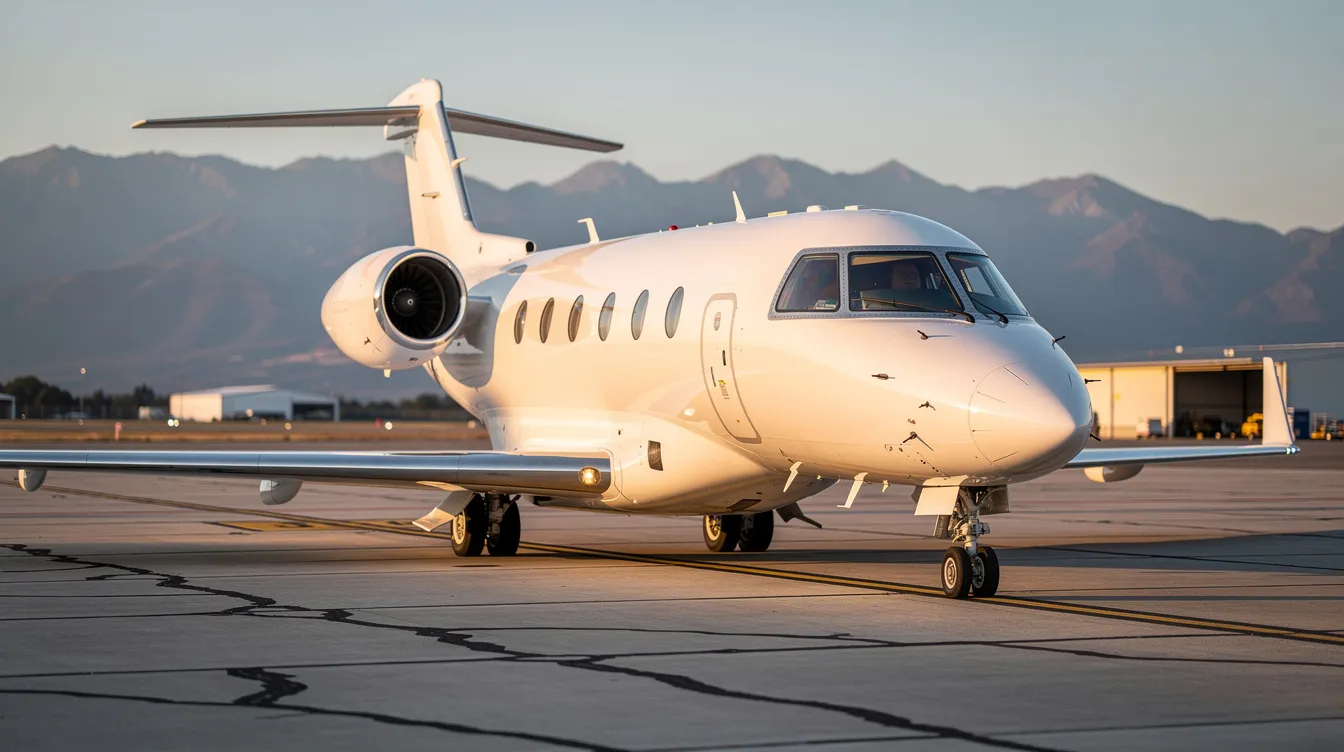
Aircraft categories serve different mission envelopes. Understanding typical flight lengths and passenger requirements helps buyers avoid overspending on capabilities they won’t use.
Midsize jets excel on 2–5 hour missions—New York to Dallas (1,350 nm), Los Angeles to Chicago (1,500 nm), or Miami to Denver (1,500 nm)—for 4–8 travelers. Midsize jets often require the capability to operate from runways of 3,500 to 5,000 feet, which enables them to access smaller airports. This operational advantage allows service to regional or less accessible destinations, such as Teterboro, Van Nuys, and Love Field, that heavy jets cannot efficiently serve.
Super midsize jets (Gulfstream G280, Challenger 350, Praetor 600) suit 5–7 hour missions, including New York to Seattle or transatlantic positioning legs, typically with 8–9 passengers and more cabin space, while truly long-range super midsize designs such as the Falcon 6X fractional ownership platform add intercontinental capability for buyers needing global reach.
Heavy jets serve larger groups on ultra-long-range missions but carry acquisition and operating costs far beyond most midsize buyers’ actual requirements, especially when considering long-range trijets like the Falcon 900LX fractional ownership option, which are best suited to frequent intercontinental travelers.
BlackJet helps clients model their actual 12–24 month mission data to determine whether midsize, super midsize, or a blended fleet solution within a fractional program delivers optimal value, a process that mirrors broader analyses comparing fractional jet ownership versus membership programs and evaluating how regional bases like Bhubaneswar private jet access and ownership options support specific route needs.
Private aircraft ownership costs divide into two categories: acquisition and ongoing operations. Both require realistic planning to avoid financial surprises, and many buyers benchmark these figures against a complete guide to fractional jet ownership costs before deciding on a structure.
Older midsize (Hawker 800 series, early Citation XLS): $5M–$9M
Newer midsize (Citation Latitude, Praetor 500): $12M–$20M+
Annual fixed costs for owning a midsize jet generally run between $700,000 and $1.5 million, which includes expenses like crew salaries ($300K–$500K for captain and co-pilot with training), hangar fees ($50K–$100K), insurance ($100K–$200K), and minimum maintenance requirements—numbers that often push regional travelers in corridors like fractional jet ownership in Portland toward shared ownership instead of a sole aircraft.
Variable operating costs for midsize jets typically range from $2,200 to $2,800 per flight hour, influenced by factors such as fuel prices and maintenance reserves. With fuel at $6–7 per gallon and engine programs at $400–$600 per hour, total variable costs often reach $2,500–$3,500 per flight hour for whole owners, which is why many users in high-frequency markets like fractional jet ownership in Phoenix evaluate fractional programs as a cost-control strategy.
For 250 annual hours, the total yearly cost ranges from $1.5 million to $3 million, before structural depreciation pressure affects residual value.
Fractional ownership through BlackJet delivers similar access for 25–150 hours annually with a fraction of these annual fixed costs and no crew management, hangar negotiations, or compliance burdens, especially when paired with tailored fractional jet ownership financing solutions.
Ownership typically makes financial sense for those who fly more than 200–250 hours annually. Below this threshold, the fixed cost burden creates unfavorable economics compared to fractional or membership alternatives, so it’s important to weigh fractional jet ownership as an investment rather than just a travel expense.
Individuals or companies flying under 150 hours yearly should focus on fractional ownership or membership programs. The math is straightforward: spreading $1.5 million in fixed costs across 100 hours yields $15,000 per hour before fuel—far exceeding fractional or charter alternatives, and aligning closely with structures like 1/8 fractional jet ownership at around 100 hours per year.
BlackJet’s Equity Fleet serves clients in the 50–150-hour range seeking predictable access, potential tax benefits, and guaranteed availability without full ownership exposure. The Reserve Fleet suits clients with variable or seasonal flying who prefer pay-as-you-go hours with no capital investment.
Track 12 months of actual or projected business travel to determine which access model fits your own schedule and budget, and consider whether a home base, such as Calgary International, fractional jet ownership options can efficiently support your most common city pairs.
Fractional ownership allows buyers to acquire a share of a jet or fleet category rather than the entire private aircraft. This structure, pioneered by NetJets in 1986, has become increasingly popular because it addresses the fundamental mismatch between ownership costs and typical usage patterns.
Factor | Whole Ownership | Fractional (Equity Fleet) |
|---|---|---|
Upfront capital | $7M–$20M+ | $1M–$2M (share) |
Fixed costs | Owner bears 100% | Shared among owners |
Scheduling | Complete control | Priority booking windows |
Exit strategy | Full resale process | Share remarketing (typically 90–95% recovery) |
BlackJet’s Equity Fleet model ties fractional shares to specific aircraft categories (midsize or super midsize) with guaranteed availability, priority booking, and transparent hourly rates. Engine programs like ESP Gold and Honeywell MSP are maintained at the fleet level, eliminating individual owner risk for major shop visits.
Fractional ownership can unlock tax treatment advantages under US rules, including potential bonus depreciation when structured correctly through LLC frameworks. Dedicated guidance on the tax implications for fractional jet owners helps clients design compliant, efficient structures. BlackJet coordinates with clients’ tax advisors to maximize these benefits for both domestic bases and international hubs, such as fractional jet ownership in Kaohsiung.
Many clients who initially searched for pre-owned jets ultimately choose an Equity Fleet share because it spreads maintenance reserves, residual value risk, and market volatility among multiple owners. Understanding both the total cost of fractional ownership and the structure of an aircraft fractional ownership sample contract helps them enter these programs with clear expectations, whether they are based in established markets like fractional jet ownership in Nashville or smaller regional airports.
Reserve Fleet is BlackJet’s non-equity, pay-as-you-go solution for business aviation users not ready for fractional ownership. It functions differently from a traditional charter company or generic jet card program.
Reserve Fleet access works through a membership framework with guaranteed availability, vetted operators, and transparent pricing. Many of these solutions rely on floating fleet fractional ownership structures to increase flexibility and aircraft availability. Clients access midsize and super midsize jets—Citation XLS+, Hawker 900XP, Challenger 300/350, Praetor 600—based on mission requirements and availability.
Advantages over traditional charter operators and jet cards include access to geographically tailored programs such as fractional jet ownership in Orlando, along with core service benefits like:
Curated fleet standards with modern avionics and in-flight Wi-Fi
Vetted operators meeting BlackJet safety criteria and supported by highly trained professional pilots and crews
Scheduling support for complex itineraries
Fixed or dynamic hourly rates depending on program tier
Reserve Fleet often serves as a testing ground—clients fly specific models to evaluate cabin volume, noise levels, and performance before committing to an Equity Fleet fractional share, including trialing lifestyle-driven routes from hubs like Ibiza, private jet access, and ownership options.
Even fractional and membership clients benefit from understanding aircraft evaluation criteria. These factors directly impact safety, reliability, and resale value across the fleet, and they are mirrored in the essential contract terms of fractional ownership agreements as well as in critical protections like essential liability and insurance coverage in fractional jet ownership.
Total time and cycles (under 5,000 hours ideal for midsize)
Engine program enrollment (MSP Gold airframe, ESP Gold, JSSI covering 80–100% of events)
Engine time remaining to overhaul
Maintenance tracking systems (CAMP, CESCOM)
Damage history and previous incidents
Maintenance records completeness
Recent major inspections matter significantly. A-checks occur every 200–600 hours, with 12/24/48-month phase inspections ranging from $100K–$500K. New aircraft are preferable for their modern avionics and full warranties, while pre-owned aircraft offer significant savings up to 70%—a trade-off that many regional users in markets like fractional jet ownership in Virginia Beach weigh carefully.
Modern avionics and connectivity options, like high-speed Ka-band Wi-Fi, significantly enhance productivity and resale value. Upgrades such as ADS-B Out (mandatory), WAAS/LPV approaches, and Gogo Avance L3/L5 connectivity affect both operational capability and pricing, and are increasingly expected on aircraft serving experience-focused bases such as Kelowna private jet access and ownership programs.
BlackJet’s technical team applies equivalent due diligence when selecting aircraft for Equity and Reserve Fleets, so clients benefit from professional vetting without managing these evaluations themselves.

For readers continuing toward full acquisition, the purchase process typically spans 60 to 120 days from initial search to closing. A typical acquisition process for a midsize jet spans 60 to 120 days from initial search to closing, and owners considering future flexibility should understand the steps involved in selling a fractional jet ownership share if they decide to transition later.
Define mission and budget: The purchase process begins with defining the mission and budget, followed by submitting a letter of intent and negotiating the purchase terms
Shortlist models: Evaluate 3–5 specific aircraft meeting criteria
Engage acquisition advisor: Consider specialized brokers or consultants
Issue Letter of Intent (LOI): Typically includes a 5–10% refundable deposit
Pre-purchase inspection: A pre-purchase inspection is essential and typically costs between $25,000 and $75,000, covering engine, structural, and avionics checks. Facilities like Duncan Aviation or OEM service centers handle these evaluations. Request seller-funded repairs for discrepancies
Closing: Escrow, title search, lien verification, FAA registration, insurance placement
Operations setup: Crew hiring, management contracts, Part 135 certification if needed
Buyers should engage with aviation-savvy lenders early in the process to prevent delays in closing, especially for aircraft in the $8 to $15 million range. Sales agreements should clearly address the US owner history, new engines or overhaul status, and warranty transfers.
Even whole owners can benefit from BlackJet for overflow lift, backup coverage, or fractional shares in other categories when their primary aircraft undergoes maintenance, especially if they maintain operations from busy regional hubs such as fractional jet ownership in Seattle.
Environmental impact increasingly influences corporate travel decisions. Flight departments face pressure to demonstrate emissions awareness alongside operational efficiency.
Newer midsize and super midsize jets—Citation Latitude, Embraer Praetor 500, Gulfstream G280—typically deliver 15–25% better fuel burn per seat than older Hawker 800 series aircraft. Fuel prices remain a significant variable cost component, making efficiency gains meaningful over hundreds of annual hours, especially when incorporated into a broader view of the cost of fractional jet ownership and compared with location-specific offerings like fractional jet ownership in Austin.
Most modern midsize jets accept sustainable aviation fuel (SAF) blends up to 50% without modification. SAF availability continues expanding at major US and European business aviation hubs and leisure destinations such as Bay of Islands private jet access and ownership programs, cutting lifecycle CO2 emissions by up to 80% where available.
Advanced avionics, performance-based navigation, and engine health monitoring reduce both fuel waste and unplanned maintenance events. These technologies improve range efficiency while lowering per-trip costs.
BlackJet incorporates aircraft efficiency into fleet planning, helping clients lower average emissions per trip versus irregular charter on older, less efficient airframes.
Ownership typically becomes financially viable above 200–250 annual hours. Below this threshold, fractional ownership or membership programs deliver better economics.
Yes. BlackJet’s Equity Fleet offers category-specific shares covering midsize and super midsize aircraft. Clients aren’t required to commit to other categories.
Reserve Fleet provides guaranteed availability, vetted operators, and BlackJet scheduling support—unlike generic jet card programs with dynamic pricing and variable quality. It functions as a fractional on-ramp for many clients.
In-production models with strong OEM support historically perform better. Citation XLS+ and Citation Latitude typically retain 60–70% of value after 10 years, compared to 40–50% for out-of-production Hawker models.
Yes. Clients can fly specific models via BlackJet’s networks to evaluate club seating comfort, cabin size, noise levels, and cruise speed performance on real-world routes.
Confirm airworthiness, review maintenance records thoroughly, verify registration and ADS-B Out compliance, and conduct a title search. Work with aviation legal counsel and technical advisors for any whole-aircraft purchase.
The 2026 market offers a wide array of midsize jets for sale across pre-owned and new aircraft segments. However, whole ownership represents only one access model—and for most executives flying under 200 hours annually, fractional jet ownership or membership delivers superior economics without operational burdens.
BlackJet’s Equity Fleet and Reserve Fleet programs provide predictable access, professional management, and potential tax efficiencies. Regional hubs such as Atlanta's fractional jet ownership programs and Pittsburgh's fractional jet ownership offerings illustrate how these models scale to specific markets, as do destination-focused bases like Atlantic Municipal's private jet access and ownership options. Clients avoid crew management, hangar negotiations, compliance headaches, and the full weight of structural depreciation pressure that whole owners bear.
Analyze your last 12–24 months of travel—or project upcoming requirements—to align aircraft category, hours, and budget with the right access model. For some, this may mean a fractional interest in a super midsize like the Falcon 2000EX; others may prefer light jet access through a HondaJet fractional share or even a high-performance turboprop arrangement such as a TBM 850 fractional ownership program. Compare your actual mission profile against whole ownership, Equity Fleet shares, and Reserve Fleet membership to identify the best fit.
Ready to explore the smarter way to fly private? Schedule a consultation to review your mission profile and compare buying a midsize jet versus joining BlackJet programs. Visit https://www.fractionaljetownership.com/ for detailed information on Equity Fleet and Reserve Fleet options, or request a tailored cost analysis based on your specific travel patterns.
