
January 19, 2026
In the modern private aviation landscape, light jets play a critical role in efficiently and discreetly connecting business leaders, entrepreneurs, and high-net-worth individuals to destinations. Among these aircraft, the Embraer Phenom 300 has emerged as a benchmark—combining speed, reliability, comfort, and operating efficiency in a way few competitors have matched.
Consistently ranked as the world’s best-selling light jet for 12 consecutive years as of 2026, the Phenom 300 has earned its reputation not through luxury hype, but through real-world performance and dependable economics. For individuals and organizations evaluating private jet access—whether through full ownership, charter, or fractional jet ownership—the Phenom 300 represents a compelling balance of capability and value.
This guide explores why the Phenom 300 continues to dominate its class, examining its design philosophy, performance, operating costs, and passenger experience, and highlights why it remains a cornerstone aircraft in the private aviation market.
The Phenom 300 is a light business jet developed by Embraer, one of the world's most respected aerospace manufacturers. Designed for business aviation efficiency, the aircraft is certified for single-pilot operations and accommodates up to 10 passengers in various configurations, including options like a belted lavatory and side-facing divan.
Work on the Phenom 300 began in response to customer demands for a larger business aircraft than the Phenom 100. While initially intended as a straightforward stretched derivative of the Phenom 100, Embraer adopted a clean sheet design approach, resulting in more powerful engines, swept wings with winglets, spoiler systems, and a significantly elongated cabin.
The prototype Phenom 300 conducted its maiden flight on 29 April 2008, and type certification was received on 3 December 2009, allowing entry into service that same month. By February 2023, over 700 Phenom 300-series aircraft had been delivered worldwide, underscoring market confidence and long-term reliability.
The Phenom 300 competes directly with other modern light jets, such as the Citation CJ4. Notably, the Phenom 300 experiences approximately 10% lower depreciation rates over a three-year period compared to the Citation CJ4, making it an attractive investment for buyers.
Known for its speed, range, and luxury, the Phenom 300 is often used for corporate and private travel on short-to-mid-range trips. Its ability to reach isolated locations with ease and operate from shorter runways adds to its appeal.
With a range of approximately 2,010 nautical miles, the aircraft comfortably supports nonstop city pairs across the United States, such as Miami to Teterboro, at a high-speed cruise of up to 495 miles per hour. This speed allows travelers to maximize productivity while minimizing total travel time.
The Phenom 300E builds upon the original platform with meaningful upgrades rather than cosmetic changes. Enhanced avionics, refined aerodynamics, and a reimagined interior deliver improved performance and a more spacious cabin. The improved engines provide a higher maximum speed while maintaining fuel efficiency, reinforcing the aircraft’s value proposition.
The Phenom 300E received triple certification from Brazil's ANAC, the FAA, and EASA in March 2020, confirming its compliance with the highest international standards.
Configured to carry up to nine passengers along with a two-pilot crew, the Phenom 300 offers a cabin width of approximately 5 feet 1 inch, a height of 4 feet 11 inches, and a cabin length of 17 feet 2 inches. These dimensions allow for comfortable seating, in-flight movement, and productivity without the constraints often associated with smaller light jets.
The aircraft also provides a generous baggage volume of 84 cubic feet, accommodating luggage for extended trips.
The Phenom 300 flight deck is built around the Prodigy avionics suite, derived from Garmin technology and customized for Embraer. Touchscreen controls, intuitive system layouts, and advanced alerting reduce pilot workload and enhance situational awareness.
An industry-first Runway Overrun Awareness and Alerting System (ROAAS) provides an additional layer of safety, particularly during operations into shorter or unfamiliar runways. These systems make the aircraft well-suited for single-pilot operations while still meeting rigorous safety expectations.
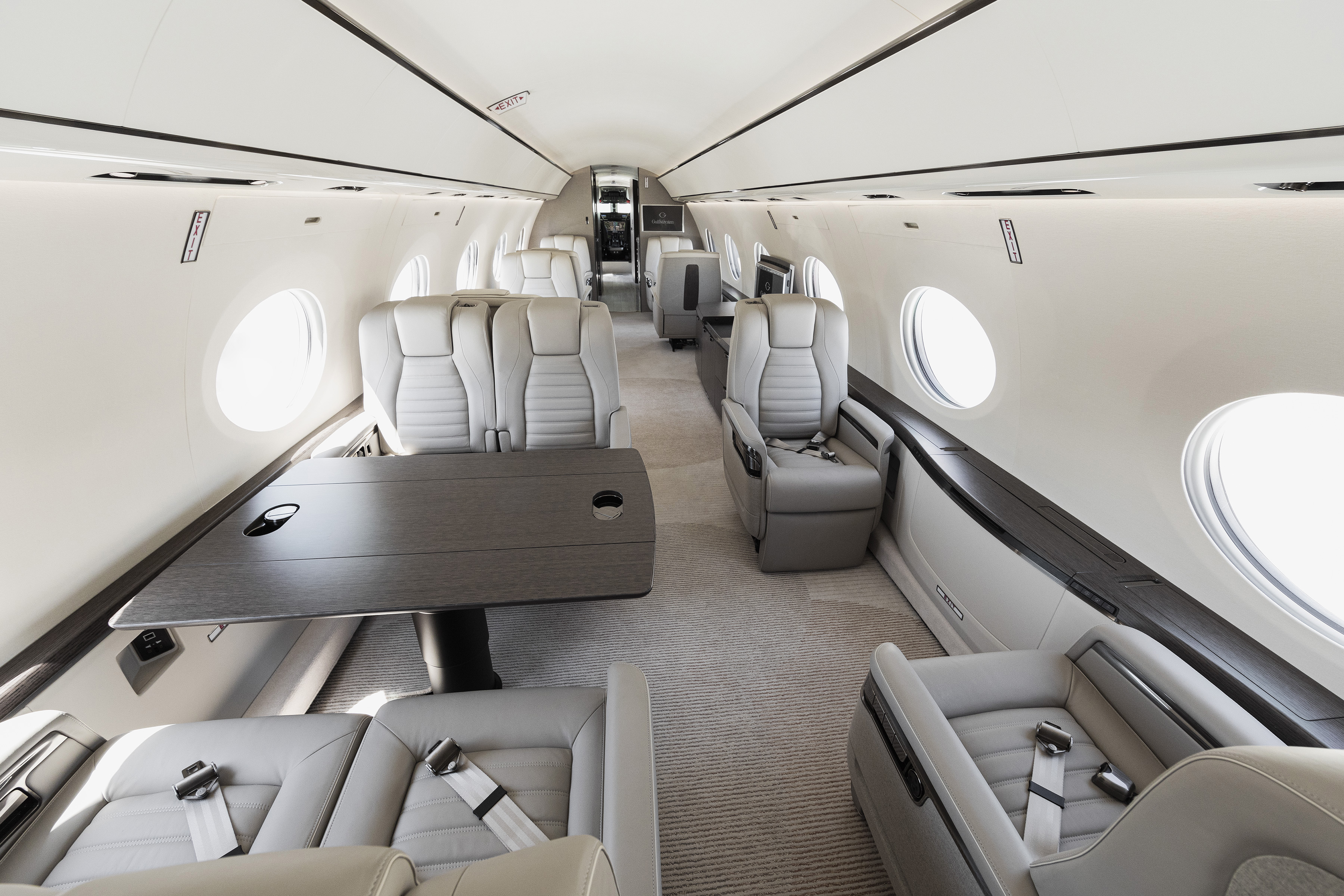
Embraer’s design philosophy emphasizes usable space rather than visual extravagance. The Phenom 300 cabin reflects this approach with a large entry door, flat-floor cabin, and an enclosed lavatory—features that significantly improve the passenger experience on longer flights.
Pressurization levels are optimized to reduce fatigue, and noise levels remain low throughout the cabin, even at higher cruise altitudes. Connectivity options and entertainment systems support both business productivity and leisure travel.
Beyond comfort and technology, reliability remains a defining feature of the Phenom 300. Systems are designed for high dispatch rates, and Embraer’s global support network ensures consistent access to parts, maintenance, and technical expertise worldwide.
The Phenom 300’s performance profile places it at the top of the light jet class. With a maximum cruise speed approaching Mach 0.80 (approximately 495 mph), the aircraft reduces time en route while maintaining excellent fuel efficiency.
A range of approximately 2,010 nautical miles allows for flexible routing and fewer fuel stops. The service ceiling of 45,000 feet enables the aircraft to fly above weather systems and congested airspace, improving ride quality and on-time performance.
The aircraft’s takeoff distance of roughly 3,209 feet and landing distance near 2,212 feet under standard conditions allow access to thousands of regional and secondary airports. This superior short-field performance is especially valuable for business travelers seeking to avoid large commercial hubs and land closer to final destinations.
Powered by two Pratt & Whitney Canada PW535E turbofan engines delivering approximately 3,200 pounds of thrust each, the Phenom 300 offers strong climb performance and responsive handling. Pilots consistently cite predictable control behavior and excellent stability across all phases of flight.
Fuel burn averages 200 gallons per hour, supporting favorable operating economics without compromising performance.
Operating costs play a critical role in private jet decision-making. The Phenom 300 stands out with maintenance expenses averaging near $1,000 per flight hour, a figure that compares favorably with other aircraft in its category.
Fuel efficiency, simplified systems, and strong manufacturer support contribute to predictable ownership costs. These factors make the aircraft attractive not only to individual owners, but also to charter operators and fractional jet ownership programs seeking consistent margins.
New Phenom 300 aircraft are typically priced around $10 million, depending on configuration and market conditions. More importantly, the aircraft demonstrates strong resale value, supported by high demand and a large installed fleet.
This stability of residual value reduces long-term financial risk and improves the overall cost-per-mile calculation for owners and shared-ownership participants alike.
The Phenom 300 has claimed more than half of the light jet market share since 2012 and has been the most delivered business jet in 2013, 2014, and 2015. During March 2019, Embraer delivered the 500th Phenom 300, and the aircraft has been used in over 30 countries, carrying 2.5 million passengers.
After July 2016, all Phenom assembly was transferred to the Melbourne, Florida line, further enhancing production efficiency and delivery capabilities.
With a generous cabin width, nearly five-foot height, and a layout optimized for executive seating, the Phenom 300 provides a comfortable environment for flights lasting several hours. The flat-floor design allows passengers to move naturally, while ergonomic seating supports productivity and relaxation.
A well-equipped galley, enclosed lavatory, and modern entertainment options elevate the onboard experience. The cabin’s pressurization and soundproofing reduce fatigue, making the aircraft well-suited for same-day round trips or multi-leg itineraries.
Every design decision in the Phenom 300 reflects a focus on passenger satisfaction rather than superficial luxury. This emphasis resonates with executives and frequent flyers who value consistency, comfort, and efficiency over excess.
For individuals exploring fractional jet ownership, the Phenom 300 offers a balanced solution. Its combination of performance, reliability, and cost efficiency makes it an ideal shared-ownership aircraft, providing access to private aviation without the obligations of full ownership.
Fractional programs benefit from the aircraft’s strong dispatch reliability and resale value, while owners gain predictable access to a proven platform that supports both business and personal travel needs.
The Embraer Phenom 300 continues to set the standard for what a light business jet should deliver. Its success is rooted not in luxury branding, but in thoughtful engineering, reliable performance, and long-term economic value.
For those evaluating private aviation options—whether through ownership, charter, or fractional aircraft ownership—the Phenom 300 represents a smart, future-proof choice that balances speed, comfort, and operational efficiency.
Ready to explore the smarter way to fly private?
Visit https://www.fractionaljetownership.com/ to learn how fractional jet ownership featuring aircraft like the Phenom 300 can transform your travel experience with flexibility, confidence, and control.
