.jpeg)
December 10, 2025
The private jet market, valued at $26.6 billion in 2024, is projected to grow to nearly $50.8 billion by 2034. Suddenly, private aviation is less “secret society of the absurdly rich” and more a service for executives, entrepreneurs, and anyone allergic to airport chaos.
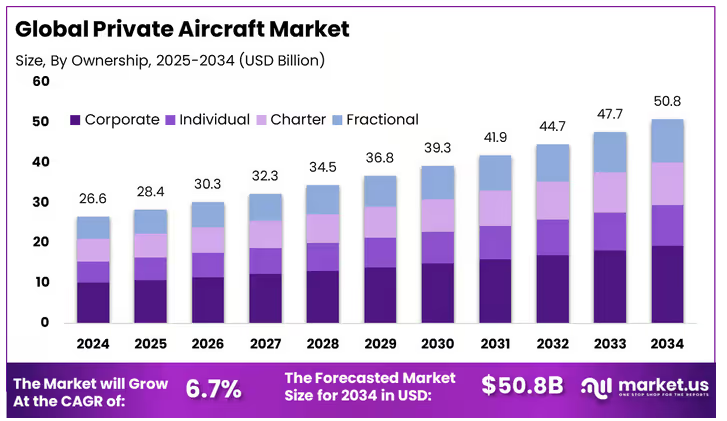
This is possible due to shared ownership models, particularly fractional ownership.
In this article, Fractional Jet Ownership examines growth trends in the private aviation market.
Having your own jet parked in the hangar and ready to go is still mostly a lifestyle for the billionaires. Besides the initial investment (ranging from $2 million to $110+ million), a plane comes with a series of ongoing expenses, including maintenance, hangar rental (if you don’t own one), crew salaries, insurance, repairs, and so on.
Now, what’s this about having access to a private plane without paying all the costs?
But the market has grown with the rise of fractional jet ownership. In this model, specialized platforms enable multiple owners to buy a fraction of a private jet and enjoy all the benefits of owning one.
For instance, owning 1/16th of a jet gives you access to 50 hours of flight per year. This entails two main costs: the cost of the share (a one-time payment) and a monthly management fee of $5,000 to $10,000+.
Some private companies manage the planes and ensure a plane that’s similar to the one the buyer co-owns will always be ready to take them where they need to go. Such management companies also handle crew hiring, maintenance jobs, scheduling, and more.
Compared to the costs of full ownership, fractional ownership reduces the initial investment. For under $1 million, buyers can have a plane that’s ready to go (with some planning in advance).
The lower entry price point has attracted corporations, government organizations, and high-net-worth individuals who are not part of the ultra-rich.
As a result, the global aircraft fractional ownership market size was valued at $11.2 billion in 2024. Forecasts indicate it will grow rapidly, reaching $23.7 billion by 2033.
One reason private aviation is on an upward trend is the degradation of commercial aviation services.
In an interview with Fortune, Janine K. Iannarelli, the founder and president of aviation consultancy Par Avion, affirmed that commercial airlines are losing first-class passengers due to lower-quality service, flight delays, and cancellations. In her opinion, those who no longer enjoy the first-class experience have switched to private aviation.
So it’s not just about flying in style. It’s also about saving time (both in the air and on the ground), reducing stress, and optimizing travel.
Plus, the growth of the private aviation sector doesn’t benefit only the well-to-do. It also has ramifications for the local economy. Private jets don’t usually land at commercial airports; they primarily use a vast network of general aviation (GA) and reliever airports.
In the United States, commercial airlines serve roughly 500 airports. Private jets have access to over 5,000 public-use airports that are not usually frequented by commercial airships.
According to Monarch Air Group President David Gitman, these smaller regional airports make a significant impact on local communities, creating jobs and supporting small businesses. Over 1.2 million people are working in this industry in the U.S. alone. In Europe, the numbers are smaller (around 450,000 people), but still significant. Additionally, new markets, such as those in Latin America and Asia, are emerging.
Beyond pilots and crew, regional airports need staff to function, as well as catering, security, and ground transportation services. Private aviation also supports local tourism and hospitality industries and keeps specialists in aircraft manufacturing and maintenance employed.
Furthermore, regional airports are usually the first in line for humanitarian missions, whether it’s disaster relief or ensuring food and medical supplies reach areas in need. Without these points of air contact, these missions would have much more difficulty reaching their destination.
Even though private aviation is seen as a service for the ultra-wealthy, its existence pumps money into local economies and helps keep regional airports alive.
