February 18, 2026
For decades, there were two choices in air travel: buy the jet or fly commercial. That binary is changing. A shift in financial realities has opened up a third lane, fundamentally changing how businesses and high-net-worth individuals get from point A to B.
This analysis from Fractional Jet Ownership evaluates the real-world costs of both models to determine when it makes sense to lease and when it makes sense to own a private jet.
According to the National Business Aviation Association (NBAA), the depreciation and operational costs of full ownership no longer make financial sense compared to leasing and fractional models for travelers logging fewer than 400 flight hours annually.
While the "billionaire owner" stereotype persists in headlines, the modern private aviation consumer is increasingly prioritizing capital liquidity over asset accumulation.
The upfront purchase price of a private aircraft often varies depending on the aircraft chosen and whether it’s purchased new or used. While entry-level light jets like the Cirrus Vision Jet may start around $2 million, and converted commercial liners like a customized Boeing 747 can exceed $350 million, the purchase price is rarely the defining economic factor.
The primary erosion of value comes from depreciation. Much like luxury automobiles, new aircraft depreciate immediately upon delivery. According to PwC’s Depreciation of Business Aircraft (2024), business aircraft experience predictable early‑life value declines driven by market valuation behavior.
And the level of depreciation varies. Kevin O’Leary, president of Jet Advisors, estimates that it sits in the 5%-7% range each year. The more an aircraft is used, the faster it will depreciate. For a $20 million midsize jet, this equates to a $1 million loss in value per year, regardless of how often the plane leaves the tarmac.
Beyond the purchase price, fixed annual costs—hangarage, insurance, crew salaries, and pilot training—accrue whether the aircraft flies 10 hours or 500 hours. When these fixed costs are divided by a low number of flight hours, the effective "cost per hour" skyrockets.
Once a private jet is purchased, ongoing operating costs must be paid. These are typically combined as a collective operational price per flight hour, which, again, varies depending on the size and complexity of the plane in question.
According to the Rules of Thumb for Business Aircraft Ownership and Operating Options by the NBAA, whole-aircraft ownership typically becomes cost‑effective when annual utilization approaches 300-400 hours.
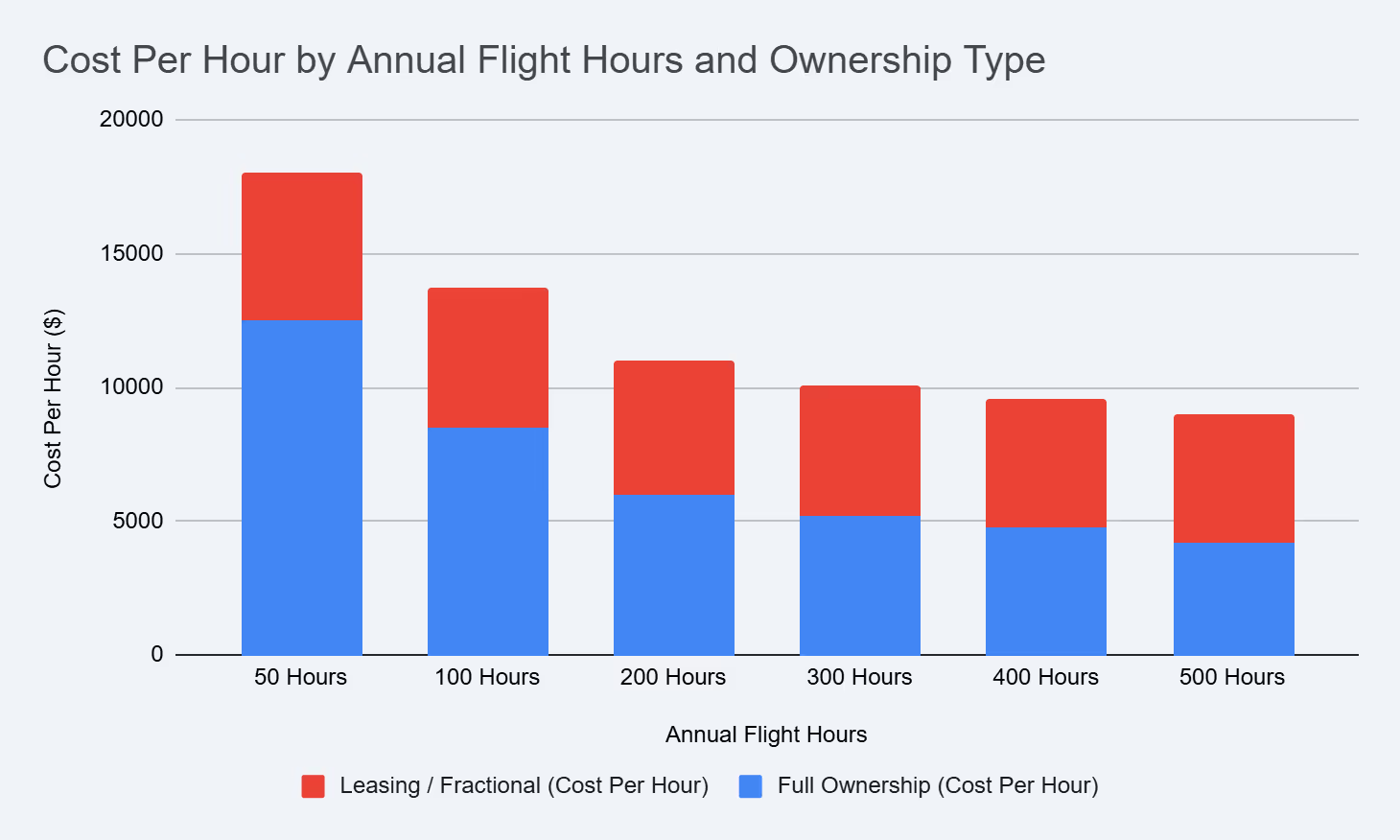
Source: Cost efficiency modeling based on Jettly’s Private Jet Operating Cost Guide. Analysis assumes standard fixed costs (hangar, insurance, crew) amortized over annual flight hours.
For individuals or corporations flying more than 400 hours per year, ownership begins to offer economies of scale. The fixed costs are spread over enough duration to lower the per-hour operational rate, and tax incentives (such as bonus depreciation in certain jurisdictions) can offset the capital expense.
However, for private travelers who fly between 50 and 200 hours annually, full ownership results in a utilization inefficiency. In this bracket, the cost of capital and depreciation outweighs the convenience of possessing the asset.
Leasing and fractional ownership models have emerged to close this gap. Under fractional ownership, travelers purchase a share of a specific aircraft, gaining access to scheduled use and customized onboard features without assuming the full financial and operational responsibilities of sole ownership. However, this convenience comes with its own set of economic and operational trade-offs.
This move toward flexibility has democratized access to private aviation beyond the ultrawealthy. The demographic utilizing business aviation is broadening. While reports from Wealth-X, an Altrata company, indicate that the average net worth of a full jet owner is approximately $1.66 billion, the threshold for entering the fractional or leasing market is significantly lower.
This trend mirrors shifts in other high-capital sectors, such as luxury real estate, where the "access economy" is replacing the "ownership economy." As sustainability concerns also mount, the efficiency of shared fleets—which fly more hours per day than individually owned jets sitting in hangars—presents a compelling argument for the future of the industry.
And according to data from the NBAA, fractional fleet aircraft accrue an average of 1,200 flight hours per year, compared to fewer than 400 hours for the average wholly owned business jet, which spends the majority of its time sitting in a hangar.
For the modern traveler, the question is no longer just "Can I afford a private jet?" but rather "Does my flight volume justify the burden of owning one?" For those under the 400-hour threshold, the economic data suggests that the answer is “no.”
