
April 26, 2026
Travel in a private jet has become more accessible than ever. The math behind private jet travel has shifted dramatically. In 2025, global private jet departures reached a record 3.9 million, signaling that more executives, entrepreneurs, and families are discovering what frequent flyers have known for years: the real cost of commercial aviation isn’t just the ticket price—it’s the time.
This guide is designed for executives, entrepreneurs, and families considering private jet travel. It covers the benefits, access models (charter, jet cards, fractional ownership), cost structures, and practical steps to book and manage your flights.
Consider the New York to Miami corridor. A commercial flight takes roughly 2.5 to 3 hours in the air, but factor in early arrival for long security lines, boarding delays, and baggage claim, and you’re looking at 4 to 5 hours door-to-door on a good day. That same trip on a private jet shrinks to under 2.5 hours total, including the 15-30 minute check-in at a private terminal. Private jet travel can save travelers between 90 and 180 minutes on many business routes due to expedited check-in, direct access to smaller airports, and flexible routing. On routes like Los Angeles to Aspen during ski season, the difference becomes even more pronounced—commercial options require connections through Denver and long drives, totaling 5-7 hours, while a private flight lands directly at Aspen-Pitkin County Airport in just over two hours.
Private jets have access to over 5,000 airports across the U.S., whereas commercial airlines serve only about 500. This opens direct routing to destinations that commercial carriers simply cannot reach efficiently.
Key benefits driving this shift include:
Time savings through customizable departure schedules and minimal airport procedures
Access to more airports, including secondary fields near final destinations
Enhanced privacy in cabins seating 4-16 passengers without strangers
Superior security via private terminals, avoiding TSA crowds and public exposure
Complete control over same-day multi-leg itineraries that would be impossible on scheduled charter flights
BlackJet Fractional Jet Ownership specializes in providing access to these advantages without the full cost and complexity of whole aircraft ownership, and travelers who want to get familiar with fractional jet ownership terminology and concepts can quickly gain the background needed to evaluate their options. Whether clients need 25 hours annually for leisure travel or 150 hours for intensive business use, BlackJet’s programs match aircraft types to actual flying patterns.
For those new to private aviation, understanding the access models matters. On-demand charter works for sporadic use but comes with variable pricing. Jet card programs offer prepaid hours but often include blackout dates. Fractional jet ownership provides guaranteed availability and predictable costs for consistent flyers, and a detailed comparison of fractional jet ownership versus membership programs helps clarify which structure best aligns with your flying habits. Each serves a different purpose—and the sections ahead explain exactly how to determine which fits your world.
Picture a Chicago-based CEO with meetings scheduled in Dallas at 10 a.m. and Nashville at 3 p.m., with a board dinner back home that evening. On commercial airlines, this itinerary is functionally impossible—connections, layovers, and schedule rigidity would consume the entire day and likely spill into the next. Flying private transforms this into a routine single-day operation.
A light jet departs Chicago Midway at 7 a.m., covering the 800-mile hop to Dallas Love Field in about 1.5 hours. The CEO lands by 8:30 local time, conducts a two-hour meeting, and boards the 50-minute flight to Nashville. After a productive afternoon session, the return flight touches down in Chicago by 7 p.m.—leaving time for that board dinner. This schedule sovereignty is why private jets allow for on-demand adjustments to itineraries, facilitating spontaneous stops or rerouting when business demands shift.
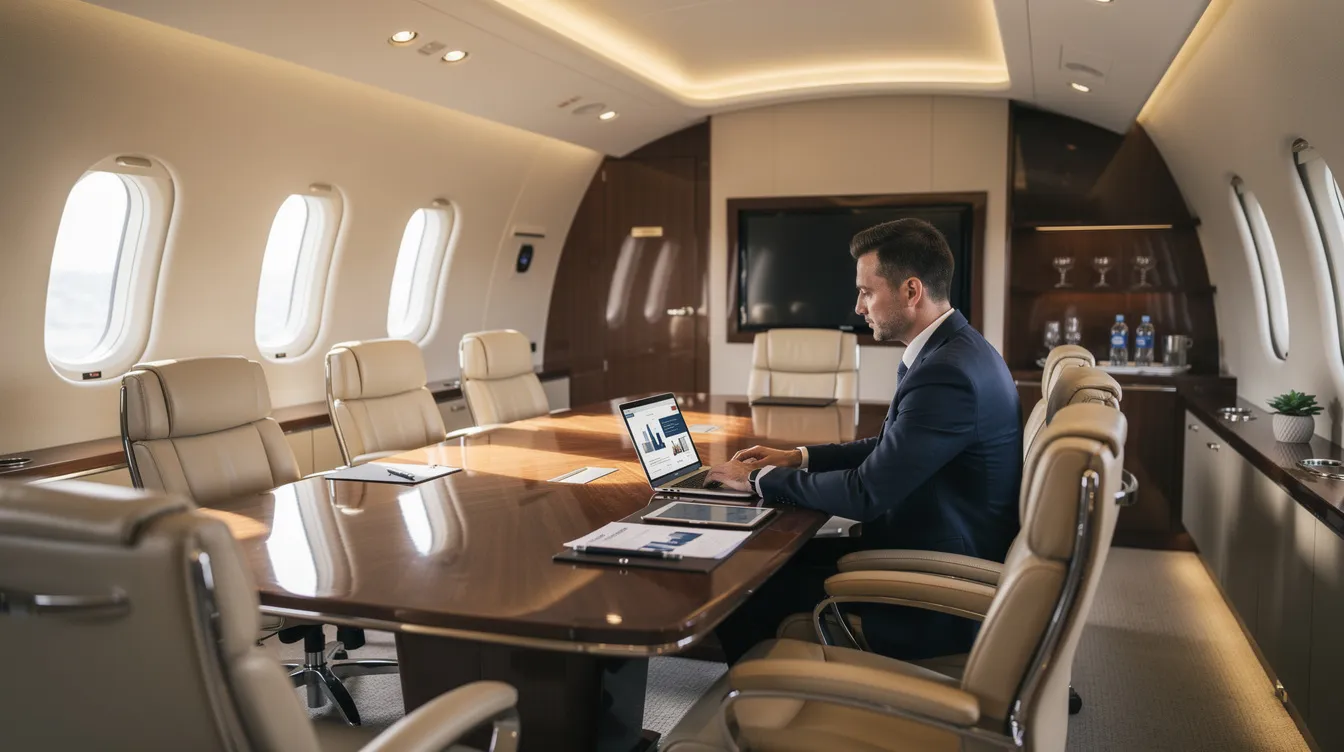
The journey itself becomes productive. Private jets offer a focused work environment with quiet cabins and high-speed internet for real-time video conferencing. Modern cabins feature Ka-band Wi-Fi delivering 50-100 Mbps, ample power outlets at every seat, and noise levels under 60 dB—quieter than a typical office. Teams can conduct confidential discussions, review sensitive documents, or hold impromptu board meetings without commercial eavesdropping concerns.
Practical business advantages include:
Predictable access through fractional ownership (e.g., 50-100 hours per year) eliminates last-minute charter uncertainty
Direct routing shaves 20-30% off flight times versus commercial paths bound by air traffic corridors
Multi-city trips in a single day that would require overnight stays are commercially
Privacy for sensitive negotiations, M&A discussions, or investor presentations
While private travel is more expensive, for groups of 4 to 8 or frequent business travelers, the time savings can make it a strategically sound investment
BlackJet’s Equity Fleet model prioritizes frequent business travelers needing consistent service. Fractional owners receive guaranteed availability with 24-48 hour advance booking, covering peak travel windows Monday through Thursday, 6 a.m. to 10 p.m. This reliability is underpinned by highly trained fractional jet pilots and crews focused on safety, consistency, and service. Industry analyses suggest that high-frequency business travelers reclaim 100-200 hours annually that would otherwise be lost to commercial delays.
Leisure time is finite, and private jet journeys compress what would be exhausting travel logistics into seamless transitions. Consider the New York to Jackson Hole corridor in February. Commercial options demand a connection through Denver, followed by a drive or regional hop—totaling 6+ hours on a good weather day. A midsize jet flies nonstop in 2.5 hours, landing at Jackson Hole Airport just minutes from the slopes. The vacation begins the moment the flight details are confirmed, not after layovers and rental car lines.
Similarly, Los Angeles to Cabo San Lucas during holiday weekends becomes a 2-hour direct flight to Los Cabos International’s private facilities, bypassing the chaos of LAX commercial terminals and Tijuana border crossings. Private jets provide access to thousands of regional airports, allowing travelers to reach destinations that are difficult to access via commercial airlines, such as remote ski resorts or beach towns.
Comfort factors that transform leisure travel:
Unrestricted baggage for skis, golf clubs, strollers, and sporting equipment—light jets handle 1,500 miles with 4-8 passengers plus gear, while private jets allow for more luggage and equipment to be brought on board without the strict limitations imposed by commercial airlines
Bespoke catering from favorite local restaurants, whether Manhattan bistros or LA organic cafes, accommodating gluten-free, plant-based, or specialty dietary needs
Pet-friendly arrangements with cabin travel for dogs and cats, including coordinated documentation for trips between the United States, Canada, Mexico, and the EU
Proximity to second homes via underserved strips like Truckee-Tahoe (5 miles from resorts) or Naples Municipal in Florida
BlackJet’s Reserve Fleet suits families or couples flying 25-50 leisure hours per year. This pay-as-you-go model provides fixed rates without ownership commitments, making it ideal for seasonal travelers who embark on ski trips during the four seasons or beach getaways without needing guaranteed year-round access. The private jet experience extends beyond transportation—it becomes an extension of the vacation itself.
Understanding the main access models helps travelers select the right aircraft program for their patterns. Each model serves different usage levels, and the cost-effective travel solution depends on annual flying hours and flexibility requirements, which is why many clients use a dedicated page to compare BlackJet’s Reserve Fleet, Equity Fleet, and Lease Program before deciding.
Fractional jet ownership is a model where multiple owners share access to a private jet, each purchasing a share that entitles them to a set number of flight hours per year. This approach matches an aircraft to specific mission requirements such as destination, passenger count, and desired amenities.
Best suited for occasional flyers under approximately 25 hours per year. In 2026, private airplane rental costs typically range from $2,000 to over $16,000 per flight hour, influenced by aircraft type, size, and additional fees such as taxes and positioning charges. Charter rates for private jets can vary significantly, with typical one-way prices ranging from $8,000 to $140,000, depending on aircraft type and distance.
The tradeoff: variable pricing based on demand, repositioning fees when aircraft must fly empty to reach you, and limited guarantees around peak days like holidays or major events. After inquiring about a charter jet, travelers are usually assigned a personal charter specialist who provides a selection of quotes and assists with the booking process.
Jet cards pre-purchase blocks of flight hours (typically 25 hours) at fixed hourly rates. This provides pricing consistency but often includes:
Blackout dates around holidays and high-demand periods
Peak-day surcharges of 20-50% above standard rates
Annual membership fees range from $2,000 to $5,000
Minimum booking windows (often 72 hours)
The cost of a private jet flight can increase by 20-40% due to additional expenses beyond the base hourly rate, such as fuel surcharges and crew costs.
For travelers flying 25-150 hours annually, fractional ownership provides guaranteed availability and predictable costs. Owners purchase a share of an aircraft (typically 1/16th to 1/2), receiving proportional access with all-in hourly rates covering maintenance, crew, and management. Typical rates run $5,000-$9,000 per hour for midsize to large jets in the U.S., often undercutting comparable private jet charters for regular users through shared fixed costs; a dedicated resource on the complete cost of fractional jet ownership can help quantify these numbers for your situation.
BlackJet focuses on two distinct models, and in parallel, many travelers consider floating fleet options in fractional ownership to maximize flexibility and utilization:
Equity Fleet: Traditional fractional ownership with actual aircraft shares, priority booking, and potential tax benefits through IRS depreciation provisions, which are often evaluated alongside fractional jet ownership financing, costs, and benefits
Reserve Fleet: Non-equity access to a curated network with fixed rates and guaranteed availability—similar to premium jet cards but without ownership commitment, and often compared using tools that break down the total cost of fractional jet ownership across different structures
Booking an empty leg flight can save customers 25% to 75% compared to regular pricing, provided flexibility in scheduling is possible. These empty leg flights represent repositioning aircraft and offer significant savings for travelers with adaptable schedules.
Fractional jet ownership simplifies private aviation by giving clients access rights to specific aircraft categories without the full burden of ownership. The mechanics are straightforward: clients buy or commit to a specific number of annual flight hours—typically 25, 50, 100, or 150—on a chosen aircraft category such as light, midsize, or super midsize jets.
The Equity Fleet represents actual ownership. Clients purchase a proportional share in a specific tail number or fleet type, receiving:
Priority booking with guaranteed availability windows (48 hours during peak periods, 24 hours off-peak)
Potential U.S. tax advantages, including depreciation under current IRS Section 168 rules (clients should consult their tax advisor for specific guidance)
Buyback options and transparent exit provisions
Consistent aircraft experience with familiar crews and configurations
For clients preferring flexibility without capital commitment, the Reserve Fleet provides:
Access to BlackJet’s curated network of aircraft
Fixed hourly rates without ownership requirements
Guaranteed availability for qualifying trips
No equity stake, but predictable pricing and service standards
BlackJet handles all operational complexity: aircraft sourcing, FAA Part 135/91K certifications, maintenance scheduling, crew management (pilots averaging 5,000+ flight hours), and day-to-day scheduling. Clients maintain control over their travel plans while the operational burden stays with BlackJet’s aviation experts.
An executive logging 80 hours per year between New York, Toronto (1-hour light jet hop), and London (6.5-hour super midsize flight) might structure their access as follows, similar to how a 1/8th fractional jet ownership share with about 100 hours is often used to balance cost and availability:
A 50-hour midsize share through the Equity Fleet covers routine domestic and North American travel
Reserve Fleet hours supplement for overflow periods or when a specific trip requires a different aircraft class
This hybrid approach minimizes deadhead legs and caps total costs 20-30% below comparable charter options for regular travelers
The right blend depends on route patterns, seasonal demand, and whether tax efficiency matters to the client’s broader financial strategy, especially if you view fractional jet ownership as an investment rather than purely a travel expense.
Step aboard a 2024 Gulfstream G280 or 2023 Citation Latitude, and the difference from commercial first class becomes immediately apparent. These aircraft feature 8-9 passenger seating, flat floors for easy movement, and cabin noise levels under 60 dB—quieter than a typical conversation. The plane becomes a mobile office, meeting room, or private retreat depending on the mission.
Standard amenities across modern private aircraft include:
High-speed Ka-band Wi-Fi delivering 50-100 Mbps for video conferencing and real-time document collaboration
Power outlets at every seat with universal charging options
Configurable seating arrangements for meetings, dining, or rest
Noise-reducing cabin design that enables confidential discussions
Health benefits of private jets include flying at higher altitudes and maintaining lower simulated cabin altitudes, which can improve rest and breathing. Private aircraft typically cruise at 45,000 feet versus commercial 35,000 feet, reducing turbulence and fatigue, and many travelers weigh these qualitative factors alongside rankings of the best fractional jet ownership programs when choosing a provider.
Culinary customization distinguishes the private jet experience from commercial alternatives. Traveling by private jet allows for a more personalized dining experience, where passengers can choose their meals from their favorite restaurants rather than being limited to standard in-flight catering. BlackJet coordinates pre-ordered meals from specific city restaurants—Upper East Side bistros for New York departures, organic cafes for Los Angeles legs—and accommodates dietary needs, including gluten-free, plant-based, or allergy-conscious menus.
Privacy and security extend from the board to arrival. Private terminals (FBOs) eliminate public exposure, providing dedicated lounges and car-to-aircraft transfers. Clients conduct board discussions, review sensitive materials, or simply relax with family without commercial cabin eavesdropping.
For travelers with pets, cabin-friendly arrangements accommodate dogs and cats with proper documentation. BlackJet’s team coordinates rabies vaccination records and paperwork for international travel to Canada, Mexico, and EU destinations under Pet Travel Scheme requirements.

This section addresses common questions from first-time private jet travelers and those exploring charter options versus ownership programs.
Speeds vary by aircraft class. Light jets cruise at approximately 420-480 mph, midsize jets at 450-500 mph, and long-range jets can reach up to about 560 mph (the Bombardier Global 8000 leads this category). Weather conditions and routing can affect actual flight time, as headwinds may add 15-30 minutes on transcontinental routes.
Range depends on aircraft selection:
Aircraft Type | Typical Range (miles) | Typical Passengers | Usage Example |
|---|---|---|---|
Light Jets | Up to 1,500 | 4-8 | Short-haul regional trips |
Midsize Jets | Up to 2,450 | 6-9 | Domestic flights like NY to LA |
Super Midsize Jets | 3,500+ | 8-12 | Transatlantic flights like NY to London |
Heavy Jets | ~7,000 | 10-19 | International long-haul flights |
Ultra-Long-Range Jets | 8,000+ | 12-19 | Nonstop global travel |
Turboprops | 600-1,000 | 6-14 | Short regional or remote access |
Private jet travel significantly reduces travel time by allowing passengers to avoid long security lines and check-in processes, often enabling them to arrive just 15-30 minutes before departure. Travelers can often arrive just 15 minutes before departure when using private terminals for private jets, significantly reducing the time spent at the airport compared to commercial flights. The car-to-aircraft transfer through FBOs eliminates TSA queues and gate waits.
Golf bags, skis, strollers, and sporting equipment are typically accommodated. However, private jets impose strict weight and balance limits for luggage and passenger counts, which can affect fuel range and necessitate unplanned stops. BlackJet provides guidance on aircraft selection when baggage is unusually heavy or bulky, ensuring the right aircraft matches your specific trip requirements and that clients understand essential contract terms in fractional jet ownership that may govern such operational limits.
Yes. Pets travel in the cabin rather than in cargo holds. International trips to Africa, Europe, Canada, or Mexico require rabies vaccines and documentation. BlackJet coordinates with operators to ensure pet-friendly cabins and cleaning standards meet expectations.
Pricing varies by aircraft size, distance, and peak dates. Rather than quoting fixed rates that may not apply to your situation, BlackJet provides tailored, transparent estimates based on your actual route patterns and preferred aircraft types. Expect hourly rates to scale with cabin size—a small plane or light jet costs less per hour than a heavy jet, but the appropriate choice depends on passenger count and mission range.
Full aircraft ownership appeals to travelers flying 250-300+ hours annually, but the financial and operational complexity extends far beyond acquisition. Consider a typical U.S.-based owner operating a midsize jet 200 hours per year:
Acquisition: $10-70 million, depending on aircraft type and age
Annual fixed costs: $1-2 million including hangar fees ($200,000), insurance ($100,000), crew salaries ($600,000+ for two pilots), and maintenance reserves ($500,000)
Regulatory compliance: FAA certification management, training programs, operational oversight
This demand for dedicated aviation departments or third-party management companies adds an administrative burden that distracts from core business activities. For many enterprises, the matter comes down to hours flown: below 250 hours annually, the economics favor shared access models.
Entry capital: $1-5 million for a proportional share
Shared fixed costs across multiple owners
Outsourced operations, maintenance, and crew management
Guaranteed availability without fleet management responsibility
Exit options through buyback provisions
Many corporations combine fractional ownership with ad-hoc charter or Reserve Fleet access for overflow periods. Rather than purchasing a second aircraft for peak seasons, they layer flexible hours with their core fractional position. This hybrid approach delivers control where it matters while avoiding the person-hours required to manage a standalone aviation operation and underscores why a well-drafted aircraft fractional ownership sample contract is so important.
The decision framework centers on predictability. Fractional ownership provides it for consistent flyers; full ownership makes sense only when utilization justifies the infrastructure cost.
The booking process reflects the convenience that private aviation promises. Booking a private jet involves selecting a reputable broker or operator, requesting quotes based on your itinerary, choosing an aircraft, and finalizing logistics within hours.
Request submission via phone, email, or BlackJet’s digital portal with trip details (dates, routing, passenger count)
Confirmation from BlackJet’s team with schedule options, aircraft type recommendations, and transparent pricing
Itinerary finalization, including FBO details, crew information, and ground transportation coordination
Departure with car-to-aircraft service at the private terminal
The private jet booking process typically involves four main steps: defining trip details, selecting an aircraft, verifying safety credentials, and booking the flight. Key factors in booking a private jet include passenger count, flight distance, baggage capacity, safety records, and aircraft size. Booking a private jet is a highly customized process that involves matching an aircraft to specific mission requirements such as destination, passenger count, and desired amenities.
Equity Fleet members receive booking guarantees—48 hours advance notice during peak periods (Monday-Thursday, major holidays) and 24 hours off-peak for North American and key European routes. This eliminates the uncertainty that plagues charter-only travelers during high-demand windows.
BlackJet supports last-minute changes, same-day multi-leg routings (New York-Dallas-San Francisco), and international connections. When business needs shift, the flexibility to adjust arrival times or add stops demonstrates why flying private delivers value beyond simple transportation.
Beyond the sky, BlackJet coordinates:
Ground transportation (car service to/from airports)
Catering arrangements matching dietary preferences
Special requests such as FBO meeting rooms, on-board branding for corporate roadshows, or specific cabin configurations
The air of control extends from the first flight inquiry through wheels-down. Once a program is in place, scheduling becomes as simple as sending a text or making a brief call.
Safety underpins every aspect of private aviation, governed by rigorous standards that often exceed commercial airline requirements.
Safety standards for private jet operators include holding a current FAA Part 135 certificate and checking third-party ratings. Safety credentials for private jet operators should exceed standard FAA requirements, including ‘Platinum’ ratings from ARGUS or ‘Wingman’ status from Wyvern. These third-party audits evaluate maintenance records, pilot training protocols, and operational history.
BlackJet vets every operator, aircraft, and crew in its network. Pilots must meet minimum experience thresholds (typically 1,500+ hours with recurrent training), and maintenance records undergo regular review. This providing access approach ensures clients fly with operators meeting the highest industry standards—not just regulatory minimums, whether they’re considering fractional jet ownership in Atlanta or other key hubs.
Private aviation is addressing environmental concerns through multiple channels:
Sustainable Aviation Fuel (SAF) availability at major hubs, with blends up to 50%, reducing lifecycle CO2 emissions by approximately 80%
Carbon offset options priced at $10-20 per ton of CO2
Route planning that minimizes empty repositioning legs through network optimization
Global network coordination to match aircraft positioning with client demand
International travel requires customs pre-clearance where available (Ireland for U.S.-EU connections, for example), advanced passenger information (APIS) filings, and documentation coordination. BlackJet manages compliance requirements, ensuring clients arrive prepared rather than scrambling with paperwork at departure.
The international network operates under consistent safety protocols, whether flying to London, Cabo, or destinations across Africa.

Private jet travel, when structured through fractional jet ownership or shared-use programs, delivers the control and efficiency that full ownership promises—without the operational burden. For executives and families flying 25-150 hours annually, fractional ownership represents the intersection of smart financial planning and elevated travel experience.
BlackJet Fractional Jet Ownership specializes in helping clients determine the right blend of Equity Fleet and Reserve Fleet access based on actual route patterns. Whether your priorities center on business productivity, leisure convenience, or both, the structure exists to match your specific needs.
We invite executives, family offices, and corporate travel decision-makers to review their 2024-2026 travel patterns against the benefits outlined here. Explore what predictable access, guaranteed availability, and professional management could mean for your schedule.
Ready to explore the smarter way to fly private? Visit FractionalJetOwnership.com to schedule a consultation and see how a tailored fractional jet ownership program can transform your business and leisure travel.
