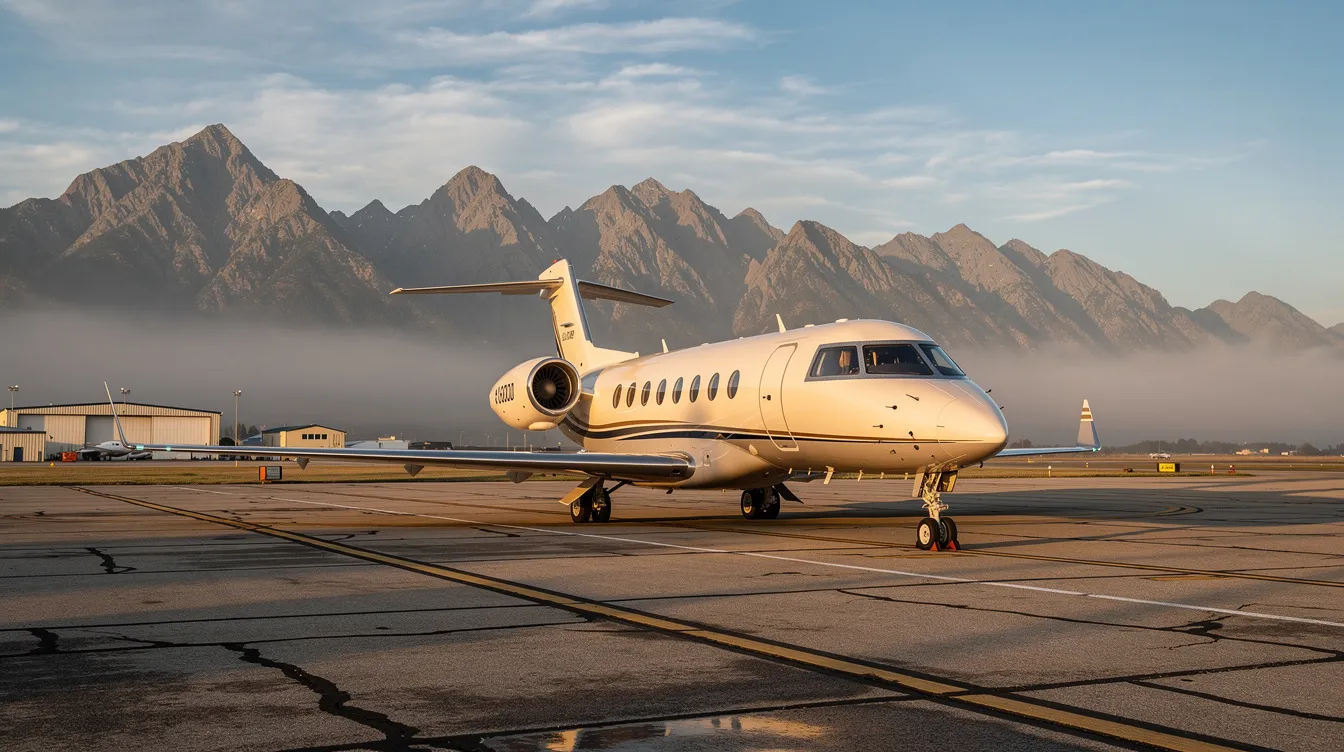
August 5, 2026
When a corporation needs to move its entire leadership team across an ocean—or a family of twelve plus staff wants nonstop access to remote destinations—the 18-passenger private jet becomes the obvious solution. But buying one outright is rarely the smartest financial move. Here is everything decision-makers need to know about these aircraft, from cabin layouts and operating costs to the access models that actually make economic sense.
An 18-passenger private jet typically refers to ultra-long-range heavy jets such as the Gulfstream G550, Gulfstream G650ER, Dassault Falcon 8X, Bombardier Global 7500, and Embraer Lineage 1000E—aircraft built for true intercontinental travel.
These jets deliver an exceptional range of 4,600–7,500 nautical miles, high-speed cruise between Mach 0.82 and 0.925, and nonstop capability on routes like New York–Dubai or Los Angeles–Tokyo.
Comfortable configurations for 18 passengers include multiple cabin zones, a forward galley, full-service dining, and six to eight proper sleeping berths, offering comfort and productivity even on long-haul flights.
Heavy jets typically feature true stand-up headroom exceeding six feet, facilitating free movement throughout multi-zone cabins designed for working, dining, and sleeping. Lie-flat berths and suites enable restful sleep on extended flights.
Dedicated flight attendants are standard on these aircraft, providing in-flight service supported by full-service galleys capable of gourmet multi-course catering for all passengers.
Fractional ownership reduces individual financial exposure and provides guaranteed aircraft availability and flexibility, along with potential tax benefits—making it far more practical than whole-aircraft ownership for travelers logging 25–150 hours per year.
BlackJet Fractional Jet Ownership offers both Equity Fleet and Reserve Fleet access, giving clients predictable scheduling without the $50 million-plus capital commitment.
An 18-passenger private jet is a large-cabin, heavy or ultra-long-range business jet certified for up to 18 occupants. These aircraft sit squarely in the business aviation category above super midsize models like the Bombardier Challenger 350 and below full airliner-size VIP conversions such as the Boeing BBJ.
The number 18 is typically the maximum certified seating. Most owners and operators select comfortable configurations of 12–16 seats plus crew, converting the remaining space into lounges, conference areas, or private bedrooms. This aircraft offers ample room for work, rest, and dining over flights lasting 10 hours or more.
Common missions include multinational executive roadshows, board meetings on the move, sports teams traveling together, diplomatic delegations, and ultra-high-net-worth family travel with staff. Private jets can access over 5,000 airports worldwide, and these larger aircraft can operate from runways as short as 5,000 to 6,000 feet—reaching far more airports than commercial widebody aircraft and saving valuable time on every trip. By contrast, smaller jets can access even shorter runways but lack the cabin space and amenities of heavy jets.
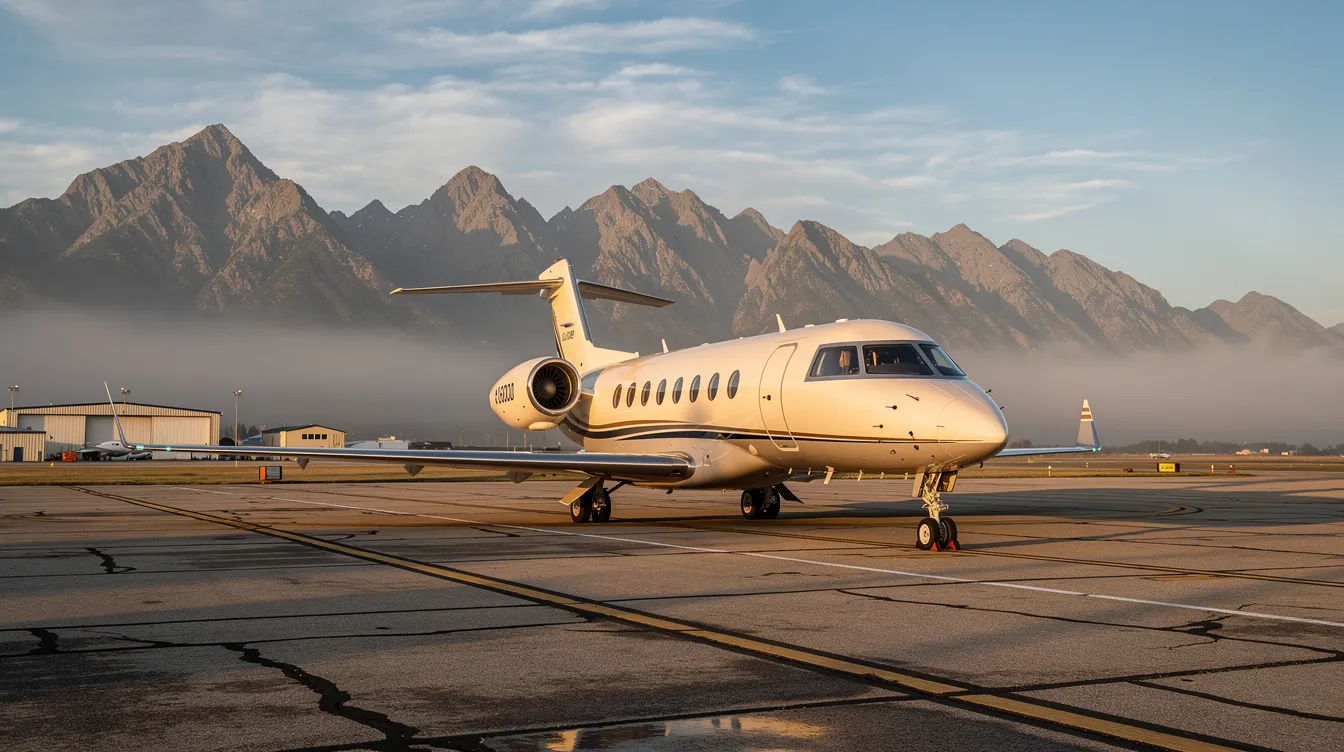
Ultra-long-range jets carrying 18 passengers are purpose-built for nonstop intercontinental travel, eliminating fuel stops that add hours and complexity. Their range capabilities break down into three distinct tiers:
4,600 nm: The Embraer Lineage 1000E handles routes like New York–London or Dubai–Paris nonstop.
6,000–6,750 nm: The Gulfstream G550 and Dassault Falcon 8X enable routes such as New York–Dubai or London–Tokyo without refueling.
7,500+ nm: The Gulfstream G650ER has a range of 7,500 nautical miles, and the Bombardier Global 7500 reaches 7,700 nm, handling Los Angeles–Hong Kong or New York–Johannesburg.
18-passenger jets typically cruise at speeds of Mach 0.82–0.925. Most heavy jets settle at Mach 0.85 (roughly 560 mph), while newer Gulfstream aircraft like the G650ER push to Mach 0.925—translating to roughly 610 mph. The Gulfstream G550 can reach a maximum speed of 885 km/h. That high speed differential can shave 30–60 minutes off routes such as New York–Paris, reducing nonstop flight time and wear on the airframe.
These jets cruise at altitudes up to 51,000 feet, well above airline traffic and most weather. Flying at those altitudes means smoother rides, fewer air traffic delays, and outstanding performance reliability for time-sensitive international flights. The result is that business executives land closer to their destinations, more rested, and ready to work—a direct payoff in productivity.
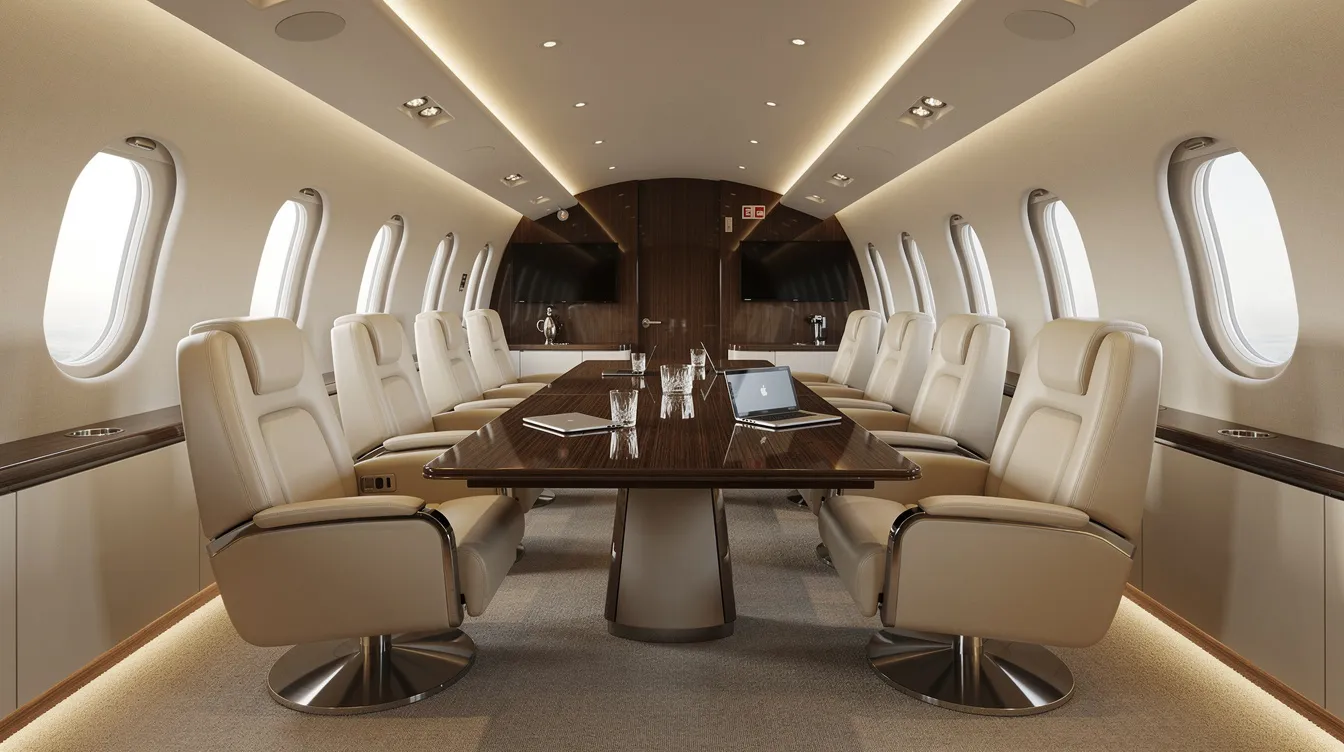
The cabin inside an 18-passenger heavy jet functions as a flying office and residence, not a dense airline-style tube. These aircraft deliver an expansive cabin with multiple distinct zones, each designed for a different purpose across long missions.
Typical cabin zoning includes:
Forward club-four seating for business meetings and collaboration.
Mid-cabin conference or dining area with four seats and a table.
Aft lounge or private stateroom with divan and optional queen-size bed, where passengers can sleep in genuine comfort.
Dedicated crew rest in ultra-long-range aircraft, essential on 12–15-hour flights.
The forward galley in heavy jets is a critical feature. It includes full-height cabinetry, a convection oven and microwave, an espresso machine, and chilled storage. Acoustic doors separate the galley from the spacious cabin for quiet dining. Two flight attendants can prepare and serve all the onboard meals for 18 passengers across multiple hot-meal services on long missions, handling other service needs like turndown and beverage service.
Comfort details include a cabin height exceeding six feet (the G550 stands at 6 ft 1 in, the Global 7500 at 6 ft 2 in), large oval windows, and a lower cabin altitude equivalent of 4,000–5,000 feet that significantly reduces fatigue. For 2026, expect Ka-band high-speed Wi-Fi, Bluetooth audio, personal screens, latest audiovisual systems, cabin management via touch panels or smartphone apps, and Airshow moving maps for real-time route tracking.
Compared to smaller jets, these heavy aircraft offer true stand-up headroom, multiple living areas, and full galley facilities that support gourmet multi-course catering—amenities simply unavailable in smaller cabin classes.
Several aircraft manufacturers produce jets capable of carrying 18 passengers on intercontinental routes. Here are the leading models and what sets each apart:
Gulfstream G550: An ultra-long-range classic workhorse widely used in corporate and government fleets, with a strong support network across North America. It accommodates up to 18 passengers and cruises at speeds up to 885 km/h.
Gulfstream G650ER: The benchmark for range and speed among heavy jets, favored by Fortune 500 companies and heads of state. It offers a range of 7,500 nautical miles and seating for up to 18 passengers with luxurious suites and lie-flat berths.
Dassault Falcon 8X: Long range with exceptional short-field capability and fuel efficiency, popular with European operators needing access to smaller airports.
Bombardier Global 6000/6500/7500: A strong combination of cabin volume, outstanding performance, and smooth ride—the Global 7500 offers the largest cabin in this class with a spacious three-zone cabin layout.
Embraer Lineage 1000E: A businessliner with one of the largest cabins in the segment, derived from the E190 platform. It accommodates up to 19 passengers across five cabin zones and is especially popular with charter operators needing maximum cabin volume.
VIP airliners provide maximum floor space and multi-zone layouts for larger groups, but typically at a higher operating cost and complexity.
Gulfstream aircraft dominate U.S. corporate fleets, while the Dassault Falcon and Bombardier Global series hold stronger positions in European and Middle Eastern markets. Most owners select 13–16 seats to gain luxurious cabins with enough room for work and rest zones rather than filling every single seat. The Gulfstream G700 incorporates advanced materials to improve fuel efficiency, representing the newest generation in this class.
BlackJet Fractional Jet Ownership focuses on modern, widely supported models—including the G550, G650ER, Global series, and Dassault Falcon 7X/8X—to balance maximum comfort, reliability, and maintenance support across its fleet.
The Gulfstream G550 remains a reference point in the 18-passenger category. Since its introduction in the early 2000s, it has built a reputation for range, a spacious cabin, and proven reliability across tens of thousands of flight hours in corporate, government, and private service.
Key performance metrics tell the story:
Maximum range around 6,750 nautical miles.
Typical cruise speed about 500 knots (roughly 590 mph).
Service ceiling up to 51,000 feet.
Ability to fly nonstop routes like New York–Dubai, Los Angeles–London, and Hong Kong–Sydney.
The Gulfstream G550 can seat 14–18 passengers comfortably depending on cabin configuration. A typical executive layout features up to three or four distinct living areas with a forward galley, berthable divans, lie-flat club seats, and generous baggage space of approximately 169 cubic feet—enough for 20–25 medium suitcases. The quiet cabin, large oval windows, and ample room throughout make it a favorite in business aviation fleets worldwide.
What keeps the G550 relevant in a market full of newer designs is its long production run, which created a strong support network and parts availability, mature avionics and safety systems, and attractive value on the pre-owned market. Pre-owned G550 pricing ranges from roughly $11–$35 million depending on age and maintenance status—significantly less than a factory-new ultra-long-range jet.
BlackJet's team often uses G550-class performance and cabin metrics when advising clients on whether they truly need 18 seats, or if a slightly smaller heavy jet delivers a better cost–benefit ratio for 25–150 hours per year.
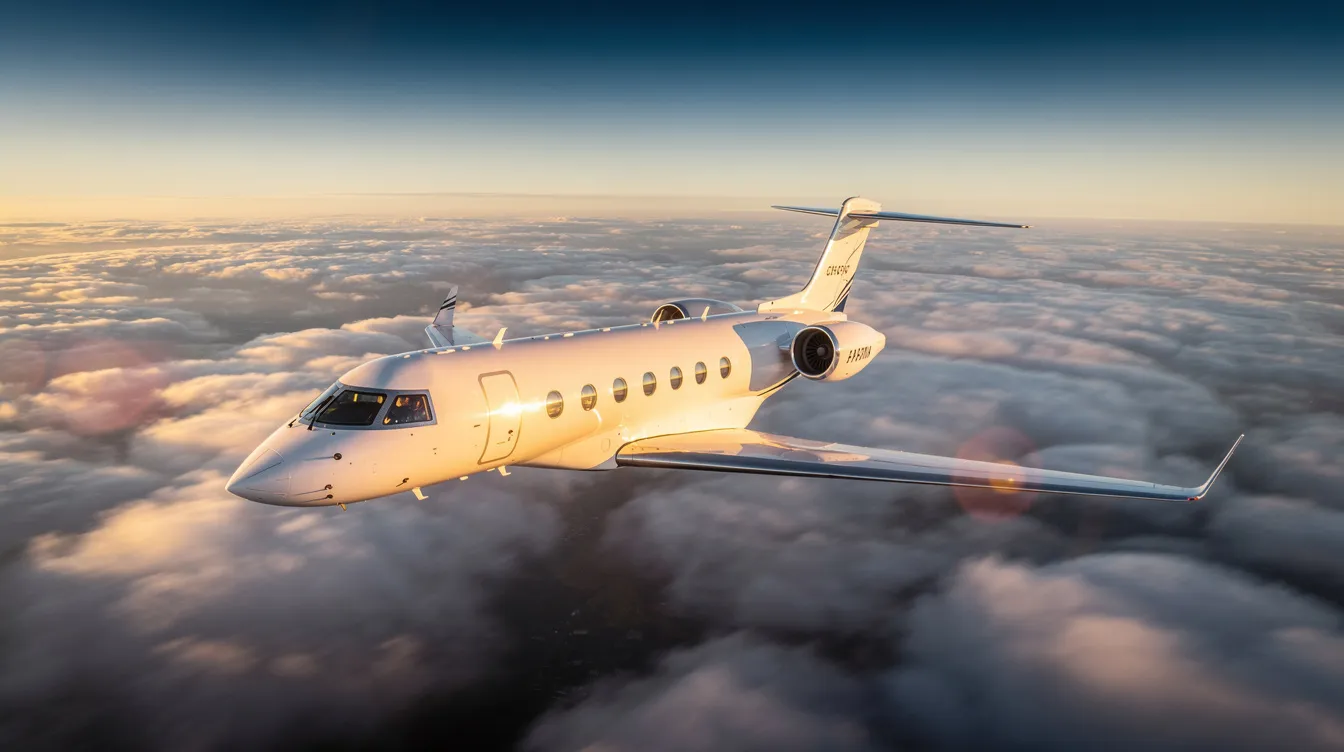
The same airframe can look dramatically different depending on whether an operator configures it for 18 passengers in dense seating or 12–14 in a more spacious executive layout. That cabin configuration decision drives the entire onboard experience.
Common business jet customization themes include:
Conference-style seating with integrated power, HDMI/USB-C connectivity, and videoconferencing capability equipped for productive business meetings at altitude.
Quiet zones for rest, including private bedrooms with queen-size beds (common on the G650ER, Global 7500, and Embraer Lineage), offering ultimate luxury for overnight flights.
Bespoke finishes—wood veneers, leathers, carpeting—aligned with a corporate brand or personal taste.
OEM approaches differ meaningfully. Dassault Falcon cabins are optimized for efficiency and shorter runways, often with three living spaces but slightly narrower width. Bombardier Challenger and Global cabins feature purpose-built work and dine tables and a reputation for a smooth ride, with cabin-identical comfort across zones. Embraer Lineage multi-zone layouts include a shower, walk-in baggage access, and up to five cabin areas for larger groups of 18 passengers.
Many corporate buyers sacrifice two to four seats to add features like a larger forward galley, extra wardrobe storage, or enhanced crew rest—leading to better in-flight productivity on 10–12-hour missions. BlackJet advisors help clients define the real number of passengers they typically carry before recommending a specific aircraft type or cabin layout.
Eighteen-passenger heavy jets sit at the top of private jet cost, and understanding real numbers before committing to full ownership prevents expensive surprises. A thorough view of the total cost of fractional jet ownership is equally important when comparing alternatives. Insurance costs typically range from 1–2% of aircraft value annually, adding another significant line item.
Acquisition prices for 2024–2026:
New heavy or ultra-long-range jets capable of seating 18 passengers run roughly $44–$62 million depending on model. A Bombardier Challenger 650 sits at the lower end, while a new Gulfstream G700 or Bombardier Global 7500 can exceed $75 million.
Pre-owned Gulfstream G550, Falcon 7X, or Global 6000 models often trade in the $15–$35 million range, and owners of fractional interests in these aircraft eventually need a strategy for selling a fractional jet ownership share when their travel needs change.
Operating costs are equally substantial. Direct operating costs run $6,000–$12,000+ per flight hour including fuel, maintenance reserves, and engine programs. Fuel consumption for these jets can reach 4,000–5,000 gallons per hour, translating to fuel costs of $16,000–$35,000 per hour. Annual fixed costs—hangar, insurance, crew, training, management, and navigation data—often reach $800,000–$1.5 million even if the aircraft flies very little. Annual operating costs for ownership range from $500,000 to over $2 million, and maintenance costs can reach $1–$2 million for large-cabin aircraft. Charter rates for 18-passenger jets range from $8,000 to $15,000 per hour, with a round-trip New York to Paris flight costing $240,000 to $450,000.
Full ownership only makes economic sense above roughly 300–400 flight hours per year. Below 200 hours, fractional jet ownership or block-hour membership usually delivers a far better cost per use. For prospective owners evaluating the complete cost of fractional jet ownership, detailed modeling of acquisition, management, and hourly expenses is essential. BlackJet Fractional Jet Ownership is designed precisely for the 25–150 hours per year segment, where clients want predictable heavy-jet access without a multi-million-dollar annual overhead and may benefit from specialized fractional jet ownership financing options.
Three primary access models exist for an 18-passenger private jet. Each serves different usage patterns and financial priorities.
On-demand charter works best for occasional larger aircraft trips or one-off events. It offers flexibility in aircraft type but is subject to market availability, peak-season price spikes, and repositioning fees. Booking private jets should occur 4–6 weeks in advance during peak seasons. There is no asset exposure, but limited control over specific tail numbers and cabin configurations. A private jet charter gives no guarantee of the same spacious cabin on repeat trips.
Fractional jet ownership and membership programs sit in the middle. Through providers like BlackJet, a client purchases or commits to a share tied to a specific aircraft category suitable for up to 14–18 passengers. Fractional ownership programs typically require 25–100 flight hours annually. The Equity Fleet model may allow depreciation and potential tax benefits in the U.S., while the Reserve Fleet model offers pay-as-you-go flexibility without capital outlay. Understanding the tax implications of fractional jet ownership is critical when choosing between these structures. Fractional ownership provides tax benefits for private jet users and guaranteed aircraft availability. Membership programs provide access to a branded fleet of jets, and providers like VistaJet offer flexible, investment-free membership solutions, though BlackJet's equity and reserve models are tailored more specifically to the heavy jet segment. A comparative look at fractional jet ownership vs membership programs helps clarify which structure best matches a given travel pattern. Membership programs also help maximize jet occupancy and reduce emissions.
Full ownership delivers maximum control over schedule, branding, and cabin design but carries the highest cost and operational responsibility, including crew management, maintenance planning, and regulatory compliance. It is often combined with charter revenue when not in use, which brings complexity and accelerated wear.
BlackJet advisors guide clients through a usage and route analysis—hours per year, typical group size, domestic versus global flying—before recommending a specific structure, making sure travelers also understand fractional jet ownership terminology and concepts before committing.
For 18-passenger heavy jets, safety and maintenance standards mirror or exceed those in commercial airline operations. Enhanced safety equipment includes additional emergency exits to meet certification requirements for larger passenger counts.
Common engine, APU, and airframe programs include:
Rolls-Royce CorporateCare for engines on Gulfstream and some Bombardier models.
GE OnPoint programs for Challenger and Global engines.
Honeywell MSP Gold for APUs and avionics; manufacturer programs like Smart Parts or FalconCare Elite for airframe components.
Aircraft must comply with FAA and EASA regulations. Regular maintenance schedules are based on flight hours and calendar intervals, with scheduled checks at 48-, 96-, and 192-month milestones common on large-cabin jets. Digital maintenance tracking systems such as CAMP keep records current and auditable, and clearly defined fractional ownership contract terms specify how operators manage maintenance responsibilities and costs.
Operating 18-passenger jets requires two qualified pilots with type ratings on the specific aircraft. Pilots undergo recurrent training every 6 to 12 months, including simulator time. At least one professional flight attendant serves on most international flights, with two flight attendants standard for full 18-passenger loads or ultra-long-range flights. Training covers emergency procedures, CPR/AED, and high-level service standards for business travelers.
BlackJet works only with operators adhering to stringent safety audits such as ARGUS and IS-BAO, providing a vetting layer that ad-hoc charter sourced without screening cannot match, while robust liability coverage in fractional jet ownership further protects owners and passengers.
In practice, 18-passenger jets serve corporations, ultra-high-net-worth families, and institutions on missions where flight time, group size, and productivity intersect.
Concrete route examples include:
New York (Teterboro) – London (Luton) – Geneva – back to New York in a three-day European investor roadshow.
Los Angeles – Tokyo – Singapore sequence for an Asia-Pacific leadership summit.
Dallas – São Paulo nonstop for a Latin American regional meeting, saving valuable time versus commercial connections.
Corporate use cases center on moving an entire executive team and key advisors to a board retreat without layovers, hosting pre-meeting briefings in a conference layout during a transatlantic flight, and allowing senior staff to sleep in lie-flat seats and arrive ready for same-day negotiations. The ultimate comfort of a dedicated cabin makes these scenarios practical rather than aspirational.
Private and government use includes family trips with nannies, security, and staff to destinations like the Bahamas, Aspen, or the south of France. Government delegations and NGOs use 18-passenger jets to reach locations beyond standard commercial networks while maintaining secure communications on board.
BlackJet clients often combine a fractional ownership stake in a heavy jet with Reserve Fleet or partner access to smaller aircraft, optimizing cost and aircraft size for each mission rather than flying an 18-seat jet half empty on shorter trips; in some cases, floating fleet options in fractional ownership further enhance flexibility and fleet utilization.
Heavy jets like the Gulfstream G550 and Global 7500 consume significant fuel, and sustainability is an increasing priority. A Gulfstream G550 emits up to 20 times more CO₂ per passenger than commercial flights, and 18-passenger jets contribute disproportionately to aviation emissions on long-haul flights when flown with only a few passengers on board.
High load factors matter. Flying with 12–18 passengers instead of three or four meaningfully reduces emissions per traveler. Shared ownership programs help maximize occupancy and reduce emissions per passenger, and membership programs help maximize jet occupancy and reduce emissions overall.
Industry measures are advancing. Sustainable aviation fuel can reduce lifecycle emissions by up to 80%. Newer models from Gulfstream and Dassault Falcon incorporate cleaner aerodynamics and improved engine efficiency.
Access models also affect environmental impact. Fractional and shared-use programs improve average aircraft utilization versus under-used wholly owned jets. Intelligent fleet selection—right-sizing the aircraft to the group size—avoids deploying an 18-passenger heavy jet for a two-to-three passenger regional hop when a super midsize or light jet would suffice. BlackJet advisors can incorporate ESG goals into travel planning, recommending aircraft classes and scheduling strategies that balance convenience, cost, and environmental footprint.
The following questions address practical details about 18-passenger jet access and fractional ownership that go beyond the topics covered above, including whether structures like 1/8 fractional jet ownership are appropriate for specific usage profiles.
For heavy jets, fractional ownership often starts to make sense around 25–50 hours per year, especially when travelers value guaranteed availability and a consistent cabin experience. Full ownership generally becomes rational only above 300–400 hours annually—below that threshold, capital and fixed costs are difficult to justify. Fractional ownership requires 25–100 hours of annual commitment in most programs. BlackJet typically works with clients flying 25–150 hours per year and can model scenarios using actual trip profiles to compare charter, fractional, and full ownership costs side by side.
Guarantees are tied to aircraft category and peak-day rules defined in the program documents, not always to an exact seat count. For true 18-passenger missions during holidays or major events, most providers—including BlackJet partners—require longer notice or may deploy multiple aircraft if a single heavy jet is unavailable. Clients should share their peak-season travel calendar (Davos, Art Basel Miami, major sports finals) so that advisors can pre-plan and secure the right capacity well in advance.
Heavy jets generally require longer runways—often 5,500–6,000 feet or more—compared with light and midsize aircraft that can sometimes use runways under 4,500 feet. While they cannot reach the very smallest airfields, 18-passenger jets still access far more airports worldwide than most commercial airliners and can often use secondary airports closer to city centers. BlackJet's planning teams analyze airport suitability and runway data for each trip, sometimes pairing a heavy jet for the long segment with a smaller aircraft for final regional hops.
Maximum certified seating is the legal limit of occupied seats allowed by the aircraft's type certificate, sometimes including jump seats and denser divan arrangements. A truly comfortable business layout usually includes more personal space per seat, offering comfort through larger tables and six to eight lie-flat sleeping positions, which may reduce the seated count from 18 to 14–16. BlackJet helps clients prioritize whether they want every seat filled a few times a year or daily comfort and productivity for a smaller core team, then matches them to the right aircraft accordingly.
The process begins with an initial consultation, followed by a review of recent and planned travel—cities, frequency, passenger counts—and a side-by-side comparison of charter, fractional, and ownership options. Many clients discover they do not always need a full 18-passenger heavy jet and that a tailored mix of aircraft categories via BlackJet can optimize both cost and convenience.
Ready to explore the smarter way to fly private? Visit FractionalJetOwnership.com to learn how fractional ownership can transform your travel experience.
Eighteen-passenger private jets offer unparalleled space, range, and flexibility for large group travel, making them ideal for multinational corporations, governments, and ultra-high-net-worth families. While full ownership involves substantial upfront investment and operational complexity, fractional jet ownership presents a smarter, more accessible alternative that balances cost, convenience, and guaranteed availability. By leveraging fractional programs like those offered by BlackJet Fractional Jet Ownership, travelers gain access to top-tier heavy jets without the burden of full asset management.
These aircraft combine advanced performance with luxurious cabins featuring multiple living zones, full-service galleys, and comfortable sleeping accommodations, ensuring productivity and comfort on long-haul flights. Moreover, fractional ownership and shared-use models promote more efficient aircraft utilization and can reduce environmental impact compared to underused private jets.
For executives and decision-makers seeking to elevate their travel experience while optimizing cost and operational flexibility, exploring fractional ownership of 18-passenger jets represents a compelling solution. To learn more about how fractional jet ownership can transform your private aviation experience, visit FractionalJetOwnership.com and connect with our expert advisors.
