July 9, 2026
When a corporate flight department or a high-net-worth individual begins evaluating private aviation solutions, the conversation almost always starts with a deceptively simple question: which aircraft fits my travel profile? An airliner comparison is the process of weighing airliner-derived aircraft, narrowbody and widebody VIP jets, and large-cabin business jets against mission fit, range, cabin size, operating cost, and airport access so you can choose the right aircraft for the way you actually travel. According to NBAA data, the average stage length for U.S. business aircraft flights is less than 1,000 miles, with most aircraft carrying roughly six passengers. Yet the range of available aircraft spans from compact super-midsize jets to converted widebody airliners capable of crossing oceans nonstop. That gap between what most people actually fly and what they think they need is exactly why a structured airliner comparison matters.
This article shows executives, companies, and frequent private flyers logging roughly 25 to 150 hours a year how to compare airliners and large private jets side by side so the choice matches route structure, passenger count, budget, and service model—whether you regularly fly New York to Los Angeles, London to Dubai, or Chicago to Miami. The payoff is practical: the right aircraft type and access plan can reduce unnecessary cost, improve schedule efficiency, expand airport options, and deliver a better cabin experience without overbuying capability you will rarely use.
Commercial airliners are divided into narrowbody and widebody categories. Narrowbody jets handle short-to-medium domestic routes in airliner service and form the basis for VIP conversions like the Boeing Business Jet (BBJ). Large-cabin business jets—think Gulfstream G650, Bombardier Global 7500, or Dassault Falcon 8X—serve an entirely different purpose: ultra-efficient point-to-point travel for smaller groups with access to airports that commercial carriers cannot reach. Both categories are relevant when evaluating private aviation solutions such as charter, jet card programs, and fractional jet ownership, and the comparison points that matter most are range, passenger capacity, operating costs, airport access, cabin experience, and typical mission profile.
BlackJet Fractional Jet Ownership helps clients navigate this exact decision. Through its Equity Fleet and Reserve Fleet programs, BlackJet uses an internal aircraft comparison approach—functioning much like a dedicated aircraft comparison tool—to match each client's 25 to 150 annual flight hours with the right aircraft or fleet mix. Rather than defaulting to a single airframe, the goal is to understand how range, cabin size, operating cost, and airport access interact with real-world travel schedules, ownership options, and potential tax advantages.
The sections below break down the key factors in any aircraft comparison, contrast airliner-derived options with traditional business jets across different access models, and provide a step-by-step framework for defining the ideal fleet strategy.
Mission fit is paramount: Selecting the right aircraft depends on matching range, passenger capacity, operating costs, and airport access to your specific travel patterns and mission profile.
Narrowbody vs. widebody: Narrowbody jets excel at short-to-medium routes with lower operating costs, while widebody aircraft dominate long-haul international travel with higher passenger capacity.
Business jets offer superior airport access: Large-cabin business jets provide access to smaller airports and save valuable ground time, critical for frequent travelers prioritizing convenience.
Cost efficiency varies by mission: Operating costs must be evaluated on a per-passenger and per-route basis to determine true value, balancing fuel burn, capacity, and trip frequency.
Fractional ownership enhances predictability: For 50 to 150 flight hours annually, fractional jet ownership provides guaranteed availability, tax benefits, and cost stability compared to ad-hoc charter, and understanding fractional jet ownership terminology and concepts helps prospective owners evaluate these programs confidently.
Jet card programs add flexibility: Jet card programs offer prepaid flight hours with guaranteed availability, serving as an alternative for those flying less frequently or seeking simplified access to private jets, and they can be compared directly to fractional jet ownership vs membership programs when choosing an access model.
Use data-driven comparison: Leveraging aircraft comparison tools alongside expert advisory services ensures informed decisions that align aircraft capabilities with real-world travel needs.
Hybrid access models offer flexibility: Combining fractional ownership with reserve fleet options allows tailored solutions for both routine and occasional long-range or large-group missions.
These insights guide executives and high-net-worth individuals toward private aviation choices that optimize efficiency, convenience, and value for their unique travel requirements.
When choosing the right aircraft for private or business travel, understanding the basic distinctions between narrowbody and widebody airliners alongside large-cabin business jets is essential. Narrowbody jets like the Boeing 737 MAX and Airbus A321XLR excel on short-to-medium routes with seating capacities ranging from 100 to 240 passengers and operating costs that are generally more economical for frequent, regional travel. Widebody aircraft such as the Airbus A350-1000 and Boeing 787-9 offer extended range capabilities—up to 9,000 nautical miles—and accommodate larger groups of 250 to 450+ passengers, making them ideal for long-haul international missions.
Large-cabin business jets, including models like the Gulfstream G650 and Bombardier Global 7500, serve smaller groups (typically 10 to 19 passengers) with greater airport access flexibility and lower runway requirements, enabling faster, more convenient travel to secondary airports. Operating costs vary significantly: while widebody jets have higher hourly expenses, their cost per passenger can be competitive when flying larger groups. Narrowbody jets strike a balance between capacity and cost for mid-sized groups, and business jets prioritize speed and airport access for smaller, time-sensitive missions.
This quick comparison sets the stage for a deeper dive into how mission fit, range, cabin size, and cost influence the ideal aircraft choice for your travel needs.
Instead of choosing an aircraft by brand name or cabin photos alone, effective decision-making requires evaluating mission-critical metrics: range, passenger capacity, operating cost, airport access, and cabin experience. Each of these factors shifts the calculus depending on the routes you fly most and the number of travelers on board.
Range is the starting point for any aircraft comparison. Consider three common private aviation routes: New York to Los Angeles (approximately 2,150 nautical miles), New York to London (approximately 3,000 nm), and Los Angeles to Honolulu (approximately 2,200 nm).
The Boeing 737 MAX can reach a range of about 3,100 nautical miles in its standard airline configuration, covering the first two routes but leaving thin margins for the transatlantic leg with a full passenger load. The Airbus A220-300 offers roughly 3,400 nm of range, handling the same missions with slightly more breathing room. The Airbus A321XLR can fly up to 4,700 nautical miles, opening medium-haul routes that narrowbodies historically could not reach.
On the business jet side, the Gulfstream G650ER delivers approximately 7,500 nm nonstop—enough for Los Angeles to Tokyo (5,500 nm) or New York to Dubai (6,700 nm) with reserves and a realistic passenger load. For even longer legs, the Airbus A350-1000 offers a range of up to 9,000 nautical miles, while the Boeing 787-9 has a range of approximately 7,800 nautical miles. These widebody aircraft are designed for high passenger capacity over long distances, and widebody jets dominate long-haul international markets for that reason.
When comparing, always evaluate range with typical payload and required fuel reserves—not just the manufacturer's maximum figure. A Gulfstream G650 carrying 14 passengers and full baggage on a 6,000 nm leg is a fundamentally different proposition than the same aircraft doing a 2,000 nm hop.
Narrowbody aircraft typically have a capacity of 100 to 240 passengers in airline service. An Airbus A220-300 seats 120 to 160 in a two-class layout, while a Boeing 737 MAX accommodates roughly 138 to 230 depending on variant and density. Widebody aircraft typically have a capacity of 250 to 450+ passengers, and widebody jets carry significantly more passengers and cargo than narrowbodies.
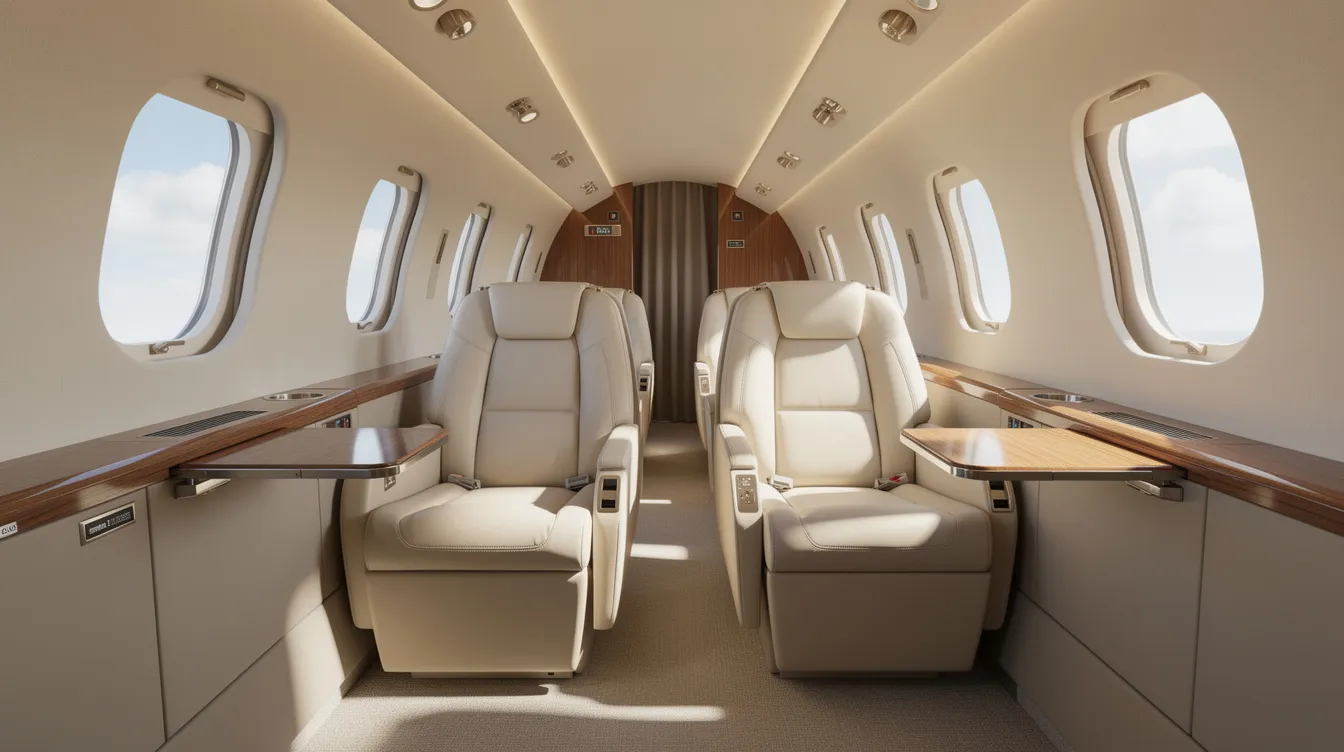
In private or VIP configurations, those numbers shrink dramatically. A BBJ MAX-8 configured for VIP travel might carry 8 to 60 passengers with lie-flat seating and living zones. A Gulfstream G650 in typical configuration seats 10 to 19 passengers across a cabin measuring approximately 6 feet 3 inches in height, 8 feet 6 inches in width, and 47 feet in length. An airliner cabin is taller—roughly 7 feet 3 inches—but that height advantage disappears once you factor in standard airline seating density versus a bespoke private layout.
Passenger comfort is often better in wider cabins of the A320 compared to the 737, a distinction that carries over into VIP conversions. The A320 family uses fly-by-wire technology with a side-stick controller, while the Boeing 737 features a traditional control yoke design—a technical difference that rarely affects passenger experience but is relevant to operators and pilots evaluating fleet standardization.
Baggage capacity also matters more than most buyers expect. The G650 offers approximately 195 cubic feet of baggage space, which is generous for international business travel, ski trips, or golf outings. Airliner cargo holds dwarf that figure but are typically shared with other payload considerations in VIP conversions. For groups of 15 passengers or more, cabin zoning and baggage access become critical differentiators.
Modern variants of both narrowbody and widebody aircraft improve fuel efficiency by 15 to 20 percent over their predecessors, but fuel burn per hour varies enormously across categories. A G650 burns considerably less total fuel per hour than a 737-class aircraft at higher gross weight, but cost efficiency in aviation considers total economics versus simply choosing the largest aircraft.
Operating costs for narrowbody aircraft are generally lower than for widebody aircraft on a per-hour basis. However, when you divide total trip cost by the number of passengers, an airliner carrying 50 to 80 travelers on a corporate incentive trip will beat a business jet on cost per seat every time. Airlines optimize for total economics including passenger demand, route distance, and total operating cost—a principle that private aviation buyers should adopt as well.
Approximate direct operating costs for a G650 land around $4,500 to $5,500 per flight hour. Charter rates for ultra-long-range business jets often range from $8,000 to $15,000 per hour depending on region, operator, and season. A dedicated 737-sized VIP charter can run $8,000 to $12,000 per hour, but it carries far more passengers, fundamentally changing the per-person math. The right comparison depends on your typical group size and route frequency.
One of the strongest arguments for large-cabin business jets over airliner-derived options is airport access. The G650 requires approximately 5,800 feet of runway at maximum takeoff weight, which grants access to hundreds of general aviation and regional airports—including Teterboro (KTEB) near Manhattan, Van Nuys (KVNY) in Los Angeles, and London Farnborough (EGLF). Narrowbody airliners generally need longer runways and are restricted to larger commercial airports.
This difference translates directly into time savings. Departing from Teterboro instead of JFK can save 60 to 90 minutes of ground transportation in each direction. For frequent travelers, that adds up to dozens of hours per year—time that no amount of onboard luxury can replace.
Understanding the concept of mission profile is essential before settling on any aircraft. Narrowbody aircraft are highly efficient for high-frequency short-haul routes—think New York to Boston or Dallas to Houston—but a super-midsize jet like a Challenger or Citation will almost always be more practical for groups under 12 on these shuttle-style legs.
Transcontinental U.S. trips of 2,000 to 3,000 nm (Miami to Seattle, New York to San Francisco) put airliner-derived VIP configurations and large-cabin jets into direct competition. The trade-off centers on passenger count, airport preference, and whether the mission demands a flat-bed cabin or simple club seating.
Long-range international routes exceeding 5,000 nm—Los Angeles to Tokyo, New York to Dubai, London to São Paulo—require ultra-long-range jets like the Global 7500, Gulfstream G700, or Falcon 8X compared to widebody airliners in VIP or first-class configurations. If passenger counts stay below 19, a purpose-built business jet will nearly always be the better fit.
Online comparison platforms can be genuinely useful for initial screening. The best available tool compares over 300 aircraft types side by side, and users can view key specifications of three aircraft simultaneously. The tool includes performance specs and cabin dimensions, making it a practical first step for anyone evaluating different types of jet airplanes. It helps users make informed decisions for private jet charters, and the comparison tool allows printing a printer-friendly version for offline review.
However, raw data only tells part of the story. BlackJet's advisory team functions as a human-powered aircraft comparison tool that layers in real-world pricing, scheduling constraints, tax implications for fractional jet owners, and airport-specific operational information that no online database captures. For CFOs and decision-makers, this means actionable recommendations rather than spreadsheets of specifications.
Aircraft Model | Category | Range (nm) | Passenger Capacity (VIP Config) | Cabin Dimensions (HxW) | Approx. Operating Cost (per hour) | Airport Access (Runway Length) | Typical Mission Profile |
|---|---|---|---|---|---|---|---|
Boeing 737 MAX | Narrowbody Airliner | ~3,100 | 8 - 60 | ~7'3" x 12'6" | $8,000 - $12,000 | ~8,000 ft | Short to medium routes, large groups |
Airbus A321XLR | Narrowbody Airliner | ~4,700 | 8 - 60 | ~7'3" x 11'8" | $7,500 - $11,000 | ~7,500 ft | Medium-haul routes, VIP charter |
Gulfstream G650ER | Large-Cabin Business Jet | ~7,500 | 10 - 19 | 6'3" x 8'6" | $4,500 - $5,500 | ~5,800 ft | Long-range, small groups, premium access |
Bombardier Global 7500 | Ultra-Long-Range Business Jet | ~7,700 | 10 - 19 | 6'2" x 8'2" | $5,000 - $6,000 | ~6,000 ft | Ultra-long-range, international travel |
Airbus A350-1000 | Widebody Airliner | ~9,000 | 8 - 50 (VIP) | ~7'3" x 19'0" | $15,000+ | ~9,000 ft | Long-haul international, large VIP groups |
This table provides a snapshot of key aircraft types, illustrating how range, capacity, cabin size, operating cost, and airport access vary to support different mission profiles.
Choosing between airliner-type aircraft and traditional business jets is only half the equation. The access model—on-demand charter, jet card programs, or fractional jet ownership—often has a greater impact on cost predictability, scheduling flexibility, and long-term value than the aircraft itself.
Chartering a regional airliner such as an Embraer E190, Boeing 737-700 in BBJ configuration, or Airbus A319CJ makes sense for large groups. Corporate roadshows, sports teams, and incentive travel programs involving 30 to 80 passengers between major hubs like New York and Chicago or Los Angeles and Dallas represent the sweet spot for these aircraft.
The trade-offs are significant. Note that minimum costs are higher (because you're chartering an entire airliner regardless of how many seats you fill), access to smaller airports is more limited, and positioning costs—flying the empty aircraft to your departure point—can add thousands to the total bill. For groups under 20, chartering a narrowbody airliner is almost always economically inefficient.
For groups of 10 to 16 passengers, large-cabin business jets like the Gulfstream G550, Bombardier Global 6000, and Dassault Falcon 7X offer a different value proposition. These models deliver better access to secondary airports (White Plains instead of JFK, London Biggin Hill instead of Heathrow) and far more tailored departure schedules. Even legacy platforms like the Learjet played a role in establishing the light jet charter market, though today's missions at this passenger count call for larger airframes.
A charter flight on an ultra-long-range business jet might run $10,000 to $15,000 per hour, while a dedicated 737-class VIP charter could range from $8,000 to $12,000 per hour but carry three to five times the passengers. The right answer depends entirely on how many people are on board and how often the trip repeats.
For travelers flying 50 to 150 hours per year on recurring routes, fractional jet ownership consistently outperforms ad-hoc charter on both cost and convenience. Understanding the full cost structure of fractional jet ownership is essential here. BlackJet Fractional Jet Ownership's Equity Fleet model allows clients to own a share of a specific aircraft type—such as a super-midsize or large-cabin jet—that aligns with their most common missions.
The benefits add up. Guaranteed availability within a set notice period removes the scheduling uncertainty of on-demand charter. Standardized hourly rates make budgeting predictable. And under current U.S. tax law, fractional owners who use their share more than 50 percent for business can take accelerated depreciation and deduct proportional operating expenses, potentially reducing the after-tax cost well below equivalent charter spending, especially when structured with thoughtful fractional jet ownership financing. For a deeper breakdown, see Understanding the Total Cost of Fractional Jet Ownership.
BlackJet's Reserve Fleet offers non-equity, pay-as-you-go hours that complement the Equity Fleet for clients with occasional outlier missions. If a client's core travel involves domestic transcontinental routes on a large-cabin jet, but two or three times a year they need an ultra-long-range aircraft for international trips, the Reserve Fleet fills that gap without requiring a second ownership commitment.
For rare large-group movements—say, flying 50 employees to a company retreat—BlackJet's advisory team can source an appropriate airliner through its network, applying the same compare aircraft logic on the client's behalf, much like evaluating floating fleet options in fractional ownership to match capacity with demand. This hybrid approach means clients never overpay for capacity they rarely need.
For 25 to 150 flight hours per year, fractional jet ownership through the Equity Fleet is typically more efficient than ad-hoc charter or jet cards, especially for executives flying repeated routes like New York to Dallas, Los Angeles to Chicago, or Miami to New York. Evaluating fractional jet ownership as an investment helps clarify how equity appreciation potential, tax benefits, and guaranteed access create a cost structure that improves with each hour flown.
For sporadic flying below 25 hours per year, charter flights or membership-style access through the Reserve Fleet may offer greater flexibility without long-term capital commitment. Comparing the top fractional jet ownership programs to charter and membership options helps clarify where that dividing line sits. The dividing line is consistency: if you can predict your annual hours within a reasonable band, fractional ownership rewards that predictability.
Consider a U.S.-based company with 10 executives who regularly fly from New York to Houston and from New York to San Francisco. Option A is chartering a 737-700 in VIP configuration a few times a year—accommodating all 10 plus support staff in a single aircraft with lower cost per seat but higher total trip cost and limited airport flexibility. Option B is holding a fractional share in a large-cabin jet through BlackJet's Equity Fleet, flying the same routes with 8 to 10 passengers per trip, accessing Teterboro and private FBOs, and using the Reserve Fleet for the occasional international leg.
Option B almost always wins on time efficiency, airport access, scheduling flexibility, and after-tax cost for the company—while Option A may still make sense for a single annual all-hands event where headcount exceeds 30.
BlackJet uses the same analytical principles as an online aircraft comparison tool but layers in expert human guidance, real-world pricing, and scheduling context. For some executives, a 1/8 fractional jet ownership structure will align neatly with 80 to 120 hours of annual flying. To start benchmarking specific aircraft models—say, a Global 6000 versus a G550 versus a Falcon 7X—for your most frequent missions, BlackJet's advisory team can present the analysis in a clear, boardroom-ready format.
Narrowbody aircraft typically have a single aisle and seat 100 to 240 passengers, making them ideal for short-to-medium domestic routes. Widebody aircraft feature two aisles and accommodate 250 to 450+ passengers, designed primarily for long-haul international travel.
Fractional jet ownership offers guaranteed aircraft availability, predictable costs, and tax benefits for frequent flyers (50 to 150 hours per year). Charter flights provide flexibility without long-term commitment but can be less cost-effective and less predictable for regular travel.
Yes. Programs like BlackJet's Reserve Fleet complement fractional ownership by providing pay-as-you-go access for occasional missions outside your core travel needs, such as ultra-long-range or large-group flights.
Key factors include route distance, passenger count, airport access, operating costs, and cabin comfort. Evaluating these against your mission profile ensures you select the right aircraft type for efficiency and convenience.
BlackJet Fractional Jet Ownership offers expert advisory services that analyze your travel patterns, budget, and mission requirements to recommend the best aircraft and access model tailored to your needs.
Jet card programs provide prepaid flight hours with guaranteed availability and simplified access to private jets, ideal for flyers with less frequent travel needs. Fractional ownership offers equity, tax benefits, and greater cost predictability for higher annual flight hours.
Airport access affects total travel time and convenience. Large-cabin business jets access smaller airports closer to final destinations, saving ground transportation time compared to airliner-derived jets restricted to major commercial airports.
Defining your ideal fleet doesn't require aviation engineering expertise. It requires a clear-eyed view of your actual travel patterns and a structured framework for matching aircraft to those patterns. Here's a practical four-step approach:
Step 1: List your top 5 to 10 recurring routes. Include real city pairs (New York to Palm Beach, Los Angeles to Aspen, Chicago to Toronto, London to Geneva) and typical passenger counts per trip. This baseline data eliminates guesswork and reveals which missions repeat often enough to justify ownership versus an occasional charter.
Step 2: Determine range, seasonal performance, and airport constraints. High-altitude airports like Aspen or Telluride require aircraft with strong hot-and-high performance. Noise-sensitive or short-runway airports narrow the field further, and for fractional programs, you should also confirm liability and insurance coverage in fractional ownership for these more challenging operations. Select aircraft that can operate your most demanding route reliably, not just your average one.
Step 3: Narrow to 2 to 3 aircraft categories and specific models. Compare aircraft across super-midsize (Challenger 3500), large-cabin (Gulfstream G500), and ultra-long-range (Falcon 8X, Global 7500) categories. Evaluate each on cabin size, range, runway requirements, and hourly operating cost, and review an aircraft fractional ownership sample contract to understand how these choices translate into co-ownership rights and responsibilities. Add any best private jet options that fit your passenger count and route profile.
Step 4: Decide on the access structure. Based on your projected annual hours and desired cost predictability, choose between a charter flight approach, a jet card program, or fractional jet ownership. As you evaluate options, make sure you understand essential contract terms in fractional jet ownership and how you might eventually sell or transfer a fractional jet share. For 50 to 150 hours per year, fractional ownership through BlackJet's Equity Fleet typically delivers the strongest combination of access, economics, and tax efficiency.
BlackJet advisors can present this entire comparison in a professional, boardroom-ready format—giving CFOs and executives the information they need to make a confident, long-term private aviation decision.
Every effective airliner comparison comes down to the same question: does the aircraft match the mission? Passenger count, route distance, airport access, and the frequency of travel all feed into that answer. A converted 737 makes sense for a 60-person corporate event. A Gulfstream G650 makes sense for a leadership team of 12 flying transcontinental and international routes. And a super-midsize jet may be the most efficient choice for short-haul domestic travel at lower passenger counts.
While public aircraft comparison tools offer a useful starting point for reviewing high-level specifications, real decision-making demands more. Integrating performance data with cost structure, scheduling flexibility, tax considerations, and operational realities is where generalized tools fall short—and where BlackJet Fractional Jet Ownership's advisory team delivers measurable value. Whether you're evaluating your first fractional share or reconsidering an existing fleet strategy, the goal is the same: aligning every flight hour with the right aircraft at the right cost.
Review your last 12 to 24 months of travel. Identify your most common routes, typical passenger counts, and the access model you've been using. Then bring that information to a conversation with BlackJet's team for a tailored aircraft comparison and fractional jet ownership strategy built around your actual flying life.
Ready to explore the smarter way to fly private? Visit FractionalJetOwnership.com to learn how fractional ownership can transform your private aviation travel experience and reduce your private jet cost.
