June 15, 2026
A black private jet is primarily a branding and personal style decision, but it comes with measurable trade-offs in heat absorption, paint weight, and potentially increasing maintenance costs that every buyer should understand.
BlackJet Fractional Jet Ownership offers a smarter way to access black private planes—and other aircraft types—through fractional ownership and membership, without purchasing an entire jet.
Iconic examples like Sean Combs' "Black Excellence" Gulfstream and Prada's matte-black G450 show how color choices reinforce brand identity and cultural presence in the aviation industry.
For most travelers flying 25–150 hours per year, fractional ownership or Reserve Fleet membership delivers better value than whole-aircraft ownership or relying solely on charter flights.
Fractional jet ownership allows shares from 1/16 to 1/2, with owners typically flying between 50 to 400 hours annually. Initial investments range from $500,000 to $1.5 million, and monthly management fees span $8,000 to $25,000.
Jet membership programs offer flexible access to private jets, usually requiring a minimum deposit of $50,000, catering to travelers needing 25–150 flight hours annually with instant pricing and guaranteed availability.
Private jet charters provide flexible scheduling and instant online booking, with access to over 5,000 airports worldwide and one-way charter options that save significant time compared to commercial flights.
The right decision depends on annual flight hours, routes, and strategic goals—not just whether the jet is black or white.
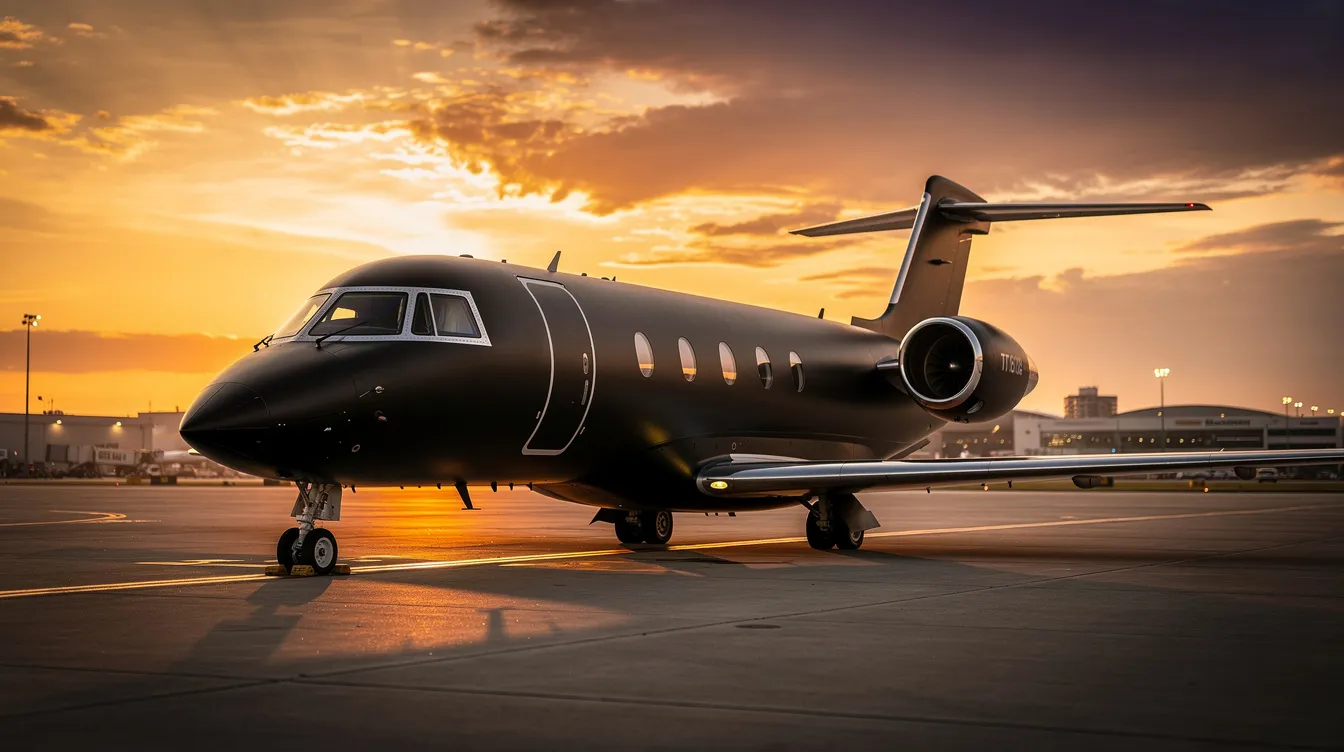
Picture a glossy black Gulfstream rolling onto the ramp at Teterboro or Van Nuys, its dark fuselage cutting a stark contrast against a lineup of standard white jets. Every eye on the tarmac turns. That single moment—equal parts theater and engineering—captures why the black private plane has become one of the most discussed aesthetics in private aviation.
This is a complete guide to black private jets: how they look, how they perform, what they cost, and the smartest ways to access them without full ownership. While the global business aviation fleet remains overwhelmingly white, a small but growing number of owners, luxury brands, and high-net-worth individuals are choosing black liveries to signal identity and stand out.
A black livery refers to the exterior paint scheme of an aircraft finished in black, which is a popular customization choice for large private jets. Dark finishes, such as matte or gloss black, provide a high-prestige look for private jets and are often selected by those seeking to make a bold statement on the ramp.
Whether you are a private jet traveler exploring a Honda Jet aircraft for regional hops or evaluating a large cabin Gulfstream G650ER for ultra-long-range transatlantic travel, the color of the fuselage tells a story before anyone steps aboard.
BlackJet Fractional Jet Ownership specializes in predictable, flexible access to private aircraft—including black liveries where available—through its Reserve Fleet and Equity Fleet programs. These programs cater to high-frequency travelers needing 25–150 flight hours annually, offering priority access, customization options, and potential tax benefits such as bonus depreciation and Section 179 expensing for business-use flight activity. This guide is written for U.S. and global founders, executives, business and leisure travelers, and corporate flight decision-makers who fly private or are considering their first step into private air travel.
A black livery refers to the exterior paint scheme of an aircraft finished in black, which is a popular customization choice for large private jets. Dark finishes, such as matte or gloss black, provide a high-prestige look for private jets and are often chosen to convey exclusivity and sophistication.
The black private jet look evolved from rare one-off liveries in the early 2000s to more frequent appearances on Gulfstreams, Bombardiers, and newer light jets by the mid-2010s. What was once a curiosity became a deliberate design language—one that conveys power, discretion, and modernity at a glance.
Black liveries span matte, satin, and high-gloss finishes, often combined with subtle metallic accents, logos, or striping to reinforce luxury air travel and corporate branding. The psychological impact is immediate. Against the standard Matterhorn White schemes used by most charter operators, a black private jet reads as intentional and confident. It signals that the owner—or the brand behind the aircraft—has made a choice that goes beyond function.
Brand-led black jets illustrate this perfectly. Prada's matte-black Gulfstream G450 turns every arrival into a moving billboard for the fashion house's minimalist aesthetic. Tech founders and entertainment figures use dark liveries to project the same energy on the ramp that they cultivate on social media. For these owners, the choice is less about performance and more about storytelling, status, and aligning the aircraft with a personal or corporate brand. In a world where image travels faster than the jet itself, a black exterior can redefine luxury before the cabin door even opens.
Perhaps the most recognized black private jet in recent memory belonged to Sean "Diddy" Combs. The aircraft was a 2015 Gulfstream G550 (tail number N1969C), finished in matte black and operated under the name "Combs Air." With seating for up to 14 passengers and a luxury beige interior, the all-black Gulfstream became a centerpiece of Combs' public identity and a symbol of black excellence and ownership in an industry where such visibility remains rare.
Combs paired the exterior with an all-Black crew, heightening the jet's cultural messaging. The aircraft was sold in October 2025 and re-registered under T7-OKS on the San Marino registry, following Combs' federal conviction. Similar G550s from that model year are typically valued between $15 million and $30 million, depending on hours and condition. Its loss was more than transactional—it carried symbolic weight.
The Italian fashion house owns a matte-black Gulfstream G450, a deliberate extension of Prada's monochrome, minimalist brand aesthetic. Every detail—from the finish to the cabin design—aligns aircraft type, appearance, and corporate identity. It is frequently cited in luxury aviation journalism as one of the most consistent examples of brand-led livery in the world.
The trend is not just a 2000s curiosity. Recent years have seen darker and more aggressive liveries appearing on newer platforms, including light jets and very light jets with factory dark or accent schemes. While fully documented factory-black Vision Jet G2+ deliveries remain uncommon in public records, renderings and style-forward buyers suggest growing demand. Other bold schemes—orange G550s, red Bombardier Challenger 605s—serve as color counterpoints, but black in particular communicates power, subtlety, and discretion that resonates with the business aviation crowd and aspiring fractional share buyers alike.
Choosing a black finish is not a single decision. It is a spectrum, and each option creates a dramatically different impression on the ramp, in photographs, and across different environments.
Matte black is low-reflection and almost stealth-like, echoing military aircraft while projecting understated authority. It absorbs light rather than reflecting it, giving the fuselage a flat, velvety appearance. The trade-off is practical: every smudge, water spot, and fingerprint shows more readily. Matte finishes require special coatings and careful cleaning to maintain a uniform look—an important consideration for owners who fly frequently between major destinations in varied climates.
Satin black sits as a compromise between matte and gloss. It offers a soft sheen that hides minor imperfections better than matte, while still feeling modern and understated. Under overcast skies or during night departures, satin reads as rich and dimensional without the mirror-like drama of gloss. Cleaning is somewhat easier, though streaks and uneven sheen remain concerns.
High-gloss black is the most dramatic option, producing mirror-like reflections under ramp lighting and bright Caribbean sun alike. On a snowy mountain runway, a gloss-black fuselage can look cinematic. But it demands meticulous polishing to avoid swirl marks and requires more frequent cosmetic attention. For owners who prioritize photography and ramp presence, gloss delivers; for those who prioritize low-maintenance flying, it can become a burden.
Interior design often echoes the exterior. Black leather, carbon fiber accents, or dark veneers create a cohesive cabin experience, but designers balance these with lighter textiles and ambient lighting to keep the space from feeling confined. These additional features inside the cabin complete the overall travel experience.
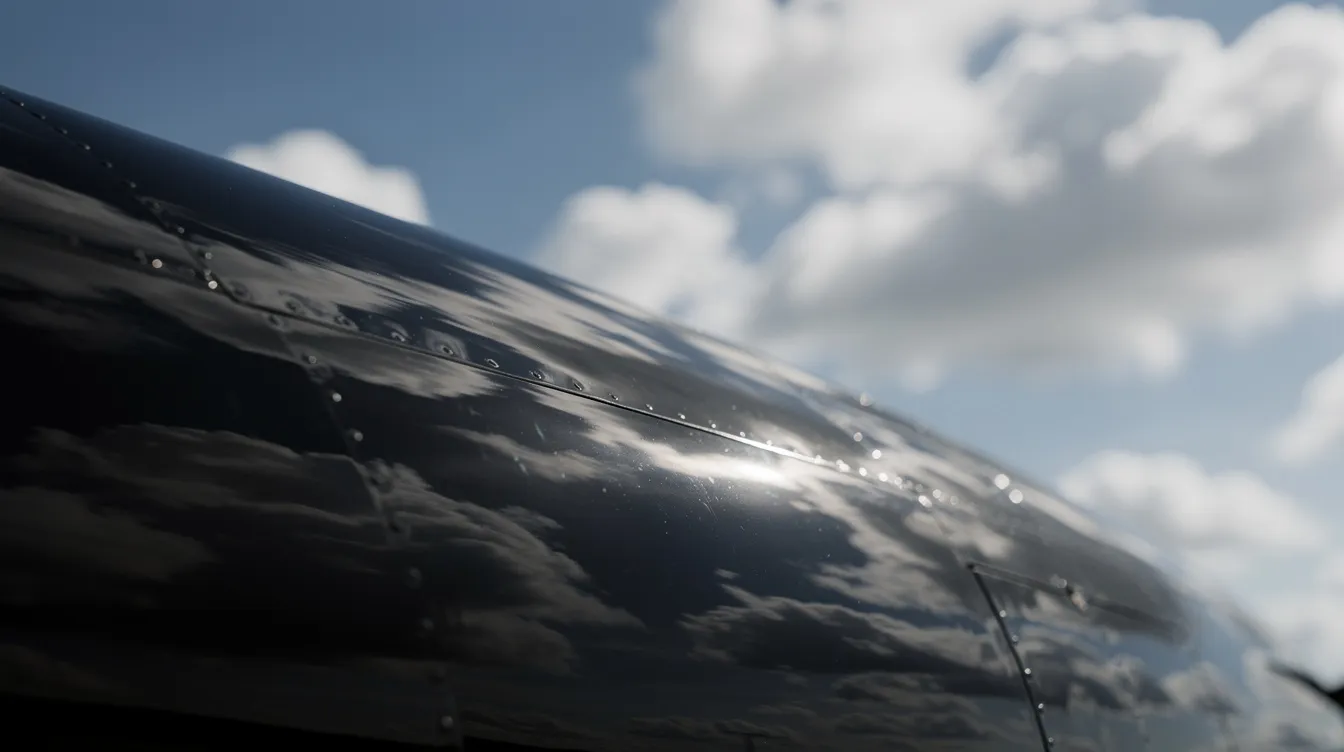
The aesthetic appeal of a black private plane comes with measurable engineering trade-offs that prospective owners and serious charter users should understand.
Black liveries require additional pigment-rich layers, clear coats, and UV-protective finishes. According to JetPro Finish, a full repaint on a large-cabin or ultra-long-range aircraft can run $150,000 to $500,000+, with downtime of three to six weeks. The extra layers add tens of pounds compared with standard white paint, and over thousands of flight hours, that weight delta slightly increases fuel burn and operating costs.
Black paint absorbs significantly more solar radiation than white. On a hot ramp in Phoenix or Dubai, skin temperatures climb higher, requiring more cooling time and energy from the APU or ground air conditioning before boarding. This raises ground-level energy expenses—a factor that matters most for operators flying short hops with frequent ramp exposure.
Visibility of defects is another concern. Leaks, cracks, corrosion, and sealant failures are harder to spot on dark surfaces, potentially complicating walk-around inspections and driving more frequent or more detailed maintenance checks. Black surfaces make visible signs of wear less obvious, meaning maintenance costs can rise over time.
These realities connect directly to total ownership costs. Fractional aircraft ownership or Reserve Fleet access can insulate clients from many of these lifecycle maintenance burdens, spreading them across a managed fleet rather than a single owner's balance sheet; understanding the total cost of fractional jet ownership is key when evaluating these trade-offs.
Paint and livery decisions play out differently across aircraft categories and mission profiles. Understanding where black works best—and where it creates friction—helps buyers make sharper choices.
For light jets and very light jets, including platforms like the Honda Jet aircraft and the Bombardier Learjet 35, black or dark liveries often appear as limited editions or special trims, and buyers benefit from a clear grasp of fractional jet ownership terminology and concepts before committing to any program. These aircraft appeal to owner-pilots who want to stand out at regional airports. The overall cost penalty is lower because surface areas are smaller, but payload margins are tighter, so even modest weight additions from extra paint layers can matter.
In super midsize and large cabin jets—think Challenger 3500, Gulfstream G450, or Gulfstream G650ER—black private jets are more often tied to corporate image, celebrity branding, and long-range business travel. These aircraft can accommodate large groups and offer impressive range for transcontinental or transatlantic private flights. Their larger fuselage surfaces make a black livery more visually commanding.
Heavy jets and ultra-long-range aircraft categories magnify both the visual impact and the trade-offs. More surface area means higher paint costs, greater heat absorption, and increased maintenance complexity. Mission types also matter: short hops between New York and Boston expose the aircraft to more ramp heat cycles than a single long-haul flight to London or Dubai, where the jet spends most of its time at altitude.
Many fractional and membership programs, including BlackJet's Reserve Fleet, source from a wide variety of liveries, and understanding the trade-offs in fractional jet ownership vs membership programs helps clients align aesthetics with access and cost structure. Clients can often request or prioritize darker schemes without owning them outright—an approach that preserves style without absorbing the full fuel efficiency and maintenance penalty.
The visual idea of a black private plane connects to a broader cultural concept: black excellence, ownership, and representation in private aviation. Sean Combs' all-black Gulfstream was more than a transport asset. It expressed cultural pride, economic success, and intentional hiring practices, including an all-Black crew operating in an industry where Black representation remains disproportionately low among pilots and executives.
Collective and fractional ownership models lower the barrier to aircraft ownership benefits, positioning fractional jet ownership as an investment that blends lifestyle, access, and capital efficiency. Through programs like BlackJet's Equity Fleet, successful Black entrepreneurs and professionals can participate in aircraft ownership without the full capital outlay of buying a jet outright. Equity Fleet owners enjoy priority access, customizable aircraft sourcing, and tax benefits, including bonus depreciation and Section 179 expensing. Greater Black participation in aircraft ownership, aviation businesses, and flight departments contributes to local job creation, STEM interest, and long-term wealth-building in underrepresented communities.
Increased visibility of black private jets—whether through celebrity owners, brand campaigns, or social media—symbolically pushes the industry forward. Seeing ownership in action encourages broader inclusion in hiring, leadership, and career aspiration across the aviation industry.
For clients attracted to the black private jet aesthetic, understanding access models is essential. Three primary paths exist, each with distinct economics and trade-offs.
On-demand charter is the most flexible pay-per-trip option for flying private. Variable access to specific liveries means requesting a black private jet may narrow options and increase repositioning fees. Charter works well for leisure travelers and those flying fewer than roughly 75 hours per year who want to skip crowded terminals without long-term commitment. Booking is instant online, with access to over 5,000 airports worldwide and one-way charter options that provide flexible travel solutions. For pricing context, review this guide to private airplane charter prices.
Jet card programs pre-sell blocks of hours—typically 25 or 50—offering guaranteed availability but limited control over aircraft livery or custom branding. Membership programs require a minimum deposit of around $50,000 and cater to travelers needing 25–150 flight hours annually. Jet cards simplify booking with instant pricing options, providing a solid middle ground for travelers who want predictability without equity.
Fractional aircraft ownership, like BlackJet's Equity Fleet, suits clients flying 25–150 hours per year, and prospective buyers should carefully evaluate the cost of fractional jet ownership before deciding on share size or aircraft category. It combines equity, potential tax advantages, predictable scheduling, and more say in aircraft branding and appearance. Fractional shares range from 1/16 to 1/2, with initial investments between $500,000 and $1.5 million, monthly management fees from $8,000 to $25,000, and hourly rates varying by aircraft type. Consider a tech founder flying 80 hours annually between San Francisco, New York, and London: charter costs roughly $480,000–$600,000 annually with inconsistent availability, whereas fractional ownership offers predictable access, tax benefits, and branding influence at a lower capital commitment than full ownership.
BlackJet Fractional Jet Ownership is built around structured, predictable access to private aircraft—black liveries included—through two core programs.
The Reserve Fleet model operates as a pay-as-you-go membership with no full ownership costs. It targets clients who want to fly private with predictable pricing and instant booking capability but do not need equity or branding control. There are no ownership costs to manage, no crew to hire, and no hangar to lease.
The Equity Fleet offering is fractional jet ownership that can be customized around specific aircraft categories—light, super midsize, or heavy jets—and, where viable, specific liveries or black paint schemes, with flexible fractional jet ownership financing options allowing clients to structure their capital outlay strategically. Owners gain potential tax benefits, priority scheduling, and a voice in aircraft selection. To understand how fractional jet ownership works in detail, BlackJet provides tailored consultations.
For high-net-worth individuals and corporate users, key service elements include 24/7 scheduling, guaranteed availability within defined notice windows, and professional aircraft management covering crew, maintenance, and regulatory compliance. BlackJet's model shields clients from the extra complexity and cost of maintaining a black private jet—providing personalized service and flexible access to similar aircraft types through floating fleet options in fractional ownership—while the client focuses on business, not logistics.
This is a smarter way to access private aviation options without bearing full depreciation, paint upkeep, or the operational considerations that come with sole ownership.
Modern digital platforms have transformed how private travel is arranged. Today, it is possible to search, select, and confirm private jet flights—including requests for black private jets—within minutes from a phone or laptop.
The trend toward instant booking in private aviation reflects demand from executives and founders who value time above almost everything else. Serious providers pre-vet aircraft and crews so that speed does not compromise safety or premium service quality. BlackJet's technology platform allows clients to filter by aircraft category, route, timing, and sometimes aesthetic preferences, then receive transparent pricing without back-and-forth negotiations.
The user journey is straightforward: log in, enter route and dates, choose aircraft type, confirm pricing, and complete booking. For executives managing packed schedules, reducing travel management to a few taps—rather than coordinating with brokers, operators, and FBOs—can be just as valuable as the travel experience itself. Direct flights to airports near final destinations, without the friction of commercial flights or crowded terminals, complete the picture.
Understanding when black ownership makes financial sense requires looking beyond the paint job to the full cost structure of private aviation.
Typical hourly operating costs by category:
Aircraft Category | Hourly Rate Range |
|---|---|
Light jets | $2,500–$4,500 |
Super midsize | $4,000–$6,500 |
Heavy jets / Ultra-long-range | $6,000–$10,000+ |
Black liveries add modestly to paint and upkeep costs—not dramatically to hourly fuel burn. The real cost driver is the acquisition, financing, crew salaries, hangar fees, insurance, and ongoing maintenance that come with full private jet ownership. Whole-aircraft ownership typically makes sense only above 200–300+ flight hours per year.
Fractional aircraft ownership delivers many of the same tax benefits as full ownership, and dedicated guidance on tax implications for fractional jet owners can help structure usage and documentation for maximum advantage. Under U.S. IRS rules, when structured correctly through a corporate entity, owners may access depreciation deductions, including bonus depreciation and Section 179 expensing, and the deductibility of operating expenses. However, depreciation recapture may occur upon resale of the jet, making consulting tax professionals essential for ownership tax benefits.
Painting or repainting a jet in black can easily run into six figures and involve weeks of downtime. Many prospective owners prefer to access existing black private jets through fractional fleets or Reserve Fleet membership rather than commissioning a repaint themselves.
The right jet and the right access model depend on annual flight hours, route patterns, and balance-sheet strategy—not just whether the fuselage is black or white.
Private aviation carries a higher per-passenger carbon footprint than commercial flying, regardless of aircraft color. For modern clients, sustainability is increasingly part of the conversation.
Black jets, because of heat absorption, may require more ground cooling energy—but the dominant environmental impact comes from fuel burn in flight, not paint color. The difference between a black and white livery on fuel efficiency is marginal compared with the choice of aircraft type, route optimization, and operational practices.
Common sustainability tools in the industry include sustainable aviation fuel (SAF), carbon offset programs, and newer, fuel-efficient aircraft types that reduce emissions per mile flown. BlackJet and comparable providers can guide clients toward more efficient aircraft categories while still honoring aesthetic preferences. It is entirely possible to pursue the black private jet aesthetic while asking providers hard questions about emissions, offsets, and fleet modernization.
The decision to operate or access a black private plane comes down to a few core factors: visual impact, brand alignment, operational realities, and total cost.
Ideal profiles for black jet enthusiasts include:
High-visibility entrepreneurs and entertainers who treat the aircraft as part of their brand identity
Luxury brands (fashion, tech, hospitality) that want every touchpoint—including air travel—to reflect their aesthetic
Executives and founders who value discretion and modernity over flashy colors
Contrast that with travelers who primarily value efficiency and cost. For them, accessing a variety of well-managed aircraft through fractional ownership or a membership may be preferable to insisting on a specific livery. BlackJet Fractional Jet Ownership allows clients to fly private regularly—on black private jets when available—without taking on the full risk, capital outlay, and complexity of whole-aircraft ownership.
Think in terms of hours flown per year, routes, and strategic goals. A black livery is a powerful statement, but the private aviation experience is defined by safety, reliability, and access long after the paint dries.
If you typically fly 25–150 hours per year, request a tailored comparison of Reserve Fleet vs. Equity Fleet with scenarios showing expected annual costs and benefits. If you are specifically interested in black private jets, ask about current fleet liveries, branding options, and how your aesthetic preferences can be accommodated within a fractional model.
Ready to explore the smarter way to fly private? Visit FractionalJetOwnership.com to schedule a consultation and design a private aviation plan that fits your life, your brand, and your budget.
Fractional jet ownership remains the most strategic balance between freedom, control, and financial discipline in private aviation—whether the jet on the ramp is black, white, or anything in between.
Availability of black private jets is limited compared with the standard white fleet, so requests can often be accommodated on select routes and dates but are not guaranteed on every trip. Clients who care deeply about livery should discuss this upfront with BlackJet, which can indicate how frequently black aircraft appear in their Reserve Fleet or as Equity Fleet acquisition options. For some clients, occasional access to distinctive dark liveries is sufficient, while others may choose an Equity Fleet share in a black-painted aircraft when the economics make sense.
When properly engineered and maintained, black private jets meet the same safety standards as white aircraft. The certified performance and flight envelope remain unchanged. The main effects are secondary: slightly higher skin temperatures on the ground, marginally higher fuel burn from extra paint weight, and more rigorous visual inspection procedures. Reputable operators and fractional programs account for these operational considerations in their maintenance planning, so safety is not compromised.
Exact figures vary by aircraft size and paint shop, and owners must also weigh key fractional ownership contract terms that govern repainting responsibilities, downtime, and cost allocation. A full strip and repaint on a midsize jet typically ranges from $90,000–$180,000, while large-cabin aircraft can run $250,000–$500,000+ for complex black or metallic schemes. Black finishes sit at the higher end due to additional layers, special pigments, and longer labor times. This is one reason many clients prefer to access existing black private jets through fractional ownership or membership rather than commissioning a repaint themselves, especially if they anticipate selling a fractional jet ownership share or transitioning to another access model in the future.
Twenty to thirty hours per year is near the lower boundary where fractional ownership starts to make financial sense; for some travelers, a 1/8th fractional jet ownership structure can bridge the gap between occasional charter and heavier-use equity models. Below that threshold, on-demand charter or Reserve Fleet membership may be more economical. Clients in this range should ask BlackJet for a side-by-side comparison of charter, Reserve Fleet, and a small Equity Fleet share based on their actual routes and preferred aircraft type, similar to how investors compare the best fractional jet ownership programs across providers. Corporate tax planning, need for guaranteed access, and branding goals—including preferences for black liveries—can all tilt the decision toward or away from fractional ownership.
Black private jets tend to be more visible in high-profile markets like the United States, Western Europe, and the Middle East, where celebrity, fashion, and luxury branding are concentrated. In hot, high-sun environments such as Dubai, Miami, and Los Angeles, operators weigh the thermal penalties more carefully, even when clients favor darker aesthetics. Asking your provider where black private jets are most frequently based can affect repositioning costs and availability for your typical routes between major destinations.
Choosing a black private plane is more than an aesthetic decision—it is a strategic statement that blends personal or corporate branding with the realities of private aviation. While black liveries offer unmatched visual impact and cultural significance, they come with operational considerations such as increased paint costs, heat absorption, and maintenance challenges. For discerning travelers and executives, fractional jet ownership through programs like BlackJet’s Equity Fleet provides an optimal solution, balancing style, access, and financial prudence.
By leveraging fractional ownership or Reserve Fleet memberships, clients gain predictable availability, potential tax benefits, and the flexibility to enjoy black private jets without the full burden of sole ownership. Whether you are a high-profile entrepreneur, a luxury brand, or a frequent flyer seeking efficiency and distinction, understanding the trade-offs and benefits of black private planes empowers smarter decisions in private aviation.
Ready to elevate your travel experience with the sophistication and strategy of black private jets? Visit FractionalJetOwnership.com to explore tailored options and start your journey toward smarter, stylish private flying.
