
May 18, 2026
Business jets are no longer reserved only for heads of state or Fortune 100 flight departments. For business travelers, founders, family offices, and corporate teams, the real value is time: direct routing, private terminals, secure cabins, and aircraft access matched to actual travel needs.
Business jets range from efficient twin turboprops and light jets to large business jets, ultra-long range aircraft, and vip airliners such as Boeing business jets and Airbus corporate jets.
Business jets are categorized by weight, range, and cabin size, including very light jets, light jets, midsize jets, super midsize jets, and heavy jets.
Fractional jet ownership and membership programs can provide access to private aviation with less complexity than full private jet ownership.
Prominent manufacturers in the business jet sector include Airbus Corporate Jets, Boeing Business Jets, Bombardier, Dassault, Embraer Executive Jets, Gulfstream, HondaJet, and Textron.
BlackJet Fractional Jet Ownership helps clients compare charter, jet card programs, Reserve Fleet access, and Equity Fleet fractional ownership.
A business jet is a turbine-powered aircraft configured for private or corporate travel rather than scheduled airline service. The category stretches from King Air turboprops to Boeing business jets, with each aircraft designed around flexible flight schedules, privacy, and productivity.
Business jets can access over 5,000 airports in the U.S., compared to around 500 for commercial airlines. That difference matters when a team needs to fly from New York to a secondary Midwest airport, continue to Dallas, and return home without losing a day to connections.
Typical missions include New York–Los Angeles, London–Dubai, and shorter intracontinental hops between secondary airports. Business aviation can save travelers an average of two hours per flight by skipping security lines and avoiding layovers, and passengers often arrive at private terminals only 15 minutes prior to departure.
Cabins of business jets serve as secure environments for holding confidential meetings and working. Security screenings for business jets are expedited, and comprehensive background checks ensure a vetted environment, while limited passenger counts lower germ exposure compared with crowded terminals and airline cabins.
BlackJet Fractional Jet Ownership specializes in giving individuals and companies predictable access to private aircraft through Reserve Fleet membership and Equity Fleet fractional jet ownership.
Aircraft size, range, speed, and private jet cost scale from turboprops to ultra-long-range large jets and airliner-based business aircraft. The right choice depends on passengers, route length, runway access, cabin needs, and annual flight time.
Category | Typical passengers | Typical range | Best use |
|---|---|---|---|
Turboprops | 4–9 | 1,500–1,800 nautical miles | Regional corporate travel |
Very light jets | 6–7 | 1,174 nautical miles average | Short trips, small teams |
Light jets | 6–8 | 1,953 nautical miles average | Regional travel and shorter flights |
Midsize jets | 8–9 | About 2,500 nautical miles | Transcontinental flights |
Super midsize jets | 10–14 | 3,420–4,000 nautical miles | Coast-to-coast and selected international |
Large business jets | 12–19 | 6,000–8,000 nautical miles | Long-distance journeys and intercontinental range |
Turboprops such as the Beechcraft King Air 260 and 360 remain practical for short regional corporate travel. These twin turboprops are efficient, comfortable, and able to serve smaller airports where runway length or operating cost makes jets less attractive
Very light jets, or VLJs, typically have a maximum takeoff weight limit of 10,010 lb (4,540 kg). They are designed for single-pilot operation, accommodate 6-7 passengers, and average about 1,174 nautical miles of range; examples include the HondaJet Elite S and Phenom 100-class aircraft. The HondaJet Elite S incorporates new avionics features that reduce pilot workload, including FAA data comm and aircraft communications addressing and reporting system (ACARS) capabilities, enhancing safety and operational efficiency.
Light jets generally accommodate 6-8 passengers and have an average range of 1,953 nautical miles, making them suitable for regional travel and shorter flights such as Dallas–Chicago. Popular models include the Embraer Phenom 300E and Cessna Citation CJ4 Gen2, a popular private jet class for executives who value speed without excess cabin cost.
Midsize jets typically accommodate 8-9 passengers and have a range of approximately 2,500 nautical miles, making them ideal for transcontinental flights. Super midsize jets combine the capabilities of larger jets with the speed and comfort of smaller jets, accommodating 10-14 passengers over ranges of 3,420 to 4,000 nautical miles.
Large business jets and ultra-long range heavy jets, including the Bombardier Global family, Gulfstream G700/G800, and Dassault Falcon 8X, support non-stop flights of 6,000–8,000 nautical miles. These aircraft are often chosen for their impressive top speed and long-range performance, allowing for faster intercontinental travel compared to smaller categories. BlackJet usually matches clients to midsize, super midsize, or large cabin aircraft based on mission profile rather than aircraft prestige.
At the top end of the global private jet market, flagship aircraft are measured by maximum range, top speed, cabin comfort, and dispatch capability. These aircraft types are designed for long flights across continents with fewer compromises.
The Bombardier Global 7500 offers a range of 7,700 nautical miles and reaches a top speed of Mach 0.925, ranking it among the leading aircraft in the ultra-long-range jet segment. It incorporates advanced wing technology designed to actively minimize turbulence, ensuring a smoother flight experience. Its 2019 record-setting nonstop flight from New York to Hong Kong showcased its exceptional long-range capabilities.
The Bombardier Global 8000 holds the distinction of being the world’s longest-range private jet, with an 8,000 nautical mile range and a maximum speed of Mach 0.94, making it the fastest business jet currently in service. Its top speed surpasses most other business jets, setting a new benchmark for performance in the category. It is expected to enter service in the mid-2020s and represents the next generation of ultra-long-range aircraft.
Gulfstream flagships also define the category. The Gulfstream G700 features a range of 7,500 nautical miles and a top speed of Mach 0.935, positioning it among the fastest private jets available; the G800 extends that mission profile toward roughly 8,000 nautical miles with high-speed cruise and up to five living zones.
Dassault Aviation offers the Falcon 8X and Falcon 10X for discerning travelers who value runway flexibility and advanced avionics. The Falcon 8X provides about 6,450 nautical miles of range, while the Falcon 10X targets roughly 7,500 nautical miles, the widest cabin in its class, fly-by-wire controls, and steep approaches into airports such as London City.
VIP airliners sit above even large business jets. Boeing Business Jets, including BBJ 737 MAX variants and BBJ 787 Dreamliner configurations, can offer multi-room cabins and range up to roughly 9,945 nautical miles; they are often flying for the headquarters of governments, corporations, and heads of state. Airbus Corporate Jets, including ACJ319neo and ACJ TwoTwenty, offer more space, often two to three times the cabin area of traditional large jets, with intercontinental range around 5,600–6,700 nautical miles.
While BlackJet clients may occasionally charter vip airliners for special events, most fractional owners find large-cabin business jets more efficient for 25–150 hours per year.

A relatively small group of manufacturers shapes the global fleet, each with strengths in range, cabin design, runway performance, and support. Industry data from the General Aviation Manufacturers Association helps track deliveries and market activity across these aircraft categories.
Bombardier is recognized as the world’s third-largest aircraft manufacturer, having expanded its business through acquisitions such as Canadair and Learjet. Its Challenger and Global series make Bombardier a leader in super midsize and ultra-long-range business aircraft.
Gulfstream Aerospace has built its reputation primarily on long-range, large-cabin business jets, starting with the Gulfstream I in the late 1950s. Today, aircraft such as the G500, G600, G700, and G800 are benchmarks for high speed, quiet cabin design, natural light, and long-range international travel.
Dassault Aviation brings its fighter jet heritage into its Falcon family, including the Falcon 2000LXS, 6X, 7X, 8X, and 10X. That background shows in advanced avionics, efficient aerodynamics, steep approach capability, and systems designed to reduce pilot workload.
Embraer Executive Jets focuses on efficient light to super midsize aircraft, including the Phenom 100EX, Phenom 300E, Praetor 500, and Praetor 600. HondaJet has also influenced the very light jets market; the HondaJet Elite S incorporates new avionics features that reduce pilot workload, including FAA data comm and aircraft communications addressing and reporting system capabilities.
Textron Aviation includes the Cessna Citation line and the Beechcraft King Air family. The Cessna Citation Longitude is equipped with the Garmin G5000 flat-panel touchscreen-controller avionics system, which includes a wireless cabin-management system for controlling lighting and entertainment; newer safety features also include Garmin Autoland technology on selected general aviation platforms.
Airbus Corporate Jets and Boeing Business Jets serve the airliner-based market. The Boeing Company also promotes BBJ Select, a curated interior concept that simplifies Boeing business completions compared with fully bespoke cabin projects.
BlackJet Fractional Jet Ownership evaluates these platforms for its Equity Fleet with a focus on reliability, support, cabin standards, and mission fit across the United States, South America, the Middle East, and the wider world.
Business jets are tools for time-sensitive travel, not simply luxury assets. Their value is clearest when a flight schedule must serve business meetings, family needs, or government missions that airlines cannot support efficiently.
Corporate travel use cases include executive roadshows, multi-city site visits, board meetings across the United States in one day, and just-in-time trips to secondary cities. A team can fly New York–Chicago–Dallas–San Francisco on a schedule built around meetings rather than airline timetables.
Private and family missions include vacation travel to remote resorts, quick weekend getaways, medical-related travel, and schedules that allow principals to return home the same night. Limited passengers also create a more controlled environment for families and executives.
Governments and heads of state use Boeing business jets and Airbus corporate jets for secure communications, diplomatic travel, and long-distance missions. Special missions also include sports team travel, touring artists, NGO operations, and aircraft configured for equipment, staff, and extended range.
These use cases align with BlackJet’s typical members: executives, founders, family offices, and corporate teams that need predictable access without managing crew, maintenance, and aircraft logistics directly.
Modern business jets are designed around productivity, rest, privacy, and health. The best cabin is not just attractive; it supports work, sleep, communication, and arrival readiness.
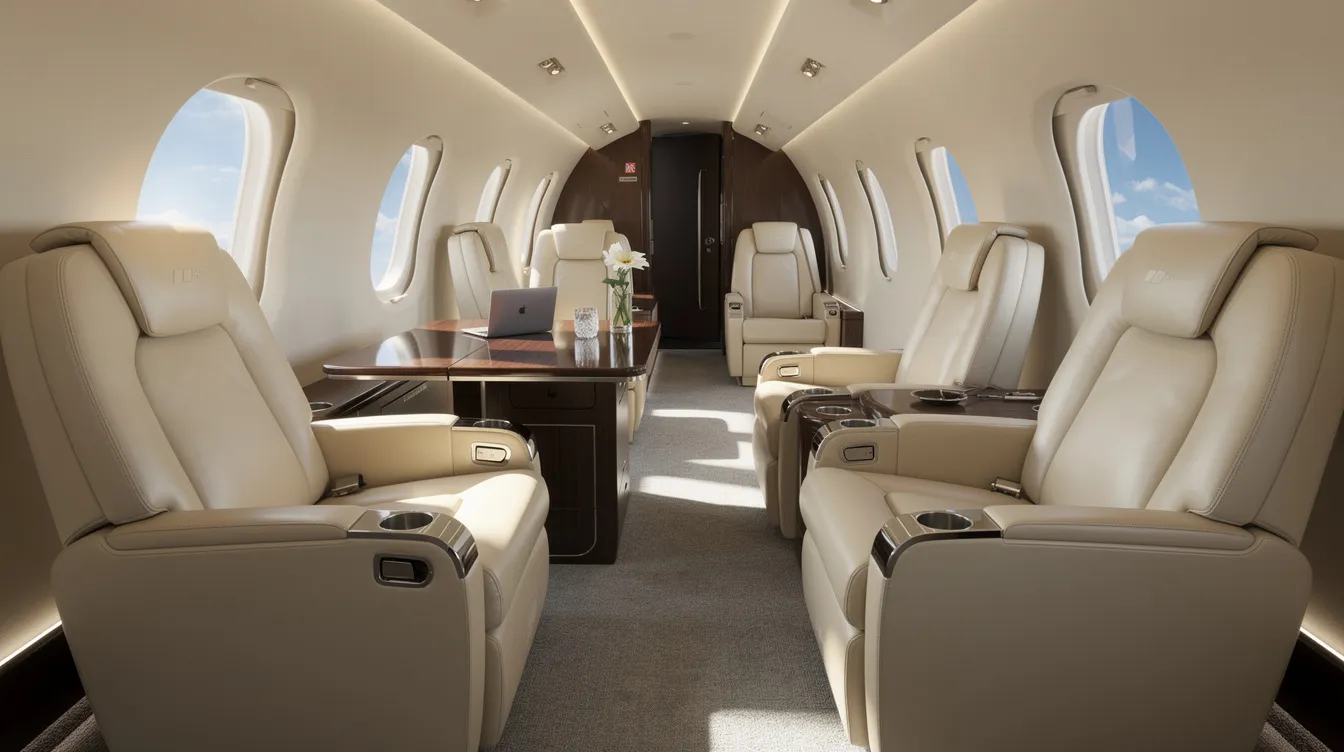
Midsize jets often feature club seating, work tables, and refreshment centers. Large business jets may include a spacious cabin with multiple zones, conference areas, lie-flat seating, private suites, and natural light from larger windows.
Comfort technology now matters as much as décor. Many new aircraft provide lower cabin altitude around 4,000–4,850 feet at cruise, advanced air filtration, active noise reduction, smoother wings, and a quiet cabin for calls or rest.
Connectivity is central to business aviation. High-speed Ka-band Wi-Fi, secure VPN compatibility, smartphone cabin controls, and integrated cabin management systems allow business travelers to hold secure calls, review documents, and continue business meetings in flight.
Real-world examples include Bombardier’s Nuage seating, Gulfstream’s Symmetry Flight Deck, and Dassault’s FalconEye. These systems improve passenger experience, cockpit awareness, and operational confidence without turning the flight into a technical exercise for the client.
How a client accesses a business jet often matters as much as which aircraft they fly. Choosing between fractional ownership and membership programs can significantly influence unused hours, availability, and fixed costs.
On-demand charter is an ad-hoc booking per trip. It offers broad aircraft choice and low fixed commitment, but the pay-as-you-fly model resembles commercial airline practices, where clients only pay for the flights they actually use, although it can lead to challenges in securing flights due to high demand compared with floating fleet access models.
Jet card programs and time-sharing options for business jets allow clients to purchase blocks of flight hours in predetermined increments, providing flexibility based on their travel needs. These programs often include guaranteed availability, fixed hourly rates, and 12–24 month terms.
Full private jet ownership offers maximum control but requires major capital, crew salaries, hangar fees, insurance, maintenance reserves, management, and depreciation planning. Evaluating fractional jet ownership as an investment alongside full ownership is usually most logical when annual utilization is high and mission patterns are consistent.
Fractional ownership of business jets allows individuals or corporations to purchase an equity share in an aircraft, sharing costs such as maintenance and crew among multiple owners while opening the door to fractional jet ownership financing, costs, and benefits. In fractional ownership, if four parties are involved, each partner typically pays one-fourth of the aircraft price, gaining access to a certain number of flight hours on that aircraft or others in the fleet.
BlackJet’s Reserve Fleet provides flexible access without owning an asset. Its Equity Fleet supports fractional aircraft ownership with priority access, custom aircraft sourcing, professional management, and possible U.S. tax benefits when properly structured with qualified advisors.
Understanding total cost means looking beyond the hourly rate. Acquisition price, share buy-in, occupied hourly cost, fuel, maintenance, crew, insurance, management fees, repositioning, and opportunity cost all matter.
Indicative hourly figures vary widely. Light jets may charter around $2,500–$4,000 per hour in many markets, while super midsize aircraft can run meaningfully higher, and large jets or ultra-long-range aircraft can exceed $10,000 per hour, depending on aircraft age, routing, and demand, which shapes the overall cost of fractional jet ownership relative to charter.
Fractional shares often begin around 1/16th of an aircraft. Industry examples place light-jet shares near $500,000–$850,000, midsize shares around $800,000–$1.2 million, super midsize shares around $900,000–$1.5 million, and large-cabin shares above $3 million.
U.S. tax benefits may apply when aircraft use is primarily business-related. Fractional shares can potentially qualify for depreciation treatment, including accelerated or bonus depreciation where applicable, but every client should consult a qualified tax advisor before relying on any tax outcome.
The efficiency case can be stronger than the cost case alone. Instead of four executives losing a full week to commercial connections, hotel nights, and layovers, a well-planned three-day business jet itinerary can recover working hours, reduce overnight stays, and improve meeting density.
BlackJet works with clients to align aircraft category and ownership model to annual flying, often 25–150 hours per year, so clients do not overbuy capacity or pay for unused hours, and to ensure essential liability coverage in fractional ownership is appropriate for their risk profile, while reviewing essential contract terms in fractional jet ownership so there are no surprises over the life of the investment.
Business jets have higher emissions per passenger than commercial flights and are under increasing scrutiny. Traveling in private jets results in a disproportionately high carbon footprint compared to commercial jetliners, with some individuals generating thousands of tons of CO2 emissions annually by flying over 350,000 km (220,000 mi).
Projects tracking the movements of private jets owned by celebrities and elites have gained attention due to the significant greenhouse gas emissions associated with these flights. The concerns include CO2 emissions, local noise, and frequent flights by a small number of ultra-frequent users.
The industry is responding through sustainable aviation fuel, more efficient engines, lighter materials, and operational planning. Sustainability efforts in the private aviation industry include carbon-neutral delivery programs and the use of more efficient engines to reduce overall emissions, including platforms using GE Passport, Rolls-Royce Pearl, and LEAP-1A engine power.
Clients can also reduce per-trip impact by selecting the right aircraft size, improving load factor, grouping meetings into fewer trips, and using offset programs or SAF where available. BlackJet evaluates operators and aircraft with efficiency in mind and can help clients incorporate carbon-conscious choices into private aviation plans.
Choosing correctly starts with the mission, not the aircraft brochure. Define annual flight hours, typical passenger count, longest nonstop route, luggage needs, preferred departure airports, and budget tolerance.
Use a simple framework:
For short regional hops with four passengers, consider a King Air or light jet.
For frequent U.S. coast-to-coast trips, consider midsize or super midsize jets.
For regular international or long-distance journeys, consider large cabin or ultra-long-range aircraft.
For occasional use under roughly 25 hours per year, a charter may be enough.
For 25–150 hours per year with guaranteed availability needs, Reserve Fleet or fractional jet ownership may be more efficient.
For very high, consistent usage, full ownership may be worth evaluating.
Many BlackJet clients begin with Reserve Fleet access to understand their real flying pattern. Once usage stabilizes, they may transition to an Equity Fleet fractional share for stronger access, potential ownership benefits, and more predictable planning.
For a tailored comparison, visit FractionalJetOwnership.com and request a consultation.
Ranges vary widely. Light jets often cover 1,200–2,000 nautical miles, super midsize jets roughly 3,000–3,500 nautical miles, and ultra-long-range large business jets up to about 7,500–8,000 nautical miles.
The Bombardier Global 7500 reaches 7,700 nautical miles, the Gulfstream G800 is around 8,000 nautical miles, and a Boeing Business Jet 787 can reach roughly 9,945 nautical miles in VIP configuration. Actual range depends on passenger load, weather, routing, reserves, and payload versus fuel trade-offs.
The original Bombardier Global Express made its first flight in October 1996, while the Gulfstream GV first flew in November 1995. Those programs helped define the modern ultra-long-range era.
These milestones followed earlier business aircraft history, including debates around the first business jet and early purpose-built corporate aircraft. Today’s Global 7500, Global 8000, G700, and G800 build on those test programs with more range, speed, cabin technology, and fuel efficiency.
No. Full ownership of Boeing Business Jets or Airbus Corporate Jets is usually limited to governments, very large corporations, and ultra-high-net-worth individuals, but shared access models have changed the market.
Fractional aircraft ownership, jet card programs, and membership programs lower the capital barrier while still offering consistent access, and some owners eventually evaluate how to sell a fractional jet ownership share when their flying needs change. BlackJet clients often include entrepreneurs, mid-market company owners, and corporate teams flying 25–150 hours per year.
BBJ Select is a curated interior options program for certain Boeing Business Jets. It bundles popular layouts and design choices to reduce completion time and cost compared with fully bespoke interiors.
The concept matters because it shows where the market is going: cabins optimized for productivity, rest, secure work, and comfort rather than customization for its own sake.
Start with realistic annual flight hours, passenger loads, common routes, and whether most travel is domestic U.S. or international. Then compare charter, jet cards, Reserve Fleet access, Equity Fleet fractional ownership, and full ownership side by side.
Fractional jet ownership often makes sense for clients who want guaranteed availability, predictable pricing, ownership structure, and professional management without operating an entire aircraft, but it is critical to understand the aircraft fractional ownership sample contract and how it allocates rights, responsibilities, and costs. Reviewing the best fractional jet ownership programs for smart investors can help frame options before you engage a provider. Ready to explore the smarter way to fly private? Visit FractionalJetOwnership.com for a personalized assessment.
Business jets remain essential tools for executives, entrepreneurs, and organizations seeking efficiency, privacy, and flexibility in travel. As technology advances with innovations like new wing designs and higher top speeds, the private aviation landscape is poised to evolve significantly over the next decade. Fractional jet ownership and membership programs offer a compelling alternative to full ownership, balancing cost, convenience, and access to a diverse fleet of aircraft tailored to mission needs.
Choosing the right aircraft and access model depends on individual travel patterns, priorities, and budget. Whether opting for a midsize jet for regional trips or a large, ultra-long-range jet for intercontinental travel, the goal is to optimize time and productivity while minimizing complexity and overhead.
For those ready to explore the smarter way to fly private, BlackJet Fractional Jet Ownership provides expert guidance, flexible options, and personalized service to match clients with the ideal aircraft and ownership solution. Visit FractionalJetOwnership.com to learn more about fractional ownership, Reserve Fleet memberships, and how these models can transform your private aviation experience.
Unlock the benefits of private jet travel with confidence, efficiency, and sustainability—partner with BlackJet to elevate your journey today.
