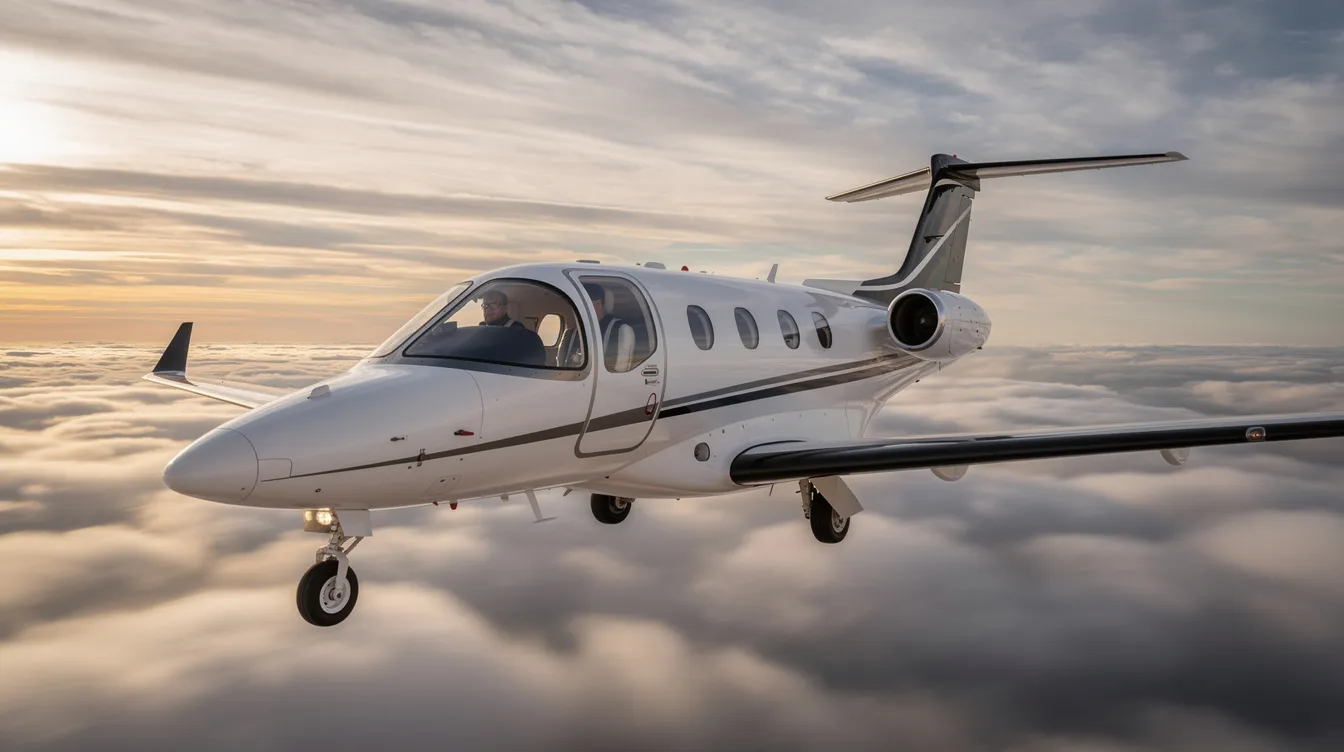
August 8, 2026
The Cirrus Vision Jet changed what personal aviation looks like. As the world's first single-engine personal jet to reach production, it occupies a unique position between high-performance piston aircraft and traditional twin-engine business jets. For travelers weighing the costs and logistics of private aviation, the Vision Jet raises a practical question: does a single-engine jet with advanced safety features and lower operating costs make more sense than the alternatives?
This guide breaks down every dimension of the Vision Jet that matters to prospective buyers, owner-pilots, and fractional members - from real-world performance numbers to cabin comfort, safety technology, and ownership economics.
The Cirrus Vision Jet (SF50) is the world's first certified single-engine personal jet, bridging the gap between high-performance pistons and traditional light jets with a maximum cruise speed of approximately 300 knots, a maximum range of 1,275 nautical miles, and seating for up to seven occupants.
Headline safety technology includes the Cirrus Airframe Parachute System (CAPS), Garmin Safe Return Autoland, synthetic vision, auto radar, and envelope protection - making it one of the most safety-forward aircraft in its class.
The Vision Jet is optimized for regional travel between approximately 200 and 1,000 nautical miles, offering direct access to smaller airports that larger jets cannot reach efficiently.
Operating costs are approximately $676 per hour, and a new aircraft carries a list price of $1.96 million, making it significantly lower in both acquisition and hourly cost compared to twin-engine light jets.
The Vision Jet has a maximum takeoff weight of approximately 5,500 pounds, which supports its compact size and performance characteristics.
BlackJet Fractional Jet Ownership provides access to Vision Jet–class aircraft through fractional ownership and membership programs, removing the complexity of full ownership while delivering predictable scheduling, professional crews, and transparent pricing.
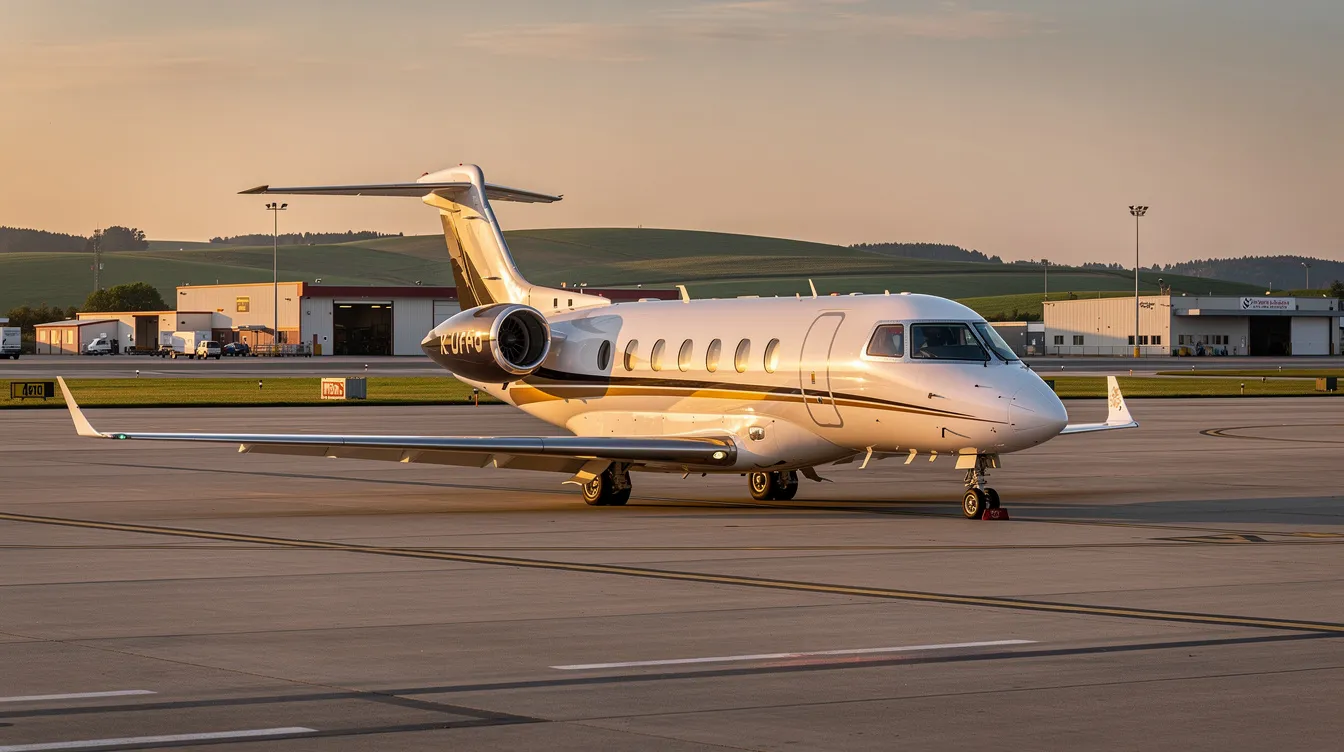
The Cirrus Vision Jet sits in a category that barely existed a decade ago. It is a very light jet designed not for airlines or large charter fleets, but for owner-pilots and small groups who want jet convenience without the overhead of a twin-engine platform. Built by Cirrus Aircraft - the same company behind the SR22, one of the most popular piston aircraft in the world - the SF50 Vision Jet was certified in 2016 as the first production single-engine personal jet.
The aircraft is powered by a single Williams International FJ33-5A turbofan engine and classified in the very light jet category. Its compact size and maximum takeoff weight allow it to operate from smaller airports that larger jets simply cannot use, opening up hundreds of additional departure and arrival points across the United States. The Vision Jet is designed specifically for owner-pilots stepping up from piston or turboprop platforms, as well as small executive teams and families who need efficient regional personal transportation.
For high-net-worth individuals and business owners flying 25 to 150 flight hours per year, the Vision Jet's lower acquisition and operating costs compared to other light jets make it an appealing option. BlackJet Fractional Jet Ownership positions Vision Jet–class aircraft inside both its Reserve Fleet and Equity Fleet models, giving travelers direct access to this aircraft without the burden of sole ownership, scheduling headaches, or aircraft management.
The Cirrus Vision Jet's journey from concept to production spanned a ten-year development process shaped by engineering ambition, economic headwinds, and relentless iteration.
The Vision Jet completed its first flight on July 3, 2008, in Duluth, Minnesota, followed by a public debut at EAA AirVenture Oshkosh that same year. The 2008–2009 recession forced slowdowns, requiring Cirrus to navigate financing challenges and refine the design through extended flight testing. The SF50 earned its FAA type certificate on October 28, 2016, and the first customer delivery occurred on December 19, 2016. Cirrus received the Collier Trophy in 2018 for the Vision Jet, recognizing its contribution to personal aviation and safety innovation.
The aircraft has evolved through several generations, each targeting better efficiency, comfort, and capability:
Original Vision Jet (G1): Baseline performance with CAPS integrated into a composite airframe, establishing the platform's foundation.
G2 Vision Jet (2019): Higher ceiling reaching 31,000 feet, improved speed and range, upgraded cabin, and advanced avionics including the Garmin Perspective Touch+ flight deck.
G2+ Vision Jet (2021): Approximately 20% improved hot-and-high takeoff performance, added connectivity options, and incremental avionics refinements.
G3 Vision Jet (entering service around 2025–2026): A redesigned cabin accommodating six adults plus one child, Cirrus Spectra wingtips for improved aerodynamics, and updated avionics including ATC datalink and automatic database updates.
Each generation has kept the aircraft accessible to owner-pilots while making it increasingly viable for fractional programs that demand reliability, comfort, and dispatch consistency.
The Vision Jet is immediately recognizable. Its V-tail, top-mounted engine on the rear fuselage, and low wing design give it a profile unlike any other light jet in production. The aircraft is made entirely of composite material- carbon-fiber-reinforced polymer - delivering benefits in weight reduction, structural strength, and corrosion resistance that aluminum airframes cannot match.
The composite construction also enables a wider cabin cross-section relative to the aircraft's external dimensions, with large window cutouts that contribute to the spacious cabin feel. The fuselage's smooth composite skin reduces drag, supporting both fuel efficiency and a quieter ride.
The single Williams International FJ33-5A turbofan, producing approximately 1,846 pounds of thrust, is mounted atop the rear fuselage rather than on wing pylons. This placement serves multiple purposes:
Reduced cabin noise compared to wing-mounted twins, since the engine sits far from the passenger compartment floor.
Protection from foreign object damage (FOD) during operations on shorter or unimproved runways.
Centralized mass near the fuselage center, improving handling characteristics across different loading conditions.
The latest G3 Vision Jet introduces Spectra winglets and over 30 aerodynamic and design refinements. These translate to meaningful gains in range, fuel flow efficiency, and handling - practical improvements that matter for both owner-pilots and fractional fleet operators managing dispatch reliability across varied airports.
Consider a routine business trip: Dallas to Santa Fe, roughly 500 nautical miles. In a Vision Jet, that flight takes about 90 minutes at altitude - no connections, no security lines, no two-hour buffer. A New York to Miami route at approximately 1,090 nautical miles pushes closer to the aircraft's limits but remains feasible with favorable winds and lighter loads.
Here are the headline performance numbers for the G2 and newer variants:
Specification | Value |
|---|---|
Max cruise speed | ~300–317 KTAS (~345–365 mph) |
Maximum operating altitude | ~31,000 feet (FL310) |
Maximum range (NBAA IFR range) | ~1,275 nautical miles |
Takeoff distance | 2,036 feet |
Landing distance | 1,628 feet |
Fuel consumption at FL280 | ~60 US gallons per hour |
Stall speed (flaps down) | ~67 knots |
The takeoff performance—requiring only 2,036 feet—and approach speeds compatible with shorter runways give fractional and membership users access to secondary and municipal airports closer to final destinations. The aircraft can operate at a maximum altitude of 31,000 feet, clearing most weather and turbulence.
For fractional jet members, the practical sweet spot falls between 300 and 800 nautical miles—the range that covers the majority of US business travel demand and enables same-day, out-and-back trips without overnight stays.
Step inside the Vision Jet and the first impression comes from light. The aircraft features large panoramic windows that flood the cabin with natural light and provide excellent visibility for every seat. High shoulder room and a club-style seating arrangement create a spacious cabin feel that belies the aircraft's smaller exterior dimensions.
The cabin can seat up to seven occupants depending on configuration. On G2 and G2+ models, typical layouts accommodate five adults and up to two children. The G3 expands this with seating for six adults plus one child, using premium materials and a redesigned cabin that improves both aesthetics and functionality. Quick-release seating modules allow operators to convert between business, family, and cargo-focused layouts—a practical feature for fractional programs serving diverse client needs.
Core cabin dimensions include a height of 4.1 feet, a width of approximately 5.1 feet, and a usable length of about 11 feet. While standing height is limited, seated comfort for two to four passengers on regional flights is comparable to or better than many other very light jets.
Standard amenities include:
Pressurized, climate-controlled environment with cabin altitude around 8,000 feet at cruise.
USB ports and 110V outlets for devices and laptops.
Rear climate controls and optional in-flight Wi-Fi on G2+ and G3 models.
Storage for carry-on luggage, golf bags, mountain bikes (with reconfiguration), and business equipment.
The cabin does not include a fully enclosed lavatory, which is realistic for the short- to mid-range missions of one to three hours where this aircraft excels. For fractional and corporate users, the quiet environment supports laptop work, confidential calls, and small team discussions—delivering genuine jet comfort during regional flights.
The Vision Jet's flight deck is built around the Cirrus Perspective Touch+ system by Garmin, a suite designed to make jet operations more intuitive for both owner-pilots and professional crews. Large touchscreen primary flight displays and multi-function displays present navigation, engine instrumentation, and flight management in a clean, integrated layout. A Garmin touch controller provides direct interaction with avionics functions.
Situational awareness tools include:
Synthetic vision rendering 3D terrain on the primary flight display for excellent visibility of terrain features even in instrument conditions.
Weather radar and auto radar capability (such as the Garmin GX8000 on recent G2+ aircraft), along with NEXRAD weather overlays.
Traffic awareness and terrain/obstacle alerting critical for operations in dense airspace along the East Coast and near mountainous terrain.
Stall warnings through stick shaker, stick pusher, and angle-of-attack indications.
Connectivity and automation features on newer G2+/G3 aircraft include ATC datalink for text-based clearances and reroutes from air traffic control, automatic database updates that reduce pilot workload and maintenance downtime, and auto throttle integration that optimizes climb, cruise, and descent profiles for fuel flow efficiency.
These advanced avionics support safe single pilot operations under IFR conditions—a significant advantage for the Vision Jet's target market. For fractional and charter environments, the automation translates to better dispatch reliability, shorter flight training curves for crews, and a consistent passenger experience regardless of which specific aircraft or pilot is assigned.
The Cirrus Airframe Parachute System made the Vision Jet one of the most discussed innovations in business aviation. The Vision Jet is the first jet with a whole-aircraft parachute system—a rocket-deployed canopy stored in the fuselage that can bring the entire airframe to the ground under a parachute if needed. This airframe parachute system, CAPS, is standard equipment on every Vision Jet produced.
CAPS is designed to control descent during emergencies including loss of control, engine failure over unsuitable terrain, or pilot disorientation. Real-world CAPS deployments in the Vision Jet have resulted in survivable outcomes, reinforcing the system's value as a last-resort safety layer. It includes a whole-aircraft ballistic parachute system that has earned recognition across the aviation industry.
The Vision Jet also includes an autonomous landing system called Safe Return. If the pilot becomes incapacitated, a passenger can press a clearly marked emergency button on the cabin ceiling. Safe Return takes control of the aircraft, communicates with air traffic control, selects the nearest suitable airport, manages descent and approach, and completes the landing and rollout automatically. Safe Return can land the aircraft if the pilot is incapacitated—a feature that provides meaningful reassurance for non-pilot passengers, especially families and corporate travelers.
Additional embedded safety layers include:
Envelope protection and electronic stability augmentation preventing stall, overspeed, and abnormal attitudes.
Emergency Descent Mode triggered by cabin pressurization anomalies.
Flight Into Known Ice (FIKI) certification and ice protection systems for all-weather regional flying.
Emergency procedures training integrated into every pilot's recurrent curriculum.
BlackJet's safety philosophy layers professional crews with rigorous recurrent training on CAPS and Safe Return, plus maintenance partnerships that incorporate all service bulletins and airworthiness directives.
The Vision Jet's economics are a core part of its appeal. Compared to twin-engine light jets like the Citation M2 or Embraer Phenom 100, the SF50 offers a significantly lower cost of entry and operation. The list price for a new Vision Jet is $1.96 million for the base model, while the equipped price for the G2+ variant is about $3.25 million with full avionics, premium interior, and connectivity packages.
Operating costs are approximately $676 per hour, driven by single-engine fuel burn and simpler maintenance requirements compared to twin-engine platforms. For context, many comparable light jets exceed $1,200–$1,500 per occupied hour when all direct costs are included.
Typical cost categories break down as follows, and understanding the complete cost structure of fractional jet ownership helps buyers budget realistically:
Cost Type | Examples |
|---|---|
Fixed costs | Hangar, insurance, crew salaries (if professionally operated), management fees |
Variable costs | Fuel, maintenance reserves, landing and handling fees |
Reviewing a detailed framework for calculating the total cost of fractional jet ownership can clarify how these fixed and variable items add up over a typical year.
For travelers flying 25 to 150 flight hours per year, fractional aircraft ownership makes the Vision Jet particularly attractive. Multiple owners or members share the capital outlay and fixed costs while still getting predictable access, and a clear understanding of fractional jet ownership terminology and concepts helps prospective users evaluate these programs. The lower hourly cost base supports more frequent usage for regional business travel without the financial strain of sole ownership.
BlackJet Fractional Jet Ownership structures access through two models that mirror the broader distinctions between fractional jet ownership and membership programs:
Equity Fleet: Fractional jet ownership shares in Vision Jet–class aircraft with potential tax benefits and priority booking, ideal for clients with consistent annual usage.
Reserve Fleet: Pay-as-you-go hours with no equity stake, suited for travelers testing private aviation or those with variable schedules.
BlackJet's advisory team helps clients compare full ownership, leasing, jet card programs, leading fractional jet ownership programs, and fractional jet ownership to determine whether the Vision Jet or a larger cabin class best matches typical missions and budget. Clients flying fewer than five flight hours per month may find the Reserve Fleet more cost-effective, while higher-frequency travelers often benefit from equity participation.
Two distinct audiences approach the Vision Jet: experienced pilots upgrading to their first jet, and non-pilots who will rely on professional crews through fractional or corporate service. Both benefit from understanding what training involves.
For owner-pilots, the SF50 requires a type rating under US regulation—all jets demand this regardless of weight. Cirrus and approved training centers provide initial programs typically spanning roughly two weeks, combining ground school with simulator and in-aircraft sessions. The Vision Jet is designed to be user-friendly for pilots transitioning from high-performance piston aircraft, with emphasis on jet energy management, high-altitude operations, CAPS deployment procedures, automation management on the flight deck, and emergency procedures specific to the single-engine jet platform. Recurrent training is required annually, often conducted at facilities like Cirrus's Scottsdale center using realistic weather radar scenarios and system failure simulations.
For fractional and corporate clients flying with professional crews, operator requirements include commercial or ATP certificates, the Vision SF50 type rating, and regular recurrent training. Standardized training across a fleet ensures high safety margins and consistent service—critical for programs like BlackJet where clients expect reliability regardless of which crew is assigned.
The Vision Jet's design emphasizes safety and automation to reduce pilot workload. Systems like the auto throttle, Safe Return, and auto radar support human pilots rather than replacing skill. Combined with robust flight training programs, these advanced avionics significantly reduce risk in single pilot operations compared to older light jets that lacked comparable automation.
Picture a week in the life of a business owner using a Vision Jet through a fractional membership: Monday, a 400-mile flight from Atlanta to Nashville for a client meeting, returning the same afternoon. Wednesday, a family trip from Dallas to Santa Fe for a long weekend. Friday, a quick hop to a secondary market airport 200 miles away—a route commercial airlines don't serve directly.
Common business aviation missions include:
Same-day, multi-stop trips within a single region (e.g., Los Angeles to San Francisco to Scottsdale and back).
Short-notice client meetings in secondary markets not well served by commercial airlines.
Commuting between company offices in different states, with privacy to discuss strategic matters in flight as a form of personal transportation.
Lifestyle and family missions are equally well-served:
Weekend leisure flights such as Miami to Nassau, Chicago to Traverse City, or accessing ski resorts and coastal communities.
Transporting children to schools or colleges, or combining business meetings with family vacations.
The Vision Jet excels at these missions because it is efficient at 300 to 800 nautical mile legs—the distance band covering a large share of US business travel demand. Its ability to use small airports closer to suburban corporate campuses, resorts, and private communities eliminates the ground transport time that erodes the value of commercial flying.
BlackJet uses data on each client's historical or projected trips to determine whether a Vision Jet share, a jet card, or access to a larger aircraft type will deliver better value and flexibility.
Choosing between a Vision Jet and alternatives requires an honest look at trade-offs rather than brand loyalty.
Compared to other very light jets: Aircraft like the Citation Mustang (now out of production) or Embraer Phenom 100 are twin-engine platforms that may fly slightly higher and faster. However, they carry higher fuel burn, operating costs, and sometimes more complex two-pilot requirements. The Vision Jet's advanced safety features—CAPS and Safe Return—are differentiators no twin-engine VLJ currently matches.
Compared to turboprops: Advanced turboprops may offer similar or better short-field performance and sometimes larger cabins. But turboprops are generally slower, and some corporate travelers accept the slightly higher hourly costs of the Vision Jet in exchange for improved speed, time savings, and jet comfort at altitude.
Compared to jet card programs: Traditional jet card providers and large fractional companies often focus on midsize and large cabin jets. BlackJet can tailor access to Vision Jet–class smaller aircraft for clients whose missions are primarily regional.
When a Vision Jet makes sense: Small groups (two to four passengers), regional routes under 800 nautical miles, and budget- and efficiency-conscious travelers.
When to step up: Larger teams, coast-to-coast missions, or the need for a stand-up cabin and larger lavatory point toward midsize jets.
BlackJet advisors conduct a mission-profile review—including trip frequency, typical passenger count, and airports used—to recommend the most cost-effective mix of aircraft types and programs.
Growing ESG expectations among corporate flyers and wealth managers are pushing private aviation toward greater accountability. The Vision Jet's single-engine design and composite construction deliver meaningfully lower fuel burn per hour compared to twin-engine light jets, translating to reduced CO₂ emissions per passenger-mile on typical two- to four-passenger missions. Fuel consumption at FL280 is about 60 US gallons per hour—roughly half what many twin-engine competitors consume.
Modern flight planning integrated in the flight deck optimizes altitudes and routes, while auto radar and real-time weather data help avoid inefficient deviations. These operational efficiencies compound over hundreds of annual flight hours.
Fractional jet ownership and shared-use models further improve asset utilization. Higher annual hours per aircraft mean fewer aircraft are needed to deliver the same travel volume, and better matching of aircraft type to mission size avoids flying larger, less efficient jets when a Vision Jet will suffice.
BlackJet can integrate carbon offset programs or sustainable aviation fuel (SAF) usage where available, and the Vision Jet's inherently lower fuel flow makes those initiatives more cost-effective for members.
Vision Jet pricing has evolved considerably since the program's early days. Initial projections placed the purchase price near $1–1.3 million; actual delivered pricing for early G1 and G2 aircraft approached $2 million. By the mid-2020s, new G2+ and G3 models carry an equipped price in the low- to mid-$3 million range. By April 4, 2023, 439 Vision Jets were registered in the US, with over 720 delivered worldwide by late 2025.
The pre-owned market includes models from 2017 through 2024, spanning G1 through G2+ variants. Key value drivers include avionics package (whether the aircraft includes auto throttle, auto radar, Safe Return), interior condition, and enrollment in factory programs like JetStream that support resale values. While the FAA grounded certain aircraft configurations temporarily during specific airworthiness reviews, resolved service bulletins and compliance records are standard due diligence items.
Demand drivers include growth in the owner-pilot community, increased acceptance of single-engine jets in corporate and fractional fleets, and interest from flight training organizations running high-end jet transition programs. Cirrus owners upgrading from SR-series piston platforms represent a natural buyer pool.
The G3 Vision Jet—with its larger cabin, avionics enhancements like ATC datalink and automatic database updates, and Cirrus Spectra wingtips—is expected to become the preferred variant for fractional and membership fleets after 2026. BlackJet monitors these trends to advise clients on whether to target new G3 acquisitions, late-model G2+ aircraft, or pre-owned earlier models, optimizing fleet mix to balance capital cost, member demand, and residual value expectations, and helping existing owners navigate selling a fractional jet ownership share when their needs change.
BlackJet's role is straightforward: match each client's travel profile with the most efficient aircraft type and ownership model. For regional usage, the Vision Jet is a key option.
Equity Fleet fractional jet ownership can be structured around Vision Jet–class aircraft with typical share sizes (e.g., 1/16 or 1/8) aligned with 25 to 150 annual flight hours. Owners receive priority access to a specific tail number or pool of similar new aircraft, along with potential tax advantages of owning an equity interest in an aircraft used for business travel. (Clients should consult their tax professionals for specifics on depreciation and deduction rules.)
Reserve Fleet membership requires no equity purchase. Members pre-purchase hours or deposit funds to access Vision Jet–class aircraft on a pay-as-you-go basis—ideal for travelers who appreciate the Vision Jet's capabilities but want maximum flexibility or lower upfront commitment.
The service experience includes:
A dedicated scheduling team and digital tools for booking flights, selecting departure times, and communicating special requests.
Guaranteed or high-probability availability for Vision Jet missions within specified notice periods.
The ability to upgrade to larger aircraft for specific trips when passenger count or route distance exceeds Vision Jet sweet spots.
BlackJet's advisory approach, safety standards, and transparent cost structures make the Vision Jet a strategic asset for personal and business aviation rather than just a luxury purchase. Advisors model all components—capital costs, fixed fees, variable costs, depreciation expectations—to calculate the true cost per occupied hour and ensure each client's program delivers genuine value.

Most BlackJet clients fly with professional crews who meet strict experience and recurrent training standards. The Vision Jet's safety layers—the whole-airframe CAPS parachute, Safe Return Autoland, advanced avionics with weather radar integration, and envelope protection—are specifically designed to protect non-pilot passengers. For parents traveling with children, these systems provide meaningful peace of mind that goes beyond what most light jets in this category offer.
The Vision Jet accommodates several roll-aboard bags, duffel bags, or a pair of golf bags depending on passenger count. Mountain bikes or skis may require seat reconfiguration. For fractional and membership missions, BlackJet advisors review party size, luggage type, and route to confirm a Vision Jet is appropriate—or suggest a larger jet when baggage needs exceed available space.
Many clients mix business and personal use. However, hours and costs must be tracked carefully for tax and accounting purposes, and a solid grasp of the tax implications for fractional jet owners helps avoid surprises. BlackJet can help structure usage reporting, but travelers should consult their accountant or tax attorney on depreciation, deductions, and fringe benefit rules specific to their situation.
Standard terms typically provide guaranteed availability with a few days' notice, with shorter-notice bookings often accommodated on a best-effort basis. Peak travel days and holiday periods may require longer lead times. BlackJet's scheduling team recommends ideal booking patterns based on each client's home region and typical travel rhythm.
BlackJet's fractional and membership structures are designed with flexibility. Clients can upsize to midsize or large-cabin jets for specific trips without restructuring their entire program, while ensuring that liability and insurance coverage in fractional ownership remain appropriate as their flying profile changes. Over time, advisors help rebalance the mix of Vision Jet hours versus larger aircraft hours—or transition to different ownership shares if mission requirements consistently evolve.
The Cirrus Vision Jet brings together jet speed, advanced safety features including CAPS and Safe Return, and practical cabin comfort in a package optimized for regional business and personal travel. It is a new aircraft category that has matured through multiple generations into a reliable platform for both owner-pilots and professionally crewed fractional fleets.
For many high-net-worth individuals and business owners in the United States, fractional jet ownership or membership access to Vision Jet–class aircraft offers a smarter balance of cost, control, and jet convenience than either full ownership or ad-hoc charter. The numbers support this: lower acquisition costs, operating costs around $676 per hour, and the ability to access smaller airports that cut total travel time dramatically.
Start by analyzing your last 12 to 24 months of travel. How many trips fell within the Vision Jet's 300 to 800 nautical mile sweet spot? How much time did you lose to connections, security, and airport transfers?
Ready to explore the smarter way to fly private? Visit FractionalJetOwnership.com to request a personalized consultation, compare ownership and membership options, and see how a Vision Jet–centric solution could fit your lifestyle and business strategy.
