July 11, 2026
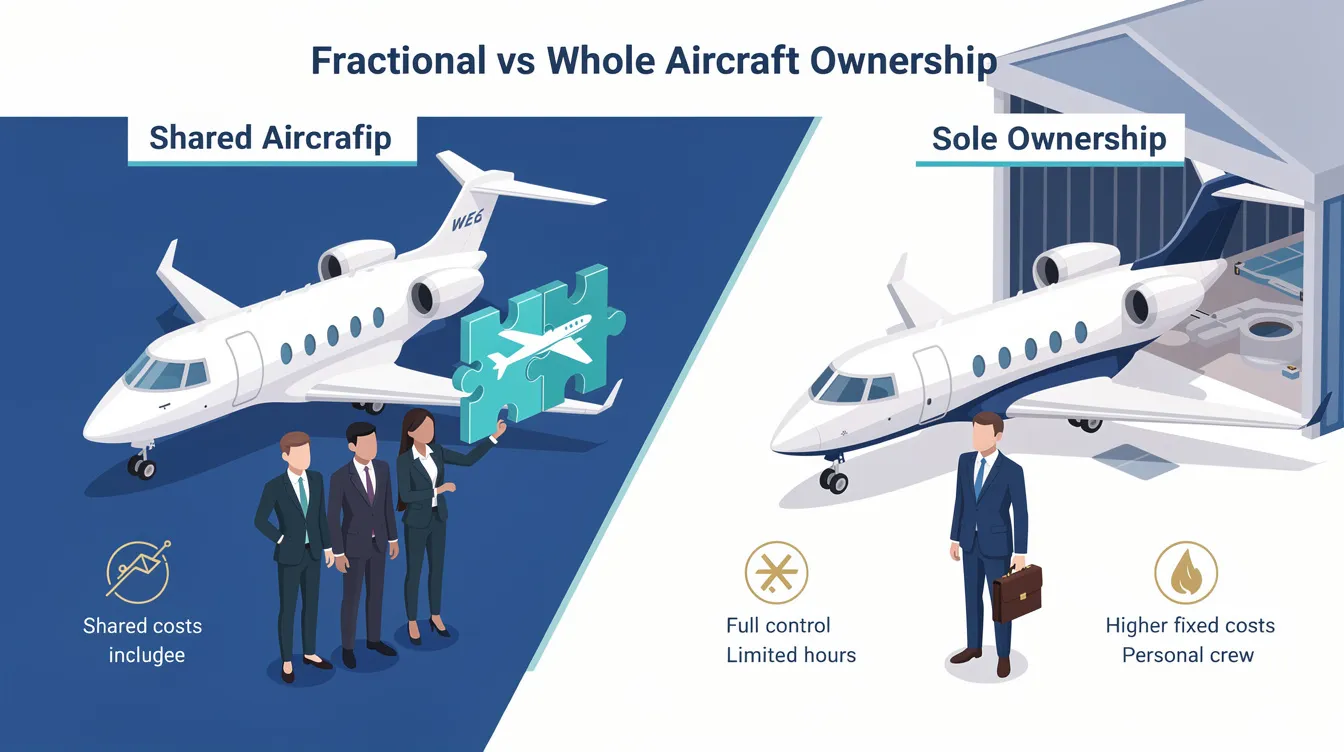
Fractional and whole aircraft ownership solve the same problem in two very different ways. One gives you a share of a professionally managed program with fixed annual hours and a defined fee structure. The other gives you a whole airplane and every responsibility that comes with running it. This fractional vs whole aircraft ownership comparison breaks the choice into five things you can actually measure: control, cost structure, safety oversight, privacy, and exit liquidity. Fractional ownership is best understood as buying a share of annual access, not buying a guaranteed tail number.
Fractional jet ownership is a shared ownership model where multiple owners buy percentage interests in a private aircraft and receive a fixed number of annual flight hours based on share size, while a management company handles crew, maintenance, scheduling, insurance, and regulatory compliance. Whole aircraft ownership means buying 100% of an aircraft and taking on full operational responsibility, plus full exposure to the resale market when you sell.
The simplest difference is control vs complexity: whole aircraft ownership gives you full control of the aircraft and its sale, while fractional ownership trades some control for a managed, contract-based access model with defined hours, defined fees, and contract-defined exit terms.
Common fractional share sizes map to predictable hours. A 1/16 share runs about 50 flight hours a year, a 1/8 share about 100 hours, and a 1/4 share about 200 hours or more. Booking notice in most programs sits inside an 8 to 24 hour window, and contract terms commonly run three to five years. An occupied hour is a billable flight hour charged only when passengers are onboard.
Fractional vs Whole Aircraft Ownership at a Glance | ||
Dimension | Fractional Ownership | Whole Ownership |
|---|---|---|
Control | You request trips; the provider runs operations and assigns aircraft | Full control of aircraft, crew, and configuration |
Cost Structure | Upfront share, monthly management fee, occupied hourly rate | Full acquisition plus all fixed and variable operating costs |
Safety Oversight | Centralized and provider-run under Part 91K | Owner-built or outsourced to a manager |
Privacy | Fleet interchange can reduce tail association; provider holds data | You control data; a single tail can create a pattern |
Exit Liquidity | Contract-defined formula, limited timing control | Full control of sale timing, full market exposure |
You can read a fuller walkthrough of how fractional ownership works before you compare programs.
If you are comparing these models, start with one question: do you want equity, access, or a specific tail? Each model answers that differently, and the difference shows up in what you buy, how you pay, what you control, and what happens when you stop.
Fractional ownership means multiple owners each buy a percentage interest in an aircraft, with annual hours proportional to share size. A management company runs crew, maintenance, scheduling, insurance, and compliance. You pay upfront for the share, a monthly management fee, and an occupied hourly rate when you fly. Your exit value comes from a contract formula.
Whole aircraft ownership means buying 100% of one aircraft. You, or a management company you hire, handle staffing, maintenance planning, insurance, and compliance. You choose when and how to sell, and you carry the depreciation. Control is total, and so is responsibility.
Jet card programs sell prepaid hours or a subscription at fixed or semi-fixed hourly rates. There is no equity, no monthly management fee, and no resale to manage. A jet card is a service purchase you can walk away from once the hours run out.
Charter is trip-by-trip booking. Pricing moves with market demand, and there is no long-term commitment. On-demand marketplaces such as Jettly connect flyers with operators for single trips. Read up on what charter means if the model is new to you.
Leasing gives you access to a specific aircraft without buying it. A dry lease is the aircraft only; a wet lease adds crew and services. Leasing usually offers more control than fractional ownership and asks for more operational involvement than a jet card. Block hours are pre-allocated flight hours associated with a share size or access program.
A jet card is a service purchase; fractional ownership is an asset-backed access contract; whole ownership is running an aviation business.
Access Models Compared | ||||
Model | Equity? | Typical Commitment | Primary Fees | Exit Reality |
|---|---|---|---|---|
Fractional | Yes | 3 to 5 years | Share, monthly, hourly | Contract formula, limited liquidity |
Whole | Yes (100%) | Indefinite | All costs | Open market, you control timing |
Jet Card | No | Prepaid block | Fixed hourly | Use remaining hours, no resale |
Charter | No | Per trip | Market rate | Nothing to exit |
Leasing | No (access) | Lease term | Lease plus operating | End of lease term |
Control is not a vibe. It is a list of responsibilities, and the list is where fractional ownership and whole ownership actually diverge.
"The choice between fractional and whole aircraft ownership isn't simply about budget, it's about deciding how much operational responsibility you want to retain. Whole ownership offers maximum control, while fractional ownership is designed to transfer much of the complexity of operating an aircraft to a professional management organization."
- Justin Crabbe, CEO
With whole ownership you decide aircraft selection and cabin configuration, you hire and retain the pilots, you set the maintenance plan, you buy the insurance, you define the safety approach, and you set the scheduling rules. You also pick the moment you sell. That is a lot of control, and every bit of it is your problem to run.
With fractional ownership you control when you request trips and, within program rules, who flies under your share. The provider controls staffing, training, and maintenance, and it often assigns an aircraft from a shared fleet rather than the exact tail you own. Fleet interchange means you receive access to an aircraft of the same type or performance class, not a guarantee of a specific tail number.
Guaranteed access in most programs runs on that 8 to 24 hour notice window, depending on the terms you sign. Some programs let you scale over time by adding shares, reducing share size, or moving between aircraft categories, subject to contract terms. Leasing sits between the two extremes, so you can weigh aircraft leasing when you want more control than fractional gives but less exposure than owning outright.
Whole ownership maximizes control, but it also makes you responsible for every operational failure mode: staffing gaps, maintenance downtime, and resale timing.
Operational Responsibility Map, Fractional vs Whole | ||
Function | Fractional | Whole |
|---|---|---|
Aircraft selection and cabin configuration | Provider (you pick category) | Owner |
Crew hiring and retention | Provider | Owner |
Pilot training standards | Provider | Owner or outsourced |
Maintenance planning | Provider | Owner or outsourced |
Dispatch and scheduling | Shared | Owner |
Insurance | Provider | Owner |
Compliance monitoring | Provider | Owner or outsourced |
Data and privacy controls | Shared | Owner |
Sale and exit | Shared (formula) | Owner |
In fractional ownership, the hourly rate is only one line item. Costs fall into three buckets, and the buckets you ignore tend to reshape years two and three.
Fractional costs split into three parts: the upfront share acquisition cost, fixed monthly management fees that cover crew, training, insurance, hangar, and administration, and variable hourly operating fees for fuel, maintenance, and parts reserves. A monthly management fee is the fixed charge that typically covers crew, training, insurance, hangar, and administration, whether you fly or not.
The occupied hourly rate is billed only when the aircraft flies with passengers onboard, not necessarily during every repositioning leg, depending on program rules. That single detail explains why two programs with similar hourly rates can produce very different annual bills.
Several charges sit outside a quoted hourly rate depending on the contract: de-icing, international landing, handling and overflight fees, peak-day or short-notice premiums, fuel surcharges, and certain taxes. In the United States, a 7.5% federal excise tax applies to many private flights, and it belongs in any honest cost comparison. Most contracts also carry escalation clauses that adjust for fuel prices, labor and training increases, insurance premium changes, and scheduled annual escalators, so your year-one number is rarely your year-three number. Our deeper explainer on monthly management fees shows how the fixed bucket tends to move.
Whole ownership uses the same logic with different labels: acquisition plus depreciation exposure, crew salaries and benefits, maintenance and engine programs, hangar, insurance, an optional management company fee, and trip costs that vary by mission. Upfront costs are the clearest contrast. A fractional share asks for a slice of an aircraft's price as upfront capital, and whole ownership asks for the whole thing in upfront costs.
Fractional ownership tends to be more cost-effective at moderate utilization. Whole ownership becomes more competitive at higher annual hours, with the break-even point shifting by aircraft category and management efficiency. To compare fractional vs whole ownership fairly, separate fixed costs (paid even when you don't fly) from variable costs (paid only when you do).
Cost Buckets, Fractional vs Whole | ||
Bucket | Fractional | Whole |
|---|---|---|
Upfront | Share acquisition cost | Full purchase price |
Fixed monthly | Monthly management fee | Crew, hangar, insurance, management |
Variable hourly | Occupied hourly rate | Fuel, maintenance, reserves |
Common add-ons | De-icing, peak-day, short-notice premiums | Repositioning, AOG, trip fees |
Taxes and fees | Federal excise tax, international handling | Federal excise tax, sales/use tax, international handling |
Escalation mechanisms | Contract escalators | Market-driven cost inflation |
Safety is a system, not a slogan. Ask who owns the system.
US private aviation sorts into a few regulatory buckets you will see in program materials. Fractional programs commonly operate under Part 91K, formally Part 91 Subpart K. Charter commonly runs under Part 135. Private non-commercial flying commonly falls under Part 91. Each carries different oversight expectations set by the FAA.
Fractional providers typically manage safety centrally: standardized pilot training, centralized maintenance management, compliance monitoring, and shared operating procedures under Part 91K. Safety oversight is the governance and verification system that ensures pilots, maintenance, training, dispatch, and compliance standards are consistently met.
Whole owners build or outsource that same system. You need standard operating procedures, training standards, maintenance oversight, hiring and retention, and continuous compliance checks. Structured programs like IS-BAO give operators a formal way to document governance, a point illustrated in an industry IS-BAO case study. In whole ownership, you control safety decisions, but you also own the work of proving they're consistently executed.
Ask any operator for documents rather than assurances: a safety management overview, a pilot training standards summary, the maintenance tracking approach, current insurance certificates, and any audit or certification evidence they claim. You cannot infer safety from marketing. Verify operator credentials and oversight practices before you sign anything.
Safety Oversight Checklist | ||
Area | Fractional (provider-run) | Whole (owner-run or outsourced) |
|---|---|---|
Training | Standardized program | You set the standard |
Maintenance | Centralized management | You track and schedule |
Dispatch | Provider dispatch | You or your manager |
Compliance monitoring | Continuous, provider-run | Your responsibility |
Incident reporting culture | Program-wide | You build it |
Third-party audits | Ask for evidence | You commission them |
Privacy has two parts: who can connect you to a tail, and who holds your travel data.
With whole ownership you control who can see scheduling and passenger data. Consistent use of a single tail, though, can build an identifiable pattern over time that outside observers track. Operational anonymity is the degree to which outside parties can connect a person or organization to a specific tail number and flight pattern over time.
Fractional ownership can cut repeated association with one tail, since fleet interchange rotates the aircraft you fly. The trade is dependency. You rely on the provider's systems and policies for passenger data handling. Fractional ownership can improve operational anonymity by reducing repeated tail-number association, but it makes the provider's data governance part of your privacy posture.
Ask any provider or manager the same set of questions. What is the data retention policy? What limits sharing? Who counts as an authorized user? What is the incident response plan? The aviation terms glossary covers the vocabulary you will meet in these conversations, including occupied hour and block hours.
Privacy Risk Surface | |||
Factor | Fractional | Whole | Question to Ask |
|---|---|---|---|
Tail association | Lower (interchange) | Higher (single tail) | How often does the assigned tail change? |
Crew consistency | Varies | Consistent | Who sees my manifest? |
Data storage | Provider systems | Your systems | What is the retention policy? |
Authorized users | Provider-controlled | Owner-controlled | Who can book under my account? |
International handling | Provider-managed | Your responsibility | Who shares data with authorities? |
Exit is where fractional ownership stops looking like a membership and starts looking like a contract.
"The most overlooked part of any ownership decision is the exit strategy. Buyers should understand exactly how they plan to leave the program before they enter it, because depreciation, resale mechanics, and contract terms often have a greater impact on long-term value than the initial purchase price."
- Justin Crabbe, CEO
Fractional exit value is typically formula-based, tied to the aircraft's depreciated value rather than open-market pricing, and owners may recover less than their original capital. Fractional resale pricing usually follows contractual formulas, provider-defined depreciation schedules, and internal fleet valuations. Our primer on depreciation basics explains why the depreciation curve drives the resale number.
Most fractional contracts run three to five years. Exit eligibility typically arrives at maturity, and early exits can be restricted or penalized. Read the exit fees and early-termination language before you sign, not after. Capital recovery can stall even at maturity, since replacement-buyer queues, provider-managed remarketing, and settlement timelines all add delay.
Fractional shares generally are not liquid. Most programs restrict exit to contract maturity and use provider-defined resale formulas, and capital recovery can be delayed by resale queues and settlement timelines. Treat the share as an access contract, not a liquid investment.
Whole ownership flips the tradeoff. You control sale timing and method, and you carry full exposure to market pricing, time-to-sell, and transaction friction. Aircraft supply matters here. AOPA noted that buyers faced severely limited inventory even as demand softened slightly, which can lengthen or shorten a sale depending on the model. When you are ready, our guide to selling a fractional share walks through the steps. Whole ownership gives you control over sale timing; fractional ownership usually gives you a contract-defined price mechanism but less control over timing.
Get these answers in writing before you commit: buyback terms, the exact formula definition, timing commitments if any exist, exit fees, and what happens in a downturn.
Liquidity Heat Map, Fractional vs Whole | ||
Factor | Fractional | Whole |
|---|---|---|
Price certainty | Formula-defined | Market-driven |
Timing certainty | Low (queues) | You decide |
Early exit options | Limited or penalized | Sell anytime |
Market exposure | Buffered by formula | Full exposure |
Transaction complexity | Provider-managed | Owner-managed |
A typical fractional exit moves through three stages. Notice: you notify the provider at or near maturity. Queue: your share waits for a replacement buyer or provider remarketing. Settlement: funds transfer after the aircraft transfers. No stage carries a promised date, which is exactly why exit liquidity deserves its own line in your planning.
Start with hours, then mission, then control, then exit. That order keeps brand names out of the decision until the end. This decision framework works for individuals, families, and organizations alike.
"Many buyers focus on the aircraft itself, but the real decision is choosing between two very different operating models. Fractional ownership purchases managed access through a long-term contract, whereas whole ownership means assuming responsibility for every aspect of aircraft ownership, from staffing and maintenance to regulatory compliance and resale."
- Justin Crabbe, CEO
Estimate realistic annual hours. Pull your last 12 to 24 months of travel. Guessing high is how buyers overpay.
Match aircraft category to mission. Light, midsize, super-midsize, large-cabin, and ultra-long-range aircraft each fit a different trip profile. Pick the category, not the brand.
Choose the smallest share that avoids chronic overage. Usage-mismatch risk is buying a share size or aircraft category that doesn't match your real flying, causing you to overpay for unused hours or overage premiums. Too large wastes capital; too small triggers premium rates on every extra hour.
Decide interchange or consistency. Fleet interchange improves availability. An aircraft-specific share improves consistency. You cannot fully maximize both at once.
Stress-test the exit. Can you live with a multi-year term and limited liquidity? If not, the answer may sit outside fractional entirely.
Jet cards fill a useful middle. Per-hour pricing often runs higher than a fractional contract rate, but a jet card carries no equity, no monthly management fee, and no resale complexity, which can make it cheaper at lower annual hours. If your flying is inconsistent or you dislike multi-year commitments, start your comparison with jet cards or charter, then evaluate fractional only if your demand stabilizes. Our guides on who fractional ownership fits and when to choose fractional add detail once you know your hours.
Which Model Tends to Fit by Annual Hours | ||||
Annual Hours | Charter | Jet Card | Fractional (1/16 to 1/4) | Whole |
|---|---|---|---|---|
25 to 50 | Often fits | Often fits | Sometimes fits | Usually not |
50 to 100 | Sometimes fits | Often fits | Often fits | Usually not |
100 to 200 | Usually not | Sometimes fits | Often fits | Sometimes fits |
200+ | Usually not | Usually not | Sometimes fits | Often fits |
Use this checklist before you request pricing. Pricing is meaningless if the contract terms differ. This is the fractional jet ownership comparison checklist 2026 buyers can copy straight into a provider call agenda. Before you buy a fractional share, verify five things in writing: the access guarantee and notice window, the full fee schedule (monthly and hourly), what's billed outside the hourly rate, the aircraft substitution policy, and the exact exit formula and timing.
Peak days are high-demand dates when programs may require longer advance notice, apply premiums, or impose usage caps. Verify how many peak days a program declares before you commit. A good fractional purchase decision is 20% aircraft and 80% contract terms, especially the fee schedule and the exit clause.
Comparison Checklist, What to Verify and Where | |
Item to Verify | Where It Appears |
|---|---|
Access guarantee and notice window | Contract or ops policy |
Peak-day rules and caps | Policy addendum |
Fleet interchange and substitution policy | Contract |
Hourly rate inclusions | Fee schedule |
Charges billed separately | Fee schedule |
Fuel surcharge policy | Fee schedule |
Monthly management fee inclusions | Fee schedule |
Escalation clause | Contract |
Authorized users | Management agreement |
International fee handling | Fee schedule |
Exit formula and timing | Contract |
Early exit penalties and transfer rules | Contract |
Insurance certificate | Ops documents |
Sample management agreement | Provider packet |
Download the one-page version, the Fractional vs Whole Ownership Comparison Checklist (2026), and bring it to every call. For clause-level guidance, our post on contract terms breaks down the language to watch. Tie every checklist item back to your exit strategy so nothing surprises you at maturity.
Don't start with best provider. Start with best structure for my flying. Structure over branding means comparing how a program works, its fees, guarantees, and exit terms, before caring what the logo is.
The market holds three archetypes. Large legacy operators run big fleets and standardized programs. Boutique and mid-sized providers offer more customization. Asset-light and managed-fleet companies emphasize flexibility over fleet scale. Common examples buyers research across fractional jet ownership companies include Jettly, BlackJet, PlaneSense, and Airshare. Naming them is market context, not endorsement.
Watch three misconceptions as you compare fractional ownership companies. A lower hourly rate does not always mean a lower total cost. A bigger fleet does not guarantee availability. Exit terms are not all similar. Two fractional programs can quote similar hourly rates and still have very different total costs because monthly fees, add-ons, and exit terms are where the economics often diverge.
Provider Comparison Snapshot | |||||||
Type | Fleet Scale | Access / Notice | Interchange | Fee Transparency | Contract Term | Exit Mechanics | Best-Fit Profile |
|---|---|---|---|---|---|---|---|
Legacy | Large | Strong guarantees | Broad | Standardized | 3 to 5 years | Formula | High, steady hours |
Boutique | Mid | Customized | Narrower | Varies | Varies | Formula or hybrid | Service-focused flyers |
Asset-light | Managed | Flexible | Program-based | Varies | Shorter options | Lower resale complexity | Flexibility seekers |
See how we compare providers by structure rather than ranking them.
Fractional ownership gives you contract-based access through a shared aircraft share, while whole aircraft ownership gives you full control of a single aircraft, and full responsibility for operating and selling it.
Control: the provider runs operations under fractional; you run everything under whole ownership.
Cost buckets: fractional splits upfront costs, monthly fees, and hourly rates; whole ownership rolls every cost onto you.
Exit and liquidity: fractional uses a contract formula; whole ownership uses the open market with full timing control.
In the US, fractional jet ownership generally works by buying a percentage share that includes a set number of annual flight hours, while a management company runs operations and dispatches aircraft within a defined access window. Common share sizes are 1/16, 1/8, and 1/4, and many programs deliver trips through fleet interchange, meaning you receive an aircraft of the same type or class rather than one guaranteed tail number.
A 1/16 share is commonly around 50 hours per year, a 1/8 share around 100 hours, and a 1/4 share around 200 hours or more, depending on the program and aircraft category. Buying too large a share wastes capital on unused hours; buying too small triggers overage premiums. Some programs let you scale by adding shares or moving categories as your flying changes.
Most fractional programs charge a monthly management fee that covers fixed operating costs like crew, training, insurance, hangar, and administration, even when you don't fly. The occupied hourly rate covers direct flying costs like fuel and maintenance reserves, and items such as de-icing, international handling, and peak-day premiums are often billed separately.
An occupied hourly rate is the per-hour fee billed when the aircraft is flown with passengers onboard, typically covering direct operating costs like fuel and maintenance reserves. Read the contract to see which add-ons sit outside the rate, including de-icing, international landing and handling, short-notice premiums, and fuel surcharges.
Fractional ownership can be very safe, but safety depends on the operator's training, maintenance oversight, and compliance systems, so you should verify standards and documentation rather than rely on marketing. Request a safety management overview, a pilot training standards summary, the maintenance tracking approach, current insurance certificates, and any audit or certification evidence the operator claims.
Most fractional exits happen at contract maturity under provider-defined resale formulas, and early exits may be restricted or penalized depending on the contract. Capital recovery can be delayed by replacement-buyer queues and settlement timelines, so the timing is rarely in your hands. Whole ownership works the opposite way, giving you control over sale timing at the cost of full market exposure.
In most fractional programs, maintenance downtime is covered by dispatching a substitute aircraft from the fleet, usually within the same category or performance class. Your contract should spell out the substitution rules, how upgrades or downgrades are handled, and whether any charge applies in those situations.
A jet card is often more economical at lower annual flight hours because it requires no upfront capital and no monthly management fees, while fractional ownership can win at moderate, steady utilization. The crossover often lands somewhere between 50 and 150 hours a year, shifting with aircraft category, contract terms, and how consistently you fly.
You typically buy into fractional jet ownership by contracting directly with a fractional program provider or managed-fleet operator, after reviewing the fee schedule, access guarantee, and exit terms in the program documents. Compare legacy, boutique, and asset-light providers by structure, and run the FractionalJetOwnership.com comparison checklist before you request quotes.
The fractional vs whole aircraft ownership decision is not a matter of prestige. It is a tradeoff between control and complexity, and it turns on five measurable dimensions: control, cost structure, safety oversight, privacy, and exit liquidity. Fractional ownership hands off operations for a contract-defined access model. Whole ownership hands you the controls and the responsibility. If you are weighing a multi-year fractional contract against buying an aircraft, use the FractionalJetOwnership.com checklist and talk with our team to pressure-test the structure and the exit terms. Download the 2026 comparison checklist, bring it to your provider calls, and compare the fee schedule and the exit clause line by line.
FractionalJetOwnership.com is an independent educational resource, not a fractional program seller. We evaluate programs by structure over branding, issue no rankings or endorsements, and rely on no single source, drawing instead on public program materials, industry disclosures, standard contracts, and market-level pricing patterns. We do not provide individualized financial, legal, or tax advice, we do not replace provider disclosures or contracts, and we do not represent real-time pricing or availability. Figures on this page are illustrative and vary by provider, aircraft category, and contract terms.
IS-BAO case study, Guardian Helicopters (IBAC) - context on how structured safety oversight and governance systems are documented in industry case studies.
AOPA market note - general aviation demand softened slightly while buyers still faced severely limited inventory, relevant to whole-aircraft acquisition and resale timing.
