
May 17, 2026
Italy remains one of the world’s most sought-after destinations for both business and leisure travelers, renowned for its rich history, vibrant culture, and stunning landscapes. This guide is designed for business executives, frequent travelers, and families seeking efficient and flexible travel solutions in Italy. Navigating Italy’s diverse regions—from bustling cities like Milan and Rome to serene coastal retreats and alpine resorts—demands efficient, flexible, and private travel solutions. Fractional jet ownership and private aviation provide a strategic advantage, offering unparalleled convenience, time savings, and personalized service. This guide explores how BlackJet Fractional Jet Ownership empowers travelers to “jet Italy” with confidence, safety, and cost-effectiveness, while honoring Italy’s unique aviation regulations and heritage.
BlackJet Fractional Jet Ownership helps travelers “jet Italy” with predictable private jet access, structured private jet cost, and less exposure to peak-season charter volatility.
Italy has over 18 private jet destinations, with airports connecting business hubs, coastal resorts, islands, and ski areas often in under two hours’ flight time.
The 1998 Cavalese cable car crash involving a US Marine Corps aircraft, an EA-6B Prowler, remains a turning point for low-level flight safety near aerial lift systems in Italy.
This guide covers destinations, aircraft choice, ENAC/EASA regulations, sustainability, and how fractional jet ownership or Reserve Fleet access can support Italy travel.
Jet travel within Italy includes extensive commercial airline networks and premium private aviation services. Jet travel in Italy for 2026 will involve major commercial carriers, low-cost airlines, and private charter networks, but private aviation gives executives and families control over timing, privacy, and routing.
The domestic jet market in Italy is competitive and dominated by low-cost carriers. The most popular airlines in Italy include ITA Airways, Ryanair, and easyJet; Ryanair holds over 35% of total departure capacity in Italy, while ITA Airways operates a fleet of over 100 aircraft out of Rome Fiumicino and Milan Linate. Major US legacy carriers dominate long-haul travel between the US and Italy, and Delta Air Lines maintains a leading capacity share on US-Italy routes, operating significant traffic to Rome and Milan.
Private jet travel to Italy can save significant time compared to commercial flights, with a typical Milan to Rome flight taking only 1 hour and 10 minutes in the air, while commercial options can require 2-3 hours door-to-door due to check-in and security procedures. London–Milan is around 1h50m flight time.
Close-in airports such as Milan Linate, Rome Ciampino, Venice Marco Polo, and Florence Peretola can cut transfers to 10–25 minutes from the city center.
Italy’s diverse locales make it practical to enjoy la dolce vita in the eternal city, the Amalfi Coast, Capri, Sardinia, Sicily, and a Dolomites ski resort in one week.
Dedicated FBO terminals allow expedited boarding without commercial crowds, making each flight more private and efficient for board meetings, site visits, lunch, dinner, and family vacations.
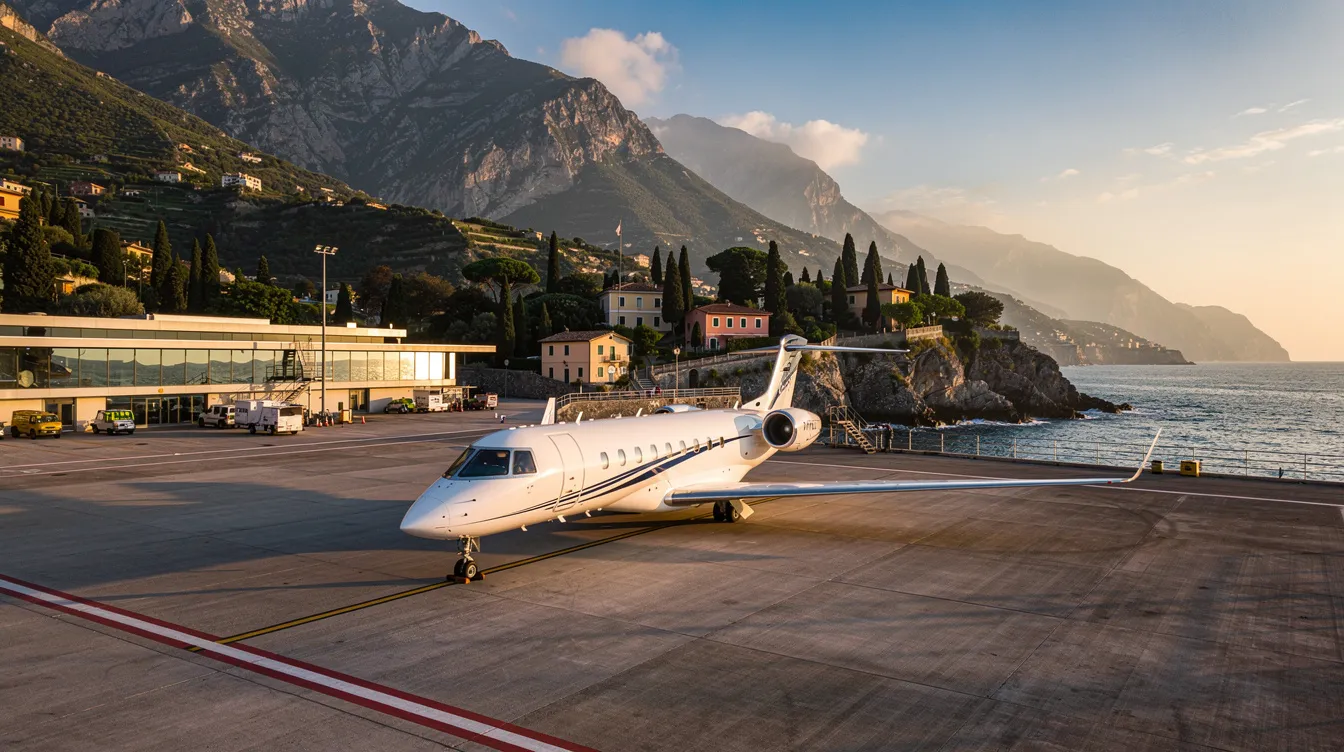
BlackJet Fractional Jet Ownership advises frequent flyers and companies on fractional aircraft ownership and membership-style private jet access into and within Italy, helping clients understand essential fractional jet ownership terms and program structures. Fractional jet ownership is a model where multiple individuals or companies share ownership of an aircraft, allowing each to access private jet travel without the full cost and responsibility of sole ownership.
Equity Fleet: fractional jet ownership shares for roughly 25–150 hours per year, with priority access, custom aircraft sourcing, and potential tax benefits for fractional jet owners depending on the country or other country of ownership.
Reserve Fleet: flexible pay-as-you-go access with guaranteed availability and no full aircraft ownership burden, appealing to travelers comparing fractional jet ownership vs membership programs.
Ad-hoc charter in Europe can move quickly in price, especially after 2020; seasonal surcharges of 20–30% are common during Sardinia summers or Milan events.
Example: a US executive flying New York–Milan–Rome–Zurich can use a large cabin aircraft across the Atlantic and smaller jets inside Europe.
Example: a family repeating Tuscany, Olbia, and the Amalfi Coast each year may use 25–50 hours without buying a whole plane, while heavier users may evaluate 1/8th fractional jet ownership structures.
Italy’s airports give private flyers access beyond the commercial route map. Private jets have the advantage of accessing smaller, more convenient airfields throughout Italy, often situated closer to luxury resorts, which significantly reduces ground transportation time.
Destination Type | Airports (ICAO/IATA) | Notes |
|---|---|---|
Business & Culture Hubs | Milan Linate (LIML), Malpensa (LIMC), Rome Ciampino (LIRA), Fiumicino (LIRF), Turin (TRN), Bologna (BLQ) | Rome Ciampino is Italy’s primary private jet charter hub |
Coastal & Island Gateways | Naples Capodichino (LIRN), Olbia (LIEO), Cagliari (LIEE), Palermo (LICJ), Catania (LICC) | Supports Amalfi, Capri, Sardinia, and Sicily resorts |
Leisure & Mountain Access | Venice Marco Polo (LIPZ), Treviso (LIPH), Bolzano (LIPB), Verona (LIPX) | Access to the Dolomites and Cortina ski resorts |
Fast transfers matter: Venice water taxis can reach St. Mark’s in about 20 minutes, while Olbia is a short drive to the Porto Cervo marinas.
Common private jet routes in Italy include Florence–Olbia, Naples–Olbia, and Venice–Rome.
Business travelers value predictable access more than ceremony.
Milan Linate is often 10–15 minutes from the city center, serving finance, fashion, and design with dedicated FBOs.
Rome Ciampino is preferred over Fiumicino for many private jets, handling government, diplomatic, and corporate flights with VIP lounges.
Venice and Florence support art, architecture, regional business clusters, and high-end tourism.
Fractional and membership models, including flexible floating fleet options in fractional ownership, help executives chain Milan–Florence–Rome or Venice–Bologna–Milan in a one- or two-day executive circuit.
Private aviation reduces transfer friction to popular destinations.
Naples supports the Amalfi Coast, with driving, helicopter, or boat transfers after private jet arrivals.
Sardinia via Olbia or Cagliari supports yachting in Porto Cervo, where July–August availability is tight.
Sicily via Palermo or Catania connects Taormina, Mount Etna, and coastal resorts with flexible departure times.
Dolomites routing may include Paris–Venice–Bolzano or London–Verona–Cortina, with winter operations planned around weather, ski gear, and mountain alternates.

The right program turns Italy from a sequence of airport waits into a planned private aviation network.
Itinerary Name | Route | Aircraft Type | Duration / Notes |
|---|---|---|---|
Executive Circuit | London–Milan–Rome–London | Midsize jet | 1h50m London–Milan, 1h10m Milan–Rome, efficient scheduling |
La Dolce Vita Week | New York–Rome–Amalfi–Capri–Florence–New York | Large cabin & light jets | 8h transatlantic, short hops within Italy for leisure |
Dolomites & Venice Escape | Paris–Venice–Bolzano–Paris | Light jet | Quick transfers, ski gear handling |
Yachting or Sicily Grand Tour | Olbia, Cagliari, Palermo, Catania | Super-midsize & light jets | Flexible dates, yacht, and villa access |
Members can apply reserved or owned hours across multiple segments without renegotiating each leg.
Route | Flight Time | Typical Aircraft |
|---|---|---|
London–Milan | 1h 50m | Light or midsize jets |
Zurich–Olbia | 1h 30m | Light jets |
Paris–Rome | ~2 hours | Light or midsize jets |
New York–Milan | 8-9 hours | Large cabin jets |
Milan–Rome | 1h 10m | Light jets |
Rome–Palermo | 1h 10m | Light jets |
Venice–Bolzano | 45 minutes | Light jets |
Within Italy, travelers can choose from a variety of private jet options including turboprops, Very Light Jets (VLJs), light jets, midsize jets, and larger heavy jets, enabling them to select the most suitable aircraft for their specific journey. BlackJet advisors match each route to distance, runway length, passenger count, baggage, cabin needs, and safety margins.
Careful aircraft selection can reduce fuel and positioning costs by roughly 10–15% on typical European itineraries, but owners still need to understand the overall cost of fractional jet ownership.
Light jets work well when efficiency matters.
Light jets, such as the Citation CJ3 and Phenom 300, typically have a range of approximately 2,000 nautical miles and can accommodate 6-7 passengers, making them suitable for short flights like Milan to Rome.
These jets can support Florence Peretola and smaller regional airfields near Tuscan or Umbrian estates.
They are cost-efficient for couples, small teams, or families linking several cities in one week.
Many offer a quiet cabin, Wi-Fi, and space for business discussions en route.
Midsize cabins fit corporate travel across Europe and the Gulf.
Midsize and super-midsize jets, like the Citation XLS+ and Challenger 350, have a range of 3,000-4,000 nautical miles and can carry 7-10 passengers, providing stand-up cabins for added comfort during travel.
Common missions include London–Milan–Dubai, Milan–Athens–Rome, and multi-country roadshows.
Stand-up cabins are often about 5’8”–6’ high, helping executives work between meetings.
Industry hourly benchmarks vary, but fractional ownership smooths exposure to sudden charter pricing changes when you account for the total cost of fractional jet ownership.
Long-range aircraft support Jet Italy travel from North America, the Middle East, and Asia.
Large cabin and long-range jets, such as the Gulfstream G450 and Falcon 7X, can travel 4,000-7,000 nautical miles and accommodate 12-16 passengers, making them ideal for transatlantic flights.
These aircraft fit New York–Rome, New York–Milan, Dubai–Milan, and Los Angeles–Rome with a possible technical stop.
Lie-flat seating, private workspaces, and large baggage holds support longer stays.
BlackJet fractional owners can combine long-range oceanic legs with smaller aircraft inside Europe under one coordinated program, often supported by tailored fractional jet ownership financing solutions.
Italy’s aviation culture is shaped by strict civil rules and hard lessons. On February 3, 1998, an EA-6B Prowler struck the cables supporting a cable car in Cavalese, Italy, resulting in the deaths of twenty people when the cabin plunged over 80 meters (260 feet).
The Marine Corps aircraft, callsign EA 6 B EASY 01, cut the cable supporting the cable car near the Italian town of Cavalese, an event known as the Strage del Cermis or the Cermis massacre.
The aircraft was flying at a speed of 470 knots (870 km/h) and at an altitude of between 80 and 100 meters (260 and 330 feet) when it struck the cables, which was against military regulations that required a minimum flying height of 2,000 feet (610 m).
Following the disaster, U.S. Marine Corps pilots were found to have used outdated maps that did not indicate the presence of the cable car cables, contributing to the incident.
The plane returned to Aviano with wing and tail damage, including tail damage, after the morning training flight over the narrow valley.
As a result of the incident, Italy implemented stricter regulations on low-level flying, allowing it only in specific unpopulated areas with a minimum altitude of 500 feet.
This was not a complete ban, but it sharply limited such things near cable car and aerial lift systems.
Civil private jet operations are different from military training; reputable operators do not perform low-level sightseeing maneuvers around a cable, resort, car, or ground obstacle.
The accountability process was closely watched by the Italian public.
The pilot, Captain Richard J. Ashby, and his navigator, Captain Joseph Schweitzer, were charged with involuntary manslaughter and negligent homicide, but Ashby was acquitted in a verdict that caused outrage in Italy.
In the first trial at Marine Corps Base Camp Lejeune, Captain Richard Ashby and Captain Joseph Schweitzer faced trial on twenty counts, including involuntary manslaughter and negligent homicide charges; Ashby’s trial ended in subsequent acquittal on manslaughter charges.
Politicians called the result unacceptable, and the verdict was strongly criticized in Italy.
A second court-martial process concerned the videotape recorded during the mission; the two four men involved in the crew became central to the Marine Corps inquiry, but only the pilot and navigator were convicted for obstruction-related conduct.
Ashby received dismissal from the Marine Corps and a six-month prison term after he was found guilty of destroying evidence.
A monetary compensation plan approved about $1.9 million per victim for victims' families, and nato treaties obligated the United States to cover 75% under nato treaties.
Today’s private aviation operates under ENAC and EASA rules, including Italy’s Regole dell’Aria and EU AIR OPS frameworks referenced by ENAC.
BlackJet partners with vetted operators holding strong third-party standards where applicable, such as ARGUS, Wyvern, or IS-BAO, and advises clients on appropriate liability coverage in fractional jet ownership.
Crews often have 5,000+ hours, recurrent training every 6–12 months, and briefings on mountain terrain.
Terrain-aware navigation, RNAV/RNP approaches, and conservative routing protect operations into airports such as Bolzano.
Incidents like Cavalese reshaped policy; reputable private aviation providers operate well above minimum standards.
Full private jet ownership can require tens of millions in capital plus several million annually, creating under-utilization risk for travelers needing only 25–150 hours per year.
An ad-hoc charter can be useful, but Milan Fashion Week, Rome events, and Sardinia summers can create variable pricing and uncertain availability.
BlackJet Equity Fleet and Reserve Fleet programs support predictable hourly rates, prioritized access, and professional scheduling across transatlantic and European Jet Italy missions, aligning with the investment case for fractional jet ownership.
A traveler taking six Italy trips per year, with two transatlantic round-trip flights and multiple domestic legs, may fit a fractional or hybrid structure better than charter-by-charter buying and can benchmark options using top fractional jet ownership programs.
Corporations may also supplement owned aircraft or marine corps-style flight departments when a plane is in maintenance or internal demand exceeds capacity, making it essential to understand key contract terms in fractional jet ownership.
Executives running quarterly New York–Milan–Rome–Frankfurt circuits can pair large-cabin oceanic legs with smaller jets inside Europe.
Families returning to Tuscany, Sardinia, or Amalfi may use 25–50 hours for villa, yacht, and school-calendar flexibility.
Corporations can add lift without buying another aircraft.
First-time private aviation users gain repeatable access without managing crew, maintenance, insurance, and scheduling alone, often relying on an aircraft fractional ownership sample contract reviewed with counsel.
A better Jet Italy strategy balances la dolce vita with responsibility toward heritage, communities, and the environment.
BlackJet can integrate carbon offset programs or sustainable aviation fuel options available through leading Italian FBOs in hubs like Milan and Rome.
SAF and offsets can support lower lifecycle emissions while preserving the flexibility of private jet travel.
Digital platforms support app or web trip requests, instant estimates, real-time notifications, and 24/7 monitoring for weather, Eurocontrol flow, and slots.
Concierge coordination can include ground transport, yacht connections, villas, and coastal transfers.
Assess annual hours to and within Italy. The 25–150 hour range often points toward fractional jet ownership, Reserve Fleet access, or a hybrid plan.
Map typical routes, such as New York–Rome, London–Milan, Geneva–Olbia, or Venice–Rome.
Ask BlackJet advisors to match aircraft category, cabin requirements, tax considerations, and scheduling needs.
Visit FractionalJetOwnership.com to compare options and request a personalized Jet Italy flight plan, and review guidance on selling your fractional jet ownership share as part of long-term planning.
Experience Italy on your own schedule, with safety, predictability, and expert guidance from takeoff to arrival.
Italian and European regulations impose strict altitude and routing rules near ski areas, cable cars, and aerial lift systems, shaped in part by the 1998 Cavalese cable car crash. Private jet flights are planned on established airways and instrument procedures, not unsafe low-level routes.
For many European countries, Italy, and domestic Italian legs, 24–48 hours’ notice is typical, and urgent trips may be possible in less than a day. Peak periods, such as August in Sardinia or major events in Milan and Rome, benefit from earlier planning.
Pets are commonly allowed on private jets into Italy, subject to EU and Italian rules such as microchipping and a valid rabies vaccination. BlackJet advisors help coordinate paperwork and confirm that the operator accepts pets in the cabin.
International arrivals from the U.S. or UK clear customs and immigration at FBOs or general aviation terminals at airports such as Rome Ciampino, Milan Linate, or Venice Marco Polo. Processing often takes about 15–30 minutes before passengers proceed to pre-arranged ground transport.
For travelers flying roughly 25–150 hours per year, fractional ownership or a well-structured membership program often provides better value than buying an entire aircraft and carrying all fixed costs. BlackJet can model historic travel patterns and compare fractional, reserve, or hybrid access.
Jetting in Italy with BlackJet Fractional Jet Ownership offers a sophisticated, efficient, and flexible approach to private aviation. Whether for business or leisure, fractional ownership and Reserve Fleet access provide predictable costs, priority availability, and tailored aircraft options that match your travel needs across Italy’s diverse regions. By leveraging Italy’s extensive private jet infrastructure and adhering to rigorous safety standards shaped by historical lessons like the Cavalese cable car incident, BlackJet ensures every journey is secure, seamless, and respectful of local regulations.
Experience the freedom to explore Italy’s cultural capitals, coastal retreats, and mountain escapes on your schedule, avoiding the constraints and unpredictability of commercial flights or ad-hoc charters. BlackJet’s expert guidance, sustainable travel initiatives, and digital booking platforms simplify the complexities of private jet travel, making it accessible and rewarding for frequent flyers and newcomers alike.
Ready to transform your Italy travel experience? Visit FractionalJetOwnership.com to learn more about how BlackJet’s fractional jet ownership and membership programs can elevate your private aviation journey. Discover smarter, safer, and more efficient ways to jet to Italy with confidence and style.
