
May 1, 2026
Every jet is an airplane, but not every airplane is a jet. This distinction resolves a common point of confusion for travelers evaluating air travel options. The term airplane refers broadly to any fixed-wing aircraft capable of sustained flight, while jet specifically describes aircraft powered by jet engines that generate thrust through high-velocity exhaust gases.
Consider a 2024 Boeing 737-8 MAX jet plane on a commercial flight from New York to Los Angeles. The trip covers 2,475 miles at roughly 521 mph, takes 5.5 to 6 hours including taxi time, and carries a multitude of passengers—typically 162 to 210—benefiting from a variety of onboard amenities. Now compare that to a 2024 Gulfstream G650 private jet on the same route: cruising at Mach 0.90 (around 690 mph) at 51,000 feet, completing the journey in under 5 hours for just 13 to 19 passengers in a customized cabin with lie-flat beds and dedicated workspaces.
BlackJet Fractional Jet Ownership focuses exclusively on business and private jets rather than commercial airliners, providing executives and high-frequency travelers with reliable access to jet aircraft optimized for point-to-point efficiency.
The word airplane (or plane) is a broad category covering all fixed-wing aircraft. A jet, by contrast, is defined by its propulsion system.
The key difference between a jet and an airplane is that a jet must have a jet engine, while an airplane can have various types of engines, including propeller engines.
Jets are propelled by turbojet, turbofan, or modern high-bypass turbofan engines that compress air, mix it with fuel, and expel exhaust at tremendous speed to generate thrust. Many other airplanes are propelled by piston engines or turboprop systems that drive a propeller. Common commercial models like the Boeing 737 and Airbus A320 families are jet airplanes, while aircraft such as the Cessna 172 and Beechcraft Bonanza are piston-powered planes.
In everyday speech, people use the word " plane to describe everything from a 15-seat turboprop to a long-range business jet. For aviation planning and ownership decisions, however, these key differences matter significantly.
Performance characteristics—speed, altitude, landing and takeoff requirements, and range—drive the practical differences between jets and other airplanes.
Modern business jets like the Bombardier Global 7500 or Gulfstream G800 cruise near Mach 0.90 (approximately 690 mph at altitude), while a typical turboprop like the Pilatus PC-12 cruises around 285 to 300 knots (330–345 mph). Jets fly faster and enable executives to cover greater distances in less time. Propeller planes usually cruise between 100 and 300 mph and generally operate below 30,000 ft as propellers lose effectiveness in thinner air.
Jets generally operate at 35,000 to 51,000 feet in the tropopause, above most weather systems, reducing turbulence on long trips. Turboprop airplanes typically max out at 25,000 to 30,000 feet. This altitude advantage translates to smoother, more efficient flights.
Turboprops excel on shorter routes of 300 to 1,500 miles, and are highly efficient for short distances. They can land on unpaved runways, making them suitable for various roles and expanding ground access to more remote locations. However, jets typically require 4,000 to 7,000 feet of paved runway for both takeoff and landing due to their higher speeds, limiting them to larger airports, whereas rugged turboprops can operate from 2,500-foot strips.
The same technology—jet engines—supports vastly different missions across the aviation industry.
Jet airliners like the Boeing 777 and Airbus A350 carry hundreds of passengers on scheduled routes worldwide.
Since the late 1950s, the Jet Age, beginning with aircraft like the Boeing 707, commercial jets have dominated mass air travel, carrying over 4.5 billion passengers annually by 2019.
The first commercial jet service was operated in 1952 by BOAC using the de Havilland Comet, following its successful first flight, and was faster and quieter than propeller aircraft.
The fastest commercial jet aircraft, the Tu-144, had its first flight in 1968 and entered service in 1975, reaching speeds of Mach 2.35 (2,503 km/h or 1,555 mph).
Turbofan aircraft, known for their improved fuel efficiency, began entering service during the 1950s and 1960s and have since become the predominant type of jet engine in use today.
These advancements have connected nations and linked major airports across the world, revolutionizing global transportation.
The history of jets began with the German Messerschmitt Me 262, which had its first flight in 1942 and became the world’s first operational jet fighter when it entered service on April 19, 1944.
Germany was a leader among nations in jet fighter development during World War II, and the Me 262 was produced in up to 1,400 units.
Later developments included the Lockheed F-104 Starfighter (Mach 2.2) and the legendary SR-71 Blackbird, the fastest military jet aircraft, capable of reaching Mach 3.35 (3,661 km/h or 2,275 mph) at 85,000 feet.
Fighter jets are high-speed, agile aircraft designed for air-to-air combat and gaining air superiority.
Bombers are large aircraft built for strategic bombing and carrying heavy munitions over long distances.
Transport and tanker aircraft, such as the C-130 Hercules, are used for moving troops and supplies, performing air drops, and can operate from rugged, unpaved runways with superior performance under challenging conditions.
Business jets range from Very Light Jets to heavy intercontinental jets and are designed for executive travel and high-speed personal transit.
Private jets include light models like the Cessna Citation CJ4 Gen2 (4–10 passengers, 2,165 nm range) to large-cabin aircraft like the upcoming Dassault Falcon 10X.
These serve executives needing flexible, point-to-point travel with minimal time on the ground.
Turboprop airplanes like the Cessna Caravan and Beechcraft King Air 260 excel in regional cargo, medical flights, and short-haul service into smaller airports across the country.
Cargo planes are designed to transport heavy or outsized cargo over long distances, often featuring nose-loading doors and a higher capacity for dangerous goods.
These aircraft play a crucial role in global logistics and connecting the world.
Both commercial jets and private jets share core aerodynamics but are optimized for entirely different mission requirements. Wings are crucial structural components that provide lift, house engines, and contribute to the aerodynamic efficiency of both jets and airplanes.
Commercial examples like the Boeing 737-800 and Airbus A321neo feature two under-wing engines, carry 150–220 passengers in single or two-class layouts, and use standardized interiors with amenities designed for operational efficiency. Jets use turbine engines to compress, ignite, and blast air out the rear at extreme speeds. Airlines maximize seats per square foot to serve the broader range of travelers efficiently.
Private jets take a fundamentally different approach. Light jets like the Embraer Phenom 300E (6–11 seats) feature club seating and dedicated refreshment centers. Super-midsize jets like the Bombardier Challenger 3500 offer workspaces, Nuage seats with 81-inch pitch, and four separate zones, including galley areas.
Large-cabin jets like the Gulfstream G700 or Global 7500 provide true separate zones—conference areas for four, lounge space, and dedicated private suites—designed for business continuity on flights up to 7,500 nautical miles. While airliners maximize seat density, private jets prioritize productivity, privacy, and convenience for decision-makers.
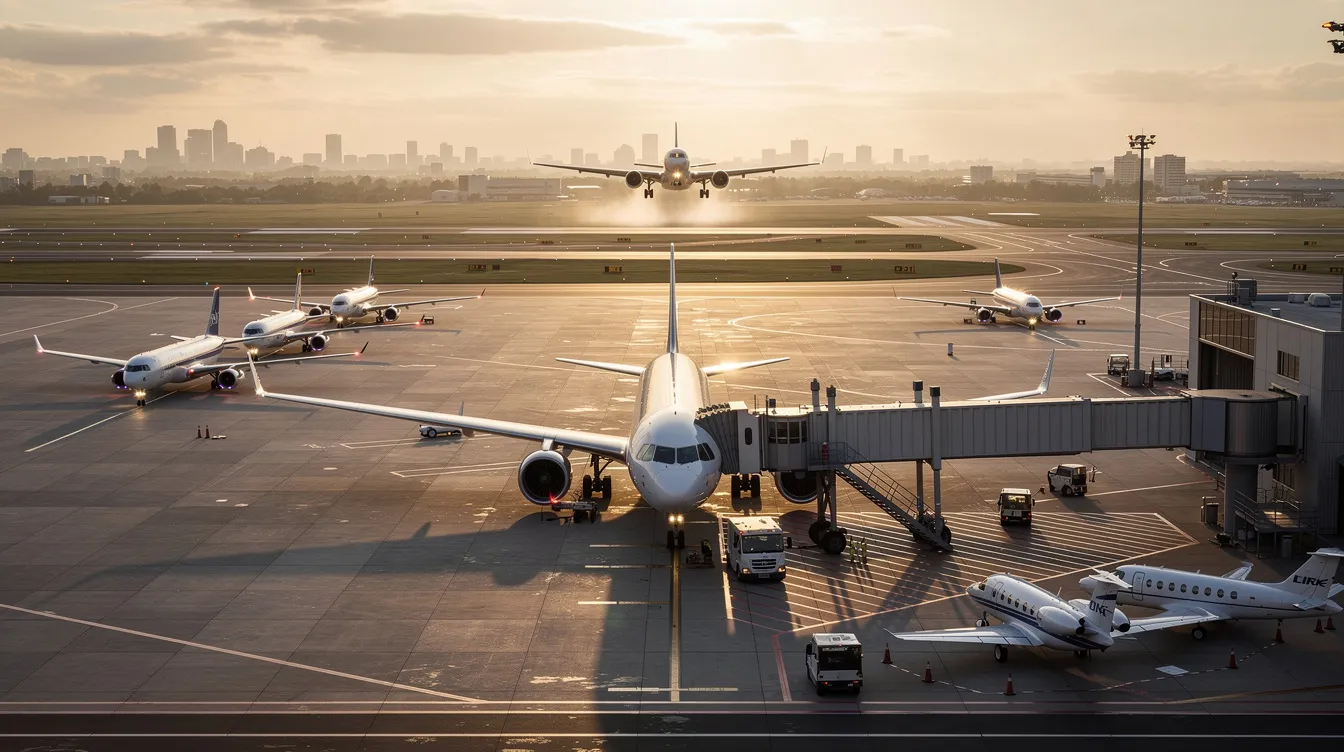
Plane size encompasses more than dimensions—it includes passenger count, baggage volume, and operational role.
Here’s a comparison of aircraft types and their typical passenger counts:
Aircraft Type | Typical Passenger Count | Typical Range (nm) | Example Routes |
|---|---|---|---|
Light Jets | 4–6 | 800–1,200 | Dallas–Chicago, Los Angeles–San Francisco |
Midsize/Super-Midsize Jets | 8–10 | 2,000–3,600 | New York–Aspen, Miami–Seattle |
Large-Cabin/Long-Range Jets | 13–19 | 6,000–7,500+ | New York–London, Los Angeles–Tokyo |
Commercial Widebody Airliners | 300–550+ | 7,000–8,000+ | Intercontinental flights |
Choosing between different types of aircraft means matching mission profile, passenger count, and budget—not assuming bigger equals better.
The standard airline model involves buying an individual seat on a scheduled jet flight operated by airlines following fixed routes. Computers are integral to various aspects of the airline industry, including ticket booking, flight planning, scheduling, and maintenance, ensuring efficient operations. Private aviation offers access to an entire aircraft on your schedule.
Commercial airliners are owned or leased by airlines and follow predetermined timetables. Private jets are generally smaller than commercial planes and are designed to offer a more intimate and exclusive flying experience, accommodating anywhere from a handful to over twenty passengers. Private jets may be owned outright by individuals or corporations, or accessed through managed programs that handle maintenance, crew training, and operational compliance.
Ad-hoc charter, jet card programs, and on-demand app-based booking represent common entry points into private aviation, offering flexibility but with variable pricing and availability challenges that can cancel travel plans compared with more structured fractional jet ownership vs membership programs.
Fractional jet ownership and aircraft share programs provide a structured alternative. Clients purchase a share of an aircraft or fleet in exchange for guaranteed annual flight hours and predictable private jet costs, supported by a clear understanding of fractional jet ownership terminology and concepts. In the United States, many corporate flight departments blend company-owned aircraft, charter, and fractional programs to optimize both efficiency and coverage.
BlackJet Fractional Jet Ownership gives clients reliable jet access without the full burden of owning an entire airplane.
The Reserve Fleet model offers flexible pay-as-you-go access. Clients hire jet hours as needed, avoiding capital outlay and long-term ownership costs while maintaining service reliability.
The Equity Fleet model allows clients to acquire an equity stake in a specific aircraft type. This delivers priority access, predictable scheduling, and potential U.S. tax benefits—including accelerated depreciation under IRS Section 168—tied to fractional aircraft ownership and supported by tailored fractional jet ownership financing options.
BlackJet manages all aircraft operations: maintenance, pilot and cabin crew resources, hangar arrangements, and regulatory compliance. This frees owners from day-to-day aircraft management while ensuring reliability standards that industry leaders demand.
This approach appeals to high-frequency travelers and companies flying 25–150 hours per year who require more predictability than charter but less complexity than full private jet ownership, and it underpins BlackJet’s suite of private aviation programs.
Light jets typically cost $3,500–5,500 per hour in variable operating costs. Midsize jets run $5,000–8,000 per hour, while large-cabin jets reach $10,000–15,000 per hour.
Premium commercial first class fares on similar routes range from $1,000–5,000 per ticket, and understanding the total cost of fractional jet ownership helps put these figures into a long-term perspective.
Frequent U.S. domestic flyers may find a light or midsize jet share optimal. Global executives traveling between North America, Europe, and the Middle East often benefit from large-cabin, long-range jets capable of nonstop intercontinental flights, making fractional jet ownership as an investment an appealing way to secure reliable access.
Fractional jet ownership spreads fixed costs—aircraft financing, crew, maintenance—across multiple owners, producing more predictable budgeting than sporadic charter bookings and aligning with the complete guide to fractional jet ownership costs. Private aviation also generates indirect value: saving executive hours, enabling back-to-back meetings in multiple cities in one day, and accessing secondary airports closer to final destinations.
Consider a CEO visiting three Midwestern cities in a single day. With a Challenger jet, this is a straightforward event. Attempting the same itinerary on commercial airlines would likely require two days and multiple connections, and understanding how to sell a fractional jet ownership share later on adds long-term flexibility to such commitments.
No. The PC-12 and similar turboprop aircraft use turbine engines, but they drive a propeller for thrust rather than producing jet exhaust. They are turbine airplanes but not jet aircraft.
Both follow strict FAA (or EASA) regulations. Reputable private operators maintain high safety and training standards, often exceeding baseline requirements through IS-BAO certification and third-party audits.
Yes. The United States has over 5,000 public-use airports, with private jets regularly accessing hundreds that airlines do not serve—bringing travelers closer to their final destinations.
Around 25–50 hours annually represents an entry threshold where fractional ownership becomes cost-competitive. Optimal benefits typically emerge at 100–150 hours, where predictability and guaranteed availability deliver clear advantages, especially with structures such as 1/8 fractional jet ownership.
Jets are essentially a subset of airplanes defined by their engine technology and performance capabilities. Understanding this distinction helps travelers explore the right aircraft and access model for their specific needs. Private jets are ideal for speed and comfort, while private turboprops offer lower operating costs and access to more airports.
For high-frequency private flyers, fractional jet ownership and membership programs offer a smarter balance of control, predictability, and cost than either full ownership or ad-hoc charter alone. Advances in private jet services and technology are ushering in a new era of air travel—an era defined by greater efficiency, luxury, and accessibility.
Ready to explore the smarter way to fly private? Visit FractionalJetOwnership.com to learn how fractional jet ownership can transform your travel experience.
