May 18, 2026
In today’s fast-paced world, luxury private planes offer more than just opulent interiors—they provide unparalleled control over your travel schedule, privacy, and efficiency. For high-net-worth individuals, executives, and corporate teams, private aviation is a strategic asset that saves time, enhances productivity, and delivers seamless door-to-door journeys. Whether flying coast-to-coast or across continents, understanding the diverse range of luxury private jets, their costs, and ownership models is essential to making an informed decision. This guide explores the key aircraft categories, features, and smarter access options like fractional ownership and jet card programs that align with your unique travel needs and lifestyle.
Luxury private planes combine privacy, speed, advanced technology, and customizable interiors for business aviation and premium leisure.
Ultra-luxury flying mansions such as Boeing business jets and Airbus ACJ aircraft sit at the top of the market for heads of state, large groups, and global family offices.
Very light jets, light jets, and midsize aircraft often deliver the best mix of cost, comfort, and flight range for most private jet users.
Full private jet ownership requires a major initial purchase price plus ongoing operational costs that can reach millions annually.
BlackJet Fractional Jet Ownership offers fractional ownership and membership-style access for luxury private jet travel without the complexity of managing an entire aircraft.
Luxury private planes are no longer defined only by polished wood, full-service bars, or seats that rival luxury cars. For high-net-worth individuals and corporate teams, the real value is time control: choosing the departure date, avoiding commercial airlines, holding business meetings in privacy, and landing closer to the final destination. This guide explains the aircraft, costs, and access models that matter before choosing the best aircraft for a real travel profile.
Luxury private jets combine personalized space, quiet cabin design, and tailored service. Modern jets often feature ultra-low cabin altitudes, which significantly reduce headaches and dehydration, plus advanced noise-suppression technology and hospital-grade HEPA filters to improve acoustic quality and air quality during flights.
Luxury private is also practical. The best private jet may include lie-flat seating, a fully equipped galley, secure Wi-Fi through Ka-band or Starlink-style systems, modern avionics, and distinct zones for work, dining, and rest. Luxury private planes offer unparalleled time savings, privacy, and comfort for corporate efficiency and premium leisure.
At the highest end, customizable interiors can include master bedrooms, guest bedrooms, dining areas, entertainment rooms, conference rooms, en suite showers, bespoke artwork, cashmere upholstery, crystal accents, and even gold finishes. These opulent private jets become mobile luxury hotels, but luxury jets also deliver schedule control, security, and access to smaller regional airports.
Luxury private jets can be categorized into several classes, including very light jets, light jets, mid-size jets, super mid-size jets, large jets, and ultra-long-range jets, each designed for different travel needs and passenger capacities. Within each class, certain jets offer advantages over other jets in their category, such as superior size, enhanced luxury features, or better performance. The aircraft's maximum range is also a key factor distinguishing these categories, determining whether a jet can perform nonstop international flights or is better suited for regional missions. BlackJet Fractional Jet Ownership helps clients match aircraft type to route length, passenger count, and annual flight time rather than simply chasing larger jets.
Very light jets are specifically designed for 2–4 passengers on short regional missions of roughly 500–1,000 nautical miles. Examples include the HondaJet Elite II, Embraer Phenom 100EV, and Cirrus Vision Jet.
These jets cater to executives commuting within one region, such as New York to Boston or Los Angeles to San Francisco. They do not offer master suites or large galleys, but they provide private aircraft access, quiet cabins, lower operating costs, and the ability to use smaller airports.
Light jets typically carry six to eight passengers, with ranges around 1,200–2,000 nautical miles. Popular private jet examples include the Embraer Phenom 300E, Cessna Citation CJ4, and Pilatus PC-24.
Cabin space may include double club seating, tables, a refreshment center, an enclosed lavatory, and enough space for productive short flights. Many jet card programs and fractional fleets favor light jets because clients flying 25–75 hours per year often find them efficient, comfortable, and cost-disciplined.
Midsize and super-midsize business jets support longer routes, often carrying up to nine passengers or 8–10 travelers depending on layout. Common examples include the Cessna Citation Latitude, Embraer Praetor 600, Gulfstream G280, and Bombardier Challenger 350.
These aircraft add a spacious cabin, stand-up height for many passengers, larger galleys, better baggage capacity, and seating that supports business meetings in flight. For corporations needing reliable private aircraft access across the United States, a BlackJet Equity Fleet or Reserve Fleet structure can be built around this category.
Large-cabin and ultra-long-range jets are built for long-haul flights and intercontinental travel. The Bombardier Global 7500 is often regarded as the benchmark for ultra-long-range private jets, with a range of up to 7,700 nautical miles, allowing for nonstop flights between distant city pairs. The Bombardier Global 7500 has a maximum range of approximately 7,700 nautical miles, allowing for nonstop intercontinental travel. The Bombardier Global 7500 is recognized as the benchmark for ultra-long-range private jets, capable of flying up to 7,700 nautical miles nonstop, making it ideal for intercontinental travel.
The Gulfstream G700 is recognized for its spacious cabin and long-range capabilities, offering a maximum range of around 7,500 nautical miles and accommodating up to 19 passengers. The Gulfstream G700 can fly nonstop on intercontinental routes with a maximum range of around 7,500 nautical miles and a top speed of Mach 0.935. The Dassault Falcon 8X is known for its impressive range of 6,450 nautical miles and is designed for operational flexibility, making it suitable for both luxury and business travel. The Dassault Falcon 8X offers a range of 6,450 nautical miles and a top speed of Mach 0.90, making it suitable for long-haul flights.
Popular ultra-long-range models include the Gulfstream G700 and Bombardier Global 7500, known for spacious interiors and luxury amenities. Ultra-long-range models are designed with innovative interiors and unique amenities, including multiple living spaces, crew rest areas, and advanced wing design for efficient long-range performance.
Flying mansions are VIP-converted airliners, including Boeing Business Jets such as the BBJ 737 and BBJ 787, plus Airbus Corporate Jets like the ACJ319neo and ACJ320neo. Executive liners, such as the Boeing 787 Dreamliner and Airbus A330neo, offer over 1,000 square feet of living space and can accommodate more than 100 passengers, featuring luxurious amenities that rival high-end hotels. The Boeing 747-8 stands out as the world's largest private jet, renowned for its exceptional luxury, extensive customization options, and status as a symbol among ultra-exclusive private aircraft.
These aircraft may include a separate executive office, formal dining rooms, staff areas, full bedrooms, gyms, showers, and lounges. They are often used by royal families, charter operations, and government leaders; unlike an air force official jet, they are typically customized around private ownership or VIP charter requirements. While the world’s largest private jet is a rare benchmark, these aircraft show the true top end of luxury private aviation.
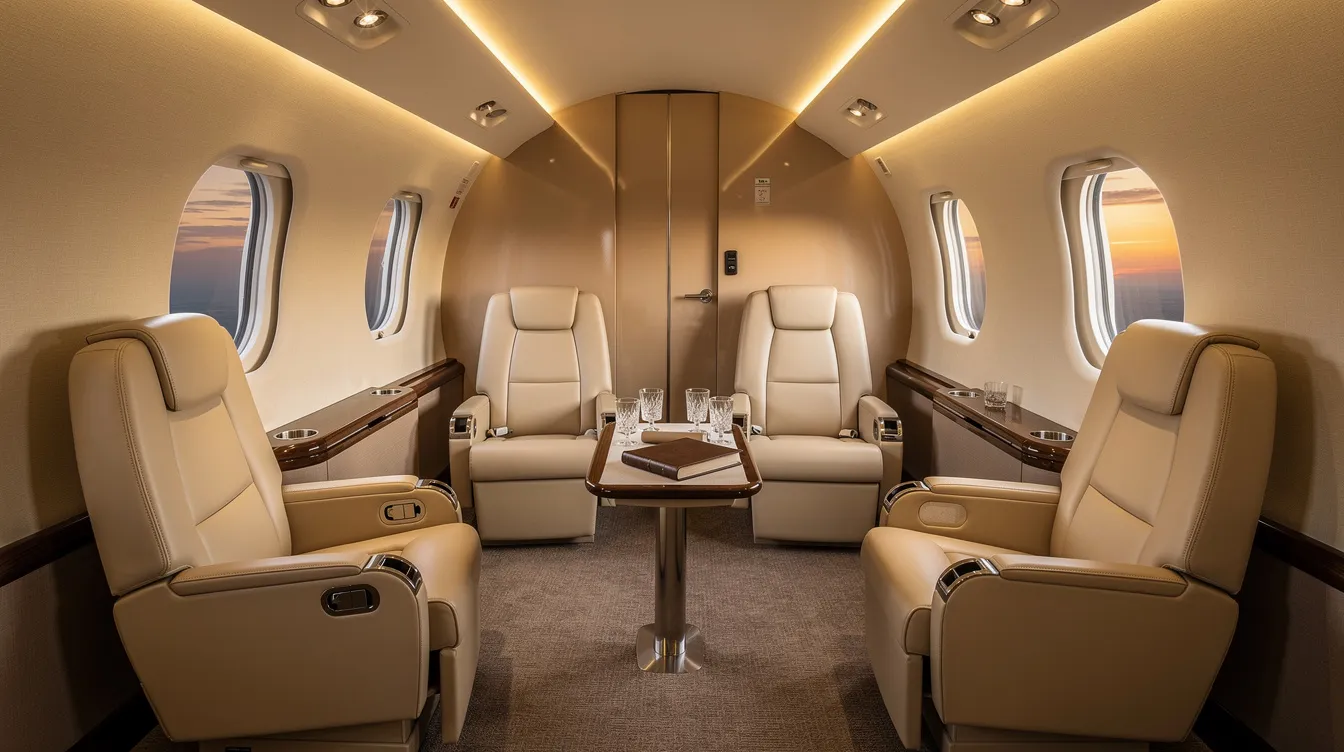
The cabin often defines the experience more than the exterior. Luxury private planes prioritize passenger wellness, modular residential spaces, and ultra-low cabin altitudes to eliminate travel fatigue.
Luxury private jets often feature customizable cabin layouts, allowing owners to tailor the interior to their specific needs, such as formal conference areas or residential-style suites. A Gulfstream G700 may feature several distinct zones, while a Bombardier Global 7500 can include a dedicated suite and shower-equipped lavatory.
Fractional aircraft ownership fleets usually use standardized, business-focused layouts. Bespoke private jet owners may choose private suites, guest areas, and crew separation for longer missions.
The interiors of luxury private jets can include designated living spaces such as master bedrooms, guest bedrooms, dining areas, and entertainment rooms, transforming the aircraft into a mobile luxury hotel. Customization options for luxury private jets can include high-end finishes like gold, crystal, and cashmere, as well as bespoke artwork and décor that reflect the owner’s personal style.
Many discerning travelers now prefer understated residential design: natural woods, soft textiles, and lighting that supports rest. For short business routes, ergonomics and cabin function often matter more than ornate decoration.
Advanced technology is now standard in premium air travel. Newer aircraft can include 4K displays, streaming systems, secure VPN-capable satellite internet, tablet-controlled cabin systems, synthetic vision, and predictive maintenance tools.
BlackJet’s partner networks prioritize aircraft with modern avionics and connectivity. This supports both productivity and relaxation, especially for frequent flyers who need dependable communications while airborne.
Buying an aircraft means funding the acquisition and the ownership ecosystem around it. According to industry pricing summaries such as Stratos Jets’ private jet cost guide, prices vary widely by aircraft size, age, and customization.
The purchase price of a luxury private jet can vary significantly, with new jets costing anywhere from $3 million to over $500 million, depending on the model and customization options. The initial purchase price for very light or light categories may begin in the low millions, while large-cabin aircraft such as the Gulfstream G700 or Global 8000 can exceed $70 million before extensive interior work.
Pre-owned jets can reduce capital outlay, but refurbishments, connectivity upgrades, avionics retrofits, and inspections can add millions. For travelers needing only 25–150 hours yearly, private jet ownership often ties up more capital than the mission requires.
Annual operating costs for private jet ownership can range from $500,000 to $4 million, depending on the size of the aircraft and its usage. Ongoing operational costs for private jets include fuel, maintenance, crew salaries, insurance, and hangar fees, which can add up significantly over time, so many buyers compare these expenses with the comprehensive cost structure of fractional jet ownership before committing capital.
Owners also face crew expenses, training, engine reserves, navigation charges, handling, cleaning, and additional services. According to OMNIJET operating cost data, direct operating costs can range from roughly $1,500–$1,800 per hour for very light jets to more than $6,000 per hour for heavy jets, before fixed ownership expenses.
A low asking price does not make an aircraft inexpensive. Depreciation, residual value risk, unscheduled repairs, regulatory compliance, and additional costs can change the economics quickly, which is why understanding the total cost of fractional jet ownership is critical when comparing it to full ownership.
Fractional ownership reduces individual exposure by spreading capital, crew, maintenance, and management across multiple owners. It also gives private jet users a structured way to access aircraft without building a full flight department, and a solid grasp of fractional jet ownership terminology and concepts. An aircraft fractional ownership sample contract helps clarify how these shared structures really work.
Many travelers want luxury private jet travel without full private jet ownership. The main alternatives are on-demand charters, jet cards or memberships, and fractional aircraft ownership, and comparing fractional jet ownership vs membership programs helps align structure with actual flying habits and budget.
On-demand charters allow customers to rent private jets for individual trips without any long-term commitments, making them an excellent option for infrequent flyers or those with fluctuating travel needs. Private jet charter is useful for fewer than 25 hours per year or when routes and passenger needs change frequently.
The trade-off is less predictability. Pricing, aircraft type, service consistency, and availability may vary by operator and market conditions.
Jet card memberships provide access to a fleet of private jets on an as-needed basis, enabling customers to pre-purchase flight hours at a fixed hourly rate.This option offers more flexibility compared to fractional ownership and is typically ideal for travelers logging around 25–50 hours annually.
BlackJet’s Reserve Fleet works in this membership-style category, offering access to vetted aircraft without asset ownership. Members can request suitable aircraft, from very light jets for regional trips to larger jets for special missions. Clients gain transparent pricing, defined service standards, and flexibility to request the right aircraft for each trip.
Fractional ownership programs allow individuals or companies to purchase a share of a private jet, entitling them to a set number of flight hours per year; for many, a 1/8 fractional jet ownership structure provides roughly 100 hours annually while sharing costs with other owners. This option provides many benefits of full ownership at a lower cost and with fewer responsibilities, and evaluating fractional jet ownership as an investment clarifies whether those trade-offs match long-term goals. Fractional jet ownership typically works best around 50–150 hours per year.
BlackJet’s Equity Fleet helps clients select the right aircraft type, from very light jets and light jets to midsize and larger jets. For many travelers, flexible floating fleet structures within fractional ownership also provide access to multiple aircraft rather than a single tail number. BlackJet handles management, crew, maintenance, hangar arrangements, and scheduling, allowing owners to focus on using the aircraft.
Traveler profile | Best-fit model | Why it works |
|---|---|---|
Under 25 hours/year | Charter | Pay trip by trip |
25–50 hours/year | Jet card or Reserve Fleet | Predictable access without equity |
50–150 hours/year | Fractional ownership | Ownership benefits plus guaranteed availability |
200+ hours/year | Full ownership evaluation | Control may justify cost |
A U.S. executive team flying 60 hours yearly between New York, Chicago, and Dallas may fit a light or midsize fractional structure. A family office flying 120 hours between North America, Europe, and the Middle East may need super-midsize or large-cabin access with occasional supplemental lift.
BlackJet Fractional Jet Ownership focuses on predictable access, professional management, and transparent pricing. The goal is not to sell the largest aircraft, but to align private aviation with actual travel needs.
The Reserve Fleet is a membership-style solution for clients who want private aircraft access without owning a share. Members can request suitable aircraft, from very light jets for regional trips to larger jets for special missions.
For example, a business owner may use Reserve Fleet access for meetings across the United States and occasional Caribbean travel. This model avoids ownership risk while improving consistency over ad hoc charter.
The Equity Fleet involves purchasing an actual share in an aircraft model or category managed by BlackJet. It includes priority scheduling, guaranteed availability within defined notice windows, and potential tax advantages where applicable.
BlackJet coordinates crew, maintenance, management, and scheduling. For many clients, this creates a “my own jet” experience while spreading capital and operating costs across a broader ownership base.
BlackJet reviews travel history, routes, passenger loads, luggage needs, and timing patterns. This prevents overbuying, such as choosing a large-cabin jet when a light or midsize aircraft handles 90% of missions efficiently, and it frames those decisions against the overall cost profile of fractional jet ownership versus other access models.
A company moving from an irregular charter to a fractional structure may reduce effective cost per flight hour by improving aircraft fit, avoiding repeated repositioning charges, and locking in clearer scheduling rules, then later apply similar rigor when selling a fractional jet ownership share if travel needs change.

The best decision starts with a mission profile, not brand reputation. Where do travelers fly, how often, with whom, and how much flexibility is required?
The key factors are maximum range, passenger count, luggage, runway performance, and airport access. Private aircraft can utilize smaller regional airports, facilitating closer access to final destinations.
Travelers with short-runway needs may consider aircraft such as the Pilatus PC-24 or Dassault Falcon 7X/8X family. Large groups may need large-cabin aircraft or executive airliners, but most clients should size around 80–90% of typical trips instead of rare exceptions.
More cabin space, full bedrooms, and extra crew facilities increase comfort but also fuel burn and complexity. A well-equipped midsize jet can provide a premium experience without the cost profile of flying mansions.
Interior refreshes and avionics upgrades can also make older airframes feel contemporary. BlackJet often recommends right-sizing first, then upgrading when usage patterns clearly justify more cabin and range.
Future-ready private jets include efficient engines, modern avionics, upgradeable cabin systems, and sustainable aviation fuel compatibility. These factors may support resale value and corporate ESG goals.
BlackJet and its partners monitor fleet technology and maintenance programs so fractional aircraft remain competitive. This matters over a 10–15-year ownership horizon.
Fractional jet ownership usually makes sense for travelers flying about 50–150 hours per year, but understanding essential fractional ownership contract terms and essential liability coverage in fractional jet ownership is just as important as matching the right hour band. Below roughly 25 hours, a charter or a flexible membership may be better; above 200–250 hours, full ownership can be evaluated, and reviewing leading fractional jet ownership programs can help benchmark options against those thresholds.
When operated under reputable Part 135 or Part 91K programs and maintained to manufacturer standards, modern business jets can meet very high safety expectations. Operator oversight, crew training, maintenance discipline, and third-party audits such as ARGUS, IS-BAO, or Wyvern are key.
In the United States, some fractional jet owners may be able to claim depreciation or business expense deductions when the aircraft is used primarily for qualifying business travel. Dedicated guidance on the tax implications for fractional jet owners underscores that treatment depends on personal facts, business use, and IRS rules, so clients should consult aviation tax counsel or a CPA.
Notice periods vary by provider, aircraft category, and share size. Many programs allow booking with 6–24 hours’ notice for non-peak travel, while holidays and major events may require longer notice or special rules.
Yes. Many modern programs allow cabin-class flexibility, letting owners upsize or downsize at adjusted rates. A client may hold a light jet share but access a midsize or large-cabin aircraft for occasional long-range travel.
Luxury private planes range from nimble very light jets to top luxury private jets such as Gulfstream, Bombardier, and Airbus or Boeing executive liners. The right choice depends on mission, budget, usage, and the level of control required.
Full ownership is only one path. Fractional jet ownership, Reserve Fleet access, and membership programs can deliver comparable comfort with less complexity and capital exposure.
Ready to explore the smarter way to fly private? Visit FractionalJetOwnership.com to request a personalized analysis from BlackJet Fractional Jet Ownership and learn how private aviation can help reclaim time, privacy, and control.
