June 24, 2026
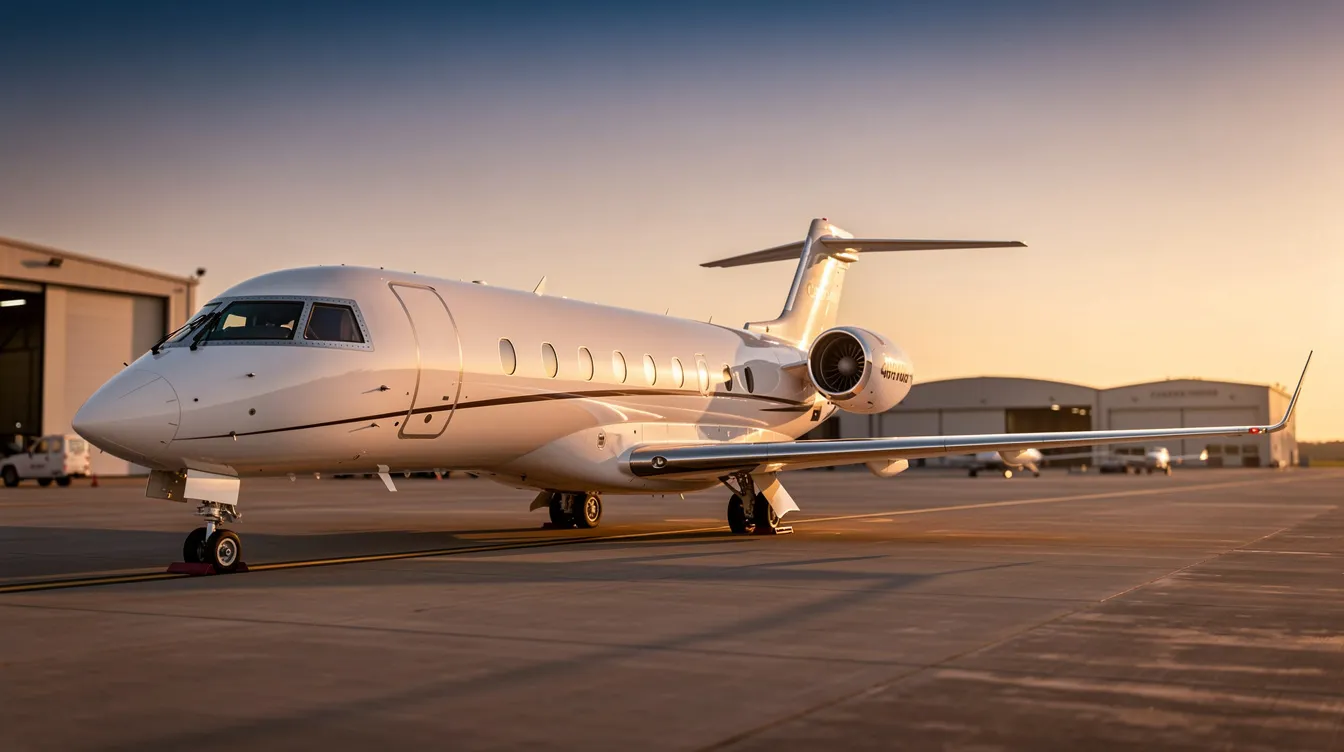
The term "million dollar plane" might sound extravagant, but in 2026's private aviation market, it barely scratches the surface. Today's business jets range from pre-owned light jets in the low single-digit millions to fully customized widebody airliners that cost hundreds of millions of dollars. Understanding what separates a $1 million Eclipse 500 very light jet from a $660 million Air Force One requires a closer look at the aircraft, the people who fly them, and the financial structures that make private aviation accessible to more than just billionaires.
A "million dollar plane" in 2026 can mean anything from a pre-owned Eclipse 500 very light jet at roughly $1 million to a customized Boeing 747-8 VIP worth $367 million or more. The term significantly understates what most modern private aircraft actually cost.
Full ownership of a large-cabin or ultra-long-range jet requires tens of millions in capital plus $1–3 million or more in annual operating costs, including fixed costs ranging from $800,000 for midsize jets up to over $2 million for ultra-long-range aircraft. For travelers flying under 150–200 hours per year, fractional jet ownership through programs like BlackJet Fractional Jet Ownership is almost always more cost-effective.
Different categories of private aircraft serve distinct missions: light jets handle regional hops with ranges typically between 1,000 to 1,500 nautical miles, super-midsize jets cover US coast-to-coast routes, and ultra-long-range models like the Bombardier Global 7500 and Gulfstream G700 fly nonstop between the US, Europe, and the Middle East.
Concrete examples—from the $78 million Gulfstream G700 with four distinct living areas to government platforms like Air Force One valued at $660 million—illustrate how range, cabin size, interior customization, and mission systems drive price.
Pricing for private planes is heavily influenced by aircraft age, maintenance history, and total operating time, with low-time jets commanding higher residual values and lower maintenance costs. Total ownership costs include both fixed expenses, such as crew salaries and hangar fees, and variable costs like fuel and maintenance reserves, which can range from $2,200 to $2,800 per flight hour for midsize jets.
BlackJet Fractional Jet Ownership offers both Reserve Fleet and Equity Fleet programs, giving individuals and businesses access to these aircraft without the complexity of owning a full plane, while fractional ownership provides guaranteed availability and tax benefits not available through jet cards.
The phrase "million dollar plane" is a relic of an earlier era. While private planes priced around $1 million are generally pre-owned light jets—the Eclipse 500, for example, sits within the very light jets category and is frequently priced around $1 million in the pre-owned market—most new business jets start well above that figure. At the top of the market, the Gulfstream G700 has a base price of $78 million, and customized VIP airliners routinely exceed $300 million. The aviation industry has evolved far beyond what a single million dollars can buy.
To understand the landscape, it helps to distinguish the main categories. Light jets such as the Cessna Citation CJ series and Citation V Ultra seat four to seven passengers with ranges of 1,000 to 1,500 nautical miles, best suited for regional flights. Midsize and super-midsize aircraft like the Gulfstream G200 and Bombardier Challenger 300 stretch range to 2,000–3,500 nautical miles with cabins for eight to ten. Large-cabin, long-range business jets—the Bombardier Global 6500 and 7500 (priced at $59,995,000), Dassault Falcon 900LX, and Gulfstream G650ER—cover 6,500 to 8,000 nautical miles nonstop with multiple living zones. At the far end sit VIP airliners, or "bizliners," like the Boeing 747-8 VIP (worth $367 million), Airbus ACJ350, and Airbus A340-300 VIP, which are essentially flying mansions.
Prices vary dramatically based on aircraft age, flight hours, and upgrades. A new Bombardier Global 8000 lists around $78 million; a new Gulfstream G700 can reach $78–$96 million when fully equipped. Meanwhile, billion-dollar military aircraft like the Northrop Grumman B-2 Spirit are not private jets, and platforms like Air Force One (valued at $660 million) bridge government, security, and VIP interior concepts at costs measured in the hundreds of millions. This article focuses on privately operated jets, VIP airliners, and fractional-ownership-accessible aircraft—including the kind of private plane high-net-worth travelers can realistically experience.
The Gulfstream G650ER and G700 define the top tier of business jets. The G700 offers a range of roughly 7,750 nautical miles, a top speed near Mach 0.935, and a cabin volume of approximately 2,603 cubic feet with four distinct living areas. Owners like Jeff Bezos and Elon Musk have purchased aircraft in this family, favoring the ability to fly nonstop between New York and Tokyo or Los Angeles and London. The G700 cabin can accommodate up to 19 passengers and includes panoramic oval windows and Gulfstream's Symmetry flight deck.
The Dassault Falcon 7X and 8X bring a distinctive tri-jet design with ranges of 5,950 to 6,450 nautical miles. These aircraft are popular in Europe and the Middle East for long-haul flights, valued for their ability to access shorter runways that other aircraft of similar size cannot. The Bombardier Global 7500, priced at $59,995,000, competes directly with the G700, while the newer Bombardier Global 8000 pushes range near 8,000 nautical miles—enough to connect New York to Hong Kong or Dubai to Los Angeles without a fuel stop.
When billionaires and royal families need more space than even the largest business jet can offer, they turn to VIP airliners. The Boeing 747-8 VIP is worth $367 million in a customized configuration, offering approximately 5,000 square feet of interior space across multiple zones. Hong Kong billionaire Joseph Lau famously owns a 747-8I VIP. The Boeing 787-8 BBJ costs $225 million before customizations, with final fit-outs often adding another $100 million or more.
Russian-born billionaire Roman Abramovich has been associated with some of the world's most expensive private aircraft, while Uzbek-born Alisher Usmanov's Airbus A340-300 VIP, known as the "Bourkhan," runs approximately $400 million after its lavish interior was completed. Perhaps the most extreme example is the Airbus A380 VIP concept ordered by Prince Al-Waleed Bin Talal, which costs $600 million after customizations. The Airbus A380 features a Turkish bath and a glass elevator across multiple decks, with private suites and a prayer room. Some jets in this class feature showers and elevators for added luxury, along with gold-plated fixtures and marble floors. Interiors can include a dining room, conference rooms, private bedrooms, bathrooms, dedicated offices, and vaulted ceilings that transform the aircraft into a true flying mansion.
The US government adapts commercial jets into ultra-secure million-dollar planes. Air Force One is valued at $660 million, and the current VC-25A operates at roughly $200,000 per flight hour. Air Force One has a medical quarter and conference room, along with hardened communications and defensive systems. The planned VC-25B replacement, based on the Boeing 747-8, has seen program costs reach $4.4 billion. Other government VIP aircraft include the Boeing 777-300ER used by Qatar Amiri Flight and various air force VIP transports worldwide. These are priced not just as aircraft but as mobile command centers hardened for conflict zones.
As of 2025, the global fleet of business aircraft totals approximately 38,489 units, of which roughly 23,000 are jets and the rest are turboprops. How many private jets exist in any given country depends heavily on economic concentration and the regulatory environment. The United States holds more than half of the world's private jet fleet, followed by Europe—particularly the UK, Germany, France, and Switzerland. The Middle East, led by Saudi Arabia, the UAE, and Qatar, is home to some of the largest and most expensive private aircraft, including VIP airliners and royal fleet jets. Growing markets in Asia and Latin America are adding aircraft at an accelerating pace.
The typical private jet owners fall into three categories: ultra-high-net-worth individuals (billionaires, celebrities, sports franchise owners), corporations needing frequent executive travel, and governments and royal families operating dedicated VIP fleets. Some billionaires own multiple aircraft—combining a long-range jet like a Gulfstream G650 for overseas travel with smaller Cessna Citation or turboprop aircraft for regional hops. President Donald Trump, for example, has been known to operate a Boeing 757 alongside other aircraft for private use and campaign travel.
While some private jet owners maintain entire fleets, many more frequent flyers rely on fractional jet ownership and membership programs to access the same categories of aircraft without purchasing a whole plane, and understanding essential fractional jet ownership terms helps them evaluate these options clearly.
Matching the right private aircraft to a travel profile is the most practical decision a buyer or fractional owner can make. The key variables are city pairs, passenger capacity, long distances versus regional hops, and how often the aircraft will fly.
Light and entry-level jets include aircraft like the Eclipse 500, Embraer Phenom 100, Cessna Citation V Ultra, and Cessna Citation Jet. Pre-owned prices sit in the low single-digit millions, with the Eclipse 500 frequently priced around $1 million in the pre-owned market. These carry four to seven passengers with an operational range typically between 1,000 to 1,500 nautical miles, suitable for short-haul flights such as New York to Miami or London to Geneva. High cruise speeds for jets in this class can reach around 425 mph, and a passenger forward galley is standard for basic catering. Pricing is influenced by aircraft age and maintenance status, with maintenance history significantly affecting purchasing price. Aircraft with low operating time have higher residual value and lower maintenance costs.
Midsize and super-midsize jets such as the Gulfstream G200, Bombardier Challenger 300, and Learjet 45XR offer 2,000 to 3,000 nautical miles of range and seat eight to ten passengers. These are ideal for US coast-to-coast missions or transcontinental flights between Europe and the Middle East. Annual fixed costs for midsize jets range from $800,000 to $1.2 million, with variable costs between $2,200 and $2,800 per flight hour.
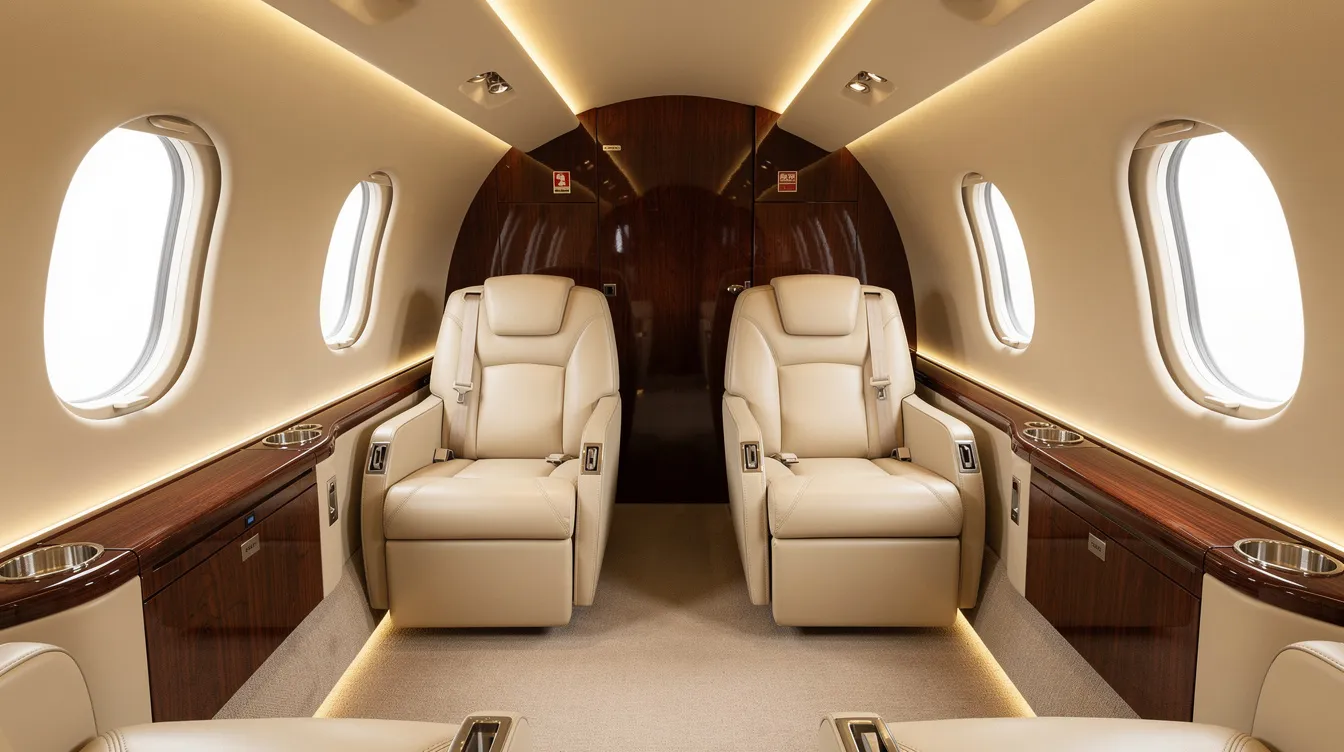
Large-cabin, ultra-long-range jets include the Dassault Falcon 900LX, Falcon 7X, Bombardier Challenger 650, Global Express, Global 6500, Global 7500, and Gulfstream G450. These cover long distances up to 7,500–8,000 nautical miles with quiet cabins, lie-flat seats, and dedicated zones for office work, lounge, and bedroom—purpose-built for overnight long-haul flights. Interior comfort includes high-end finishes and climate control features that maintain low cabin altitude to reduce fatigue. Large-cabin jets have annual fixed costs of $1.4 to $1.8 million, while ultra-long-range jets exceed $2 million in annual fixed costs. Engine overhaul on a Gulfstream G550 costs $2.5 to $3.5 million per engine.
VIP airliners and military-adjacent platforms such as the Boeing 747-8I VIP, 787-8 BBJ, Boeing 777-300ER VIP, Airbus ACJ319neo, ACJ350, and Airbus A340-300 serve as "flying headquarters" with conference spaces, full dining areas, and extensive staff and crew seating. Government aircraft like Air Force One and similar airframes in other air forces or state fleets are priced not as transport, but as mobile command infrastructure, whereas many private travelers access comparable capability and flexibility through floating fleet fractional ownership options instead of a dedicated aircraft.
The airframe is only part of a million-dollar plane's cost. Interior customization, avionics, and ongoing operations multiply the lifetime investment into hundreds of millions of dollars for some owners. Total ownership costs include both fixed and variable expenses, and understanding the split is essential before signing any purchase agreement.
Acquisition and customization costs can add tens of millions to the base airframe. Customization and lavish interior fit-outs—executed by firms like Lufthansa Technik or Greenpoint Technologies—can add $50 million to $200 million. Even details like custom paint schemes, bespoke furniture, and cabin technology integrations add millions. Avionics upgrades, including HUD, Enhanced Vision Systems, Starlink or Ka-band internet, and predictive weather radar, further increase acquisition cost. Aircraft often feature advanced avionics for superior situational awareness, which directly supports safety and efficient routing, and all of these elements factor into the total cost of fractional jet ownership when you buy a share instead of the whole aircraft.
Operating costs include annual fixed expenses such as crew salaries, hangar fees, insurance, and management, ranging from $800,000 to $1.2 million for midsize jets, $1.4 to $1.8 million for large-cabin jets, and over $2 million for ultra-long-range jets. Variable costs such as fuel, maintenance reserves, landing fees, and handling add $2,200 to $2,800 per flight hour for midsize jets, with larger jets costing significantly more. A single-engine overhaul on a Gulfstream G550 can cost $2.5 to $3.5 million, a maintenance event rivaling the purchase price of a light jet, which is why many buyers look closely at fractional jet ownership financing options instead of funding 100% of these expenses themselves.
Depreciation and resale value depend on aircraft age, maintenance history, and total operating time. For example, a $100 million Boeing 757 like the one operated by former President Donald Trump can decline to under $10 million in market value over a decade-plus. Popular models like the Bombardier Global, Gulfstream G-series, and Dassault Falcon tend to hold value better than older airliners converted into VIP jets, and similar dynamics apply when selling a fractional jet ownership share and trying to time your exit.
This cost profile is why many buyers now prefer fractional aircraft ownership and membership programs instead of bearing 100% of the capital and operating burden, making it critical to understand the full cost of fractional jet ownership before choosing a program.
Category | Typical Price Range | Passenger Capacity | Range (Nautical Miles) | Annual Fixed Costs | Variable Costs (per Flight Hour) |
|---|---|---|---|---|---|
Very Light Jets | $1M - $5M | 4-7 | 1,000 - 1,500 | $300,000 - $500,000 | $1,200 - $1,800 |
Midsize Jets | $5M - $15M | 8-10 | 2,000 - 3,500 | $800,000 - $1.2M | $2,200 - $2,800 |
Large-Cabin Jets | $15M - $60M | 10-19 | 4,000 - 7,500 | $1.4M - $1.8M | $3,500 - $4,500 |
Ultra-Long-Range Jets | $60M - $100M+ | 12-19 | 7,000 - 8,000+ | $2M+ | $4,500 - $5,000+ |
VIP Airliners | $200M - $600M+ | 30+ | 7,000+ | $5M+ | $10,000+ |
BlackJet Fractional Jet Ownership serves individuals and businesses flying roughly 25 to 150 hours per year who want consistent access to high-end business jets without the complexity of full ownership. Fractional ownership allows shared access to private jets, splitting the capital, crew, and management responsibilities across multiple owners, and many buyers evaluate fractional jet ownership as an investment alongside lifestyle and travel needs.
BlackJet offers two primary models. The Reserve Fleet provides pay-as-you-go access to a curated fleet with no capital investment and guaranteed availability within defined notice periods. The Equity Fleet provides true fractional aircraft ownership shares with potential tax benefits, priority scheduling, and customized aircraft sourcing. Equity Fleet models provide priority access to specific aircraft, and fractional ownership includes specific tax implications and potential benefits not available in jet cards.
These programs connect clients to aircraft similar to those highlighted earlier—large-cabin and long-range jets such as the Bombardier Global 6500 and 7500, Dassault Falcon 900LX and 7X, Challenger 650, and Gulfstream G-series. Clients have the ability to choose aircraft size based on trip profile, from light jets for regional trips to ultra-long-range jets for intercontinental flights. Fractional ownership offers guaranteed availability of aircraft, and BlackJet handles professional aircraft management, maintenance, and crew, much like the leading fractional jet ownership programs for smart investors across the industry. There is no need for the owner to manage jet acquisition, inspections, or resale.
Consider a US-based CEO flying 100 hours per year between New York, London, Dubai, and domestic meetings. Rather than purchasing a $70 million aircraft outright, that executive leverages an Equity Fleet share in a Bombardier Global or Dassault Falcon 7X, similar to a 1/8 fractional jet ownership structure that typically provides around 100 flight hours annually. Fractional programs typically require 200 to 250 flight hours annually to match the economics of full ownership, so for anyone flying below that threshold, fractional access delivers the experience of a million-dollar plane with significantly reduced financial and administrative overhead.
The jets for sale market in 2026 spans everything from pre-owned Cessna Citation V Ultras in the low single-digit millions to nearly new Bombardier Global 7500s and Dassault Falcon 8Xs listed near their original delivery price. A former owner selling a well-maintained aircraft with one owner on the logbooks and low total hours commands a premium, while high-time airframes with deferred maintenance trade at steep discounts.
Buyers of private aircraft prioritize several key features. Range and performance top the list—can the aircraft handle frequent long-haul flights like New York to Tokyo or London to Dubai nonstop? Cabin configuration matters: nine to fourteen-passenger layouts with crew rest areas, galleys, lie-flat seats, and quiet cabins for work and sleep. Connectivity is now non-negotiable, with Gogo AVANCE L5, Ka-band, or Starlink internet expected, along with cockpit upgrades like FANS 1/A, ADS-B transponders, RVSM compliance, and WAAS/LPV approach capability.
Recent listings in 2025–2026 highlight features like blended winglets on the Dassault Falcon 900EX, engine and APU programs (MSP Gold, CorporateCare), and recent C-checks as markers of a strong pedigree. Examples include a Learjet 45XR with JSSI programs, a Bombardier Global Express equipped with HUD and internet, and a Gulfstream G450 with low hours and enrolled engines. Buyers must balance purchase price against upcoming maintenance—240-month inspections and engine overhauls can add or subtract millions from the effective cost.
For many high-net-worth individuals, purchasing a full aircraft is still less attractive than fractional ownership or membership when annual use falls under 150 to 200 hours. Before putting your name on a registration, consider whether you truly need outright ownership—or simply need the consistent experience and control that BlackJet can provide, after weighing fractional jet ownership versus membership programs for your travel profile.
Business jets compress global distances and enable same-day agendas that are impossible on commercial airlines. Advanced technology in aircraft improves travel efficiency compared to commercial flights, turning what would be a two-day itinerary into a single productive day.
Private aviation saves time by avoiding long security lines and crowded terminals. Executives depart from closer regional airports, skip TSA queues, and fly direct to secondary airfields near final destinations. Private jets access 10 times more airports than airlines, which matters when your meeting is in Teterboro, not JFK. Onboard connectivity and quiet cabins allow executives to work, hold confidential meetings, or rest between high-stakes engagements—and 38% of business aviation missions involve multiple destinations in a single day.
Consider a US private equity firm team flying from New York to Houston to Los Angeles in one day, using a Challenger 650 or Gulfstream G450, conducting deal meetings at each stop before returning home to their loved ones that evening. Or a Middle East family business regularly commuting from Riyadh to London to Geneva on a Bombardier Global 7500 with bedrooms and a shower, arriving rested and ready for morning meetings. Private jet users report 23% higher revenue growth than non-users—a statistic that reflects the efficient use of time and resources that luxury air travel provides.
Fractional ownership and membership programs optimize aircraft use by right-sizing the plane for each mission. There is no reason to fly a 14-seat jet half-empty when a super-midsize will do. Fleet access allows consistent service levels without being locked into a single aircraft type. Private jets also provide a higher level of security during travel, with direct boarding from private terminals (FBOs), limited passenger manifests, and the ability to transport sensitive documents or equipment securely. Reduced exposure to delays and cancellations common at airline hubs is another tangible advantage.
Million-dollar planes are not just about status. They are about strategic control over time and mobility.

As of 2025, the global business jet fleet totals roughly 23,000 jet aircraft, with the broader business aviation fleet (including turboprops) reaching approximately 38,489 units. The United States accounts for more than half of all business jets in the world, followed by Europe (UK, Germany, France, Switzerland), the Middle East (Saudi Arabia, UAE, Qatar), and emerging markets in Asia and Latin America.
This figure includes everything from light Cessna Citations and Embraer Phenoms to large-cabin Bombardier Global and Dassault Falcon jets, plus a smaller number of VIP airliners like the Boeing 747-8 VIP and Airbus ACJ models.
Access to full VIP airliners—such as the Boeing 747-8 VIP or Airbus A340-300 VIP—is rare and typically reserved for governments, royal families, or ultra-high-net-worth individuals who own or fully charter these aircraft. On-demand charter availability for these platforms is extremely limited.
For most travelers, large-cabin long-range business jets like the Bombardier Global 7500, Gulfstream G650 or G700, and Dassault Falcon 7X or 8X offer a comparable experience for long-haul flights at a fraction of the sale price. These can be accessed through fractional ownership, membership programs, or on-demand charter.
For travelers flying roughly 25 to 150 hours per year, fractional ownership is almost always more cost-effective than full ownership because capital, depreciation, and fixed costs are shared across multiple owners. The break-even point where full ownership becomes more efficient typically falls around 200 to 250 flight hours annually.
Fractional programs like BlackJet's Equity Fleet model still provide ownership benefits—including potential tax advantages—and prioritized scheduling, while eliminating the need to hire crew, manage maintenance, or handle resale.
Several leading ultra-long-range business jets are designed for trips of 7,000 to 8,000+ nautical miles: the Bombardier Global 7500 and 8000, Gulfstream G650ER and G700, Dassault Falcon 8X, and select Airbus ACJ and Boeing BBJ variants. These aircraft are optimized for nonstop routes like New York to Hong Kong, Los Angeles to Dubai, or London to Singapore, with full cabins, lie-flat beds, and advanced cabin-pressure and lighting systems designed to reduce jet lag.
Charter is best for occasional flyers who need flexibility but can accept variability in pricing and aircraft quality from trip to trip. Jet card programs offer more predictability in hourly rates and service standards, making them suitable for moderate use. Fractional ownership is ideal for consistent flyers who value guaranteed availability, better hourly economics at higher usage, and potential tax benefits that jet cards do not offer.
The right choice depends on annual flight hours, typical routes, passenger count, and how much control you want over aircraft selection. BlackJet Fractional Jet Ownership can help analyze your annual flight profile and determine the most efficient structure for accessing million-dollar planes—visit FractionalJetOwnership.com to start the conversation.
The world of million-dollar planes spans from efficient light jets that cost a few million dollars to ultra-luxury Boeing 747-8 VIPs delivered with entire living suites. The real value lies not in the paint or the marble—it is in time saved, flexibility gained, and control over complex, multi-city travel schedules.
Full private jet ownership requires tens or hundreds of millions in capital plus high annual operating costs. For most frequent flyers, that level of commitment is more than they actually need. BlackJet Fractional Jet Ownership offers a smarter path: predictable access, professional management, and the option to fly long-range aircraft such as the Bombardier Global or Dassault Falcon model families without full ownership.
Ready to explore the smarter way to fly private? Visit FractionalJetOwnership.com to learn how fractional ownership and membership programs can give you access to million-dollar planes on your terms.
