
May 17, 2026
In today’s private aviation landscape, the Embraer Phenom 300E stands out as a top choice for executives, entrepreneurs, and families seeking efficient, reliable, and comfortable travel. Known for its impressive speed, range, and cabin design, the Phenom 300E blends performance with practicality. However, acquiring this light jet involves more than just purchase price—it requires understanding the best ownership model to fit your travel needs and budget.
Whether considering a full aircraft purchase or exploring fractional ownership and shared-use programs, buyers searching for a “phenom 300e for sale” in 2026 face multiple options. BlackJet Fractional Jet Ownership offers expert guidance and flexible solutions tailored to how you fly. This introduction outlines why the Phenom 300E remains a market leader and previews the smart ownership paths that can make private jet travel more accessible and cost-effective.
Buyers searching “phenom 300e for sale” in 2026 have more than one path to access this leading light jet. A whole-aircraft purchase can make sense for high-utilization owners, but fractional jet ownership and shared-use programs can deliver similar utility with less operational burden.
Late-model Embraer Phenom 300E aircraft from 2018–2025 typically trade in the roughly $8M–$13M USD range as of 2026, depending on age, hours, maintenance status, upgraded avionics, paint, cabin options, and program enrollment.
BlackJet Fractional Jet Ownership provides access to the Embraer Phenom and similar light jets through Reserve Fleet pay-as-you-fly access and Equity Fleet fractional aircraft ownership.
Fractional ownership can offer predictable availability, shared fixed costs, professional aircraft management, and potential tax advantages in the United States.
Buyers should compare the full five-year private jet cost of ownership against a fractional share before committing to a specific aircraft sale.
To review current Phenom-class availability, contact BlackJet or visit FractionalJetOwnership.com.
The Embraer Phenom 300e remains one of the most desirable light jets in the United States and the global private aviation market. For over a decade, the Phenom 300 series has been widely recognized as a best-selling light jet because it combines speed, range, runway flexibility, and a cabin that suits both business and family travel.
The Phenom 300E reaches a maximum cruise speed of 464 knots, or 534 mph, and has a range of up to 2,010 nautical miles with 5 occupants. It can operate up to 45,000 feet, with a balanced field length of 3,209 to 3,643 feet, making it practical for a wide mix of regional airports and major business hubs.
The Phenom 300e typically seats 6 to 9 passengers, but can be configured for up to 10 occupants. The aircraft has a baggage capacity of up to 85 cubic feet, divided between internal and external compartments, which makes it useful for golf bags, ski luggage, product samples, or extended business travel.
Buyers comparing “Embraer Phenom” models often favor the 300E over very light jets and older Citation aircraft because it flies faster, goes farther, and offers a more refined cabin experience. The aircraft supports single-pilot operation, though many corporate and fractional operations use two pilots for additional consistency and passenger confidence.
The “E” in Phenom 300E stands for “Enhanced.” Starting around 2018, Embraer introduced a more modern cabin and technology package, including a Garmin G3000-based flight deck. According to AOPA’s overview of the reimagined Phenom 300E, the updated model brought meaningful improvements in ergonomics, avionics, and passenger comfort.
As of Q2 2026, the resale market for the Phenom 300E is tight but active. Well-maintained aircraft with strong maintenance programs are often marked “Sale Pending” soon after serious buyer attention, while stale listings may remain visible after the aircraft has already sold or gone under contract.
In recent market observations, 2018 Phenom 300E examples have been listed around $8.5M–$9.5M USD when total time is closer to 2,000–2,500 hours, with some examples asking near $8.9M. Near-new 2024–2025 aircraft can exceed $12M depending on equipment, warranty status, maintenance coverage, low flight hours, and cabin specification.
The broader Phenom 300 market also shows steady demand. Over the last 30 days, Phenom 300 aircraft listings have been priced between $7,595,000 and $8,495,000, with higher prices for aircraft with lower flight hours and better maintenance histories. On average, a Phenom 300 aircraft remains on the market for about 113 days, with well-equipped models selling faster, especially when competitively priced. In the past six months, 12 Phenom 300 aircraft have been reported as sold or under contract, indicating steady demand for this model.
Geography matters. Aircraft offered in major private aviation hubs such as New York, Dallas, Miami, London, Dubai, or Geneva may be listed as “call for price,” reflecting seller discretion, cross-border tax considerations, and local demand rather than a transparent asking price.
Maintenance programs also influence buyer interest. Enrollment in ESP Gold, JSSI, Embraer Executive Care, or even listing notes such as JSSI essential can affect how buyers underwrite future maintenance exposure. A clean, no-damage-history aircraft with new paint, updated interior, strong logbooks, and no major inspections coming due will usually attract more qualified inquiries.
Buyers should track listing update dates carefully. A page marked “Page last updated: 5/16/2026” is more useful than an old listing carried forward from October or an aircraft that has already been sold but remains online for lead generation.
Not every Embraer Phenom 300E is configured, maintained, or operated the same way. The difference between two aircraft with similar model years can be millions of dollars once avionics, maintenance programs, cycles, interior condition, and ownership pedigree are considered.
A 2018 Phenom 300E in 2026 may commonly show 2,000–3,000 total hours, though lower-time aircraft can command a premium. Buyers should review:
Total airframe hours and landing cycles
Recent 12-, 36-, and 48-month inspections
Any upcoming 5,000-hour inspections
Damage history or major repairs
Logbook continuity and service center pedigree
Hot section inspection timing for Pratt & Whitney engines
The Phenom 300E is equipped with Pratt & Whitney PW535E engines, which are part of the ESP Gold engine maintenance program. Engine program transferability should be confirmed before closing, because an aircraft with gaps in coverage can create surprise costs after purchase.
The Phenom 300E features a Garmin G3000 integrated avionics system with three 14.1-inch interchangeable displays and advanced flight management capabilities. In many listing descriptions, buyers may also see Prodigy Touch branding, which is Embraer’s Garmin-based flight deck presentation.
Important avionics and regulatory items include:
Garmin G3000 flight deck
Synthetic Vision
ADS-B compliance
TCAS II
Class A TAWS
RVSM approval
WAAS/LPV
Datalink weather
RNP 1 capability
Optional FANS 1/A for certain international missions
The aircraft supports single-pilot operation and includes a range of safety features such as TCAS II, RNP 1, and a standard synthetic vision system. For corporate, fractional, or international travel, BlackJet generally evaluates how the aircraft will be used in real-world flight operations, not just whether it looks attractive on a listing page.
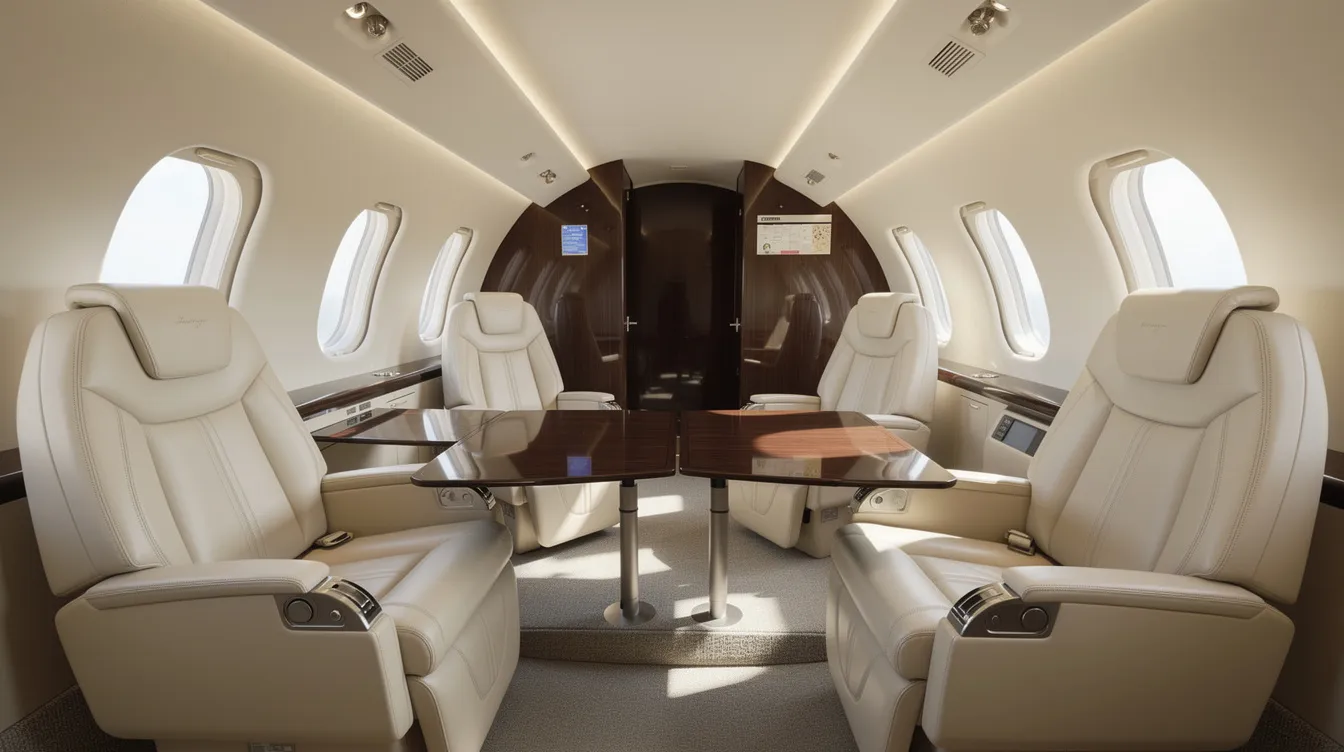
The cabin is one of the main reasons buyers choose the Phenom 300E. The interior of the Phenom 300E is designed for both utility and luxury, often compared to BMW-style automotive design. The result is a functional, modern environment rather than an overdecorated cabin.
The cabin altitude is best-in-class at 6,600 feet at cruising level, which reduces passenger fatigue. This matters on longer legs where executives need to arrive ready for meetings or families want a more comfortable travel day.
Common cabin items to review include:
6–9 passenger executive layouts
Belted aft lavatory options
Forward single-seat configurations
Divan or club seating
Refreshment center
In-flight Wi-Fi such as Gogo or Avance L3
Cabin management systems
USB and AC power
Interior soft goods and veneer condition
Listing notes, such as interior NXi, if used by a broker or operator
The Phenom 300E has a baggage capacity of up to 85 cubic feet, divided between internal and external compartments. That flexibility is important for passengers traveling with business equipment, luggage, or leisure gear.
A privately operated Part 91 aircraft may have fewer cycles and less cabin wear than a heavily chartered aircraft. However, a Part 135 aircraft can also be attractive if it has been maintained under strict oversight by reputable MROs or Embraer service centers.
Buyers should ask:
Was the aircraft used privately, for charter, or in a fractional program?
Are all logbooks complete and digitized?
Has the aircraft been based in a corrosive environment?
Were inspections performed by Embraer or a recognized maintenance provider?
Is there any damage history?
Are there open service bulletins or airworthiness directives?
A listing that looks strong online should still be verified by a technical representative before any deposit becomes non-refundable. For buyers considering shared ownership instead, it is equally important to review essential fractional ownership contract terms and understand how a well-drafted aircraft fractional ownership agreement allocates rights and responsibilities among owners.
Many buyers begin by searching “phenom 300e for sale” and then realize their flying profile does not justify full private jet ownership. For clients flying 25–150 hours per year, fractional ownership or shared-use access can often provide better capital efficiency.
Whole ownership gives one buyer full control of the aircraft. It also requires 100% of the capital outlay, often $9M–$13M for a modern Phenom 300E, plus crew, hangar, insurance, maintenance, scheduling, training, upgrades, regulatory support, and resale risk.
Operating the Phenom 300E generally costs between $2,300 and $2,500 per flight hour for variable expenses, while fixed annual costs average around $360,000 to $600,000. Those fixed costs apply whether the aircraft flies 50 hours or 250 hours per year, which is why low-utilization ownership can become expensive on an effective hourly basis.
Fractional aircraft ownership works differently. A client might acquire a 1/16 or 1/8 share in a Phenom-class light jet, typically supporting about 50–100 annual hours, while sharing fixed expenses with other owners. Before committing, it helps to review a concise glossary of key fractional jet ownership terms so you fully understand how shares, hours, and fees are defined. The owner receives access rights, scheduling priority, professional management, and potential participation in residual value at the end of the term.
BlackJet Fractional Jet Ownership structures Equity Fleet programs around mission needs. Instead of assuming every client should purchase a full aircraft, BlackJet evaluates passenger count, route distance, frequency, departure flexibility, business use, tax profile, and aircraft class, then helps clients understand the total cost of fractional jet ownership in that context.
Cost Element | Whole Ownership (Annual) | Fractional Ownership (Annual Equivalent) |
|---|---|---|
Purchase Price | $9M–$13M (one-time) | Share of $9M–$13M based on fraction |
Fixed Annual Costs (crew, hangar, insurance, maintenance reserves) | $360,000–$600,000 | Shared proportionally among owners |
Variable Operating Costs (per flight hour) | $2,300–$2,500 | Similar per hour, plus management fees |
Flight Hours Covered | Unlimited (owner's discretion) | Typically 50–100 hours per share |
Scheduling Priority | Highest (full control) | High priority within the fractional program |
Resale Risk | Full owner | Shared with other fractional owners |
Tax Benefits | Possible, depending on use | Potential depreciation and tax advantages |
Benefits of fractional vs. charter include many of the advantages outlined in this complete guide to the cost of fractional jet ownership:
Guaranteed availability with defined notice periods
Predictable monthly and hourly cost structure
Access to a professionally managed fleet
More consistent service than ad-hoc charter
Potential ownership and tax benefits that jet card programs do not provide
For many buyers, the smarter question is not “Which Phenom 300E should be purchased?” It is “Which access model creates the best outcome for the way this aircraft will actually be used?” Evaluating fractional jet ownership as an investment alongside whole-aircraft acquisition can clarify which structure best fits long-term goals.
BlackJet is not positioned as a traditional aircraft dealer focused only on completing a sale. BlackJet Fractional Jet Ownership specializes in fractional jet ownership, shared-use access, mission planning, and private aviation structures that fit how clients actually travel.
For some travelers, participating in a floating fleet fractional ownership model can further increase flexibility and aircraft availability compared with tying usage to a single tail number.
The Equity Fleet model provides fractional ownership stakes in Phenom-class or comparable light jets. Owners receive priority access, professional aircraft management, and a structure designed around predictable private aviation use.
For qualified business use in the United States, certain fractional ownership structures may offer tax advantages, including depreciation benefits when applicable. A detailed overview of the tax implications for fractional jet owners can help frame those conversations. Fractional owners should consult qualified aviation tax counsel, especially because the IRS has specific rules for fractional aircraft programs and fuel surtax treatment.
The Reserve Fleet model offers pay-as-you-go access without requiring an ownership share. This can be ideal for clients flying 25–75 hours per year who want the comfort and efficiency of light jet travel without committing capital to an aircraft.
Reserve Fleet access may suit:
First-time private aviation users
Executives testing a new travel pattern
Families with seasonal travel
Companies needing supplemental lift
Owners who already have one aircraft but need backup capacity
Some clients are determined to acquire a specific Embraer Phenom 300E. In those cases, BlackJet can help compare 2018–2025 listings against fractional alternatives on the total cost of use, including options for fractional jet ownership financing when appropriate.
That analysis may include asking price, hours, engine program status, avionics, paint, cabin condition, owner history, maintenance reserves, and expected resale position. It can also compare fractional ownership against jet membership and similar programs. BlackJet’s advisory approach can also include mission profiling for trips such as New York–Miami, Dallas–Aspen, or London–Geneva.
Clients can begin by providing a recent schedule summary by email or arranging a phone consultation with the BlackJet team through FractionalJetOwnership.com.
Practical scenarios help clarify when a Phenom 300E purchase, a fractional share, or a Reserve Fleet structure makes the most sense compared to charter and jet card programs.
A U.S.-based CEO flying 150–200 hours per year between regional cities may be a candidate for whole ownership or a substantial fractional share. If the executive frequently travels with 4–6 passengers, needs schedule control, and repeats similar routes, a Phenom-class aircraft can be highly efficient.
Whole ownership may become reasonable at this level if the aircraft is used consistently. However, the buyer still faces full capital outlay, crew staffing, insurance, maintenance management, and resale exposure. A BlackJet Equity Fleet share can reduce capital tied up in one aircraft while still delivering predictable access to similar performance.
A business owner flying 50–75 hours per year may not need a $9M+ aircraft sitting idle most of the month. For this client, BlackJet’s Equity Fleet or Reserve Fleet may be preferable to buying a single 2018–2020 Phenom 300E.
This profile often values flexibility more than aircraft control. A Reserve Fleet structure can provide access to the right class of aircraft without taking on depreciation, maintenance events, or owner administration.
Some clients combine weekday business travel with leisure trips for ski weekends, school breaks, and seasonal homes. A Phenom 300E may fit many of these missions, but not every trip requires the same layout, baggage capacity, or departure airport.
Fractional ownership can create access to a consistent light jet platform while still allowing flexibility when the mission changes. For example, a family may use a Phenom-class aircraft for regional trips and a larger jet for longer-range or heavier-passenger itineraries.
The best first step is simple: review the last 12–24 months of flight activity. City pairs, passengers, luggage needs, calendar constraints, and trip frequency provide the foundation for comparing fractional jet ownership against whole-aircraft acquisition.

When shortlisting a specific Embraer Phenom 300E aircraft in 2026, buyers and advisors should use a disciplined checklist. A beautiful listing photo is not a substitute for a technical review.
Request and review:
Complete logbooks
Compliance with mandatory service bulletins
Airworthiness directive status
Most recent 12-, 36-, and 48-month inspections
Any 5,000-hour inspection history
Upcoming hot section inspections for PW535E engines
Corrosion inspections, if applicable
Repairs, damage events, or undocumented gaps
Alongside maintenance programs, prospective fractional owners should also consider liability and insurance coverage in fractional jet ownership, since risk allocation can differ between providers.
Confirm the status and transferability of:
ESP Gold
JSSI coverage
Embraer Executive Care
OEM warranties on newer 2024–2025 aircraft
Airframe parts programs
Avionics support plans
A low asking price can become less attractive if the aircraft is outside key programs or approaching a major maintenance event. Likewise, fractional buyers should understand how and when they can sell or transfer a fractional jet ownership share if their travel needs change.
Confirm:
ADS-B Out
RVSM
TAWS
TCAS II
FAA or EASA conformity
Part 91 vs Part 135 operating history
Required equipment for international operations
Weight upgrades or design gross weight changes
Cabin configuration and passenger capacity
Any broker shorthand, such as forward single seat or interior NXi
Buyers should engage experienced aviation counsel, a technical representative, and a management company such as BlackJet or its partners before closing. Pre-purchase inspections, escrow terms, title review, tax planning, and aircraft management agreements should be addressed before the purchase agreement becomes binding.
A Phenom 300E is an exceptional light jet, but its full value depends on matching the aircraft to the right access model. Whole ownership, fractional ownership, and shared-use access each serve different types of travelers.
Readers actively searching “Phenom 300e for sale” should compare a specific aircraft purchase against BlackJet’s Equity Fleet and Reserve Fleet options. A five-year cost comparison can reveal whether full ownership is justified or whether fractional aircraft ownership offers a lower-risk path to the same travel outcome.
BlackJet can provide side-by-side analyses of sample 2018–2025 Phenom 300E listings, including asking price, total time, program enrollment, cabin specification, maintenance status, and likely cost exposure. That information can then be compared with a fractional jet ownership structure based on the client’s actual flight profile.
Ready to explore the smarter way to fly private? Visit FractionalJetOwnership.com to request a personalized flight profile review and receive current information on Phenom-class aircraft availability.
Final thoughts: the fastest path to better private aviation is not always buying the first attractive aircraft on the market. For many executives, families, and corporations, fractional ownership is the more flexible, cost-aware entry point into flying an Embraer Phenom 300E or equivalent jet.
As of mid-2026, pre-owned Embraer Phenom 300E aircraft generally range from about $8M–$13M USD, depending on model year, total time, maintenance status, avionics, and optional equipment.
2018–2019 examples with roughly 2,000–3,000 hours and strong maintenance programs may cluster around the $8.5M–$10M range. Nearly new 2024–2025 aircraft with low time, premium cabin options, fresh paint, and strong warranty coverage may command over $12M.
Buyers should also budget for acquisition costs, taxes, legal review, pre-purchase inspections, aircraft management setup, and annual operating expenses. Full aircraft ownership can add seven figures per year, depending on utilization and staffing.
In the United States, certain fractional jet ownership structures can qualify for tax advantages when the aircraft is used predominantly for qualified business purposes. These benefits may include depreciation treatment, including bonus depreciation when applicable under current law.
Specific outcomes depend on business use, ownership structure, documentation, and evolving tax rules. Clients should consult a qualified aviation tax advisor in addition to speaking with BlackJet about Equity Fleet planning.
BlackJet designs its Equity Fleet offerings with potential tax efficiency in mind and can coordinate with each client’s legal, accounting, and aviation advisors.
Jet card programs usually provide fixed hourly access without equity. They can be useful for occasional flyers, but they do not provide ownership rights, potential residual value, or the same level of fleet-specific consistency.
Fractional aircraft ownership includes an ownership stake in a defined aircraft or fleet type. Fractional owners often receive higher scheduling priority, more predictable access to a Phenom-class light jet, and the ability to sell their share at the end of the term.
Travelers flying 50–150 hours per year often find fractional aircraft ownership with BlackJet more predictable than relying only on jet card programs and ad-hoc charter, especially after reviewing independent comparisons of the top fractional jet ownership programs.
Yes. While BlackJet’s core focus is fractional jet ownership and shared-use solutions, its team can help whole-aircraft buyers benchmark specific Phenom 300E listings against fractional alternatives.
BlackJet can connect clients with trusted brokers, aviation counsel, technical representatives, and maintenance providers. It can also help manage supplemental lift needs through Reserve Fleet access.
This hybrid support is especially useful for corporations that want to own one Embraer Phenom while still needing flexible access to additional aircraft types or backup capacity.
First-time private aviation users should begin by defining typical missions: city pairs, passenger count, baggage needs, departure flexibility, and annual frequency. A light jet like the Phenom 300E is excellent for many regional and medium-distance missions, but it is not the right aircraft for every trip.
BlackJet routinely advises newcomers on whether a Phenom-class light jet, a midsize aircraft, or a diversified fractional portfolio offers the best mix of private jet cost, comfort, capability, and scheduling flexibility.
To review options before committing to any specific Embraer Phenom 300E for sale, contact BlackJet through FractionalJetOwnership.com.
Choosing the right path to access an Embraer Phenom 300E is a critical decision that balances cost, convenience, and travel needs. Whether through whole ownership, fractional shares, or flexible Reserve Fleet access, BlackJet Fractional Jet Ownership offers tailored solutions that optimize the private aviation experience for executives, families, and businesses alike.
Fractional ownership stands out as a compelling option for those seeking predictable availability, shared operational responsibilities, and potential tax advantages — all while enjoying the performance and comfort of the Phenom 300E. For travelers flying between 25 and 150 hours annually, this model can deliver exceptional value compared to full ownership or charter alternatives.
To explore how fractional jet ownership or shared-use programs can transform your travel, visit FractionalJetOwnership.com. Connect with BlackJet’s expert advisors to receive a personalized consultation and discover the smartest way to fly private with the Phenom 300E.
Ready to elevate your travel experience? Let BlackJet guide you to the ideal private aviation solution that fits your lifestyle and business goals.
