May 17, 2026
This private jets comparison guide helps you choose the right aircraft and access model for your needs in 2026. This guide is designed for business travelers, frequent flyers, and anyone considering private aviation, covering aircraft types, access models, costs, and safety factors to help you make an informed decision. A smart private jet comparison is not about picking the most expensive cabin in the skies. It is about matching aircraft models, access structures, cost, safety, and mission requirements to the way clients actually fly.
Choosing the right private jet involves balancing aircraft size, range, cabin comfort, and operational costs to fit your specific travel needs and mission profile.
Light jets and midsize jets are the most commonly compared categories, serving popular routes with differing capacities, range, and hourly rates.
Ultra-long-range and large cabin jets cater to international and long-haul travel, offering extensive amenities and passenger capacity.
Fractional ownership, jet cards, and on-demand charter each provide different levels of access, flexibility, and cost structures to suit varying flight frequencies and preferences.
Safety certifications and environmental responsibility are critical factors alongside aircraft performance when selecting a private jet provider.
BlackJet’s expertise and data-driven approach simplify complex private jet comparisons, helping clients make informed decisions that maximize convenience, efficiency, and value.
Private aviation demand remains strong. By 2025–2026, industry reports from groups such as NBAA and ARGUS showed United States business aviation activity above pre-2019 levels, driven by tighter airline schedules, privacy needs, and executive productivity.
A New York–Chicago trip shows the difference. Commercial business class may require early arrival, security lines, boarding delays, and a major airport; a private jet from Teterboro can reduce door-to-door time by using a closer airport and faster boarding.
High-frequency travelers or corporations may benefit from private jet services that provide predictable access with lower hassle compared to full ownership. For those who do not require full ownership, alternatives such as leasing or fractional ownership offer flexibility and cost efficiency. BlackJet helps clients turn complex aircraft specs into clear, mission-focused choices.
Private jets fall into categories based on size and range: very light jets (VLJs), light jets, midsize jets, large cabin jets, and ultra-long-range jets, each tailored to distinct travel requirements and preferences. The private jet market is structured into distinct categories that balance passenger capacity, flight range, hourly operating rates, and amenities.
Selecting the perfect aircraft for private jet travel requires balancing flight distance, passenger count, budget, and onboard amenities.
Very light jets (VLJs) typically seat 4-5 passengers and have a range of approximately 1,000–1,500 miles, making them ideal for short regional trips. Very Light Jets (VLJs) typically have a range of approximately 1,000–1,500 miles, making them ideal for short hops under 700 nautical miles with minimal luggage.
Light Jets generally provide a range of 1,500 to 2,500 miles, allowing for efficient travel over shorter distances without requiring refueling. A light jet such as the Phenom 300E, Citation CJ3+, or Learjet 75 may fly New York–Miami nonstop, with club seating, Wi-Fi, a small galley, and an enclosed lavatory.
Feature | Very Light Jets (VLJs) | Light Jets |
|---|---|---|
Passenger Capacity | 4-5 | 5-8 |
Range | 1,000–1,500 miles | 1,500–2,500 miles |
Typical Use | Short regional trips | Short to medium regional trips |
Cabin Height | ~4'7" | ~4'11" |
Amenities | Basic galley, lavatory | Club seating, Wi-Fi, galley, lavatory |
Example Models | Embraer Phenom 100, Citation Mustang | Phenom 300E, Citation CJ3+, Learjet 75 |
Midsize jets, such as the Cessna Citation Latitude and Hawker 800XP, offer stand-up cabins and can accommodate 7-9 passengers, making them suitable for short-to-medium trips with greater comfort than light jets.Midsize Jets typically offer a range between 2,500 and 3,500 miles, enabling longer, uninterrupted flights compared to Light Jets.
Super midsize models such as the Challenger 3500, Gulfstream G280, and Praetor 600 add longer range, stronger luggage capacity, better workspace, and quieter interiors. Light Jets and Super-Midsize categories are generally the best fit for small businesses making frequent flights due to lower operational costs and access to smaller airports.
Feature | Midsize Jets | Super Midsize Jets |
|---|---|---|
Passenger Capacity | 7-9 | 8-10 |
Range | 2,500–3,500 miles | 3,000–4,500 miles |
Cabin Height | ~6' (stand-up) | ~6' (stand-up) |
Amenities | Stand-up cabin, galley, lavatory | Enhanced galley, quiet cabin, larger luggage space |
Typical Use | Short-to-medium trips | Medium to long-range trips |
Example Models | Citation Latitude, Hawker 800XP | Challenger 3500, Gulfstream G280, Praetor 600 |
Heavy Jets are designed for large groups and transatlantic/international flights, accommodating 10 to 15+ passengers with a range of 4,000 to 8,000+ miles. Large cabin jets are designed for international and long-haul luxury travel, typically accommodating 10-16+ passengers and featuring high-end amenities for extended flights.
Ultra-long-range jets are capable of flying distances ranging from 6,000 to over 7,000 nautical miles without the need for refueling stops, making them ideal for global business travelers who require extensive range and luxurious accommodations. Ultra-long-range jets are designed to achieve distances from 6,000 nautical miles to over 7,000 nautical miles without fuel stops, accommodating 12-19 passengers with high-end amenities.
Examples include the Gulfstream G500, G600, G650ER, Bombardier Global 6500, Global 7500, Dassault Falcon 8X, and large Airbus corporate aircraft. These luxury private jets may include crew rest, multiple living zones, full galleys, and advanced connectivity.
Feature | Large Cabin Jets | Ultra-Long-Range Jets |
|---|---|---|
Passenger Capacity | 10-16+ | 12-19 |
Range | 4,000–8,000+ miles | 6,000–7,000+ miles |
Cabin Height | 6'2"–6'6" | 6'2"–6'8" |
Amenities | Full galley, multiple lavatories, crew rest areas | Multiple living zones, advanced connectivity, full galleys |
Typical Use | Transatlantic, international travel | Global business travel |
Example Models | Challenger 3500, Gulfstream G450 | Gulfstream G650ER, Bombardier Global 7500 |
Turboprops such as the Pilatus PC-12 NGX and King Air 350i are not jets, but they belong in any serious comparison tool. For Denver–Telluride, Napa–Tahoe, or Boston–Nantucket, they can be more capable, efficient, and direct than many jet types.
Many travelers first compare light jets and midsize jets because both serve popular United States routes. A side-by-side comparison usually begins with key specifications, aircraft specs, performance specs, seating, baggage, and cost.
Factor | Light Jets | Midsize Jets |
|---|---|---|
Passengers | 5-8 | 7-9 |
Practical Range | 1,500–2,000+ nm | 2,500–3,000+ nm |
Hourly Charter Rate | $5,000–$7,000 | $8,000–$11,000 |
Cabin Height | ~4’11” | ~6’0” (stand-up) |
Speed | 350-400 knots | 400-460 knots |
Typical Use | Short regional flights | Short-to-medium or longer flights |
Choose a light jet when three executives fly New York–Toronto with carry-ons, or when a family needs a fast weekend flight. Choose a midsize jet when eight passengers fly Los Angeles–Cabo with golf bags, or when weather reserves could force a stop in a smaller aircraft.
BlackJet advisors compare specifications for the same category and across categories, using route data, passenger mix, and baggage needs to determine the best aircraft.
Manufacturer brochures often list best-case specifications. A complete aircraft comparison should adjust for:
Payload
Fuel reserves
Wind
Airport elevation
Temperature
Runway length
For example, a Phenom 300E may use a shorter runway than a Citation Latitude, improving access to local executive airports. A midsize jet may require 5,000–5,500 feet but offer more range, speed, and cabin comfort on a three-hour mission.
Route | Suitable Aircraft Type | Notes |
|---|---|---|
New York–Miami | Light Jet / Midsize Jet | Light jets suit 4–6 travelers; midsize adds comfort and range buffer |
Denver–Los Angeles | Midsize / Super Midsize Jet | Hot/high performance favors midsize or super midsize |
Los Angeles–Honolulu | Long-Range Jet | Smaller jets require fuel stops |
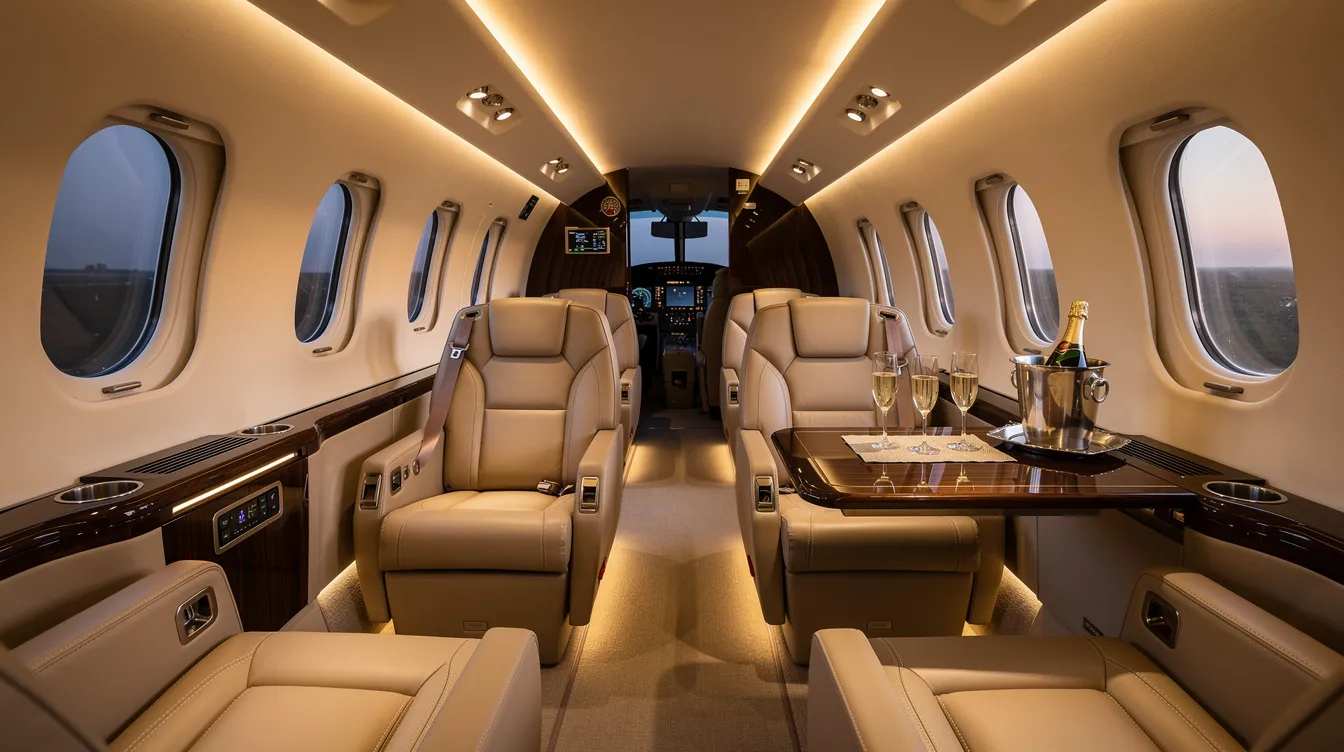
Cabin experience matters as much as performance characteristics on longer flights. Cabin dimensions, quietness, seating layout, interior condition, connectivity, and privacy can transform a trip from transportation into productive time.
Modern models may offer club seating, divans, conference tables, power outlets, streaming Wi-Fi, and cabin management systems. BlackJet focuses on useful luxury: space to work, rest, dine, and arrive prepared.
Luggage capacity can determine the aircraft. Many light jets handle standard bags but struggle with bulky ski bags, musical instruments, golf clubs, or trade show materials for several travelers.
BlackJet checks cargo diagrams, pet policies, catering limits, medical equipment needs, and operator rules before clients fly to the destination.
Hourly rates for private jet charters can range from $5,000 to $12,000, depending on the size and type of jet, with larger jets typically incurring higher operational costs. Private jet cost also includes positioning, FBO charges, de-icing, catering, overnights, and international handling.
A cheaper hourly aircraft can cost more money if it needs a fuel stop, crew overnight, or a larger airport. BlackJet evaluates cost per occupied seat-hour and cost per productive hour, not just hourly price.
Whole ownership of a private jet typically requires a capital investment ranging from $10 million to $80 million, along with annual fixed costs of $1 million to $2 million, making it most suitable for those flying 300-400 hours annually. Financing structures for the purchase price of a luxury private jet can range from $10 million to over $500 million, depending on the size and customization options.
Operational costs for private jets can vary significantly, with estimates suggesting that owners can expect to pay between $1 million and $2 million annually for maintenance, fuel, and crew salaries, and these costs also influence decisions when selling a fractional jet ownership share or evaluating the total cost of fractional jet ownership. Fractional ownership allows individuals to purchase a share of a private jet, typically starting as small as 1/16th of a jet, providing access without the full responsibilities of ownership.
Potential depreciation benefits may apply under current IRS rules; readers should consult a tax advisor and review guidance from the NBAA tax resource center and dedicated resources on tax implications for fractional jet owners.
Aircraft comparison is incomplete without comparing access. On-demand charter services offer maximum flexibility for private jet travel, allowing users to book flights as needed without the long-term commitments associated with ownership or fractional programs versus membership options.
A charter flight works well for occasional flyers under about 25 hours per year. It lets travelers test aircraft models, but pricing, security standards, and service capabilities can vary by operator, and it can also be an alternative to top fractional jet programs.
Jet card programs usually sell 25- or 50-hour blocks with fixed or capped rates. A jet card can suit 25–75 annual hours and may allow members to choose light, midsize, or longer-range aircraft within one program, similar in flexibility to floating fleet options in fractional ownership.
Fractional aircraft ownership is best for predictable usage, priority access, and ownership benefits without whole-aircraft complexity. BlackJet’s Equity Fleet helps clients own a share, use professional management, and match the aircraft class to recurring routes, supported by clearly defined fractional ownership contract terms that are typically set out in an aircraft fractional ownership sample contract.
BlackJet’s Reserve Fleet is a flexible pay-as-you-go model created for clients who want vetted access without large upfront capital. A hybrid plan may pair Equity Fleet ownership in a super midsize jet with Reserve Fleet access to turboprops, light jets, or long-range jets for the rest of the mission mix.
BlackJet uses data, route history, manufacturing details, fleet availability, and client priorities to compare aircraft options. The team can present aircraft comparison tool-style options showing range, runway, cabin, cost, and pros and cons. Note: Certain jets in the BlackJet fleet feature exceptional short runway performance, allowing access to airports that many other private jets cannot reach, which can be a decisive advantage for travelers needing to reach remote or challenging destinations.
Key safety certifications for private jets include ARGUS Platinum, Wyvern Wingman ratings, and IS-BAO certification, which ensure rigorous safety protocols are followed. Safety standards in private aviation require operators to maintain high maintenance standards, monitor average fleet age, and ensure pilot experience is up to par, alongside robust liability and insurance coverage for fractional owners.
Private jet operators are often evaluated based on their adherence to safety certifications and environmental responsibility, which are critical factors for discerning travelers. BlackJet does not simply sell access; it helps clients join a structured aviation strategy developed around convenience, safety, and value.
These answers address practical questions about comparing multiple aircraft, selecting an access model, and planning international travel.
Focus on practical nonstop range, cabin layout, runway needs, baggage, and total trip cost. Online tools help, but BlackJet validates performance with real winds, payload, airport limits, and operator availability.
Yes, but it depends on predictability and desired priority. Smaller shares, including 1/16th structures, can work for recurring routes, while 1/8 fractional jet ownership or Reserve Fleet or jet card-style access may fit more varied travel.
Many programs support Canada, Mexico, the Caribbean, Europe, and South America. Long-range jets are usually required for nonstop New York–London or similar routes, while midsize aircraft may handle shorter cross-border flights.
Look for ARGUS Platinum, Wyvern Wingman, and IS-BAO registration. Also, ask about pilot training, maintenance tracking, fleet age, and crew duty-time policies before comparing luxury features.
Newer aircraft models can be 15–25% more fuel efficient than older designs. Clients may also ask about sustainable aviation fuel, carbon offsets, fuel burn, optimized routing, and operator environmental policies.
Intelligent private jets comparison means matching models, access, cost, and performance to how often and where travelers fly. BlackJet Fractional Jet Ownership offers Reserve Fleet flexibility and Equity Fleet fractional ownership for clients seeking predictable access.
List your top 3–5 routes, typical passengers, annual flights, and preferred amenities. Then visit FractionalJetOwnership.com to request a consultation and explore how smarter private aviation choices can transform travel into a strategic asset.
