
January 23, 2026
Private jet travel has become an essential tool for business leaders, entrepreneurs, and high-net-worth individuals who value control over their schedules. Unlike commercial aviation, private aviation prioritizes efficiency, flexibility, and predictability—especially when it comes to flight times.
The primary determinant of flight time is the distance divided by speed, but this is influenced by several additional factors such as wind conditions, altitude, and airspace congestion. Stronger headwinds can increase flight time, while tailwinds decrease it, notably making eastbound flights faster than westbound ones. Private jets often fly at higher altitudes, up to 51,000 feet, allowing for faster cruising speeds and the ability to fly above weather-related turbulence, which commercial airliners typically cannot. However, air traffic control and specific routing can still influence flight time, even for private jets, despite their ability to avoid major congestion.
Private jet travel significantly reduces total travel time compared to commercial flights. For example, common short-haul routes like Los Angeles to Las Vegas take approximately one hour by private jet. This efficiency is further enhanced by private jets' ability to land closer to final destinations, accessing thousands more airports than commercial airlines, which often operate only from major hubs.
Choosing the right aircraft—based on passenger count, range, and comfort—further enhances planning accuracy. Higher-performance jets, such as midsize or heavy jets, can reach speeds up to 717 mph (with models like the Citation X+), while light jets typically cruise between 400 and 480 mph. Turboprops, best suited for short-haul flights under 500 miles, cruise at approximately 300 mph. Light jets are ideal for flights up to 1,500 miles, midsize jets for cross-country travel cruising around 500 to 530 mph, and heavy jets efficiently handle long-haul and international trips, often spanning continents in 6 to 10 hours.
Flight times can vary based on aircraft type, distance, weather, and operational factors. For instance, lighter jets tend to be faster on shorter hops, while larger jets excel on long hauls but may be slowed by air traffic and adverse winds. Additionally, high temperatures can reduce engine thrust and lift, slowing climbs or imposing weight restrictions that impact overall flight efficiency.
Private jet flight times are influenced by a combination of operational, environmental, and aircraft-specific factors. Understanding these variables provides clarity and helps travelers make informed decisions.
Distance remains the most obvious determinant. Longer routes require more flight time, but aircraft performance can dramatically influence how quickly that distance is covered. A light jet flying 1,200 miles will take considerably longer than a long-range jet covering the same route.
Aircraft type and cruising speed also play a major role. Turboprops cruise at lower speeds than jets, while midsize and heavy jets are designed for faster, more efficient long-distance travel. Wind conditions—particularly headwinds or tailwinds—can add or subtract meaningful time from a flight.
Private jets also benefit from operational flexibility. They often fly at higher altitudes than commercial aircraft and can choose more direct routes, avoiding congested airspace when possible. This routing flexibility frequently results in shorter overall flight times.
Beyond airborne time, door-to-door efficiency matters. Arriving 15 minutes before departure, landing at less congested airports, and minimizing taxi time all contribute to a faster overall journey.
Flight routing in private aviation is a highly optimized process that balances safety, efficiency, and aircraft capabilities. Routes are planned between departure and arrival airports, with additional considerations such as fuel stops, weather systems, and airspace restrictions.
Flight planning involves identifying key points along the route and considering the distances between these points. Weather conditions are one of the most dynamic factors affecting route selection. Thunderstorms, jet streams, and seasonal wind patterns may require deviations that slightly alter flight time. Air traffic control restrictions and temporary flight restrictions can also influence routing decisions.
Private aviation operators rely on advanced flight planning software to analyze optimal routes in real time. These systems consider fuel burn, cruising altitude, and time efficiency to determine the most effective flight path for each mission.
Efficient routing is especially important when matching aircraft range to trip requirements. Selecting an aircraft capable of flying nonstop avoids unnecessary fuel stops, reduces total travel time, and enhances passenger comfort.
Turboprops are well-suited for short-haul flights of 500 miles or less. These aircraft excel at accessing smaller regional airports and are ideal for quick trips such as Los Angeles to Las Vegas or Dallas to Houston. While slower than jets, turboprops offer excellent efficiency for short distances.
Light jets typically handle routes up to 1,500 miles and accommodate small groups comfortably. They balance speed, cost efficiency, and accessibility, making them popular for regional business travel. Common routes include Chicago to New York or Denver to Phoenix.
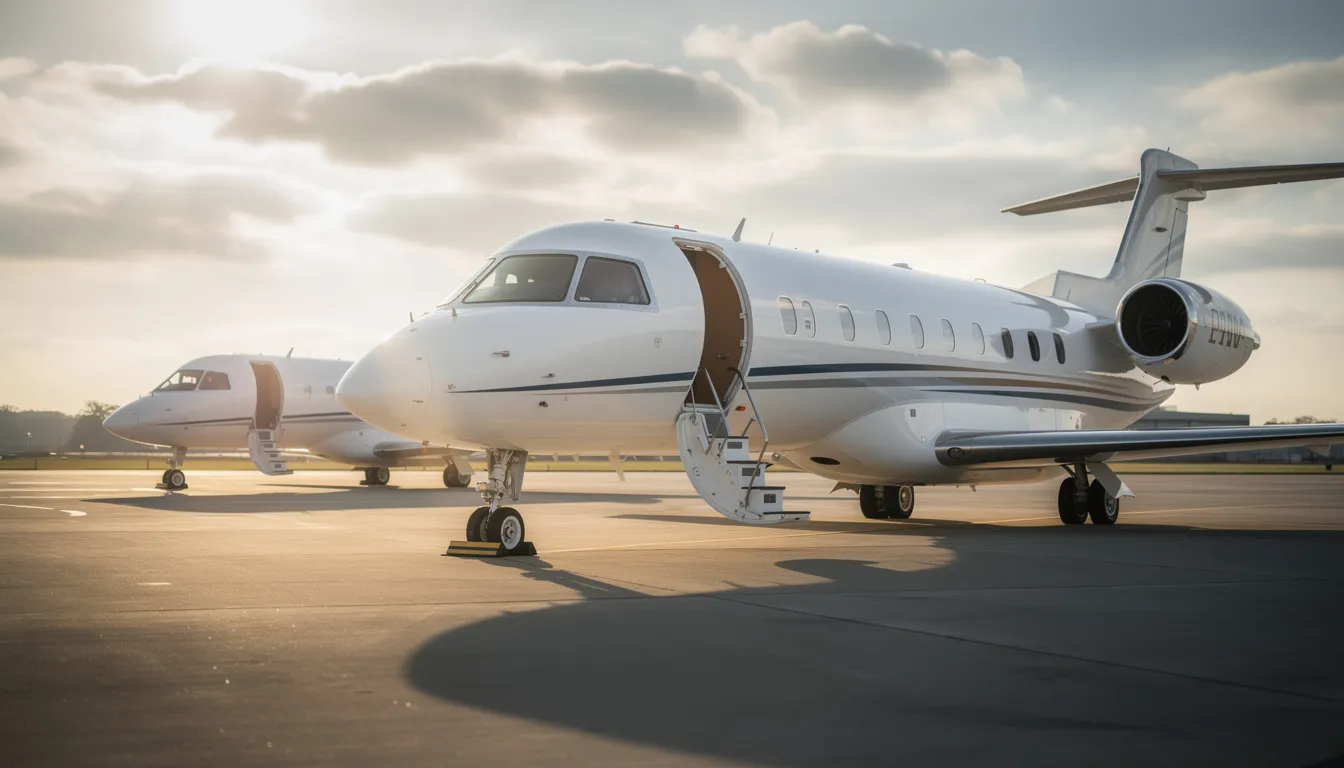
Midsize jets are designed for longer domestic routes and offer increased cabin space and range. Flights such as New York to Miami or Los Angeles to Denver are well within their capabilities. These aircraft often cruise faster and higher than light jets, reducing flight time on longer trips.
Heavy jets and ultra-long-range aircraft are optimized for coast-to-coast and international travel. With advanced avionics and powerful engines, these jets can fly nonstop from San Francisco to New York or from the United States to Europe. Their speed, range, and onboard amenities make them ideal for extended missions.
Accurately estimating flight duration is a critical component of effective travel planning. A private jet flight time calculator estimates how long a flight will take between two locations when traveling by private jet. These calculators consider flexible routing and a range of aircraft types to provide estimates based on the average cruising speed of the jet and the distance between departure and arrival points.
Knowing the estimated flight time allows travelers to coordinate ground transportation, hotel check-ins, and meeting schedules with confidence. For business travelers, this precision minimizes downtime and maximizes productivity.
Accurate estimates also support more complex itineraries, including one-way, round-trip, and multi-stop flights. Understanding how each segment contributes to total travel time ensures smoother execution and fewer surprises.
While flight time calculators provide valuable estimates, experienced aviation advisors refine these projections by accounting for real-world variables such as weather trends and airport congestion.
Flight time is a primary driver of private aviation costs. Longer flights consume more fuel and require additional crew hours, directly impacting overall pricing.
Hourly charter rates generally range from approximately $1,800 for turboprops to $18,000 or more for large, long-range jets. Aircraft size, performance, and operational complexity all influence these rates.
Additional expenses may include aircraft repositioning, crew overnight accommodations, airport handling fees, and international overflight charges. These factors are often tied to total flight time and routing requirements.
Cost estimation tools help translate flight time into a realistic budget. By comparing routes and aircraft options, travelers can align performance needs with financial expectations while avoiding unexpected expenses.

Successful private jet travel begins with thoughtful planning tailored to the specific mission. Passenger count, luggage requirements, and destination accessibility all influence aircraft selection and routing decisions.
Airport characteristics matter. Some destinations have runway length restrictions or limited operating hours, which may affect aircraft suitability and scheduling. Weather considerations should also be incorporated early in the planning process.
Efficient planning reduces the risk of delays and ensures that aircraft capabilities align with trip requirements. When flight time, route, and aircraft selection are properly matched, private aviation delivers its full value.
Working with experienced advisors further enhances planning accuracy, especially for complex itineraries or international travel.
One of the most compelling advantages of private aviation is time efficiency. Travelers typically arrive shortly before departure, bypassing security lines and boarding delays entirely.
Access to smaller airports closer to final destinations reduces ground transportation time and allows travelers to reach locations that may be impractical via commercial airlines.
Flexible departure times enable multiple meetings or destinations in a single day, making private jets particularly valuable for executives managing tight schedules.
For frequent travelers, these cumulative time savings translate into increased productivity, reduced fatigue, and greater control over travel experiences.
Private aircraft vary widely in maximum flight duration due to differences in fuel capacity, performance, and design. Smaller aircraft generally have shorter maximum airtime, while larger jets are engineered for extended missions.
Flight time is influenced by aircraft weight, weather patterns, routing decisions, and altitude selection. Even the number of passengers and luggage onboard can affect range and efficiency.
Midsize and heavy jets typically offer longer maximum flight times, making them suitable for cross-country and international travel. Turboprops and light jets are best reserved for shorter routes where efficiency outweighs range.
Understanding these distinctions helps travelers select the right aircraft and avoid unnecessary fuel stops or delays.
Understanding flight time is the foundation of accurate private aviation cost planning. When flight duration is clearly defined, travelers can evaluate aircraft options, compare routes, and anticipate total expenses more effectively.
Modern estimation tools simplify this process by connecting flight time, distance, and aircraft type to realistic cost ranges. This transparency supports smarter decision-making and reduces financial uncertainty.
Accurate projections also allow travelers to weigh private jet ownership models—such as fractional aircraft ownership—against alternatives like charter or full ownership. For many travelers, fractional ownership offers predictable costs and consistent access without the operational burdens of sole ownership.
Precise flight time knowledge transforms private jet travel from a convenience into a strategic asset. Accurate estimates improve scheduling, reduce stress, and enhance overall travel efficiency.
Typical routes, such as San Francisco to New York, may take approximately five hours depending on aircraft type and weather conditions. Understanding these variables allows travelers to choose the most effective solution for each journey.
Flight time calculators, cost estimation tools, and expert guidance all play critical roles in successful private aviation planning. When combined, they provide clarity, predictability, and confidence.
Ready to explore the smarter way to fly private? Visit https://www.fractionaljetownership.com/ to learn how fractional jet ownership can maximize efficiency, control costs, and transform the way travel is planned.
