May 17, 2026
The introduction of the Learjet in 1963 marked a significant milestone in business aviation, ushering in a new era defined by speed and exclusivity. Soon after, the Gulfstream II made its first flight in 1966 and helped define the first large business jet category for corporate travel.
Business jets are private aircraft generally designed to move 2–19 passengers with more flexibility than commercial airlines. Private aviation manufacturers specialize in different aviation segments, catering to varying customer needs and preferences.
Unlike commercial aviation, private aviation gives business travelers access to over 5,000 airports in the U.S. alone, far beyond the reach of commercial airlines.
This guide reviews the top manufacturers, their flagship aircraft, and how buyers should evaluate jets for charter flight usage, fractional ownership, and corporate fleets. This guide is intended for business aviation buyers, corporate travel managers, and high-net-worth individuals considering private jet acquisition or access. BlackJet Fractional Jet Ownership acts as an independent advisor, helping clients choose the perfect aircraft type rather than forcing one brand or one aircraft operation model.
A relatively small group of private plane manufacturers dominates modern business aviation: Gulfstream, Bombardier, Dassault Aviation, Embraer, Cessna/Textron, Airbus Corporate Jets, Boeing Business Jets, Honda Aircraft Company, and Pilatus.
Private aviation manufacturers specialize in different aviation segments, catering to varying customer needs and preferences, from very light jets and turboprop aircraft to ultra-long-range jets and bizliners.
The right manufacturer is less about brand prestige and more about matching range, cabin space, operating cost, runway length, and mission profile.
Ownership models such as full ownership, fractional ownership, jet card programs, leasing, and pay-as-you-go access can matter more to the total private jet cost than the aircraft manufacturer.
BlackJet Fractional Jet Ownership helps clients access multiple manufacturers’ aircraft through Reserve Fleet membership-style access and Equity Fleet fractional aircraft ownership.
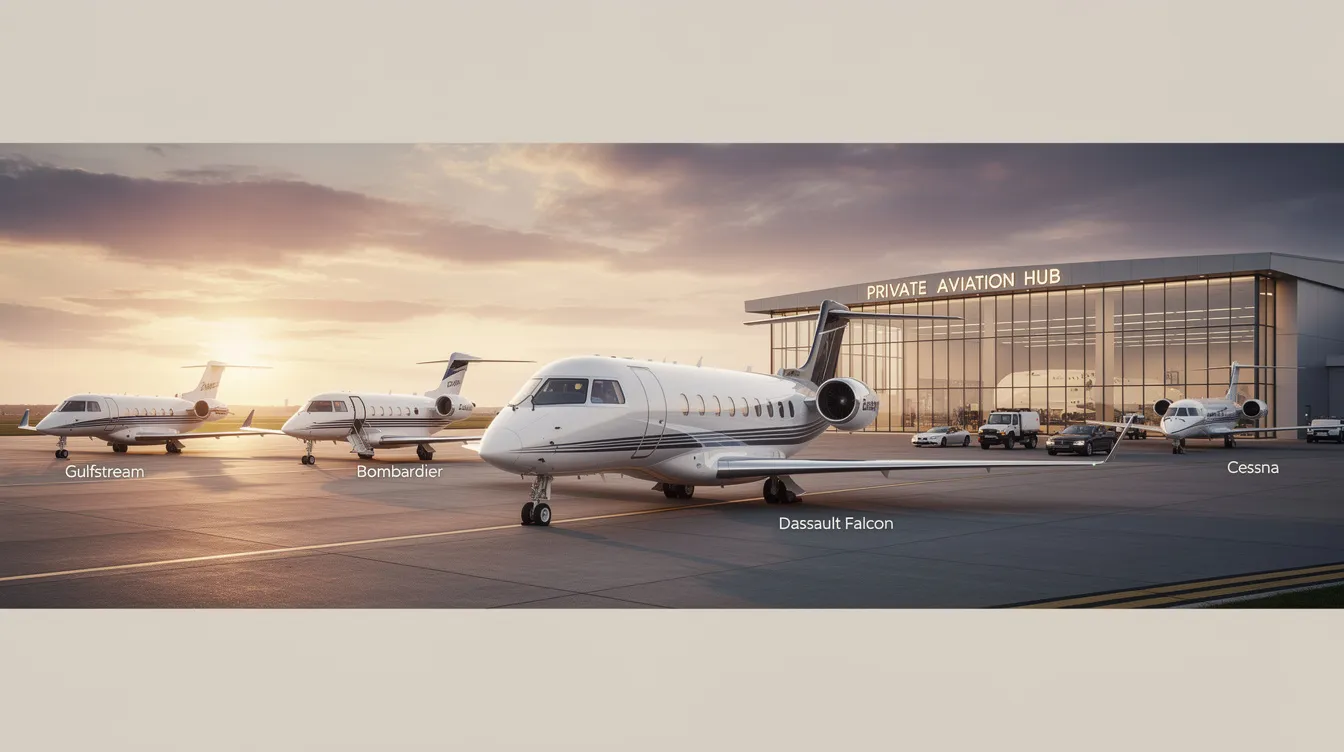
The global business aviation market is led by approximately a dozen manufacturers based in Europe, North America, and Latin America, with prominent companies including Dassault, Gulfstream, Bombardier, and Embraer. In 2022, the shipment of 712 business jets reflected a strong rebound and sustained interest in private aviation, with North America representing roughly 61% of the worldwide demand for private jets.
Manufacturer | Headquarters | Specialty & Notable Models | Key Features |
|---|---|---|---|
Dassault Aviation | France | Falcon jets with fighter-derived aerodynamics | Quiet cabins, strong short-field capability, fly-by-wire controls |
Gulfstream Aerospace | United States | High-speed, long-range luxury jets | Oval windows, low cabin altitude, and Mach 0.925 speeds |
Bombardier | Canada | Global and Challenger series | Premium luxury, ultra-long range, smooth ride |
Embraer | Brazil | Phenom and Praetor series | Tech-savvy cockpits, class-leading cabin space |
Textron Aviation | United States | Cessna Citation jets, Beechcraft King Air turboprops | Largest delivery volume, reliable, cost-effective |
Pilatus Aircraft | Switzerland | PC-12 and PC-24 turboprops and light jets | Rugged, versatile, short runway access |
Honda Aircraft Company | United States / Japan | HondaJet series | Over-wing engine mounts, fuel efficiency |
Airbus Corporate Jets | Europe | Converted A319/A320 family airliners | Ultra-large cabins, multiple zones |
Boeing Business Jets | United States | Converted 737 MAX and 777X airliners | Large cabins, VIP customization |
Niche Makers | Various | Piaggio Aerospace, Cirrus, legacy Hawker Beechcraft | Specialized small jets, VLJs, turboprops |
Very Light Jets are designed for short flights and typically accommodate 4-6 passengers, with a maximum takeoff weight limit of 10,010 lb (4,540 kg). Light jets are suitable for short to mid-range trips, accommodating 6-8 passengers with an average range of 1,953 nautical miles and a mean price of $9.6 million.
Midsize jets offer more cabin space and range than light jets, typically accommodating 8-10 passengers and suitable for longer journeys with an average range of 2,540 nautical miles. Super midsize jets offer a blend of transatlantic range and high-altitude performance, typically seating 10-11 passengers and providing an average range of 3,420 nautical miles.
Europe is home to both purpose-built business aircraft and large jets derived from commercial models. Dassault focuses on agile Falcon jets, while Airbus Corporate Jets serves governments, corporate shuttles, and charter operators needing major cabin volume.
Dassault Aviation commenced its business aviation journey with the Falcon 20 in 1963, applying its military aircraft expertise to create efficient, high-performance jets.Dassault Aviation integrates fighter-jet aerodynamics into its business jet designs, and industry observers often note that Dassault boasts unusually strong fly-by-wire experience for civil aircraft.
Current Falcon models include the Falcon 2000LXS, Falcon 900LX, Falcon 6X, Falcon 8X, and Falcon 10X. The Falcon 6X was certified in 2023 and entered service soon after, while the Falcon 10X is expected after 2026 as a new long-range competitor.
Falcons are well-suited to transatlantic routes, challenging airports, and quiet overnight flight profiles. Many BlackJet clients encounter Falcon jets when they need long-range capabilities to Europe, the Middle East, or North America with demanding airport conditions.
Compared with Gulfstream G500/G600 or Bombardier Global 5500/6500 aircraft, Falcons often compete on cabin comfort, runway flexibility, and operating efficiency. That makes them relevant to fractional ownership, high-end charter, and corporate flight department use.
Airbus launched Airbus Corporate Jets in 1997, converting A319/A320 family airframes into long-range corporate aircraft. Today, Airbus corporate jets include ACJ319neo, ACJ320neo, ACJ321neo, and ACJ TwoTwenty aircraft.
Airbus Corporate Jets and Boeing Business Jets convert commercial airliners into ultra-luxurious, custom-built aircraft. ACJs offer airliner-sized interiors, multiple cabin zones, bedrooms, showers, conference areas, and more cabin space than traditional business jets.
The trade-off is cost. ACJs require more crew, more fuel, more planning, and often longer runways than a large cabin Gulfstream, Falcon, or Global jet. They are not typical fractional ownership assets, but BlackJet may arrange them for roadshows, family offices, or group trips where capacity matters most.
North America has the largest installed base of business jets and many of the most influential private plane manufacturers. These brands cover everything from entry-level light jet options to ultra-long-range aircraft for long-haul flights.
Gulfstream Aerospace is an aircraft manufacturer in Savannah, Georgia, owned by General Dynamics. Since the Gulfstream II, Gulfstream has been known for high-speed, long-range luxury business travel.
Core models include the G280, G400, G500, G600, G700, and G800. Gulfstream’s flagship G700 and G800 jets can fly up to 8,000 nautical miles at speeds of Mach 0.925, supporting routes such as New York–Tokyo or Los Angeles–London.
Common features include elongated oval windows, low cabin altitude, noise-reducing cabins, high-speed internet, advanced avionics, and customizable interiors. Private jets are known for offering amenities typically found in five-star hotels, such as spacious, convertible seating for sleeping or working, gourmet kitchens, and efficient workspaces.
For BlackJet’s Equity Fleet clients, Gulfstream models often form the long-haul backbone when predictable access to global city pairs is the priority.
Bombardier is headquartered in Montreal and now focuses heavily on business jets after exiting major commercial aviation and rail programs. Bombardier specializes in premium luxury jets and is highly regarded for its Global and Challenger series.
The Challenger 3500 represents the backbone of corporate fleets, balancing cross-country range with cabin comfort. Challenger 650 aircraft serve larger domestic and transcontinental missions, while Global 5500, 6500, 7500, and Global 8000 aircraft serve ultra-long range demand.
The Global 7500 is already in service, and the Global 8000 is positioned among the fastest and longest-range business jets. BlackJet clients who prioritize smooth ride quality, large cabin comfort, and global range often encounter Bombardier aircraft in curated partner fleets.
Textron Aviation includes Cessna and Beechcraft, making it central to the light jet segment, mid-size jets, and regional private jet travel in the United States. Citation models include the M2 Gen2, CJ3+, CJ4 Gen2, XLS Gen2, Latitude, Ascend, and Longitude.
Citations are popular because they combine sensible list price levels, strong support, and predictable operating economics. For trips under about three hours, BlackJet Reserve Fleet flights are often best served by Citation aircraft or Beechcraft King Air turboprops.
The King Air 260, 360, and 360ER remain highly valued for reliability, short runways, and access to secondary airports. For small and midsize companies with regional facilities and owners who value efficiency, Textron products often deliver the right balance.
Boeing Business Jets launched in the late 1990s and competes directly with ACJ. The Boeing business jets lineup includes BBJ MAX 7, MAX 8, MAX 9, and planned BBJ 777X variants.
A Boeing Business Jet offers airliner reliability, extreme customization, and huge cabin volume. The downside is that large business jet and bizliner operators can face operational restrictions based on airport size, parking availability, crew needs, and runway length.
BBJs are best for heads of state, sports teams, Fortune 500 shuttles, and ultra-luxury charter operators. They are rarely standard fractional ownership aircraft, although BlackJet may source Boeing business aircraft for exceptional group itineraries.

Not every valuable private jet comes from the largest legacy brands. Embraer, Pilatus, and Honda have reshaped efficient regional and transcontinental flying.
Embraer is one of the world’s largest aircraft manufacturers and moved from regional jets into business aviation with the Phenom, Legacy, and Praetor families. Its main executive models include Phenom 100EV, Phenom 300E, Praetor 500, and Praetor 600.
Embraer’s Phenom and Praetor series are recognized for tech-savvy cockpits and class-leading cabin space. The Phenom 300E is especially common in charter and fractional fleets because it offers single-pilot capability, favorable fuel efficiency, a refined cabin, and strong performance for its class.
Typical missions include North America to Caribbean routes, US coast-to-coast flights with stops, and high-frequency corporate shuttles. For BlackJet clients, Embraer jets can provide premium access without the cost of oversized aircraft.
Pilatus Aircraft was founded in Switzerland in 1939 and is known for rugged, versatile aircraft. The PC-12 NGX is a single-engine turboprop, while the PC-24 is a light jet marketed as a “Super Versatile Jet.”
Pilatus aircraft are valuable when runway length, cargo flexibility, or remote destinations drive the mission. A PC-12 or PC-24 may reach mountain resorts, rural factories, mining sites, or smaller airfields that larger jets cannot use efficiently.
BlackJet may recommend Pilatus when the airport is the constraint rather than the in-flight luxury requirement.
Honda Aircraft Company developed the HondaJet after years of research in the United States. The HondaJet Elite II is a very light jet benchmark, and the HondaJet Echelon is in development as a larger, longer-range light jet.
The HondaJet’s over-the-wing engine mount design places engines mounted above the wing, improving cabin volume and reducing noise. It also reflects ongoing private jet market interest in fuel efficiency, advanced avionics, and lower operating costs.
HondaJets fit short-haul routes such as New York–Chicago, Dallas–Nashville, or 300–600 nm regional trips. They can be attractive in jet membership programs and Reserve Fleet access for frequent short trips.
Passengers often ask whether Gulfstream, Bombardier, or Dassault is “best.” The better question is which aircraft matches the flight profile, budget, airport pair, and access model.
Key criteria include:
Understanding essential contract terms in fractional ownership so that aircraft choice aligns with legal and operational obligations as well as performance.
Required range: domestic, transcontinental, or intercontinental
Passenger count and baggage
Cabin height, width, and workspaces
Airport infrastructure, including runway length and altitude
Crew, maintenance, and fuel cost
Resale outlook and residual value level
A five-year-old aircraft from a widely supported manufacturer may be easier to finance, maintain, and resell than a rare model with limited parts support. Newer private jets produce better range per gallon than older designs, but aircraft size still drives emissions and cost, and a well-structured aircraft fractional ownership sample contract helps ensure those economics are shared fairly among co-owners.
Large jets and ultra-long-range aircraft are ideal for global missions, but expensive for short hops. Light jets and turboprops are usually more efficient for 1–3 hour trips.
Forecasts predict that 8,683 private jets will be delivered over the next decade, reflecting sustained growth in the private aviation sector. That growth makes independent aircraft selection more important, not less, and it also means owners should understand how selling a fractional jet ownership share works if their needs change over time.
For most owners, access structure matters as much as the aircraft brand.
Full ownership: maximum control, highest capital commitment, crew, hangar, insurance, and maintenance responsibility, making fractional jet ownership as an investment an appealing alternative for buyers who want access without bearing every cost alone.
Chartering private jets operates on a pay-per-flight model, making it ideal for flexible or one-time travel needs without the commitment of ownership, while fractional jet ownership vs membership programs highlight how equity-based access compares with more flexible membership-style solutions.
Jet card programs: prepaid hours with defined terms, aircraft categories, and service rules.
Leasing agreements for private jets can be short-term or long-term, offering flexibility without the capital investment required for ownership; buyers can also evaluate floating fleet options in fractional ownership when they care more about access to multiple aircraft than to one specific tail number.
Fractional ownership allows multiple parties to share the costs and usage of a single jet, making it a cost-effective option for those who do not need full ownership, especially once you understand the complete cost of fractional jet ownership compared with charter and full ownership. For many first-time buyers, a clear fractional jet ownership glossary can make it easier to compare this structure with charter or full ownership.
In fractional ownership, an individual or corporation pays an upfront equity share for the cost of an aircraft, which entitles them to a certain number of hours of flight time; understanding fractional jet ownership financing and essential liability coverage in fractional jet ownership is critical before committing capital. BlackJet’s Equity Fleet supports fractional aircraft ownership with priority scheduling, tax advantages for fractional jet owners, and custom sourcing.
BlackJet’s Reserve Fleet provides membership-style access with pay-as-you-go hourly rates and no asset ownership. A client flying 50 domestic hours per year may use light jets, super midsize aircraft, and turboprops; a client flying 120+ global hours may pair an Equity Fleet share in a super midsize or large cabin jet with Reserve Fleet access for peak days, similar to how the best fractional jet ownership programs structure tiered access.

These questions focus on practical buying and flying decisions rather than deep technical specifications.
Fractional ownership fleets in the United States and Europe often use supportable models from Cessna Citation, Embraer Phenom and Praetor, Bombardier Challenger and Global, and Gulfstream G280, G500, and G600 families. Pilatus PC-12 and PC-24 aircraft and Dassault Falcons may appear for specific mission profiles.
Airbus Corporate Jets and Boeing Business Jets are less common because acquisition and operating costs are much higher. BlackJet’s Equity Fleet can be structured around the right manufacturer and model, while Reserve Fleet access adds flexibility across multiple clients and multiple aircraft categories.
BBJ and ACJ aircraft are derived from commercial airliners such as the 737 MAX and A320neo families. They offer far more space, separate rooms, bedrooms, and large-group capacity.
Traditional business jets from Gulfstream, Bombardier, Dassault, and Embraer are purpose-built for business aviation, with efficient aerodynamics, higher cruise altitudes, and better access to smaller airports. BlackJet generally recommends traditional business jets for most corporate and private use, reserving BBJ or ACJ charter for exceptional missions.
Private jets contribute notably to carbon emissions, with some individuals flying over 350,000 km annually and generating thousands of tons of CO2.. To address this, the European Commission has mandated a 55% reduction in greenhouse gas emissions from aviation by 2030 to meet global climate targets.
Manufacturers are improving aerodynamics, materials, engines, and sustainable aviation fuel compatibility. Research and development are ongoing for electric and hybrid-electric propulsion systems in the private jet industry, aiming for a more sustainable future. In response to environmental concerns, many private jet operators now offer carbon offset programs to mitigate their environmental impact, while models such as 1/8th fractional jet ownership can right-size aircraft use and hours for frequent travelers.
Mission profile should come first. A client flying 1–2 hour regional trips may be better served by a Cessna Citation, Embraer Phenom, HondaJet, King Air, or Pilatus aircraft than by a large business jet.
A client routinely flying nonstop intercontinental sectors should compare ultra-long-range aircraft from Gulfstream, Bombardier, and Dassault Aviation. Once mission needs are clear, brand preference can refine the choice by cabin feel, baggage capacity, support network, and cost.
BlackJet serves as an independent guide rather than a captive program tied to one right manufacturer. The platform helps clients evaluate Gulfstream, Bombardier, Dassault Aviation, Embraer, Textron Aviation, Pilatus Aircraft, Honda Aircraft Company, Airbus Corporate Jets, Boeing Business Jets, and other aircraft categories.
BlackJet handles aircraft sourcing, management, scheduling, and access planning through Equity Fleet and Reserve Fleet solutions. Ready to explore a smarter way to fly private? Visit FractionalJetOwnership.com to request a consultation and review the aircraft, ownership structure, and private aviation strategy that best fits your travel profile.
Selecting the ideal private plane manufacturer is a critical step in crafting an efficient and tailored business aviation strategy. Whether prioritizing range, cabin comfort, operating costs, or runway access, understanding the strengths of leading manufacturers like Gulfstream, Bombardier, Dassault Aviation, Embraer, and Textron Aviation can guide buyers toward the perfect aircraft. Equally important is choosing the right ownership or access model—full ownership, fractional ownership, jet cards, leasing, or chartering—to optimize cost, flexibility, and availability.
BlackJet Fractional Jet Ownership offers expert guidance and flexible solutions to help you navigate the complex landscape of private aviation. By leveraging BlackJet’s Equity Fleet and Reserve Fleet programs, clients gain access to a diverse range of aircraft from multiple manufacturers, ensuring the best fit for their unique travel requirements. With comprehensive aircraft management, scheduling support, and tailored ownership options, BlackJet empowers high-net-worth individuals and corporate travelers to enjoy the benefits of private aviation without the typical complexities.
Ready to explore the smarter way to fly private? Visit FractionalJetOwnership.com to learn how fractional ownership can transform your travel experience and provide unparalleled access to the world’s leading private jets.
