October 20, 2026
The global private aviation services market reached roughly $59.6 billion in 2025 and is projected to surpass $100 billion by 2031. That growth is not driven by billionaires buying more aircraft. It is driven by executives, entrepreneurs, and families who want predictable access to a private jet without the burden of full aircraft ownership. Private plane membership has emerged as the model that makes this possible.
The term "private jet membership" covers several structured programs, including jet card programs, deposit-based memberships, and fractional ownership solutions such as BlackJet Fractional Jet Ownership's Equity Fleet and Reserve Fleet. Each model promises a version of the same core value: guaranteed availability, fixed or capped hourly rates, access to a diverse fleet, and concierge services that simplify every trip from wheels-up to wheels-down.
These membership programs are designed for business travelers flying 25 to 150 flight hours per year and families who want a reliable alternative to on-demand charters. Private jet memberships start from a $50,000 initial investment at entry-level tiers, and membership programs typically charge annual or monthly fees for access, scaling up based on hours and aircraft class.
Here is what membership delivers over ad-hoc demand charter:
Locked-in hourly rates instead of fluctuating spot-market quotes
Guaranteed aircraft availability, even during peak travel periods
A single point of contact for scheduling, ground transportation, and trip logistics
Membership programs offer streamlined access to private aviation fleets or charter networks, reducing administrative friction for every trip
A private jet membership is a structured program that gives members contracted access to private aircraft at predetermined terms-rates, notice windows, and aircraft types-without requiring full aircraft ownership. Members typically pay initial fees or a deposit to access membership benefits, then fly against those prepaid hours or credits.
Several program models exist, including jet cards and on-demand charters, but private jet membership programs include jet cards and deposit-based options as the two most common structured formats. Here is how each model works:
Jet card programs/card membership: Members purchase a block of prepaid flight hours (typically 25 to 75 hours) at a fixed hourly rate guaranteed for 12 to 36 months. A jet card provides guaranteed availability and simple, repeatable booking.
Deposit-based membership: Members place a refundable or partially refundable deposit. Flights draw down against that balance at capped rates, protecting against market fluctuations. Programs like these suit travelers with variable schedules.
Fractional ownership: Members buy an equity share (commonly 1/16 to 1/4) of a specific aircraft, receiving guaranteed hours annually plus potential tax advantages. This is the deepest financial commitment but offers the most control.
These models differ sharply from pure charter flights, where each trip is quoted individually, pricing swings with demand, and there is no guaranteed aircraft or consistency from one booking to the next. Membership programs can save up to 30% compared to chartering costs for frequent travelers, making the financial case straightforward once annual hours cross roughly 25.
BlackJet Fractional Jet Ownership focuses on two membership paths: the Reserve Fleet (pay-as-you-go hours with guaranteed access and no ownership costs) and the Equity Fleet (fractional jet ownership with priority access, tax benefits, and professional aircraft management).
A private jet card is one of the most accessible entry points into private aviation programs. Members prepay for a specific number of flight hours-usually 25 to 75-at guaranteed hourly rates locked in for a defined contract period. Jet card programs offer prepaid hour blocks with guaranteed rates, making them ideal for executives who need to fly privately on recurring routes without renegotiating each trip.
Operationally, card membership works as follows: a member wires an initial deposit, then draws down hours as they fly. Jet card memberships often require upfront deposits starting around $150,000, though the range can span from $100,000 to $500,000 depending on aircraft class and provider. Once funded, booking is straightforward-members use apps or dedicated services to request flights, and jet cards offer guaranteed aircraft availability within 24 to 72 hours of the request.
Key advantages of jet card programs include:
Jet cards provide fixed-rate pricing for easier budgeting and corporate approval workflows
Guaranteed availability windows of 6 to 24 hours' notice, depending on tier
No need to negotiate each charter individually
Deposit-based programs provide capped rates protecting against market fluctuations
Best suited for executives with recurring routes (e.g., New York to Chicago, Dallas to Los Angeles)
BlackJet's Reserve Fleet offers similar predictability and guaranteed availability without tying the full value into a single jet card balance. Instead, Reserve Fleet members access hours on a pay-as-you-go basis with fixed pricing by cabin class, retaining the simplicity of a jet card while keeping capital more flexible.
Fractional ownership means purchasing an equity share of a specific aircraft type. Owners typically purchase shares ranging from 1/16 to 1/4 of an aircraft, receiving a proportional number of flight hours per year-usually 50 to 200 hours. It is the most capital-intensive path to private jet travel, but it delivers the most control over aircraft type, scheduling priority, and financial structure and terminology of fractional jet ownership.
Here is how the costs of fractional jet ownership break down in 2025–2026 ranges:
Fractional ownership requires an initial investment of $1.3 million for larger or newer aircraft. Fractional ownership shares start around $800,000 for mid-size jets, while light jet shares may begin near $600,000.
Monthly management fees for fractional ownership range from $15,000 to $25,000, covering maintenance, crew, insurance coverage, and hangar costs, and should be evaluated as part of the total cost of fractional jet ownership.
Occupied hourly rates apply each time the aircraft flies. These are typically lower than jet card rates because the owner has already invested capital.
Participants in fractional ownership can benefit from tax advantages through depreciation, including potential bonus depreciation under current U.S. tax law (subject to IRS business-use tests), making it important to understand the tax implications for fractional jet owners.
How does this compare to a jet card or deposit-based membership and other membership programs versus fractional ownership options?
Fractional ownership requires more upfront capital and ongoing monthly management fees, but per-hour costs decline as utilization rises above 75 hours per year.
Jet membership and card membership programs require less commitment, but members avoid aircraft ownership costs like maintenance and storage at the trade-off of not building equity or accessing depreciation benefits.
Fractional ownership provides guaranteed access to specific aircraft types, while jet cards typically guarantee a cabin category rather than a particular airframe.
BlackJet's Equity Fleet is a fractional ownership solution with guaranteed availability, professional aircraft management, and bespoke aircraft sourcing. For corporate owners flying 75 to 150 hours annually, the Equity Fleet provides complete control over scheduling, aircraft selection, and the financial advantages that come with jet ownership, including options for financing a fractional jet ownership share.
The path from initial inquiry to flying private under a membership program follows a clear sequence. Here is what a new client typically experiences:
Consultation and profiling: The client reviews historical and projected travel patterns-annual flight hours, typical routes, preferred cabin class, and notice windows. Effective membership evaluates factors like cost, availability, and flexibility before committing to any model.
Model selection: Based on the profile, the advisor recommends the right structure. For BlackJet, this means choosing between the Reserve Fleet (flexible, no ownership) or the Equity Fleet (fractional ownership with priority access and tax benefits), or a combination of both.
Contracting: Terms are defined-share size for Equity Fleet members, or deposit amount and hourly rate schedule for Reserve Fleet members. Service-level commitments such as guaranteed availability windows (e.g., 24 to 48 hours' notice for standard flights, shorter for priority tiers) are documented, alongside essential fractional jet ownership contract terms that govern scheduling, costs, and exit options.
Funding: The client funds the membership-either purchasing a fractional share, wiring a jet card deposit, or establishing a Reserve Fleet account.
First booking and ongoing scheduling: Members use apps or dedicated services to request flights. A concierge or scheduling team matches each trip with the right aircraft type based on range, passenger count, and runway requirements.
Billing: Jet card members see hours debited from their prepaid balance. Reserve Fleet members are invoiced per flight at guaranteed hourly rates. Equity Fleet owners pay occupied hourly charges plus their ongoing monthly management fees.
Members can typically access various aircraft sizes depending on their needs, and as usage patterns shift, clients can transition between models-scaling from Reserve Fleet into an Equity share when hours increase, or supplementing fractional ownership with occasional charter when demand spikes.
One of the primary reasons business travelers move from ad-hoc demand charter to membership programs is pricing predictability. Membership programs provide predictable pricing for private flights, which simplifies budgeting, corporate approval processes, and year-over-year financial forecasting.
Here are the major cost components to understand:
Base hourly rates by cabin class (2026 averages): Light jets run approximately $5,000 to $9,000 per hour. Midsize jet rates average around $9,500. Super-midsize jets range from $10,500 to $13,500. Large cabin jets and ultra-long-range aircraft reach $14,000 to over $19,000 per hour, figures that factor into the broader cost of fractional jet ownership.
Fuel surcharges: Fuel surcharges can significantly increase total flight costs, sometimes adding 15 to 40 percent over the quoted base rate. Many membership programs include fuel in the hourly rate or cap it.
Federal excise tax (FET): In the U.S., a 7.5 percent FET applies to most private air travel transactions.
Repositioning fees: Moving an empty aircraft to a departure point generates repositioning fees. Some programs absorb these; others pass them through.
Peak-day supplements and daily minimums: Holiday periods and major events may carry surcharges or minimum billing.
Hourly rates for jet cards range from $5,000 to $8,000 for light and midsize categories when fuel and FET are excluded from the base quote. Charter flights can be significantly more expensive per hour than jet cards, particularly during high-demand windows when spot-market pricing spikes.
Consider a sample annual budget: a client flying 75 hours per year on a midsize jet under a jet card at $9,500 per hour spends roughly $712,500 on flight time alone. Under a fractional ownership structure, the per-hour cost may be lower once the capital investment is amortized-especially when the monthly management fees for fractional ownership range from $15,000 to $25,000 are spread across enough hours.
Guaranteed availability is a contractual promise that an aircraft of a specified cabin category will be provided within a set response time-typically 24 to 72 hours' notice-even during the busiest travel windows. It is the single feature that most sharply separates membership from ad-hoc charter.
Private jet membership programs guarantee aircraft availability with short notice, and many programs guarantee aircraft availability during high-demand periods, including holidays, major sporting events, and end-of-quarter business travel surges. Charter flights lack guaranteed availability during peak travel periods, which can leave travelers stranded or paying steep premiums.
Here is how guaranteed availability works operationally:
Providers maintain reserve aircraft capacity, a diverse fleet across cabin classes, and partnerships with vetted charter operators to cover maintenance events, peak days, and recovery flights.
Guaranteed availability ensures aircraft access during peak travel periods by distributing demand across a broader network rather than relying on a single aircraft.
NetJets guarantees availability across all aircraft classes. Premium programs may offer same-day availability for qualifying members.
Jet card programs guarantee aircraft availability within specified timeframes, typically 24 to 72 hours from the booking request.
Top programs offer guaranteed access with no blackout days, a significant advantage over on-demand charters.
BlackJet structures guaranteed availability through both its Reserve Fleet and Equity Fleet. Reserve Fleet members receive reliable access across North America, while Equity Fleet owners receive priority booking on their owned aircraft type, ensuring executives with time-critical itineraries are never waiting for a plane.
Membership programs provide priority booking and guaranteed availability-two features that protect business continuity and reduce the travel risk that comes with depending on the open charter market.
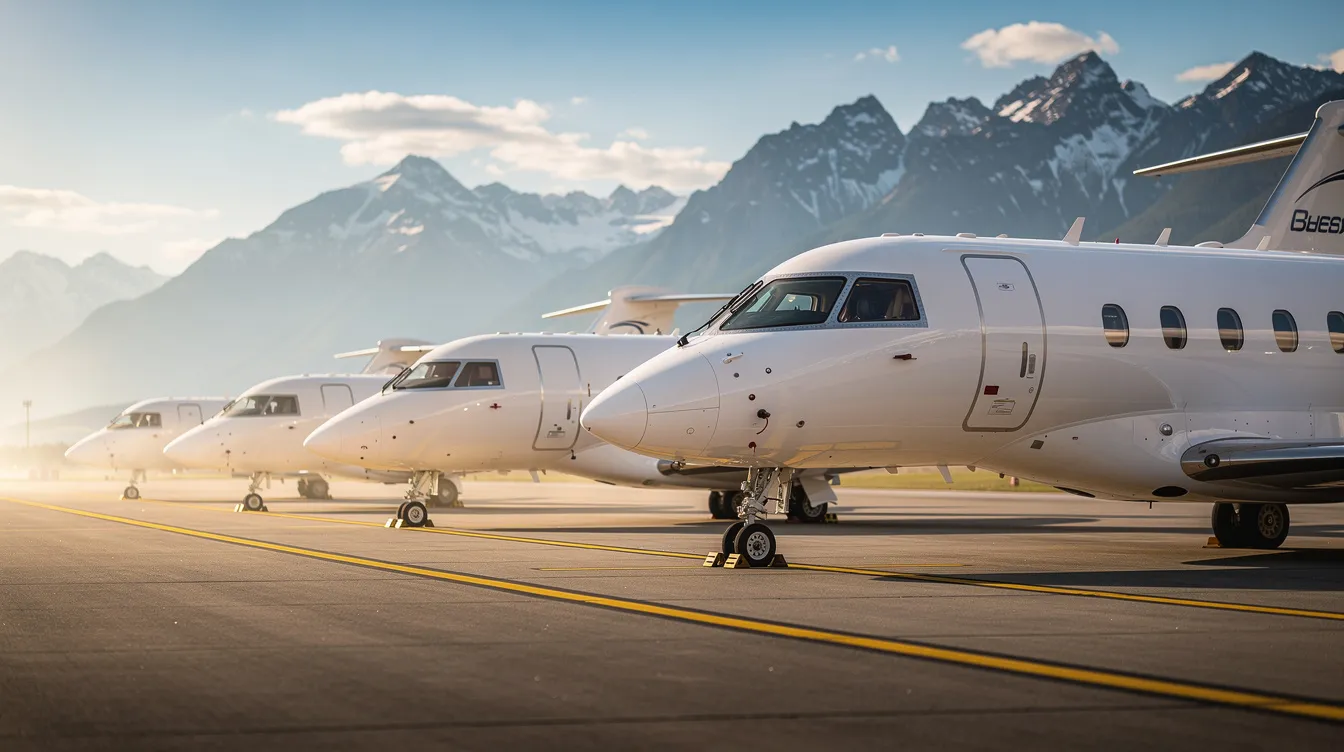
Not every trip requires the same aircraft. A two-hour hop from Dallas to Houston calls for a different plane than a coast-to-coast flight from New York to Los Angeles or an international flight from Chicago to London. Access to a diverse fleet lets members right-size each mission.
Here is how the main aircraft types align with common trip profiles:
Turboprops: Short regional flights under 500 miles, smaller airports, cost-efficient at roughly $6,200 to $6,500 per hour.
Light jets: Two- to three-hour domestic flights for up to seven passengers. Aircraft like the Citation CJ4 or Phenom 300E offer speed and efficiency on typical routes under 1,500 miles.
Midsize and super-midsize jets: Cross-country U.S. flights, four to five hours of range, stand-up cabins. Models include the Praetor 500 and Hawker 900XP.
Large cabin aircraft: Transatlantic or transcontinental missions, boardroom-style interiors, sleeping capacity for international flights exceeding six hours.
Fleet diversity directly affects cost efficiency. A member who books a large cabin jet for a 90-minute flight overspends significantly. BlackJet's model emphasizes matching each flight to the most efficient private aircraft in the fleet or partner network, optimizing both cost per hour and passenger comfort rather than forcing every trip onto the same airframe.
Concierge services are often included in private aviation memberships, and they transform private air travel from a transportation transaction into a fully managed experience. Many private jet memberships include lifestyle perks that extend into luxury sectors well beyond the aircraft itself.
Here is what concierge services typically include:
24/7 trip support with a single point of contact for scheduling, changes, and logistics
Concierge services include ground transportation and accommodation booking, coordinating everything from car service at the FBO to hotel reservations at the destination
Multi-leg itinerary planning for corporate roadshows, investor meetings, or family vacations
Members enjoy access to private terminals and VIP lounges, and private terminal access eliminates security delays and crowded waiting areas-no long security lines, no crowded gates
Exclusive partnerships offer discounts at luxury hotels and resorts, along with invitations to exclusive events
Members receive priority booking and guaranteed aircraft availability through the same concierge channel, creating a seamless workflow. For business travelers, this means maximizing productive time. For families, it means a door-to-door experience with personalized service and exceptional service at every touchpoint.
BlackJet positions itself as a trusted aviation advisor, providing a single point of contact for all aviation-related decisions. Rather than simply selling hours, the team manages the entire travel arc-from catering preferences to return-flight adjustments made mid-trip.
For corporate and executive readers, private plane membership converts travel from a discretionary expense into a tool for productivity and business growth. The ability to fly privately on your own schedule-visiting multiple client sites in a single day, holding confidential in-flight meetings, and avoiding overnight hotel stays-creates measurable returns.
Consider two realistic scenarios:
A regional sales director based in Chicago needs to visit prospects in Detroit, Indianapolis, and St. Louis in a single day. Commercial connections would require three separate days of travel. A midsize jet membership compresses that into one day, saving two hotel nights and 16 hours of downtime.
A CEO preparing for a board meeting flies from Los Angeles to Silicon Valley for a morning session, then continues to Seattle for an afternoon investor call. With priority access and guaranteed availability, the business jet flights are confirmed within hours-not days.
Benefits that matter to CFOs and travel managers:
Predictable annual budgets with guaranteed hourly rates and no surprise quotes
Reduced overnight expenses and less employee downtime
Complete control over departure times, passenger lists, and in-cabin privacy
Cost efficiency gains when annual fees and flight costs are weighed against productivity recovered
BlackJet works with corporate clients to profile typical routes and recommend the most economical combination of fractional ownership, Reserve Fleet access, and occasional private charter-ensuring every dollar spent on private aviation delivers a return.

The decision between a structured membership and on-demand charters comes down to four factors: cost predictability, aircraft availability, fleet choice, and administrative effort.
On-demand charter suits low-usage travelers-those flying under 20 to 25 hours per year-who prioritize flexibility and minimal upfront financial commitment. Each flight is quoted at market rates, and there is no obligation beyond that single trip. The trade-off is clear: charter flights lack guaranteed availability during peak travel periods, and pricing can spike dramatically during holidays or large events.
For frequent travelers flying 25 to 150 hours per year, a jet card or fractional membership delivers measurable advantages:
Fixed hourly rates replace volatile spot-market quotes
Guaranteed availability replaces the uncertainty of whether an aircraft is even available
A consistent service experience replaces the variability of working with different charter operators on every trip
Streamlined booking through a single membership portal or concierge replaces the back-and-forth of sourcing each charter individually
Here is a practical example: a client flying 60 hours per year on light jets transitions from ad-hoc charter (averaging $9,800 per hour including repositioning fees and peak surcharges) to a jet card at $8,400 per hour with repositioning included. That shift saves roughly $84,000 annually-before accounting for the time saved on sourcing, contracting, and managing each individual flight.
BlackJet often helps clients make this transition, analyzing the previous 12 to 18 months of charter spending to identify where a Reserve Fleet or Equity Fleet membership becomes cost-effective.
The answer depends on annual flight hours, travel patterns, and financial objectives. Here are the usage bands that define the best fit:
Under 20 hours per year: On-demand charters, 1/8 fractional jet ownership structures, or empty leg flights remain the most flexible and lowest-commitment option. Occasional membership tiers may be available for those who want guaranteed access without heavy prepayment.
25 to 75 hours per year: Jet cards or Reserve Fleet–style programs with guaranteed availability and fixed rates deliver the best balance of cost, convenience, and reliability. This is the sweet spot for frequent flyer executives and families who want consistent service without ownership complexity.
75 to 150 hours per year: A strong case emerges for fractional ownership through an Equity Fleet, often paired with supplemental Reserve Fleet access for overflow trips. At this volume, the per-hour economics of a fractional ownership jet begin to outperform jet cards.
Beyond hours, consider these lifestyle and business factors:
Length of typical routes (regional hops vs. coast-to-coast vs. international flights)
Frequency of short-notice departures and need for priority access
Importance of flying on a consistent aircraft type
Whether potential tax advantages from depreciation align with your financial structure
Whether travel plans are predictable enough to justify a longer-term financial commitment
BlackJet offers advisory consultations to map historical and projected flight patterns over 12 to 24 months and recommend the most efficient mix, including guidance on liability coverage in fractional jet ownership for clients considering equity shares. The goal is a specific, practical recommendation-not a generic "it depends."
When evaluating multiple private aviation programs, a structured comparison prevents costly surprises. Here are the critical factors to review:
Guaranteed availability terms: Notice windows, blackout dates, peak-day rules, and penalties if the provider fails to deliver an aircraft
All-in cost transparency: Base hourly rates, fuel surcharges, FET, repositioning fees, daily minimums, initiation fees, annual fees, and hidden fees buried in contract appendices, all of which roll up into the total cost of fractional jet ownership
Aircraft quality: Fleet composition, average aircraft age, cabin condition, and available aircraft types across light jets, midsize, super-midsize, and large cabin jets, similar to what you would compare when reviewing the best fractional jet ownership programs
Safety** credentials:** Safety standards are essential for reputable private aviation programs. Leading providers participate in third-party safety auditing systems such as ARG/US and Wyvern. NetJets pilots have eight times the industry-standard flight experience, and NetJets achieved the FAA's highest Safety Management System certification. Private aviation safety standards exceed commercial airline requirements across the board, and aircraft maintenance follows manufacturer-recommended schedules and inspections.
Geographic coverage: Whether the program covers domestic U.S. only or supports international flights, and how this is reflected in the fractional ownership agreements and sample contracts
Exit terms: Refundability of deposits, resale or sale of fractional jet ownership shares, and what happens if you need to exit early
BlackJet differentiates on transparency of costs, tailored fleet sourcing, and an advisory approach that treats each client's travel plans as a unique optimization problem-not a one-size-fits-all product.
Environmental impact matters to an increasing share of the private aviation industry. While private air travel will never match commercial efficiency on a per-passenger basis, there are concrete steps membership structures enable.
Choosing right-sized aircraft reduces fuel consumption significantly. A light jet burning 150 gallons per hour on a 90-minute regional flight is far more efficient than a large cabin aircraft burning 350 gallons on the same route.
Reducing repositioning flights lowers empty miles and emissions. Membership models can forecast demand and stage aircraft more efficiently than one-off charter bookings.
Empty leg flights and floating fleet options in fractional ownership can improve aircraft utilization and reduce footprints by filling otherwise empty return segments.
Sustainable aviation fuel initiatives are being implemented in private aviation, with several FBOs and operators now offering SAF blending at major airports.
Private aviation programs are adopting carbon offset options, allowing members to purchase verified offsets alongside their flight charges.
BlackJet can help clients select aircraft and routings that balance comfort, cost, and emissions per passenger where such data is available. The focus is on practical choices-right-sizing, route optimization, and reducing unnecessary repositioning-rather than aspirational claims.
Here are answers to the most common questions from prospective members.
Entry-level private jet memberships start at a $50,000 initial investment for deposit-based programs. Jet card memberships require initial deposits between $100,000 and $500,000 depending on cabin class and hour commitment. Fractional ownership requires significantly more capital, starting around $800,000 for a midsize jet share.
Hourly rates are set by cabin class and include base flight time. Fuel, FET, and any repositioning charges may be included or itemized separately depending on the program. Jet card rates typically range from $5,000 to $8,000 per hour before surcharges, with large cabin aircraft and super-midsize options running considerably higher.
Guaranteed availability typically requires 24 to 72 hours' notice. Premium programs may offer same-day availability for qualifying members. BlackJet's Reserve Fleet and Equity Fleet both provide guaranteed access windows documented in the membership agreement.
Cancellation policies vary by provider and tier. Most programs allow changes up to 24 to 72 hours before departure without penalty. Shorter-notice changes may incur fees, and no-shows typically forfeit the booked hours or incur a minimum charge.
Equity Fleet and fractional ownership members typically select a specific aircraft type when purchasing their share, and fractional ownership provides guaranteed access to specific aircraft types. Jet card holders are generally guaranteed a cabin category (e.g., light, midsize) rather than a particular airframe.
Yes. Many programs cover domestic U.S. and international flights. Coverage depends on the provider's fleet footprint and partner network. BlackJet's Reserve Fleet provides access across North America, with partner networks cited for broader international reach.
A jet card requires a deposit and draws down over 12 to 36 months. Fractional ownership is a multi-year commitment with an acquisition cost, ongoing monthly management fees, and exit terms tied to aircraft resale value. The right choice depends on annual hours and whether the potential tax advantages of depreciation align with the member's financial situation, as well as how you weigh the investment-style pros and cons of fractional jet ownership. For a detailed breakdown, see fractional jet ownership vs. jet cards.
BlackJet Fractional Jet Ownership provides education, trip planning, and advisory consultations for first-time private flyers. The team reviews a client's commercial or charter travel history, maps projected usage, and recommends the right membership model-ensuring the transition to flying private is informed, efficient, and aligned with the client's travel plans.
Private plane membership offers a middle ground between occasional charter and full private jet ownership. It delivers guaranteed availability, predictable hourly rates, and tailored access to a diverse fleet-the three features that matter most to frequent travelers who need unparalleled convenience and reliable access without the complexity of owning an aircraft outright.
The best solution depends on annual hours, typical routes, and financial objectives. Structured analysis-reviewing historical travel data, projecting forward demand, and comparing all-in costs across models-reveals precisely when fractional ownership or a jet card becomes more cost-effective than on-demand charters. There is no universal answer, but there is always a data-driven one.
BlackJet Fractional Jet Ownership's team can review your last 12 to 18 months of flying private or commercial and design a membership structure aligned with your business or family travel strategy. Whether the right fit is the Reserve Fleet's flexibility or the Equity Fleet's ownership advantages, the goal is the same: turning private aviation into a consistent service that works as hard as you do.
Ready to explore the smarter way to fly private? Visit FractionalJetOwnership.com to learn how fractional ownership or membership-style access can transform your travel experience.
