August 23, 2026
When lives are at 41,000 feet, safety is not a feature - it is the foundation. For travelers evaluating private aviation, understanding which aircraft offer the strongest safety profile can shape every decision that follows. This guide breaks down why the Dassault Falcon 8X consistently ranks among the safest private jets, how it compares with other leading business jets, and why the operator and ownership model matter just as much as the airframe.
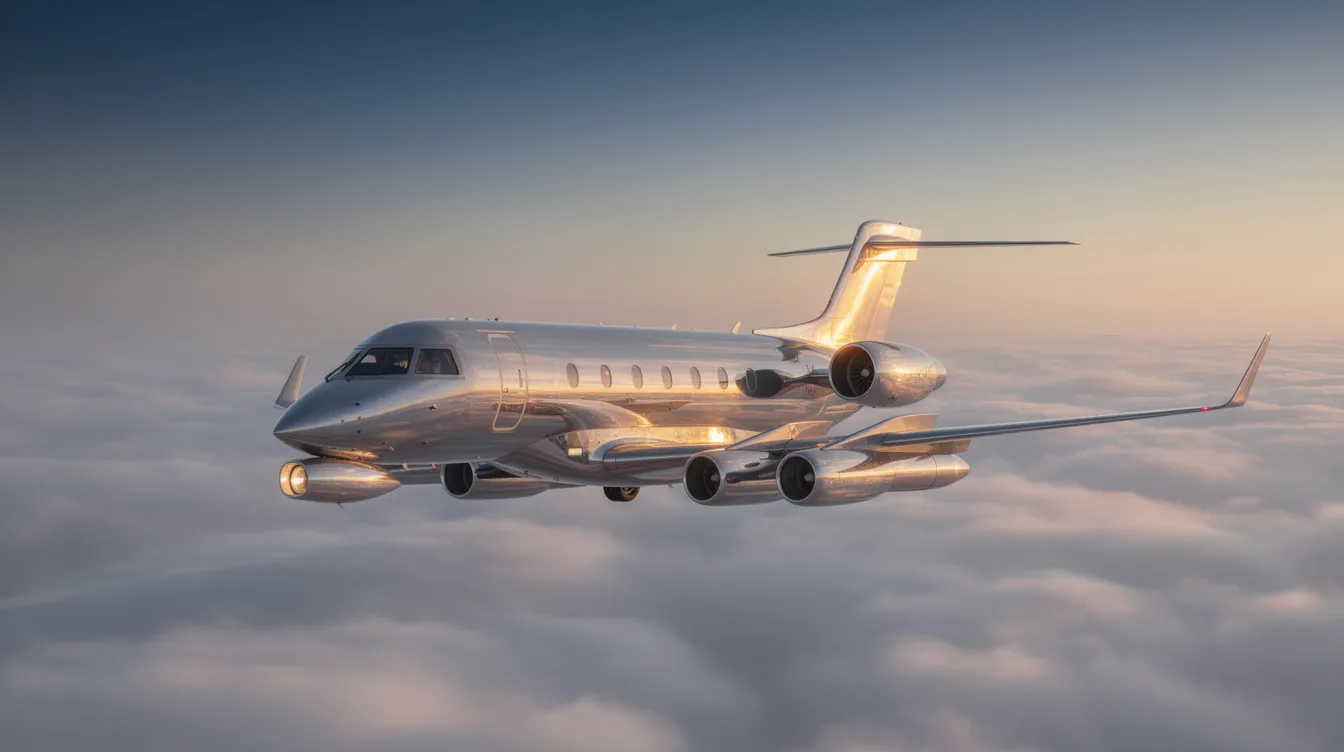
The Dassault Falcon 8X is widely regarded as one of the safest private jets in the world. It combines triple-engine redundancy, a fighter-derived digital flight control system, and the FalconEye Combined Vision System - a package no other ultra-long-range business jet replicates in exactly the same way. The Falcon 8X has zero hull-loss accidents as of May 2024, with only one non-fatal incident and no fatal accidents on record.
Other private jet models with strong safety credentials include the Bombardier Global 7500, Gulfstream G650ER, Embraer Legacy 500, Praetor 600, Cessna Citation Longitude, and the Cirrus Vision Jet. Each brings some of the best safety features to the table. But when safety is the primary criterion, the Falcon 8X stands apart.
Key Falcon 8X safety advantages at a glance:
Three Pratt & Whitney PW307D engines providing tri-jet redundancy are rare among modern private jets
FalconEye Combined Vision System blending synthetic vision system and enhanced vision system imagery for approaches down to 100 ft decision height
Digital Flight Control System (DFCS) with fly-by-wire envelope protection derived from Dassault's military fighter lineage
Rigorous safety testing and certification by FAA, EASA, and Transport Canada
Outstanding safety record across global operators since entering service in 2016
From BlackJet Fractional Jet Ownership's perspective, private jet safety is evaluated holistically - aircraft design, operator standards, pilot training, and maintenance programs all carry equal weight, and understanding fractional jet ownership terminology and concepts helps buyers align safety expectations with the right program structure.
Business aviation has an enviable safety track record. According to Cirium's Business Aviation Safety Review 2024, business jets recorded approximately 0.04 fatal accidents per 100 aircraft - nearly three times safer than turboprops at 0.11 per 100. The FAA reported that the overall general aviation accident rate dropped from 4.30 per 100,000 flight hours in 2022 to 3.86 in 2023, with fatal accidents declining from 0.69 to 0.65.
Aviation safety in private aviation is measured through accident rates, incident reporting systems (NTSB, EASA), regulatory oversight, and each operator's safety management system. Here is why modern business jets achieve high safety ratings:
Redundant systems ensure critical functions - hydraulics, flight computers, electrical - continue operating during a single failure
Private jets achieve exceptional safety through cutting-edge flight deck technology, including advanced avionics, synthetic vision, and enhanced flight vision system options
Resilient composite materials resist fatigue and stress better than traditional aluminum, extending structural life
Advanced collision avoidance systems detect nearby aircraft and issue resolution advisories automatically
Lower cabin altitude pressurization reduces passenger and crew fatigue and hypoxia risk on long flights
Multi-engine configurations allow aircraft to continue flying even if an engine fails, and two pilots are encouraged on all flights for safety
These layers of protection make air travel aboard modern heavy jets extremely safe for both routine and complex missions.
The Dassault Falcon 8X entered service in October 2016 and quickly earned a reputation as one of the safest private jets in operation. Dassault leveraged decades of fighter-jet engineering - including closed-loop flight control laws and digital architecture - to create a platform built around stability, resilience, and efficiency.
The Falcon 8X features a Digital Flight Control System that continuously manages flight control surfaces for optimal handling. Its safety record is clean: zero hull-loss accidents and no fatal accidents as of May 2024, with a proven track record across dozens of global operators. The aircraft meets or exceeds stringent FAA Part 25 and EASA CS-25 certification requirements and is popular among safety-focused corporate and fractional jet ownership programs.
For BlackJet Fractional Jet Ownership clients flying 25 to 150 flight hours per year, the Dassault Falcon 8X represents a benchmark for long-range missions - with an impressive range of 6,450 nautical miles, a spacious cabin, and safety practices that align with the most demanding operational standards, making it an attractive platform for structures such as 1/8 fractional jet ownership with around 100 hours per year.
The Falcon 8X's three-engine configuration is a rarity among modern ultra-long-range private jets, most of which rely on twin-engine designs. This tri-jet layout provides an extra safety margin that enhances safety in multiple real-world scenarios:
Engine failure over oceans or polar routes: A third engine means the aircraft can maintain altitude and range to reach a suitable airport rather than requiring emergency diversion protocols typical of twin-engine jets
Short or high-altitude runways: Three engines deliver greater combined thrust for takeoff from challenging airfields - the Falcon 8X needs only 5,880 ft of balanced field length and can land in as little as 2,220 ft
Ultra-long-range flexibility: Tri-jet redundancy provides operational flexibility similar to ETOPS relaxation, adding peace of mind on nonstop US–Middle East or Europe–Asia missions
Reduced consequence from uncontained failure: With two remaining engines, total power loss risk drops significantly compared to twin-engine designs
This configuration is a major factor in why experienced pilots and safety-conscious operators gravitate toward the Dassault Falcon platform for intercontinental flight operations.
The Falcon 8X's fly-by-wire system - its DFCS - continuously optimizes control surfaces for stability and efficiency. Derived directly from Dassault's military aircraft, the system includes flight envelope protection: automatic safeguards that prevent pilots from exceeding safe speed, angle of attack, or bank limits. Fly-by-wire systems can reduce pilot workload and enhance aircraft safety, which is critical during high-stress phases of flight.
The FalconEye Combined Vision System is the cockpit environment perfectly suited for low-visibility conditions. It blends a synthetic vision system with an enhanced vision system using multi-spectral sensors (visible, near-infrared, thermal) to let pilots see through fog, smoke, and darkness. FalconEye is certified for approaches down to 100 ft decision height with runway visual range as low as 350 meters, and it can detect LED runway lighting day or night.
Key safety outcomes for passengers:
Pilot situational awareness dramatically improved through a wide head-up display (30×40° field of view)
Pilot workload reduced through automatic trim, 3D weather radar, and predictive turbulence alerts - pilot workload reduction is essential for preventing human error during flights
Predictive landing technology helps pilots recognize potential runway overruns before they happen
Enhanced vision systems allow pilots to see hazards in poor visibility conditions that would ground less-equipped aircraft
These avionics technology advances contribute to the Falcon 8X being one of the least turbulent private jets and the most predictable rides in business aviation.

The Falcon 8X may be the reference point, but several other paramount business jets deliver exceptional safety performance. Here is how they compare:
Bombardier Global 7500 / Global 8000: The Bombardier Global 7500 includes advanced fly-by-wire technology for safety and features a head-up display for pilots, along with EFVS and SVS capabilities. The aircraft has experienced a few non-fatal incidents since 2018 but maintains a strong safety record. Learn more about top business jet companies operating these platforms.
Gulfstream G650/G650ER: The Gulfstream G650ER features an Enhanced Flight Vision System for safety and is certified for steep approaches, enhancing safety at challenging airports. Its cockpit environment and advanced avionics support comfortable flight in demanding conditions.
Embraer Legacy 500 / Praetor 600: The Embraer Legacy 500 has zero hull-loss accidents reported to date, with fly-by-wire controls and a modern safety-first design. The Embraer Phenom 300E has the industry's first runway overrun awareness and alerting system - a predictive tool that enhances safety during landing.
Cessna Citation Longitude: The Cessna Citation Longitude boasts a flawless safety record with no reported accidents or incidents as of May 2024. It uses Garmin G5000 avionics for safety with integrated synthetic vision and an intuitive cockpit layout.
Cirrus Vision Jet: The Cirrus Airframe Parachute System (CAPS) is a unique last-resort safety feature - a whole-airframe parachute with over 253 documented survivor saves that can help the aircraft land safely in an emergency. While a single-engine light jet, it demonstrates innovative safety features at the opposite end of the spectrum.
The fastest business jet designs - Bombardier Global 8000 (projected at up to Mach 0.95), Global 7500, and Gulfstream G650ER - are also among the safest private jets when operated by a reputable operator with rigorous testing and training programs. Speed and safety are not opposing forces.
High-speed aircraft incorporate cutting-edge wing design (such as Bombardier's Smooth Flĕx Wing) to reduce turbulence and structural stress, making even turbulent private jets smoother for passengers. But speed is only one variable. Safety performance depends more on avionics, redundancy, performance margins, and pilot training than on maximum Mach number.
For BlackJet Fractional Jet Ownership clients, aircraft selection balances speed, range, and safety to match each mission - a Bombardier Global or Falcon 8X for transoceanic flights, a Cessna Citation Longitude for mid-continental trips. Understanding how aging aircraft compare to modern jets also matters in this equation.
Even the safest private jet can only deliver on its potential when paired with an operator that prioritizes safety above convenience or cost. The operator's safety record can be as important as the aircraft model itself, especially when you consider liability and insurance coverage in fractional jet ownership. Maintenance is non-negotiable in aviation safety, and operational discipline involves standardized procedures and trained crews working together.
Hallmarks of a safe private jet operator — and well-structured fractional jet ownership contracts and agreements:
Independent audits: Operators audited by IS-BAO exceed FAA minimum safety standards. Look for ARGUS, WYVERN, and IS-BAO ratings.
Maintenance rigor: Pre-flight inspections are essential for private jet safety. Predictive maintenance software helps detect faults early, and real-time health monitoring spots anomalies before they threaten safety — all of which factor into the total cost of fractional jet ownership when evaluating different programs.
Crew standards: Highly trained crews are essential for maintaining safety in private aviation. Pilots undergo initial and recurrent simulator sessions, including emergency and weather-specific drills. Aircraft-specific systems training is essential, and pilots train on advanced avionics in high-performance jets.
Conservative decision-making: Go/no-go policies around weather, weight, and runway conditions prevent pilot error before it starts.
When evaluating a charter flight, jet card program, or fractional ownership option, clients should scrutinize both aircraft type and operator credentials, comparing leading fractional jet ownership programs for smart investors alongside safety metrics. BlackJet Fractional Jet Ownership partners with operators meeting or exceeding industry best practices through its unmatched service standards.
Choosing how to access the safest private jets is as important as choosing which aircraft to fly. Travelers often weigh fractional jet ownership vs membership programs before committing. Here are the main models:
On-demand charter flight: Flexible and pay-per-trip, but safety depends heavily on broker vetting and operator selection - quality varies widely compared with structured options like floating fleet arrangements in fractional ownership.
Jet card and membership programs: Predictable pricing with safety tied to the program's operator network; compare fractional jet ownership programs to find the right fit and consider fractional jet ownership financing options, costs, and benefits if you plan to move beyond prepaid flight time.
Fractional jet ownership: Equity in an aircraft with professional management, highly structured maintenance, experienced pilots, and safety processes mirroring corporate flight departments, making fractional jet ownership as an investment appealing for frequent, safety-focused travelers
Full ownership: Maximum control but also maximum responsibility for crew hiring, maintenance oversight, and safety compliance — a commitment that many compare against the overall cost structure of fractional jet ownership.
BlackJet Fractional Jet Ownership's Equity Fleet and Reserve Fleet models give clients structured access to some of the safest aircraft in business aviation - with professional scheduling, maintenance oversight, and standardized pilot training supported by robust fractional aircraft ownership contract frameworks. Redundant systems ensure critical functions continue operating during a single failure, and passenger comfort is maintained through lower cabin pressurization, luxurious interiors, and exceptional ergonomics.
For frequent travelers seeking a consistent, safety-first experience with high safety ratings, fractional aircraft ownership on leading platforms like the Dassault Falcon 8X, Bombardier Global 7500, or Cessna Citation Longitude is the most reliable path, especially when the tax implications for fractional jet owners are planned for in advance.
The Falcon 8X stands out due to its triple-engine redundancy, advanced Digital Flight Control System derived from military technology, and the FalconEye Combined Vision System that enhances pilot situational awareness in low-visibility conditions. It also maintains a perfect safety record with zero hull-loss accidents as of May 2024.
Fractional ownership programs like BlackJet ensure safety through rigorous operator standards, consistent maintenance schedules, highly trained pilots, and adherence to industry best practices. This structure provides a safety culture often exceeding that of ad hoc charter operators.
Tri-engine jets like the Falcon 8X offer additional redundancy, allowing continued safe operation even if one engine fails, especially over long oceanic or remote routes. This added margin enhances safety compared to most twin-engine jets.
Pilot training is critical, involving initial and recurrent simulator sessions, emergency and weather-specific drills, and aircraft-specific systems training. Operators encourage two-pilot crews on all flights to enhance safety and reduce human error.
Systems like the FalconEye Combined Vision System blend synthetic and enhanced vision technologies to allow pilots to see through fog, darkness, and other low-visibility conditions, enabling safer approaches and landings.
Yes, fractional ownership provides access to newer, well-maintained aircraft operated by vetted crews under strict safety protocols, significantly reducing operational risks compared to less regulated options.
Look for operators audited by recognized bodies such as IS-BAO, ARGUS, and WYVERN, which maintain rigorous maintenance programs, pilot training standards, and transparent safety management systems.
High-speed jets incorporate advanced fly-by-wire systems, cutting-edge wing designs to reduce turbulence, and predictive diagnostics to ensure stability and safety without compromising speed.
Yes, it features the Cirrus Airframe Parachute System (CAPS), a whole-airframe parachute that has saved over 253 lives, making it one of the safest light jets available.
Visit FractionalJetOwnership.com for detailed guides, expert advice, and to schedule a consultation on safe private jet ownership options.
The Dassault Falcon 8X earns its place as one of the safest private jets in the world through triple-engine redundancy, fighter-derived flight controls, and a clean safety record. But true private jet safety comes from combining the right aircraft with the right operator and ownership model.
BlackJet Fractional Jet Ownership helps clients:
Identify the right aircraft - matching jets like the Falcon 8X, Bombardier Global series, or Cessna Citation Longitude to specific routes and safety expectations
Structure ownership for safety and value - through Equity Fleet fractional shares or Reserve Fleet flexible access, with consistent maintenance and crew standards, and clear strategies for selling or exiting a fractional jet ownership share when your needs change
Navigate complexity - handling regulatory, scheduling, and technological advancements so clients focus on business, not logistics
Ready to explore the smarter way to fly private? Visit FractionalJetOwnership.com to learn how fractional ownership can deliver consistent, safety-first access to the world's leading business jets - and schedule a consultation today.
