July 11, 2026
When Set Jet launched its membership-based private jet service out of Scottsdale, it promised something appealing: private jet convenience at a fraction of the cost. For several years, it delivered semi-private flights on popular city pairs across the American West Coast and into Mexico. Then, in February 2024, the company shut down overnight. Here is what happened, how the model worked, and what former members and new private aviation explorers should consider now.
No. Set Jet was a membership-based semi-private aviation company that ended operations in early 2024. Set Jet was a membership-based semi-private aviation company that sold individual seats on scheduled, fixed routes in the American Southwest. Members paid a monthly fee, underwent security pre-screening, and could purchase individual seats on shuttle-style flights using private terminals, offering a lower entry price than full charters. The company notified approved members via email that all future flights and active memberships were canceled immediately. There were no refunds for unused credits or prepaid bookings.
The closure followed a failed SPAC merger and the loss of key investor backing, leaving the company without sufficient capital to continue service operations. Members who had relied on Set Jet for routes like Scottsdale to Los Angeles, Scottsdale to Las Vegas, Scottsdale to San Diego, and Scottsdale to Cabo San Lucas were left to find alternatives on short notice.
Travelers who need those same routes today can access them through traditional private jet charter, jet card programs, or fractional jet ownership. BlackJet Fractional Jet Ownership offers a stable alternative for predictable private jet access, including flexible floating fleet-style availability, covering both domestic and international flights tailored to business and family air travel needs.
Set Jet operated as a semi-private flight provider, a model that sits between commercial airlines and traditional private jet charter. Semi-private flights are scheduled services using private terminals and smaller aircraft, where passengers purchase individual seats rather than chartering the entire plane. This approach offers many of the conveniences of private aviation—such as bypassing TSA lines and using private FBOs—at a lower entry price than full aircraft charter.
Set Jet was founded in 2014 by Tom Smith, the former CEO of TASER International. The privately held company was headquartered at Scottsdale Airport (15115 N. Airport Drive, Scottsdale, AZ 85260) and launched its by-the-seat membership model around 2019.
The concept was straightforward. Members paid about $99 per month and completed a security pre-screening process for approval. Once cleared, they could purchase individual seats on scheduled flights rather than chartering an entire aircraft. Per-seat fares ranged from $750 to $1,550 per one-way segment, depending on the route. A Scottsdale-to-Los Angeles seat might run around $750, while longer legs to Cabo San Lucas push toward the higher end.
Set Jet positioned itself between commercial first class and traditional private jet charter. Passengers used private terminals at FBOs, bypassing crowded terminals and TSA lines, and flew alongside like-minded travelers in cabins configured for roughly 13 to 15 semi-private seats. The membership model offered a lower entry price than full charters, which can cost tens of thousands of dollars for a single trip.
Importantly, Set Jet was not a jet card or fractional jet ownership program. Members had no ownership interest, no guaranteed aircraft hours, and no equity. They belonged to a membership community with the right to book seats—nothing more.
This differs fundamentally from traditional private aviation models:
On-demand charter: Book an entire aircraft per trip, choosing aircraft type, route, and schedule. Traditional private jet charters require renting the entire aircraft.
Jet card: Prepay for 25–50+ flight hours across specific aircraft categories, with transparent rate structures and guaranteed availability.
Fractional jet ownership: Purchase an equity share of an aircraft for predictable aircraft access, priority scheduling, and potential tax advantages.
With BlackJet's models, clients get full private jet access: the entire cabin reserved for their party, flexible departure times, custom routings, multi-city itineraries, and the ability to choose aircraft class—light jets, midsize jets, or large-cabin business jets—based on mission needs.
Set Jet sold seats. BlackJet sells access to full aircraft capacity and tailored mission planning, which better serves executives, families, larger groups, and a corporate team with complex schedules.
Feature | Per-Seat Membership (Set Jet) | Full Aircraft Charter / Fractional |
|---|---|---|
Monthly fee | ~$99/month | None or large initial commitment |
Per-trip cost | $750–$1,550 per seat | Entire aircraft: often tens of thousands |
Routes | Fixed routes only | Any suitable airport pair |
Privacy | Shared cabin (10–15 pax) | Entire cabin for your group |
Ownership/equity | None | Fractional share or prepaid hours |
Scottsdale Airport was Set Jet's primary hub for operations, chosen for its affluent local clientele, strong business travel demand, and efficient private FBO infrastructure.
Set Jet's network is focused on city pairs with inefficient commercial flights, particularly across the American Southwest. The company operated fixed routes primarily in the American Southwest, with key routes including:
Scottsdale (SDL) to Los Angeles (Van Nuys area FBOs)
Scottsdale to Las Vegas (Henderson Executive / LAS)
Scottsdale to San Diego (CRQ/SAN area)
Scottsdale to Cabo San Lucas / Los Cabos (SJD)
Scottsdale to Salt Lake City (seasonal)
Occasional service to other cities like Orange County, San Francisco, and Aspen
Set Jet published fixed schedules on these popular city pairs, providing shuttle-style flights rather than on-demand services. This fixed route network worked well for frequent travelers flying the same leisure routes or business lanes weekly. However, it offered little flexibility for point-to-point travel beyond Set Jet's network or for international travel to destinations outside a small set of leisure destinations.

By contrast, providers like BlackJet offer private jet access from virtually any suitable airport in the United States to global destinations, without being limited to a handful of shuttle-style schedules.
Set Jet's membership community operated on a seat-based model: semi-private flights in shared cabins, with members paying monthly dues for the right to book individual seats. The memberships were subject to a screening process to ensure a vetted environment of vetted members.
This differs fundamentally from traditional private aviation models:
On-demand charter: Book an entire aircraft per trip, choosing aircraft type, route, and schedule. Traditional private jet charters require renting the entire aircraft.
Jet card: Prepay for 25–50+ flight hours across specific aircraft categories, with transparent rate structures and guaranteed availability.
Fractional jet ownership: Purchase an equity share of an aircraft for predictable aircraft access, priority scheduling, and potential tax advantages.
With BlackJet's models, clients get full private jet access: the entire cabin reserved for their party, flexible departure times, custom routings, multi-city itineraries, and the ability to choose aircraft class—light jets, midsize jets, or large-cabin business jets—based on mission needs.
Set Jet sold seats. BlackJet sells access to full aircraft capacity and tailored mission planning, which better serves executives, families, larger groups, and a corporate team with complex schedules.
Advantages:
Lower entry price per passenger than chartering an entire private jet
Use of private terminals, bypassing TSA queues and crowded concourses, with faster boarding
Passengers could arrive shortly before departure, reducing airport time significantly
Predictable shuttle-style schedules on popular routes like Scottsdale–Los Angeles
A luxury business experience and community feel among vetted, security-screened members
Drawbacks:
Fixed routes and timetables restricted true on-demand flexibility
Shared cabins with 10–15 passengers reduced privacy for confidential conversations
Limited suitability for international flights beyond a small set of leisure cities
Exposure to provider stability risks—the 2024 shutdown left some members with unused credits and no refunds
No ownership equity, no guaranteed hours, and price premiums on peak travel days
Best For: Regular weekenders between Scottsdale and Las Vegas, or many travelers flying the same semi-private options weekly who prioritize time savings and cost over full privacy.
Not Ideal For: Last-minute international travel, board meetings requiring confidentiality, executives needing schedule control, or travelers with itineraries beyond the fixed route network.
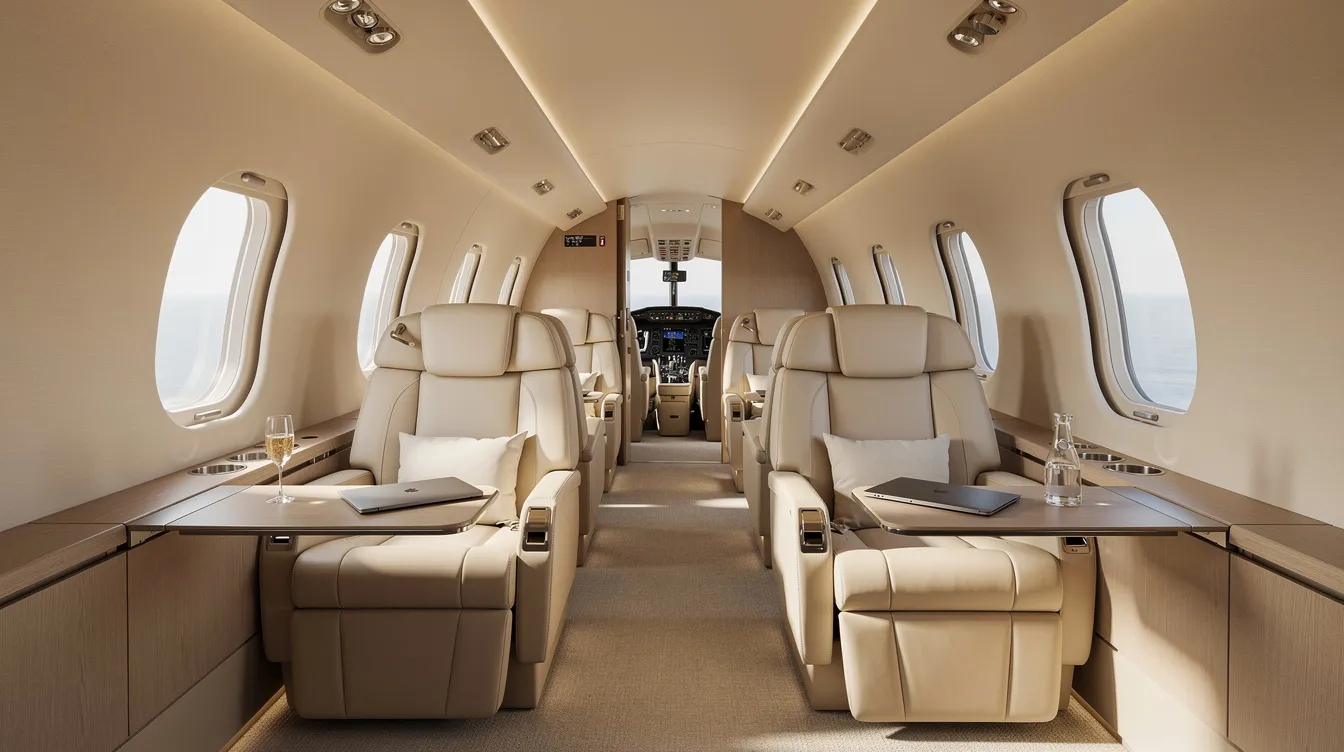
Set Jet flights operated on regional jet platforms such as the Bombardier CRJ-100/200, reconfigured with fewer, more spacious seats. Semi-private flights often use smaller aircraft with fewer passengers—typically around 13 to 15 per flight—creating a quieter onboard experience than standard commercial cabins. Complimentary snacks and drinks were included, with Wi-Fi on select aircraft and relaxed boarding from private FBO lounges.
By contrast, a fully private cabin through BlackJet's Reserve or Equity Fleet means the entire cabin is dedicated to a single client group. This setup is ideal for board meetings, legal teams, or families who need confidentiality and comfort. Catering, seating layouts, and the onboard experience can be customized depending on aircraft type and mission length, including configurations designed for overnight international flights or short regional hops.
Semi-Private Cabin vs. Full Private Jet Cabin:
Privacy: Shared space with other members vs. exclusive cabin for your party
Control: Fixed departure schedule vs. depart on your timeline, adjust for delays, redirect mid-trip
Comfort: More spacious than commercial first class but not customizable vs. a fully tailored interior and amenities
Confidentiality: Not suitable for sensitive discussions vs. boardroom-level privacy
Safety in private air travel is regulated by the FAA. Set Jet flights were operated by licensed air carriers holding FAA Part 135 or Part 121 certification, and safety oversight typically sits with the certificated operator, not the membership broker.
Safety & Stability Checklist Before You Book:
Operator FAA certification (Part 135/121): Ensure the operator is properly certified.
Pilot minimum flight hours and recurrent training records: Review pilot qualifications and ongoing training.
Maintenance programs, fleet age, and inspection intervals: Check for robust maintenance and up-to-date aircraft.
Operator audits and third-party ratings (ARG/US, Wyvern, IS-BAO): Look for independent safety audits and insurance coverage levels, including the liability coverage considerations in fractional ownership.
Financial transparency: Review refund policies, capital structure, and sustainable aviation fuel commitments.
Set Jet's February 2024 shutdown is a case study in financial and operational risk separate from aircraft safety. The company's failed SPAC merger with Revelstone Capital left it without the growth capital needed to sustain operations. Revenue in 2022 was approximately $12.9 million against losses exceeding $21 million. Some members lost money on future flights and memberships, underscoring the need for careful consideration of contracts, refund policies, and the essential contract terms in fractional jet programs and other models before committing funds.
BlackJet Fractional Jet Ownership prioritizes stability through long-term client relationships, vetted operator networks with rigorous safety standards, and transparent fractional ownership contract structures for fractional shares and jet card hours with clear terms on cancellations.
Set Jet ceased operations in February 2024 after roughly a decade of operations. The main reasons commonly cited include a capital-intensive business model, a narrow fixed route network, and the difficulty of sustaining low per-seat fares against the enormous underlying costs of private aviation.
These challenges point to broader trends reshaping the industry. Demand for private air travel continues to rise among business owners and executives seeking predictable, door-to-door travel. The market is shifting away from rigid shuttle-style memberships toward more flexible solutions: fractional jet ownership, jet card programs, and on-demand aircraft charter with global reach.
Fractional aircraft ownership and jet cards provide more resilient access. Investors and cardholders commit to defined flight-hour levels—typically 25 to 150 hours per year—giving providers a stable usage base while clients gain guaranteed availability, predictable fractional jet ownership costs, and options for both domestic and international travel.
BlackJet aligns with these trends through its Reserve Fleet (pay-as-you-go with guaranteed availability) and Equity Fleet (fractional ownership with potential tax benefits and asset-backed stability, supported by flexible fractional jet ownership financing options), supporting complex multi-leg itineraries and cross-border missions that semi-private seat models cannot handle.
The answer depends on how you fly. Key decision factors include:
Frequency: Occasional trips (under 20 hours/year) vs. 25–150+ hours annually
Route profile: Repetitive regional hops vs. nationwide or international flights
Privacy: Shared cabins acceptable vs. fully private space required
Flexibility: Planned schedules vs. last-minute changes and complex itineraries
A BlackJet jet card works simply: the client prepays for a set number of hours at transparent hourly rates. Hours can be used across different aircraft categories depending on mission needs. It is ideal for executives and families who want guaranteed private jet access without owning an entire aircraft.
Fractional jet ownership through BlackJet means acquiring an equity share in an aircraft or fleet, gaining priority access and predictable usage; for example, 1/8th fractional jet ownership typically provides around 100 hours of flight time per year. Tax implications for fractional jet owners under U.S. tax rules may include deductions, depreciation, and other potential benefits depending on usage and entity structure. Aircraft management, scheduling, and maintenance are handled by BlackJet—not the owner.
Model | Control | Commitment | Best For |
|---|---|---|---|
Seat-Based Membership (Set Jet style) | Low - fixed routes, shared cabin | Low monthly fee | Budget-conscious, same-route repeaters |
Jet Card | High - any route, full cabin | Moderate prepaid hours | Frequent flyers wanting flexibility without ownership |
Highest - priority access, equity | Significant capital investment | Heavy travelers, corporate teams, international travel |
Scenario: A Scottsdale-based CEO flies monthly to New York and quarterly to London. Under a Set Jet-style membership, most of those missions are impossible—the routes are not covered, there are no international legs, and shared cabins offer no confidentiality for first-class commercial ticket alternatives. A jet card or fractional share covers every leg, on schedule, in a private cabin.
No, Set Jet ceased operations in February 2024 following financial challenges and a failed merger. The semi-private membership model is no longer available.
Members paid a monthly fee of about $99, completed security pre-screening, and purchased individual seats on scheduled flights along fixed routes primarily in the American Southwest.
Set Jet offered lower entry costs by selling individual seats on shared flights, whereas traditional charters require renting the entire aircraft, often costing tens of thousands of dollars.
Set Jet focused on fixed routes such as Scottsdale to Los Angeles, Las Vegas, San Diego, and leisure destinations like Cabo San Lucas.
For travelers needing more flexibility, privacy, and international reach, fractional ownership or jet card programs offer guaranteed access to full aircraft with customizable schedules.
Safety standards include FAA certification (Part 135/121), pilot minimum flight hours, recurrent training, maintenance programs, and third-party audits from organizations like ARG/US and Wyvern.
While Set Jet no longer operates, travelers can arrange private charters or use jet card services to fly similar routes with full control over timing and privacy.
Jet cards suit frequent flyers wanting flexibility without ownership, while fractional ownership is ideal for those seeking equity shares, priority access, and potential tax benefits.
Set Jet expanded awareness of semi-private services as a bridge between commercial flying and full charter. It also demonstrated the risks of relying on a single, fixed-route membership provider with uncertain financial footing. Many travelers who valued that convenience are now seeking more resilient models.
For anyone who previously used Set Jet—or who is exploring private jets for the first time—the path forward starts with evaluating annual flight hours, common destinations, and privacy needs. Whether a jet card or fractional aircraft ownership makes more sense depends on those specifics, and understanding fractional jet ownership terminology can clarify which structure truly fits your flying profile.
BlackJet Fractional Jet Ownership provides stable, long-term private jet access with flexible domestic and international routing, tailored solutions for individuals and corporate flight departments, and the transparency that semi-private membership models often lacked.
Ready to explore the smarter way to fly private? Visit FractionalJetOwnership.com to compare jet card and fractional ownership options, and schedule a consultation tailored to your travel profile.
