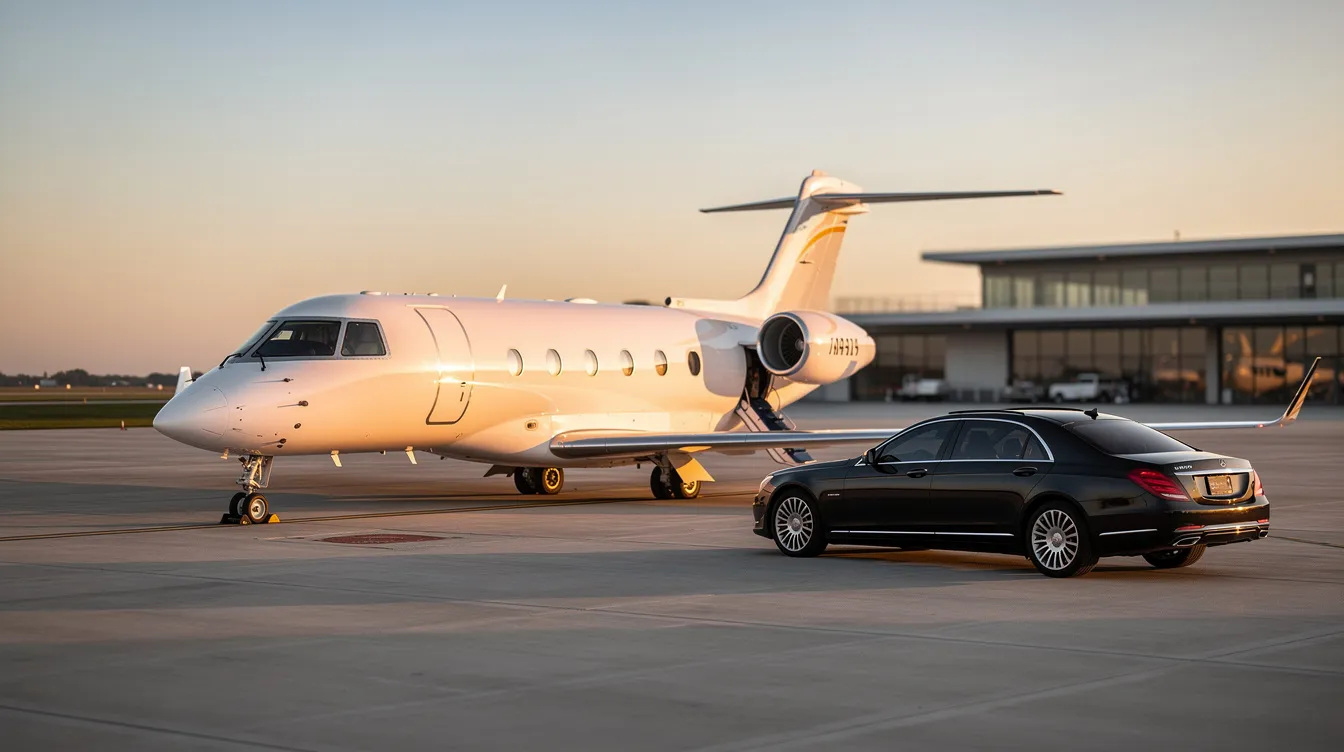
August 30, 2026
A transcontinental private jet flight is a nonstop private aviation mission across oceans or entire continents, typically flown by heavy jets and ultra-long-range aircraft with roughly 3,500 to 8,000+ nautical miles of range on routes like New York to London, Los Angeles to Tokyo, or Dubai to Sydney. These missions require serious range, overwater navigation capability, and cabins designed to keep passengers productive or rested across multiple time zones, which is why they matter so much to companies, executives, families, and other high-frequency travelers who need faster, more flexible international travel than commercial airlines can offer.
Heavy jets and ultra-long-range aircraft allow executives, families, and corporate teams to avoid layovers, connections, and wasted terminal time on long-haul routes. Private jets save 3–4 hours on many transatlantic journeys alone, and the advantage grows on longer sectors: New York to London typically takes 6–7 hours, Los Angeles to Tokyo averages 11–12 hours, and most transatlantic flights fall in the 6–8 hour range depending on winds and aircraft type. Beyond the clock, lower cabin altitude, circadian lighting, privacy, and onboard connectivity can reduce jet lag and turn flight time into usable work or recovery time.
For travelers and corporations flying roughly 25 to 150 hours per year, the real decision is not only which aircraft can make the trip, but which access model delivers predictable scheduling, comfort, and cost control. BlackJet Fractional Jet Ownership provides that access through two structures: the Equity Fleet for fractional aircraft ownership and the Reserve Fleet for pay-as-you-go use. This introduction to transcontinental private jet travel explains the aircraft categories that handle these missions, common routes and flight times, ownership and charter options, onboard comfort and performance features, operating requirements, costs, connectivity, sustainability considerations, and how BlackJet helps clients build a tailored long-range private aviation strategy.
Here is what that means in practical terms:
Time savings: Skip commercial terminals, avoid connections, and arrive hours earlier
Privacy and productivity: Work, rest, or hold business meetings without interruption
Personalized service: Customize cabin layout, catering, and scheduling around your itinerary
Predictable costs: Convert variable travel expenses into structured ownership or membership fees
Transcontinental private jets typically fall into super-midsize or ultra-long-range categories, covering missions of 3,500 to 8,000+ nautical miles nonstop.
Common aircraft types include super-midsize jets, heavy jets, ultra-long-range jets, Boeing Business Jet variants, and large VIP airliners.
Charter rates range from approximately $4,000 per hour for super-midsize jets to $10,000–$18,000+ per hour for ultra-long-range business jets.
Private jets offer direct access to over 5,000 U.S. airports and nearly 1,000 FBOs across European countries, bypassing congested commercial hubs.
Fractional jet ownership allows shared access to private jets and typically suits travelers needing 25–150 flight hours annually, offering priority scheduling and potential tax benefits; those new to this model benefit from understanding fractional jet ownership terminology and core concepts.
BlackJet's Equity Fleet gives fractional ownership of a specific aircraft with guaranteed hours, while the Reserve Fleet provides flexible, non-ownership access to transcontinental-capable jets.
In private aviation, the terms "transcontinental," "intercontinental," and "transoceanic" are often used interchangeably to describe missions that span oceans or cross entire landmasses. A transcontinental private jet flight generally refers to any nonstop sector requiring 3,500 nautical miles or more of flight range—missions that take passengers between continents or across major oceans.
These flights demand aircraft types well beyond very light jets or light jets. Private jets need a minimum range of 3,500 nautical miles for Europe from the U.S. East Coast, and significantly more for transpacific or Middle Eastern routes. Transcontinental private jets generally seat between 8 and 19 passengers depending on the configuration, and aircraft selection must match the mission profile, including range and cabin comfort needs.
Here are concrete route examples with approximate distances:
New York–London: ~3,450 NM
Miami–Paris: ~3,900 NM
Los Angeles–Tokyo: ~4,750 NM
Dubai–New York: ~5,850 NM
The main constraints determining whether a mission can be flown nonstop include aircraft fuel capacity, ETOPS/EDTO certification for extended overwater segments, runway length at both departure and arrival airports, and total payload (passenger count plus baggage plus fuel). Booking a transcontinental private jet requires consideration of aircraft suitability and regulatory compliance for every segment.
A useful way to think about mission categories:
Regional: Under ~2,500 NM (e.g., New York–Miami, London–Moscow) — suitable for midsize jets or smaller
Transcontinental: ~3,000–5,500 NM (e.g., transatlantic, US coast-to-coast — -requires super midsize or heavy jets
Ultra long range: 6,000+ NM (e.g., New York–Hong Kong, Dubai–Tokyo) — demands ultra long range jets or VIP airliners
Flight times on transcontinental routes vary with jet type, wind speed, routing, and cruising altitude. Private aircraft typically fly more direct tracks than commercial airlines and cruise at higher altitudes—up to 51,000 feet—avoiding severe weather and commercial traffic. This combination consistently delivers faster door-to-door travel.
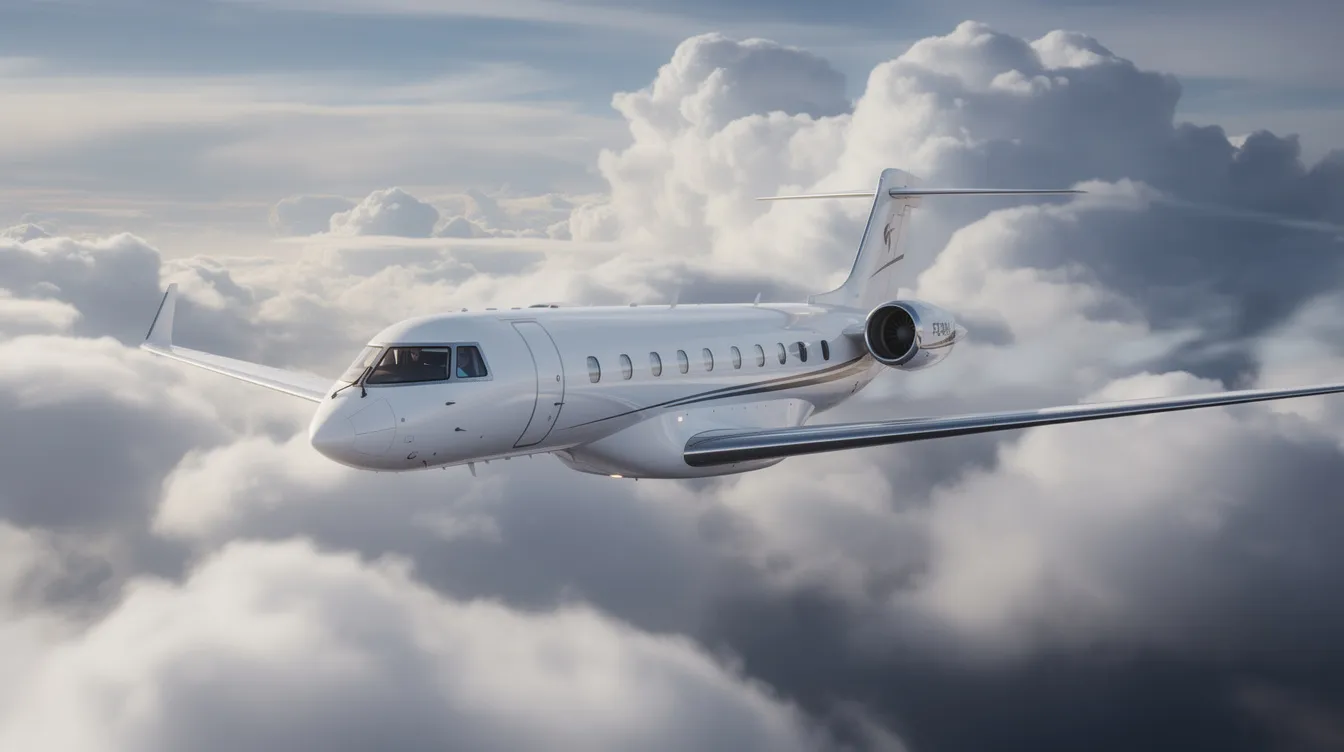
Here are popular transatlantic routes and transpacific corridors with representative business jet models:
New York (Teterboro) – London (Luton): 6–7 hours on a Gulfstream G550 or Global Express
Miami – Paris (Le Bourget): 8–9 hours on a Bombardier Global 6500
Los Angeles – Tokyo (Haneda): 11–12 hours on a Global 7500 or Gulfstream G700
Dallas – São Paulo: 9–10 hours on a Dassault Falcon 8X (Miami to São Paulo flight time is about 8–9 hours on a similar routing)
Dubai – New York: 13–14 hours on a Gulfstream G650ER
Chicago – Zurich: 7–8 hours on a Gulfstream G450 or comparable heavy jet
Toronto – Dubai: typically 12–13 hours on an ultra-long-range jet
Tailwinds on eastbound transatlantic flights can cut up to an hour from the journey. Conversely, weather can add 30–60 minutes to transatlantic flight durations, particularly during winter storms or when oceanic tracks are congested.
BlackJet's scheduling team models winds, performance data, and payload variables when advising fractional owners on whether a mission can be flown nonstop or should include a technical fuel stop at locations like Shannon, Reykjavik, or Honolulu.
Heavy jets and ultra-long-range business jets dominate transcontinental private jet travel because they deliver the right balance of flight range, typical cruise speed, cabin comfort, and baggage capacity for missions spanning 3,500 to 8,000+ nautical miles.
Here is how the main aircraft categories break down:
Super midsize jets (e.g., Cessna Citation Longitude, Embraer Praetor 600, Challenger 350): 3,000–4,500 NM range. These are highly versatile aircraft for US coast-to-coast and some East Coast–Western Europe routes with favorable winds. Super midsize jets connect distant city pairs without refueling in many scenarios.
Heavy jets (e.g., Gulfstream G450/G550, Dassault Falcon 900/2000 series): approximately 4,000–6,750 NM range. Heavy jets can fly nonstop across the Atlantic Ocean and are the workhorse class for transatlantic business aviation, handling 10–14 passengers with spacious cabin layouts.
Ultra-long-range jets (e.g., Bombardier Global Express/7500, Gulfstream G650ER/G700, Dassault Falcon 8X): 6,000–8,000+ NM range, handling missions like Los Angeles–Sydney or New York–Johannesburg with one stop or nonstop depending on model and conditions.
Boeing Business Jet and VIP airliners: larger aircraft based on commercial airframes, prioritizing group cabin size and volume for teams, events, or extended families.
BlackJet primarily places fractional owners into long-range and ultra-long-range business jets for transcontinental profiles, while leveraging super midsize jets via the Reserve Fleet for shorter or lighter missions.
Bombardier's Global series sets the benchmark for ultra long range private jet travel and is heavily used in corporate flight departments and fractional jet ownership programs across the United States and globally.
Global Express / Global Express XRS: ~6,000 NM range, well-suited for missions like New York–London or Miami–São Paulo. Three distinct zones in the passenger cabin with lie-flat seating.
Global 6500: ~6,600 NM range with optimized wings and improved fuel efficiency. Handles routes like Los Angeles–London or Dubai–London with a comfortable margin.
Global 7500: The Bombardier Global 7500 has a range of 7,700 nautical miles—enough for up to 16–17 hours of endurance. Four cabin zones, including a private suite and full galley,y make it ideal for New York–Hong Kong or Los Angeles–Sydney. The Bombardier Global 7500 features advanced aerodynamics for efficiency, reducing fuel burn compared to earlier models.
Large-cabin models like the Global 7500 offer comfort amenities including fully reclining berths and full-size lavatories. Cabin comfort features that directly mitigate jet lag include lower cabin altitude (often 3,000–4,500 feet equivalent at cruise), advanced circadian lighting systems, exceptionally quiet cabins, and full-size sleeping accommodations.
Global-series aircraft are frequently sourced for BlackJet's Equity Fleet for clients who need the ability to fly nonstop on demanding routes without upsizing to a VIP airliner.
Gulfstream dominates the long-range jet market, with its aircraft widely deployed in corporate flight departments, charter fleets, and fractional jet ownership programs worldwide.
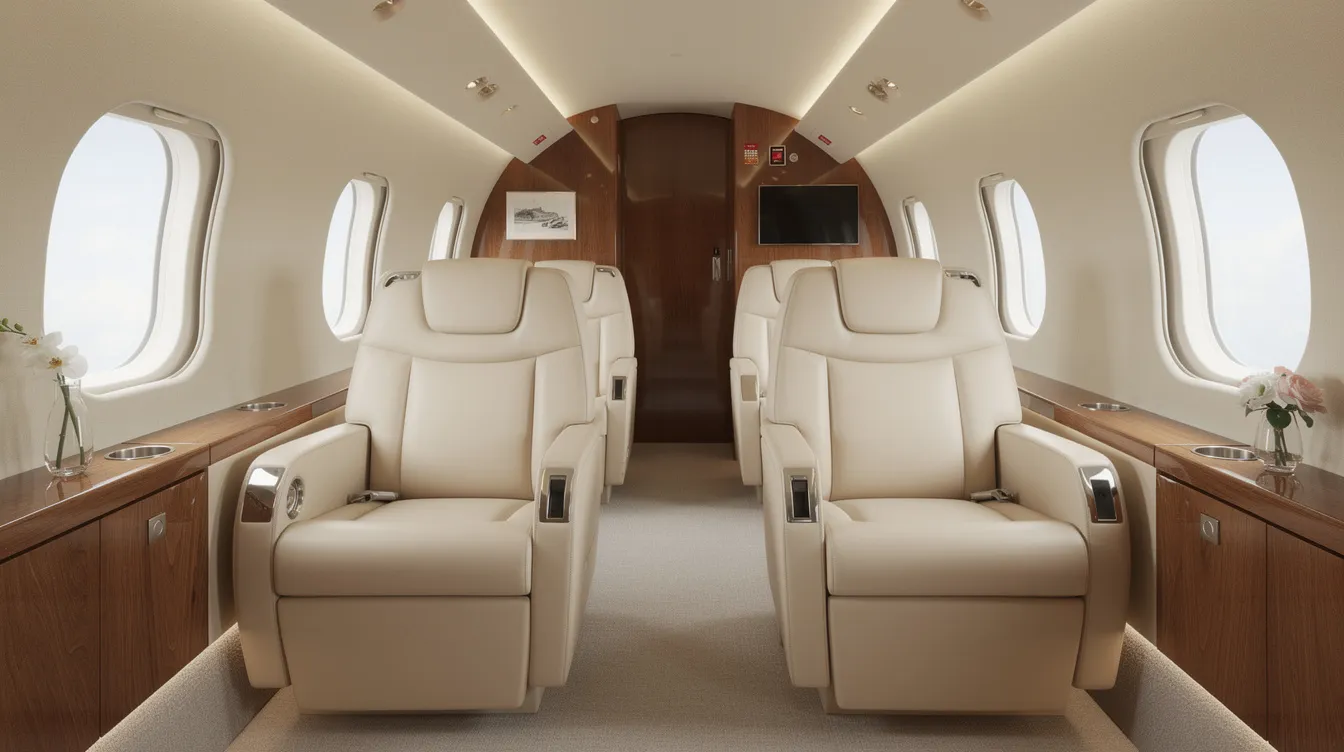
Key models and their transcontinental roles:
Gulfstream G550: 6,750 NM range, the classic workhorse for routes like New York–Dubai or Los Angeles–London. Seats 14–16 in three living zones with impressive range for its class.
Gulfstream G650ER: The Gulfstream G650ER can fly 7,500 nautical miles nonstop, making it popular with ultra-high-net-worth individuals. It connects New York–Tokyo or Dallas–Johannesburg with minimal constraint. Ultra-long-range jets like the G650ER exceed 7,500 nautical miles in range, with a maximum speed near Mach 0.925.
Gulfstream G700 and G800: 7,500–8,000+ NM published range, featuring the tallest and widest cabins in the business jet category, advanced avionics, and next-generation engine power. The Gulfstream G700 has efficient engines for reduced emissions compared to prior generations.
Performance details that matter for international travel: Mach 0.90–0.935 cruising speed, lower cabin altitude (~3,000–4,000 feet at typical cruise), and private jets can fly at altitudes of 40,000+ feet for smoother flights—all contributing to greater passenger comfort and enabling passengers to arrive ready to work.
BlackJet often recommends Gulfstream heavy jets for owners who routinely fly transcontinental routes with 10–14 passengers and demand fast cruise speeds.
When passenger count exceeds what a conventional business jet can handle comfortably, Boeing Business Jets and VIP airliners become the right tool. These larger aircraft are built on commercial airframes but configured as private aircraft for group travel, corporate roadshows, or diplomatic missions.
Boeing Business Jet 3 (based on 737-900ER): ~5,380 NM range, configurable from approximately 15 to 40+ VIP seats with lounges and conference rooms. Suited for routes like Geneva–Los Angeles.
Boeing Business Jet 787: near 10,000 NM range, capable of ultra-long-range nonstop missions like New York–Sydney. Multi-bedroom "flying residence" layouts with fully equipped galleys, private offices, and maximum fuel capacity for the longest missions.
Airbus ACJ320neo: ~6,000+ NM depending on configuration, supporting 19–22 passengers with private bedrooms, full galleys, and dedicated offices.
While BlackJet focuses primarily on business jets rather than VIP airliner ownership, the company can coordinate access via the Reserve Fleet for special events, corporate group travel, or large family movements. Clients might step up to a Boeing Business Jet when they need to hold board-level business meetings in flight, move sports teams, or require a cabin with distinct zones for work, dining, and rest simultaneously.
On extended flights lasting 8–14 hours, cabin comfort is not a luxury—it directly determines whether passengers arrive productive or exhausted. The onboard experience on a transcontinental private jet flight is fundamentally different from commercial aviation.
Key comfort factors:
Lower cabin altitude: Most heavy and ultra-long-range jets maintain cabin pressure equivalent to 3,000–4,500 feet, improving oxygenation and reducing fatigue. Commercial airliners typically pressurize to 6,000–8,000 feet equivalent.
Circadian lighting: Advanced cabin management systems control lighting and temperature, with LED systems that shift color spectrum and intensity to align with destination time zones, actively reducing jet lag.
Quiet cabins: Superior soundproofing, advanced insulation, and engine placement keep noise levels far below commercial aircraft.
Onboard amenities on these aircraft transform extended flights into productive or restful time:
Cabins often feature lie-flat beds for overnight travel, and private jets feature private bedrooms for restful sleep on longer sectors
Gourmet cuisine is available with personalized catering services, prepared from fully equipped galleys
Passengers can customize their onboard experience, including catering and seating arrangements
Multiple cabin zones—work, dining, lounge, bedroom—allow different activities simultaneously
The cabin crew on transcontinental flights plays a critical role, managing catering schedules, adjusting cabin environment through the flight, and maintaining safety and personalized service over long duty periods. BlackJet helps Equity Fleet owners specify cabin layouts and service standards so the onboard experience consistently matches their work and family habits.
Published maximum range figures from manufacturers assume ideal conditions—light payload, favorable winds, optimal altitude. Real-world nonstop capability depends on passengers, baggage, cruising altitude, headwinds, and mandatory fuel reserves.
Here are practical thresholds to keep in mind:
3,500 NM minimum for US East Coast to Western Europe under favorable conditions; 4,000+ NM preferred for year-round flexibility on popular transatlantic routes
5,500–6,000 NM typically required for West Coast US to Western Europe, or East Coast US to the Middle East, without fuel stops
7,000+ NM necessary for nonstop missions like New York–Hong Kong or Los Angeles–Sydney, depending on headwinds and payload
When a nonstop flight is not feasible, flight planning teams identify efficient technical stop locations—Reykjavik, Shannon, or Honolulu for Pacific crossings—to minimize ground time and keep total travel duration competitive.
Fractional jet ownership clients rely on their provider's operations team for this analysis, particularly when programs use floating fleet options in fractional ownership to improve aircraft availability and efficiency. BlackJet's scheduling and performance modeling determines whether each mission can be flown nonstop or requires a brief stop, factoring in wind speed forecasts, payload, and reserve requirements so owners can plan accordingly.
Costs for transcontinental private jet travel vary significantly by aircraft class, distance, and access model. Whether a traveler uses on-demand charter flights, jet card programs, or fractional jet ownership changes both the price and the predictability of each trip.
Typical charter hourly rate ranges (2025–2026 market) provide only part of the picture; understanding the full cost structure of fractional jet ownership is equally important when comparing long-term options:
Super midsize jets: approximately $4,000–$7,000 per hour
Heavy jets: hourly rates for heavy jets range from $8,000 to $10,000
Ultra-long-range jets and Boeing Business Jet types: ultra-long-range jets charge $10,000 to $18,000 per hour
Example one-way trip budgets based on current market averages:
New York–London on a Global Express: a one-way flight from New York to London costs about $70,000–$90,000
Miami–São Paulo on a Falcon 8X: roughly $90,000–$130,000
Los Angeles–Paris on a heavy or ultra-long-range jet: a one-way flight from Los Angeles to Paris costs $120,000 to $170,000
Transcontinental private jet flights can cost over $150,000 one-way on the longest or most premium routes.
Additional cost drivers include crew overnights, de-icing, international handling fees, overflight permits, and repositioning. In fractional ownership, many of these items are packaged into predictable monthly management fees and occupied hourly rates, while ad-hoc charter quotes pass each surcharge through individually. BlackJet's fractional and membership structures convert these variable costs into predictable fees for clients flying 25–150 hours per year, and prospective owners should evaluate the total cost of a fractional jet share before committing.
For travelers who routinely fly privately on long-haul flights, the choice between ad-hoc charter and fractional jet ownership vs jet membership programs shapes both cost and experience over time. Here is how the main access models compare for transcontinental missions:
Ad-hoc charter flights: Maximum flexibility with no long-term commitment, but exposure to fluctuating rates and limited aircraft availability on peak dates. Heavy and ultra-long-range jets are scarce in the charter market during holidays and major events.
Jet card programs: Guaranteed availability and fixed hourly rates with prepaid hours, but often come with blackout dates, aircraft category limitations, and fixed schedules that may not align with transcontinental needs. Fewer ownership-style tax benefits.
Fractional jet ownership: Capital buy-in for a share of a specific aircraft type, with guaranteed access, consistent cabin and crew standards, and direct access to known heavy jets and ultra-long-range business jets. Fractional ownership provides tax benefits and priority access. Fractional ownership reduces hassle compared to full aircraft ownership by offloading maintenance, crew management, and regulatory compliance to the program operator.
Private jets allow flexible departure times tailored to itineraries—a critical advantage on transcontinental routes where commercial options may offer only one or two nonstop flights per day.
For 25–150 hours of annual long-range flying, fractional ownership through BlackJet can lower effective cost per hour compared with frequent long-haul charter while providing priority scheduling and a consistent onboard experience. Comparing programs side by side helps clarify the economics for each client's specific route profile.
BlackJet offers two primary ways for clients to access transcontinental private jet capability: the Equity Fleet and the Reserve Fleet.
Equity Fleet (Fractional Ownership): The client purchases an equity share—for example, a 1/16th or a 1/8th fractional jet ownership interest—in a long-range business jet. This guarantees a fixed block of annual flight hours, priority booking on high-demand routes, predictable hourly rates, and potential tax advantages under U.S. depreciation rules (clients should consult their tax advisors for specifics). Shares typically involve multi-year commitments of 3–5 years, and many owners use fractional jet ownership financing options to manage acquisition costs and cash flow.
Reserve Fleet (Pay-as-You-Go): The Reserve Fleet model offers pay-as-you-go hours without ownership costs. Clients commit to a membership level or minimum block of hours, paying only for time flown with access to a curated fleet of transcontinental-capable business jets. Less capital required, more flexibility, but slightly less guarantee of the same newer aircraft or cabin configuration every flight.
Both models are structured to ensure aircraft availability for high-demand routes like New York–London, Los Angeles–Tokyo, and Dubai–Geneva during peak business travel periods, making fractional jet ownership as an investment in access and reliability attractive for frequent transcontinental travelers.
BlackJet manages crew, maintenance, insurance, scheduling, and safety oversight across both fleets, including ensuring adequate liability and insurance coverage for fractional jet owners. Owners and members do not need to navigate complex FAA or EASA regulations themselves—BlackJet handles the operational complexity so clients focus on their travel, not their aircraft, while helping them understand essential fractional ownership contract terms.
Safety and regulatory compliance are non-negotiable in long-haul business aviation. Transcontinental and transoceanic operations involve layers of oversight that go well beyond domestic private jet flight requirements.
Key operational requirements:
Overflight and landing permits: Transatlantic flights require overflight permits from each country along the route. Lead times vary from 24 hours to several weeks depending on the destination country and route.
Crew training and crew duty limits: Crew qualifications for international flights exceed domestic standards. Pilots must complete training in oceanic procedures, extended overwater operations, and fatigue management protocols. Operators must comply with strict crew duty limits under FAA or EASA rules.
ETOPS/EDTO planning: Private jets typically require advanced navigation systems for long-haul flights. Extended overwater segments—like North Atlantic tracks or Pacific crossings—require EDTO certification, satellite communications, and flight planning that ensures the aircraft is always within approved diversion time from a suitable alternate airport.
BlackJet partners only with operators meeting FAA Part 135 standards (or equivalent), and all aircraft in its programs comply with manufacturer maintenance schedules and international safety directives. Aviation experts within the operations team handle permits, crew scheduling, and regulatory coordination as standard practice.
One of the clearest advantages of transcontinental private jet travel is the dramatic reduction in time spent at airports. Private jets can bypass commercial terminals, leading to significant time savings for travelers on international routes.
Here is what the ground experience typically looks like:
Departure: Private jet passengers can arrive just 10–20 minutes before departure. Passengers typically arrive 15 to 30 minutes before takeoff, skipping long security lines entirely. Compare this with the 2–3-hour advance arrival required at commercial terminals.
Arrival: At U.S. and European FBOs (Fixed Base Operators), passengers often clear customs and immigration within approximately 30 minutes of landing. Proper documentation and timely customs coordination are essential for international flights.
Documentation: Valid passports, applicable visas, and registrations such as ESTA (for the U.S.) or ETIAS (for the EU) remain mandatory. Flying privately does not bypass border entry regulations.
Private jets access thousands of airports that commercial airlines do not serve—Teterboro instead of JFK in New York, Le Bourget instead of Charles de Gaulle in Paris, or London City Airport instead of Heathrow near London's financial district. This reduces ground transfer time substantially.
BlackJet's concierge team pre-arranges ground transport, catering, and handling so the transition from aircraft to car is smooth and discreet, even on late-night arrivals after long-haul flights to remote destinations.
Transcontinental private jets are often chosen precisely because they allow pets, bulky baggage, and special equipment to travel with passengers in the cabin rather than as anonymous cargo.
Baggage capacity: Heavy jets and ultra-long-range jets typically have large external baggage holds and in-flight accessible storage. A Gulfstream G650ER, for example, offers approximately 195 cubic feet of baggage space—enough for ski bags, golf clubs, and multiple large suitcases for 10–14 passengers without weight trade-offs on most routes.
Pet travel: International pet transport requires health certificates, microchipping, and current vaccinations. The European Union and United Kingdom have specific entry rules. On a private aircraft, pets typically travel in the passenger cabin rather than a cargo hold, but documentation must be fully compliant with the destination country's requirements.
Special cargo: Medical equipment, sensitive prototypes, or secure documents can usually be accommodated with advance planning. BlackJet coordinates pet documentation, checks airport and destination rules in advance, and manages any special customs declarations to avoid last-minute complications.
Very light jets and light jets are excellent tools for regional trips—but they are usually not appropriate for nonstop transcontinental missions due to limited flight range.
Range constraints: Typical light jets have ranges of 2,000–2,200 NM. A route like Boston–Reykjavik–Dublin or Miami–Bermuda–Azores–Lisbon would require multiple fuel stops, negating much of the time advantage of flying privately.
Compounding risks: More legs mean more exposure to weather delays, additional crew and handling fees, customs complexity at each stop, and increased passenger fatigue.
However, smaller jets can still play a smart role in a transcontinental strategy. A client might use a midsize jet from a local airfield to a major hub, then board a larger aircraft for the long-range leg. These feeder legs can be coordinated through the Reserve Fleet efficiently.
BlackJet advisors help clients match the right aircraft category to each mission, avoiding overpaying for unnecessary range on short hops or underspecifying for true transcontinental private jet flights. For leisure travelers and executives alike, the goal is precision: the right aircraft for the right mission.
Many transcontinental private jet travelers treat the cabin as an airborne office. Business jets provide increased productivity through features like high-speed Wi-Fi and conference tables, making connectivity and technology core requirements on flights lasting 8–14 hours.
Satellite connectivity: Modern heavy and ultra-long-range jets are equipped with Ka-band or Ku-band satellite internet. High-speed Wi-Fi enables connectivity during flights, supporting VPN-compatible connections, video conferencing, and real-time collaboration without interruption.
Cabin management systems: Passengers can control lighting, temperature, blinds, and entertainment from smartphones or built-in touch panels. These systems integrate with circadian lighting programs to support well-being on long sectors.
Avionics and efficiency: Advanced avionics and AI-assisted flight management systems enhance routing efficiency and fuel use, indirectly improving both cost and sustainability on every mission.
BlackJet works with operators who maintain up-to-date connectivity solutions on Equity Fleet aircraft and can advise owners on upgrade paths when newer technology becomes available. For business jet owners, staying current on connectivity is as important as maintaining engine power and airframe condition.
Environmental impact is an increasing consideration in commercial aviation and private aviation alike, particularly on long-haul missions that consume significant fuel across thousands of nautical miles.
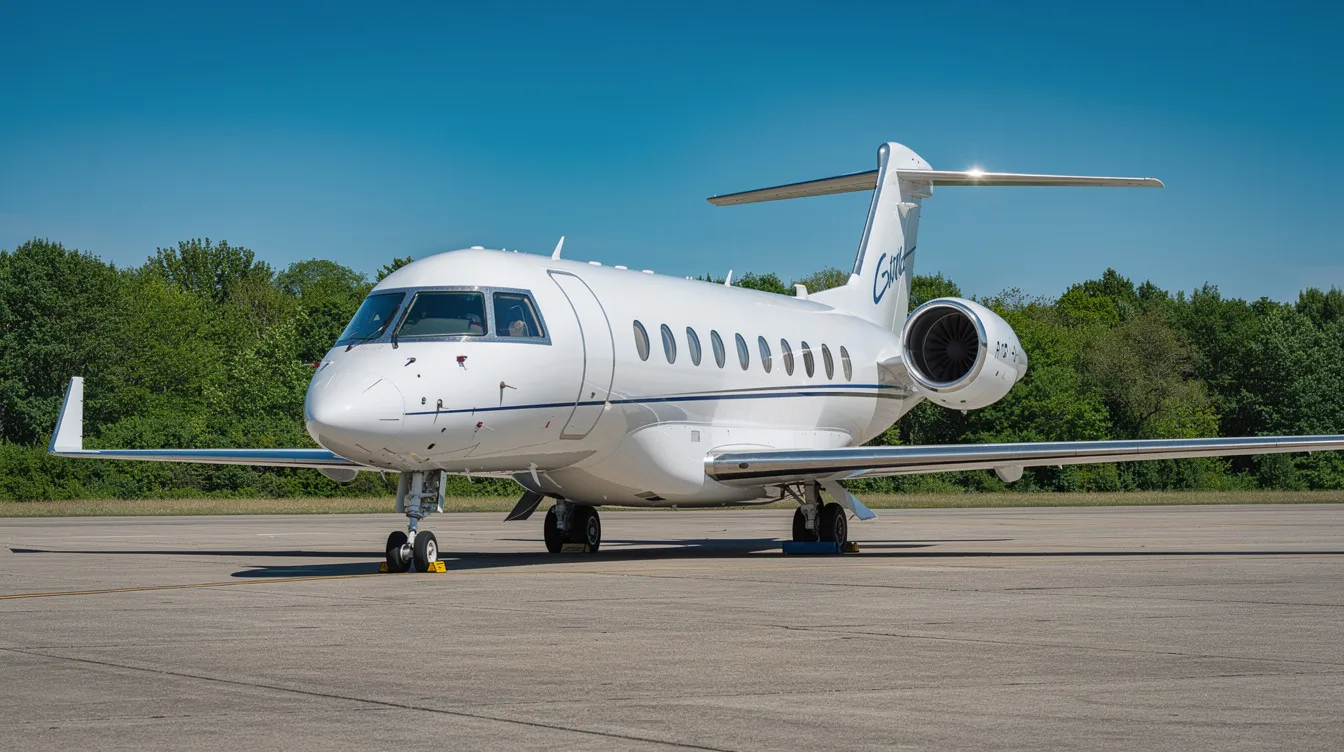
Newer aircraft efficiency: Newer jets reduce fuel burn per mile significantly. Aircraft like the Gulfstream G700, Bombardier Global 7500, and Dassault Falcon 8X incorporate advanced aerodynamics, lighter composite structures, and more efficient engines that lower fuel consumption per seat-mile compared to prior generations.
Sustainable aviation fuel: Sustainable Aviation Fuel (SAF) is increasingly adopted in private aviation, with growing supply in California, Western Europe, and parts of the Middle East. Even partial SAF blends reduce lifecycle carbon emissions on transcontinental routes.
Carbon offsets: Carbon offset programs are becoming mainstream in private aviation. Operators and clients can invest in verified carbon credits to account for emissions from urgent flights and routine long-haul travel.
Fractional programs support sustainability through optimized fleet utilization, younger fleets with better fuel efficiency, and matching aircraft size to mission requirements so excess capacity is not wasted. BlackJet can help clients prioritize newer aircraft types, discuss SAF availability on specific routes, and integrate environmental considerations into their long-term private aviation strategy, just as prospective owners should review leading fractional jet ownership programs in the market before choosing a provider.
For executives and families who routinely cross oceans, the key decision is not just "which jet" but "which access model" and "which fleet partner." Transcontinental jets allow flexible scheduling and can access smaller executive airports to avoid congestion—but the underlying strategy determines whether that advantage translates into real savings and reliability over time.
Here is how BlackJet engages with new clients:
Initial consultation: Map out typical annual flying hours, routes (e.g., New York–London monthly, Los Angeles–Tokyo quarterly), passenger counts, and cabin expectations for both business and leisure travelers.
Comparative modeling: Generate custom cost models comparing charter, jet card, and fractional aircraft ownership costs over a 3–5 year horizon for those specific transcontinental missions. All flight details-positioning, handling, crew overnights-are factored in.
Fleet recommendation: Recommend an Equity Fleet share level in a heavy or ultra-long-range jet for core missions, plus Reserve Fleet access for overflow, alternate aircraft types, or feeder legs.
Operations management: BlackJet's operations team then handles aircraft management, scheduling, and coordination with cabin crew and ground providers, turning complex long-haul flight planning into a single point of contact.
The result is a private aviation strategy designed around how you actually fly—not a generic hourly rate card.
Transcontinental private jets typically require a minimum range of about 3,500 nautical miles to comfortably cover routes such as the U.S. East Coast to Western Europe nonstop. Longer routes, such as West Coast U.S. to Europe or Asia, require jets with ranges exceeding 5,500 to 7,000 nautical miles.
Flight times vary by route and aircraft but generally range from 6 to 7 hours for New York to London, 8 to 9 hours for Miami to Paris, and 11 to 12 hours for Los Angeles to Tokyo. Weather and wind conditions can affect these times.
Yes, pets can usually travel onboard in the cabin with their owners on transcontinental flights. Proper documentation, such as health certificates, and compliance with destination country regulations are required.
Costs depend on aircraft type, flight duration, and additional fees. Hourly rates range from $4,000–$7,000 for super midsize jets to $10,000–$18,000+ for ultra long range jets. One-way flights on popular routes can cost from $70,000 up to $170,000 or more.
Fractional ownership offers predictable scheduling, access to a dedicated aircraft share, potential tax benefits, and consistent cabin and crew standards. It often reduces hassle compared to full ownership and can lower costs compared to frequent chartering.
For routine routes, booking 2–4 weeks in advance is ideal. Complex itineraries or peak travel periods may require 1–3 months lead time. Last-minute bookings are possible but may limit aircraft choice and increase costs.
Flights require overflight and landing permits, crew certifications for extended overwater operations, ETOPS/EDTO planning, and compliance with international aviation regulations. BlackJet manages these complexities for owners and members.
Modern transcontinental jets feature lower cabin altitudes, circadian lighting, quiet cabins, and lie-flat beds, all designed to reduce fatigue and help passengers adjust to new time zones more comfortably.
Yes, newer aircraft models use more efficient engines and aerodynamics to reduce fuel burn. Sustainable Aviation Fuel (SAF) and carbon offset programs are increasingly adopted to lower environmental impact.
Absolutely. Private jets can access thousands of airports, including smaller executive airports that commercial airlines cannot serve, which saves time and offers greater flexibility.
Transcontinental private jet travel enables nonstop international travel with significant time savings, superior cabin comfort, and the ability to work or rest productively across every time zone. Heavy jets, ultra-long-range jets, and Boeing Business Jets form the backbone of global business aviation-and choosing the right aircraft type and access model is essential for both cost control and schedule reliability.
For readers who fly privately 25–150 hours per year, especially on long-haul international travel routes, fractional jet ownership and membership options offer a structured path to predictable, high-quality access, but it is equally important to understand the tax implications of fractional jet ownership when evaluating those options. Rather than navigating the charter market trip by trip, a tailored program matches the aircraft, the economics, and the service level to each client's actual needs, supported by well-structured fractional aircraft ownership contracts that define rights and responsibilities over the long term.
Ready to explore how fractional ownership can transform your transcontinental travel? Visit FractionalJetOwnership.com to request a consultation, review aircraft options such as the Global Express family and Gulfstream G550 or G650ER, and learn how BlackJet Fractional Jet Ownership can turn your long-distance flying into a strategic advantage rather than a logistical challenge—including planning an eventual exit using best practices for selling a fractional jet ownership share.
