July 11, 2026
By the FractionalJetOwnership.com editorial team. Independent educational resource, structure over branding. Updated July 11, 2026.
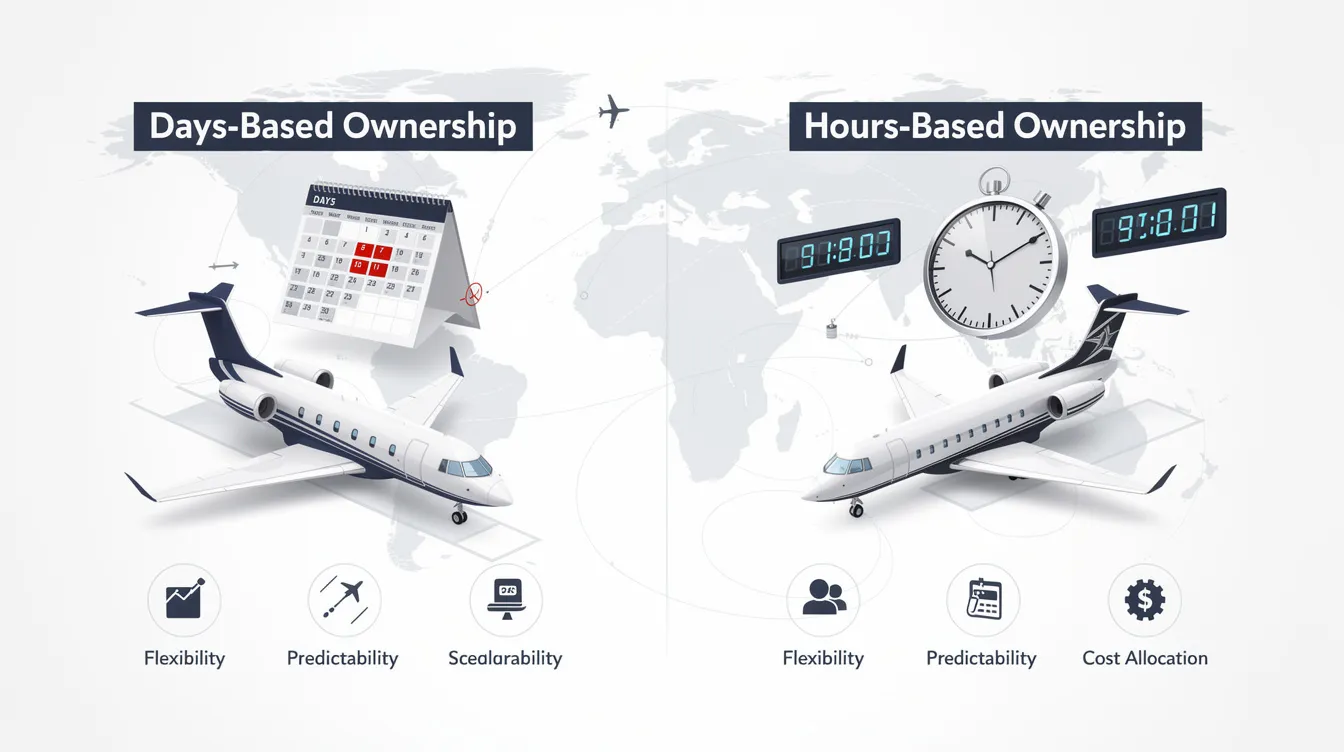
Two fractional programs can advertise nearly identical hourly prices and still hand you very different bills at year-end. The reason usually traces to one design choice: whether the program meters your usage in days or in occupied flight hours. Days-based fractional ownership bills you for access to an aircraft for a defined "program day" (often limited by crew duty time), while hours-based fractional ownership bills you per occupied flight hour. Multi-leg days usually favor day-based pricing, and long single legs usually favor hours-based pricing. This guide from FractionalJetOwnership.com shows exactly how each model builds a bill, walks through two sample invoices, and converts day-based usage into an effective cost per occupied hour so you can compare programs on equal footing.
Fly two or more stops in a single day, often: start with days-based fractional ownership.
Fly mostly single legs of 2.5 to 5 hours: start with hours-based fractional ownership.
Fly fewer than about 50 hours a year, or unpredictably: compare a jet card or charter first.
Need the same cabin and consistency every trip: weigh whole ownership against fractional.
Chasing the lowest advertised hourly rate: recheck, since the billing unit matters more than the sticker.
Fractional jet ownership is a shared ownership model where multiple owners each purchase a percentage interest in a private aircraft (or aircraft category) and receive a defined number of annual flight hours, while a management company handles operations, crew, and maintenance. Share sizes commonly run 1/16, 1/8, and 1/4. Those tiers map to roughly 50, 100, and 200-plus flight hours a year. A larger share size means more hours and larger upfront costs.
Three cost buckets decide what you pay. An upfront acquisition cost buys your share. A monthly management fee covers crew, training, insurance, hangar, and administration. A variable operating fee, usually quoted as an occupied hourly rate, hits your bill when the aircraft flies with passengers aboard. Those three buckets are the foundation for reading any program, and you can review what fractional jet ownership is in our core explainer.
Access runs on guaranteed access windows, commonly around 8 to 24 hours of notice depending on the program. Fleet interchange means you often fly a different tail in the same category rather than one specific airplane. According to NBAA, fractional shares can be as small as one-sixteenth and are commonly structured around 800 occupied hours per aircraft per year. In most fractional programs, you're buying a share of an aircraft category and a contract-defined allotment of annual usage, not a specific number of flights.
This model is not a jet card, not charter, not a lease, and not whole ownership. Each of those carries a different cost and commitment profile, covered later.
Hours programs meter time in flight. Day programs meter access for a day. That single distinction drives most of the cost gaps you will see between two otherwise similar providers.
In an hours-based program, you pay a variable operating fee for each occupied hour, sometimes plus a small taxi-time increment, and you keep paying the monthly management fee every month. In a days-based program, you draw down a set number of program days per year. Inside one of those days you may fly several legs, bounded by crew duty limits and the contract's definition of a day.
Days-based fractional ownership is a fractional program where your primary usage unit is a program day (aircraft and crew availability for that day), not the number of occupied flight hours. Airshare, a commonly cited day-based operator, frames a 1/16 share as 20 days with unlimited hours inside a maximum 14-hour crew duty day. Jettly and BlackJet are commonly cited hours-based examples, where usage draws down occupied hours.
This distinction changes real money. The same itinerary can look cheap under one model and expensive under the other. If you routinely do multiple short hops in one day, a days-based model can deliver a lower effective cost per occupied hour than an hours-based model, even when the advertised hourly rate looks higher. To compare fairly, we convert days into estimated occupied hours later so you can see the effective cost side by side. Our guide on how it works goes deeper into the mechanics.
Table 1. What Gets Metered in Each Model | ||
Attribute | Hours-based | Days-based |
|---|---|---|
Metering unit | Occupied flight hour | Program day |
Typical billing trigger | Passengers aboard, wheels-up to wheels-down (plus taxi increment in some programs) | A day of aircraft and crew availability is consumed |
Biggest advantage | Pay only for hours actually flown | Extra legs in one day add no hourly charge |
Biggest hidden constraint | Short legs and repositioning erode value | Crew duty day cap and day-definition rules |
Best for | Predictable point-to-point trips | Multi-stop same-day itineraries |
Worst for | Dense multi-leg days | Single long legs with overnights |
In an hours-based program, your variable costs rise with passenger flight time, and your fixed costs keep running even in months you don't fly. That combination is the whole point of the model, and it rewards steady, predictable flying.
Three core buckets show up: the upfront acquisition cost you paid to buy the share, the recurring monthly management fee, and the occupied hourly rate for direct operating costs. An occupied hour is a billable flight hour when passengers are onboard, and in many fractional programs it is the basis for the variable operating fee. Repositioning, sometimes called ferry flying, moves the empty aircraft to your departure point, and depending on program terms it can surface indirectly through service area rules or surcharges rather than a clean line item.
Taxi time is a program-specific detail worth reading closely. BlackJet describes billing per hour in flight plus a standard taxi-time increment of 0.2 hours. Small increments add up across many short legs, which is exactly why dense days behave differently under this model. Fractional shares commonly start at 1/16, framed by BlackJet as roughly 50 hours a year.
"An advertised hourly rate tells only part of the story. Once you factor in multi-leg itineraries, crew duty limitations, monthly management fees, and contract-specific billing rules, two programs with similar pricing can produce dramatically different total ownership costs."
Justin Crabbe, CEO
Items billed outside the advertised rate deserve attention. De-icing, international handling, overflight and landing fees, peak-day or short-notice premiums, fuel surcharges, and certain taxes can all appear separately. In hours-based fractional ownership, the hourly rate rarely equals your total trip cost. Taxes, de-icing, international fees, and peak-day rules can add meaningful "outside the rate" charges. Most contracts carry cost escalation clauses tied to fuel, labor, insurance, training, and scheduled annual increases, so budget for gradual upward drift over a multi-year term. Our management fee guide breaks down the fixed side in detail.
Table 2. Illustrative Hours-Based Monthly Invoice (Light Jet). Illustrative only, verify with provider. | ||
Line item | Amount | Note |
|---|---|---|
Monthly management fee | $18,500 | Fixed, charged even in no-fly months |
Occupied hourly rate × 8 hrs | $33,600 | $4,200/hr, passengers aboard |
Taxi-time increment (0.2 hr × 4 legs) | $3,360 | Program-specific add-on |
Fuel surcharge | $1,600 | Varies with index |
De-icing | $900 | Seasonal, billed when used |
Handling and landing fees | $1,150 | Airport-dependent |
Segment fees and taxes (approx.) | $2,520 | Federal excise plus segment fees |
Total | $61,630 | One sample month |
Say you need to touch three cities in one day. Day-based billing can be the difference between paying for two to four occupied hours plus taxi increments and simply consuming one program day. That is the scenario where day-based pricing shines.
You draw down allocated days per year based on your share size, and inside a single day you can usually fly multiple legs at no added hourly charge. A program day is a contract-defined unit of access in a days-based fractional program, typically constrained by crew duty limits and the program's rules for when the day starts and ends. Airshare references a maximum 14-hour crew duty day and frames a 1/16 share as 20 days per year.
What counts as a day varies more than buyers expect. Programs differ on start and stop clocks, calendar day versus duty day, and whether a same-day return changes anything. Overnights are the big one. Some programs treat a multi-day trip as two days (outbound plus return), and others charge a day for each day the aircraft stays with you. SkyShare, another operator that describes usage in day terms, shows how programs vary in whether they frame access by flight days or hours. Reading that clause carefully is one of the highest-value moves you can make before signing.
A days-based program is "unlimited hours" only in the sense that your bill doesn't increase with each additional leg that day. The real cap is the crew duty day and the program's definition of what consumes a day. Fees still exist. Acquisition cost and a monthly management fee usually apply, some programs still layer an hourly component, and incidentals like handling, de-icing, and catering show up as usual. Our aviation terms glossary defines the billing vocabulary if any of these are new.
Table 3. Illustrative Days-Based Invoice (Light Jet, One 3-Leg Day). Illustrative only, verify with provider. | ||
Line item | Amount | What triggers it |
|---|---|---|
Monthly management fee | $17,900 | Fixed monthly, share-based |
Day allocation used | 1 of 20 days | One program day consumed, 3 legs flown |
Hourly component (if applicable) | $0 | Bundled within the day in this example |
De-icing | $900 | Seasonal, billed when used |
Catering | $350 | Optional, per trip |
Handling and landing fees | $1,050 | Three airports |
Trip total (excl. monthly fee) | $2,300 | 3 legs, 1 day |
The model that fits best is the one that prices your most common day of travel efficiently, not the one with the lowest advertised hourly rate. Your average day-of-travel matters more than your annual total.
"The most common mistake buyers make is choosing a fractional program based on the billing method instead of their actual travel pattern. The right question isn't whether days-based or hours-based is better. It's which model prices your most common trips more efficiently over the life of the contract."
Justin Crabbe, CEO
Normalization makes this concrete. Convert a day into hours by dividing the day's all-in cost by the occupied hours you actually fly that day. The more legs you stack, the lower your effective cost per occupied hour drops.
Three legs, short stage lengths, home by dinner. Roughly 2.4 occupied hours of flying. Under hours-based billing at $4,200 an hour, plus taxi increments across three legs, the day runs past $12,000 before incidentals. Under days-based billing, those same three legs consume one program day. Divide a $12,000 all-in day by 2.4 occupied hours and the effective rate lands near $5,000 an hour. Add a fourth leg to reach 3.5 hours and the same day falls to roughly $3,400 an hour. Dense days reward day-based pricing.
Fewer trips, longer average stage length, frequent overnights. One long leg out, several nights on the ground, one long leg back. That pattern often consumes two program days for only nine or so occupied hours, so the multi-leg advantage goes unused. Hours-based billing charges for the nine hours flown and lets your remaining hours roll toward other trips. Predictable point-to-point flying with consistent stage lengths usually prices more cleanly under hours-based fractional ownership.
Blended business and personal flying, several peak travel dates a year. Access terms can matter as much as the rate. Peak-day rules, booking notice, and usage caps decide whether you actually get the airplane on the dates you need. A slightly higher effective cost can be worth it if guaranteed access on peak days is stronger. Read the peak-day calendar and notice requirements before comparing headline pricing.
Simple if/then rules follow from these patterns:
Commonly fly two or more stops per day: evaluate days-based fractional ownership first.
Most trips single-leg and 2.5 to 5 hours: evaluate hours-based fractional ownership first.
Annual utilization low or highly variable: compare jet cards and charter first.
For frequent, schedule-driven travelers, the "best" fractional program is usually the one whose billing unit matches the travel pattern: day-based works best for multi-stop same-day itineraries, and hours-based works best for predictable point-to-point flying with consistent stage lengths. A useful threshold: fractional generally starts making sense around 50-plus hours a year, a level BlackJet cites as ideal for its program, and the real break-even shifts with aircraft category and fee structure. Buying the wrong share size cuts both ways. Usage-mismatch risk is the risk of buying too large a share and underusing paid access, or buying too small a share and regularly exceeding your allocation, often triggering premium rates or upgrades. Our deeper look at use cases maps more travel profiles to models.
Table 4. Three Traveler Patterns and Where to Start | |||
Pattern | Why | Model to evaluate first | Contract clauses to scrutinize |
|---|---|---|---|
Multi-stop same-day flying | Extra legs add no hourly charge | Days-based | Crew duty cap, day definition, overnight rules |
Single long legs, consistent routes | Pay only for hours flown | Hours-based | Taxi increment, repositioning, escalation clauses |
Mixed use with peak dates | Access reliability outweighs rate | Compare both on access terms | Peak-day caps, notice time, guaranteed access |
The advertised hourly rate or day allotment is not the program. Your contract terms are the program. These are the clauses that quietly move your total cost, and the ones worth a careful read in both models.
Peak-day rules. Notice requirements, usage caps, premiums, and the provider's right to shift your departure time on the busiest dates.
Rollover and borrow rules. What happens to unused hours or days, and whether you can borrow against next year's allocation.
Service area and repositioning. When ferry flying is waived versus billed, and how that shifts by provider and geography.
Interchange and upgrade multipliers. How moving between aircraft categories changes what you pay or how fast you consume days or hours.
All-in versus separately billed. De-icing, international fees, catering, taxes, Wi-Fi, and cabin attendant charges.
Escalation clauses. Annual escalators and fuel adjustments that lift pricing over a multi-year term.
Exit mechanics. Contract length (often three to five years), resale formulas, timing delays, and a possible remarketing fee.
A fractional resale formula is a contract-defined method for valuing your share at exit, often based on depreciated value rather than open-market pricing. A remarketing fee, commonly a percentage of the sale price, can further reduce what you recover. According to NBAA, most fractional programs run a five-year commitment, often with early-out options at a cost. The biggest hidden tradeoffs in fractional ownership are usually not the hourly rate. They are peak-day access rules, interchange math, what's billed outside the rate, and how the exit value is calculated. Work through our contract checklist before you sign anything.
Table 5. How Each Clause Matters in Days-Based vs Hours-Based | ||
Clause | Days-based impact | Hours-based impact |
|---|---|---|
Peak days | Day caps can block busy dates | Premiums stack on the hourly rate |
Rollover | Unused days may expire | Unused hours may roll or forfeit |
Interchange | Category swaps can consume days faster | Upgrade multipliers raise the hourly rate |
Crew duty limits | Hard cap on legs per day | Rarely a direct cost factor |
Taxi time | Usually absorbed within the day | Added per leg, erodes short-hop value |
Incidentals | Billed per trip | Billed per trip |
Exit and resale | Formula-based, remarketing fee applies | Formula-based, remarketing fee applies |
Start with structure, meaning billing unit, access guarantees, and exit terms, then evaluate the provider. This is the "structure over branding" approach FractionalJetOwnership.com uses across every comparison. Brand reputation matters, yet it rarely fixes a contract that prices your travel pattern poorly. Buying into fractional jet ownership happens through a provider's share program, so the contract you sign, not the logo, decides your experience.
Providers tend to fall into three groups: large legacy operators with big fleets and standardized programs, boutique and mid-sized providers offering more customized service, and asset-light or managed-access hybrids built around flexibility. When comparing fractional jet ownership companies, prioritize the contract terms that control access and total cost, notice time, peak-day rules, interchange math, and exit value, before you compare brand reputation or advertised hourly rates.
Fleet interchange is the ability to fly a different aircraft in the same class (or sometimes a different class) instead of the specific tail you partially own, subject to program rules and availability. Jettly states notice time guaranteed with as little as 4 to 10 hours and a 36-month minimum commitment on its share program page. A directory from Private Jet Card Comparisons offers a non-ranked way to see which providers cover which aircraft types.
Light jets are common entry points for fractional jet ownership in the US: lower capital and operating costs, a good fit for missions under three hours, and access to smaller regional airports. Among top fractional jet ownership options light jets buyers shortlist, the deciding factor is usually billing model fit rather than badge. Compare NetJets costs against the field, and see our rundown of NetJets competition for context.
Table 6. Provider Comparison Matrix (Not a Ranking) | |||||
Provider | Billing unit emphasis | Fleet and category notes | Stated notice time | Commitment language | What to verify |
|---|---|---|---|---|---|
Jettly | Hours | Large multi-category fleet | As little as 4 to 10 hrs | 36-month minimum | Peak-day caps, escalation |
BlackJet | Hours | Premium cabins, 1/16 ≈ 50 hrs | Program-specific | Multi-year | Taxi increment, upgrade math |
Airshare | Days | Regional focus, 1/16 = 20 days | Program-specific | Multi-year | Day definition, 14-hr duty cap |
PlaneSense | Hours | Turboprop and light jet, regional access | Program-specific | Multi-year | Category fit, service area |
Fractional works well for moderate, repeatable utilization. It is not the only way to fly private, and not always the best one. Match the tool to how you actually fly.
A jet card is a prepaid or subscription program that provides access to aircraft at a fixed or semi-fixed hourly rate without equity ownership, resale considerations, or ongoing monthly management fees. On a per-hour basis a jet card often prices higher than a contracted fractional rate, yet at lower annual hours the all-in cost can be more economical, since there is no monthly fee and no upfront capital. Marketplace and membership platforms such as XO and Jettly sit in this flexible tier as well.
Charter is trip-by-trip booking at market prices: high flexibility, with availability and price swings during peak periods. Aircraft leasing gives you access to a specific aircraft without buying it, more control than fractional but more operational involvement. Whole ownership hands you full control and full cost, including depreciation, and grows more competitive at very high utilization, with a break-even that varies by category. If your annual private flying is inconsistent or well below the typical fractional threshold, a jet card or charter often delivers lower commitment and less exit risk than fractional ownership. Our explainer on private jet charter covers the trip-by-trip path.
Table 7. Fractional vs Jet Card vs Charter vs Lease vs Whole Ownership | |||||
Factor | Fractional | Jet card | Charter | Lease | Whole ownership |
|---|---|---|---|---|---|
Upfront capital | Moderate to high | Prepaid deposit | None | Low to moderate | Highest |
Monthly fixed fees | Yes | No | No | Sometimes | Yes |
Variable cost basis | Occupied hour or day | Fixed or semi-fixed hourly | Market per trip | Lease plus operating | All operating costs |
Availability and notice | Guaranteed access windows | Guaranteed with terms | Subject to market | High, your aircraft | Full control |
Aircraft consistency | Category, interchange | Varies | Varies | Specific aircraft | Specific aircraft |
Exit and liquidity risk | Formula-based, limited | None | None | Lease-term bound | Full market exposure |
Fractional programs are structured under FAA rules that differ from trip-by-trip charter, so understand who holds operational control and how the aircraft are managed. In the US, fractional operations fall under Part 91K, and you can read our Part 91K primer for the regulatory detail.
Operational control is the authority to initiate, conduct, and terminate a flight, including responsibility for safety and regulatory compliance. NBAA explains the fractional structure through a management company and dry-lease exchange arrangement, where owners make their aircraft available to one another through the operator. That same structure explains why you may not fly with the same crew each trip.
Ask serious questions of any program: safety management practices, training cadence, maintenance oversight, and third-party safety ratings. In fractional ownership, the management company's systems for crew training, maintenance oversight, and scheduling discipline matter as much as the aircraft model you fly. Strong safety standards live in those systems, not in marketing copy.
Days-based programs meter access by program days, while hours-based programs meter usage by occupied flight hours, so the cheaper option depends on whether you fly multiple legs in a day or mostly single long legs. A program day is capped by crew duty limits and by contract rules that define when the day starts and ends. An occupied hour bills only when passengers are onboard, which is why dense multi-leg days tend to favor day-based pricing and long single legs tend to favor hours-based pricing.
A 1/16 share is commonly an entry-level fractional share that provides about 50 hours per year in hours-based programs, while some days-based programs frame 1/16 as about 20 program days per year. BlackJet describes its 1/16 share as roughly 50 hours, and Airshare frames a 1/16 share as 20 days. The exact hours, days, and aircraft class differ by provider, so confirm the mapping in writing before you commit.
An occupied hourly rate is the variable operating fee billed only when passengers are onboard, typically covering fuel and maintenance reserves, but some costs may still be billed separately depending on the program. Common "outside the rate" charges include de-icing, international handling and landing fees, fuel surcharges, taxes, and peak-day or short-notice premiums. Read the contract to see which of these fall inside the quoted rate and which land as separate line items.
Many fractional programs advertise guaranteed access with short notice windows, but the exact notice time and peak-day rules vary by provider and must be confirmed in the contract. Jettly publicly describes guaranteed access with as little as 4 to 10 hours of notice, and other operators use different windows. Notice time often tightens on peak days, so check the peak-day calendar rather than assuming the standard window always applies.
They're not unlimited in practice, since most days-based programs are constrained by crew duty limits and contract rules defining what counts as a program day. Airshare, for example, references a maximum 14-hour crew duty day, which caps how many legs you can realistically fly before the crew times out. The value is that extra legs within that duty day add no hourly charge, not that flying is truly without limit.
Fractional contracts are commonly multi-year commitments, often around three to five years, and exact terms and early-exit rules vary by provider. NBAA describes a five-year structure as common in the industry, and Jettly states a 36-month minimum commitment on its share program. Verify early-exit rules, penalties, and resale timing before signing, since these clauses shape your total cost of ownership.
Most fractional programs allow an exit at contract maturity using a contract-defined resale formula, but you may recover less than your original capital and timing may be delayed. Resale value is usually set by a program formula tied to depreciated value rather than open-market pricing, and a remarketing fee can reduce your net further. Capital recovery can also wait on replacement buyers and settlement timelines, so treat fractional ownership as an access decision, not a liquid investment.
For light-jet missions, day-based billing can be compelling when you stack multiple short legs in one day, while hours-based billing can be simpler and cheaper for straightforward point-to-point flying. Light jets suit trips under three hours and reach smaller regional airports, which makes them a frequent entry point into fractional ownership. Pricing varies by provider and service area, so normalize both models to an effective cost per occupied hour using your real itineraries before deciding.
Days-based and hours-based fractional ownership are not better or worse in the abstract. They price different travel patterns differently. Multi-stop same-day flying leans day-based. Predictable long legs lean hours-based. The winner is whichever model prices your most common day efficiently across a multi-year contract, after you account for peak-day rules, interchange math, incidentals, upfront costs, and exit terms.
"The strongest fractional ownership decision comes from normalizing every option into the same economic framework. Whether a provider bills by days or occupied hours, sophisticated buyers compare the effective all-in cost per hour, the flexibility each model provides, and how closely it aligns with their real-world flying habits, not the marketing language used to sell it."
Justin Crabbe, CEO
If you're comparing days-based vs hours-based programs, or deciding between fractional, jet cards, and charter, FractionalJetOwnership.com can help you sanity-check the billing model, contract terms, and true all-in cost based on your real travel patterns. As an independent educational resource, we evaluate structure over branding and issue no rankings or endorsements. Reach the team at info@fractionaljetownership.com or 1-866-321-JETS for an independent second opinion before you sign. This article is educational and is not individualized financial, legal, or tax advice.
BlackJet, Fractional Ownership - days-based model, 1/16 share equals 20 days, 14-hour crew duty day reference.
Jettly Cloud Fraction - notice time of 4 to 10 hours and a 36-month minimum commitment.
