
July 9, 2026
Every private flight involves more than just the hourly rate. Between the moment an aircraft touches down and the time it departs again, a series of airport-level charges quietly shape the final bill. Understanding private plane landing fees-and the ground costs that surround them-is essential for anyone who wants to fly with predictable expenses rather than post-trip surprises.
A landing fee is a charge applied by the airport authority every time a private aircraft uses the runway, taxiway, and associated airfield infrastructure. These fees are separate from the hourly flight rate paid to the operator and exist to fund runway maintenance, airfield lighting, air traffic control support, emergency response, and general safety operations. In short, airport fees help cover costs for runway maintenance and safety that keep every arrival and departure secure.
Landing fees for private aircraft vary widely based on airport type and location. At smaller general aviation airports across the United States, a private plane typically incurs roughly $75 to $300 per landing. At busy commercial airports like JFK, LAX, or Miami International, that figure climbs to $300 to $1,000 or more. Across the Atlantic, major European hubs can charge anywhere from €800 to over €6,000 depending on aircraft size and the specific airport's fee schedule. Overall, landing fees typically range from $100 to over $5,000-a span that underscores why airport selection matters so much. Landing fees are common at larger airports, less so at smaller ones that may rely on other revenue sources instead.
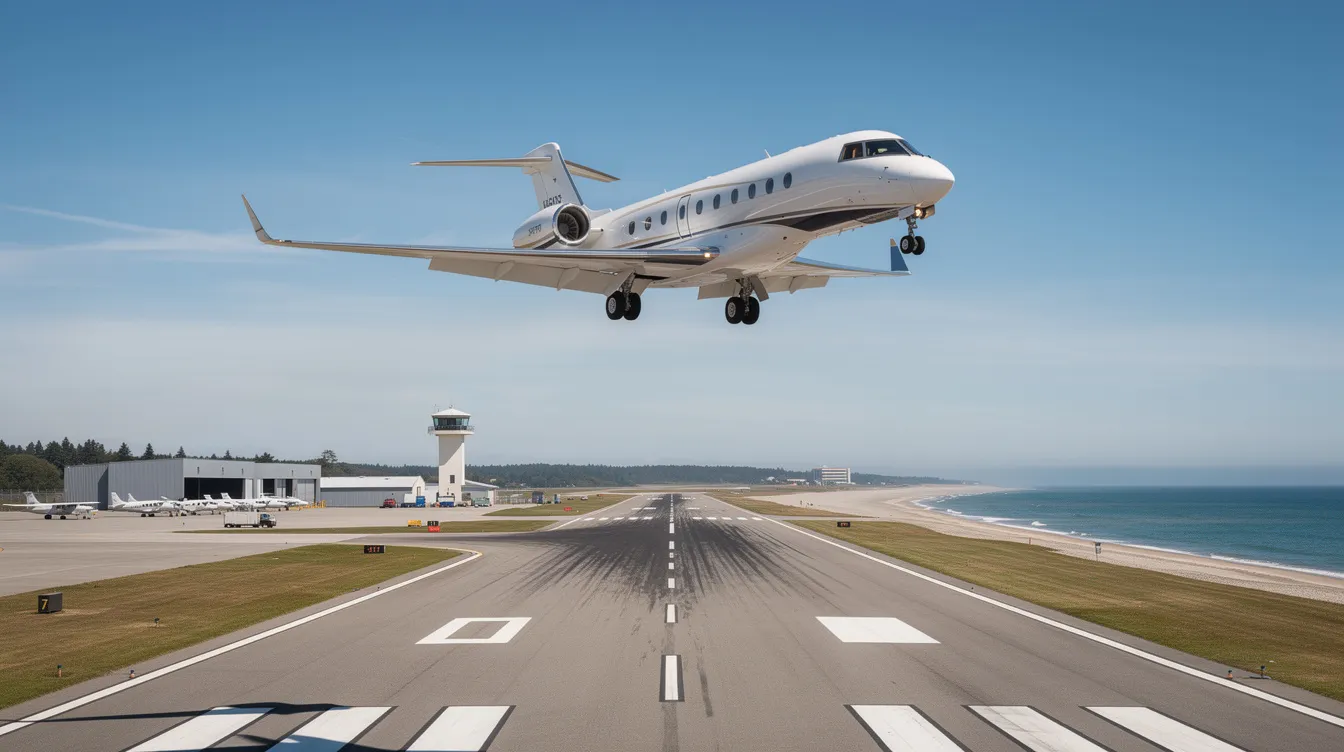
For most BlackJet Fractional Jet Ownership clients flying light to large-cabin jets on domestic legs, landing fees usually fall between $150 and $800 per landing. At top-tier international or slot-constrained airports, however, that number can exceed $2,000. Consider a quick comparison: a large-cabin jet at Teterboro might pay roughly $306 in base landing fees, while the same aircraft at JFK could owe approximately $593-nearly double-based on published rate differences between the two Port Authority facilities.
Before diving deeper, it helps to separate landing fees from the other costs that appear on a trip invoice:
Landing fees – weight-based charges for using the runway
Handling fees – services at the terminal such as marshalling, baggage handling, and lounge access
Parking and overnight fees – charges when the aircraft remains on the ground
Fuel surcharges – operator adjustments tied to jet fuel price fluctuations
Each of these line items contributes to the total price of a private flight, and each is addressed in detail below.
Most airports calculate landing fees using aircraft weight-specifically the maximum takeoff weight (MTOW)-multiplied by a published rate per 1,000 lbs, applied at the point where the airport assesses the movement charge. Fees are usually based on aircraft weight, priced per 1,000 lbs, because heavier aircraft cause more runway wear and require more infrastructure support. The formula is straightforward:
Landing fee = Airport rate per 1,000 lbs × (Aircraft MTOW ÷ 1,000)
The MTOW for any given aircraft is listed in its type certificate and in the airport's fee schedule documentation. Landing fees are based on aircraft weight, typically MTOW, making the aircraft category and size the primary cost drivers.
Concrete benchmarks for 2025–2026 illustrate the range. JFK's published flight fee stands at $8.47 per 1,000 lbs as of January 2026. LAX charges $6.44 per 1,000 lbs as of March 2026 for general aviation operations. A typical regional GA airport may charge just $3 to $5 per 1,000 lbs. Airports in high-cost living areas often charge higher landing fees, which is one reason the New York and Los Angeles metro areas sit at the top of domestic fee tables.
Fees can vary significantly by airport and time of day. Many airports layer surcharges based on the noise category of the aircraft, peak-hour congestion windows, and whether the operation is commercial or general aviation. A peak-hour surcharge of $100 or more is not unusual at slot-controlled fields.
Here is a worked example showing how aircraft size drives costs at a single airport charging $8.00 per 1,000 lbs:
Aircraft Type | MTOW | Landing Fee |
|---|---|---|
Light jet | 20,000 lbs | $160 |
Large-cabin jet | 70,000 lbs | $560 |
The fee difference is dramatic-larger aircraft pay substantially more per movement. Many airports adjust their fee tables annually, so any specific figures should be treated as illustrative ranges rather than guaranteed quotes.
Airport selection totally depends on the balance between access, convenience, and cost. Here is how fees generally break down.
U.S. general aviation airports such as Scottsdale, Van Nuys, or White Plains typically charge lower fees that reflect lower infrastructure and congestion burdens:
Light and midsize jets: roughly $75–$350 per landing
Large-cabin jets: $200–$500+ depending on the field
U.S. commercial airports like LAX, Chicago O'Hare, and Miami International impose higher per-weight rates, congestion surcharges, and terminal usage fees that push totals higher:
Midsize jets: $300–$800 per movement
Large-cabin jets: $500–$1,500+ per movement
One example of emerging trends: DeKalb Peachtree Airport (PDK) introduced a landing fee of $4 per 1,000 lbs for non-based aircraft starting April 2026-a sign that even historically fee-free GA fields are beginning to charge.
Airports with limited runway capacity may charge higher fees during busy periods, especially during large events or seasonal surges. In Europe, business-aviation hubs like Paris Le Bourget or London Luton charge €800–€2,500 per movement for midsize jets, while flying a private jet to a major European commercial hub such as Paris Charles de Gaulle or London Heathrow can push fees above €5,000 when noise, emission, and environmental surcharges are added.
International arrivals may incur additional customs or immigration charges beyond the core landing fee, and customs fees can vary significantly by country. After-hours customs processing alone can add €180–€450 in many European jurisdictions.
BlackJet's flight planning team routinely compares nearby general aviation airports and primary commercial airports in each metro area to balance access, convenience, and total fee exposure for every itinerary.
Landing fees are only one line on the invoice. Handling fees, parking charges, overnight fees, and other fees can materially change the total bill for a private flight-sometimes adding as much or more than the landing fee itself. Most private travelers see these costs as separate items, often collected by a fixed base operator on behalf of the airport and its service providers. Understanding each category helps avoid unexpected expenses.
Fixed base operators are specialized facilities at general aviation airports that provide fueling, ground handling, private lounges, crew support, and additional FBO services for private jets, and crews typically make contact with FBO staff on arrival to coordinate handling and other services. Handling fees encompass services such as baggage handling, aircraft marshalling, lavatory servicing, GPU utilization, and the coordination of ground transportation and catering arrangements.
At a typical U.S. GA airport, handling fees for light to midsize jets run approximately $150–$400 per turn. At premium FBOs attached to larger airports, that range climbs to $400–$1,500 or more depending on aircraft size and requested services. Premium European FBOs at business-aviation hubs like Farnborough or Le Bourget routinely exceed €1,000 per visit. Handling fees can add 20 to 40 percent to total trip costs, making FBO selection a meaningful lever for cost control.
Some FBOs reduce or waive handling fees when operators purchase fuel above a minimum amount, and negotiating these fuel purchase requirements is part of how experienced providers like BlackJet manage client costs. For BlackJet members, FBO selection focuses on safety, reliability, and consistent service quality while also seeking competitive handling fee structures.

Parking fees apply for overnight aircraft parking and begin once the aircraft remains on the ground past a grace period-typically a few hours for a same-day turnaround. Ramp parking, tie-down fees, and hangar storage each serve a different purpose. Tie-down parking is generally cheaper but offers less protection than a hangar, which matters for high-value jets or operations in harsh climates.
Realistic 2025–2026 examples:
Overnight ramp parking for a midsize jet at a busy U.S. GA airport: roughly $150–$350 per night
At top-tier business airports or during major events: $500 or more per night
Heated hangar storage for a large-cabin jet in peak winter: $1,000–$2,000+ per night
Overnight fees vary greatly by airport and facilities, and overnight parking fees vary widely by airport as well-a small airport in the Southeast will charge a fraction of what a congested Northeast field demands.
Out-of-hours or evening extension fees are surcharges applied when operations take place outside published hours, for instance, a departure after 22:00 local time. These can be flat fees or per-movement charges. BlackJet's operations team reviews airport opening times, bank holiday premiums, and extension fee policies in advance to avoid unnecessary overnight or out-of-hours costs where possible.
Fuel surcharges are operator-level adjustments added when jet fuel prices exceed a defined benchmark. They are distinct from airport landing and handling fees but still affect the final bill. Fuel costs at airports depend on local taxes, regional supply dynamics, and infrastructure, so the cash paid to fuel the same aircraft at two different airports on a single route can differ by several hundred dollars.
Fuel service fees are charged per gallon of fuel taken, and FBOs may apply separate fuel infrastructure or fuel service fees per uplift. Importantly, some airports waive landing fees with minimum fuel purchases, creating a strategic opportunity: by choosing to purchase fuel at a particular stop, operators can offset or eliminate handling and parking fees entirely. This relationship between fuel uplift and ground charges is a lever that experienced pilots and dispatchers use routinely.
Choosing a nearby general aviation airport with more competitive fuel and fee structures-for instance, using White Plains instead of LaGuardia for private flights into New York when practical-can yield meaningful savings without sacrificing access or convenience.
BlackJet's fractional and membership programs are structured to make fuel and typical fuel-related surcharges predictable for members, minimizing unexpected additions to the final invoice.
Private jets can often choose between major commercial airports and dedicated general aviation airports in the same metro area. The differences in landing fees, handling fees, and overall passenger experience are significant.
Consider the New York area: Teterboro (a GA-focused airport) versus JFK (a primary commercial hub). Landing fees at Teterboro are lower per 1,000 lbs, taxi times are shorter, and the terminal facilities are designed around private aviation-faster customs processing, dedicated lounges, and no commercial airline congestion. At one airport like JFK, private flights face higher landing fees, stricter slot controls, longer taxi times, and potentially higher security surcharges. The same dynamic plays out in Paris (Le Bourget vs. Charles de Gaulle) and London (Farnborough vs. Heathrow).
Commercial airports generally impose higher landing fees per weight unit, more restrictive operating procedures, and additional terminal usage fees that simply do not apply at dedicated GA fields. General aviation airports and FBOs are purpose-built for private aviation, offering streamlined arrival procedures, specialized ground staff, and lower total ground costs.
BlackJet's network planning favors high-quality GA airports and FBOs when they provide a better trade-off between access, cost, and overall passenger experience-while still using major hubs when mission requirements demand it.
Ad-hoc charter quotes often list landing, handling, parking, and other factors as separate line items stacked on top of a base hourly rate. For someone flying 25–150 hours per year, this unpredictability makes it difficult to budget with any confidence. Understanding private airplane charter prices means understanding that each quote may carry a different set of airport-related expenses depending on routing, aircraft, and timing.
Fractional jet ownership and membership models are designed to simplify this. For travelers new to shared ownership, understanding fractional jet ownership terminology and core concepts and the broader benefits and considerations of fractional jet ownership as an investment provides useful context for how these programs are structured. BlackJet's Reserve Fleet and Equity Fleet structures aim to provide predictable, near-all-in pricing on typical domestic missions at preferred general aviation airports and partner FBOs, with clear fractional jet ownership contract terms that define how fees and responsibilities are allocated. Some programs also incorporate floating fleet options within fractional ownership, which can enhance aircraft availability while still keeping airport-related costs in check. Many landing and handling fees at common GA airfields are included, capped, or standardized within program hourly or segment rates, so members are not subject to volatile line-item surprises.
Extraordinary or unusual costs-such as diversions to high-fee commercial hubs, special event surcharges, or complex international handling-are identified and disclosed in advance wherever possible. For prospective owners, evaluating fractional jet ownership financing, costs, and benefits alongside these operational realities and the tax implications for fractional jet owners is key to building an accurate long-term budget. BlackJet's expert operations team proactively selects airports, FBOs, and schedules that balance convenience, slot availability, and minimized exposure to premium landing and handling charges.
Corporate flight departments and high-frequency travelers often find that fractional aircraft ownership with transparent fee policies, robust liability and insurance coverage in fractional jet ownership, and a clear view of the total cost of fractional jet ownership delivers more predictable budgets than sporadic charter. The payment structure shifts from decoding fee tables after every trip to knowing what flying will cost before the plane leaves the ground.
For any traveler or corporate travel manager evaluating total ground costs, the equation looks like this:
Total ground cost = Landing fee + Handling fee + Parking/overnight fees + Fuel and surcharges + Extras (de-icing, customs, out-of-hours)
A few practical strategies can reduce expenses without compromising the mission:
Compare nearby airports. Work with an experienced provider to evaluate GA airports versus commercial hubs. Choosing Westchester over LaGuardia, or Luton over Heathrow, can lower landing and handling fees meaningfully.
Time arrivals wisely. Planning arrival and departure within normal operating hours avoids evening extension and out-of-hours premiums. Same-day turns eliminate overnight and parking fees entirely when operationally practical.
Request itemized estimates. Ask for all-in trip projections that clearly separate aircraft hourly costs from landing, handling, parking, and other airport fees. This transparency supports better internal budgeting and money management, and it also complements planning for future decisions such as selling a fractional jet ownership share if your travel profile changes.
Leverage fuel strategically. Where FBOs waive fees in exchange for a minimum fuel purchase, coordinate fueling stops to maximize those savings.
Choose the right program. For anyone flying regularly, a fractional ownership or membership program like BlackJet absorbs much of this complexity, and structures such as 1/8th fractional jet ownership can align predictable fees with a defined number of annual flight hours. Resources comparing fractional jet ownership vs. membership programs can help align airport-fee predictability with your flying profile. Rather than managing an instance-by-instance negotiation with every airport and FBO, members receive detailed pre-trip cost projections and ongoing optimization of airport choices.
BlackJet provides this level of planning so members can focus on business objectives and personal convenience rather than decoding fee tables.
Ready to explore the smarter way to fly private? Visit FractionalJetOwnership.com to learn how BlackJet Fractional Jet Ownership can streamline your private aviation costs and bring predictability to every flight.
Landing fees cover the use of airport infrastructure such as runways, taxiways, lighting, air traffic control support, and emergency services. These fees help maintain safety and operational efficiency at the airport.
Landing fees are typically calculated based on the aircraft's maximum takeoff weight (MTOW), multiplied by a rate set per 1,000 lbs or per metric ton. Heavier aircraft pay higher fees due to increased runway wear.
Some airports waive or reduce landing or handling fees if a minimum amount of fuel is purchased or if specific FBO services are used. Negotiating these terms is a common strategy to manage costs.
Commercial airports generally have higher landing fees due to congestion, security, and operational costs. General aviation airports typically charge lower fees and provide faster, more streamlined services for private jets.
Additional fees may include handling fees, parking or overnight fees, customs and immigration charges, fuel service fees, and surcharges for out-of-hours operations or special services like de-icing.
BlackJet’s fractional ownership programs include or cap standard landing and handling fees at preferred airports, providing predictable pricing and minimizing surprise charges for members.
Understanding private plane landing fees and the full spectrum of airport-related charges is crucial for anyone seeking a seamless and predictable private aviation experience. These fees cover essential services and infrastructure that ensure safety, efficiency, and convenience at every airport visit. While landing fees vary widely depending on airport type, location, and aircraft size, savvy travelers can manage costs effectively through strategic airport selection, timing, and fuel purchasing.
BlackJet Fractional Jet Ownership offers clients expert guidance and transparent pricing models that simplify these complexities. By leveraging preferred FBO partnerships and a curated network of airports, BlackJet helps members minimize unexpected fees and optimize their travel budgets. Whether flying domestically or internationally, fractional ownership provides a reliable, cost-effective alternative to full ownership or ad-hoc charter, delivering both flexibility and predictability.
For high-net-worth individuals and executives seeking to elevate their private flight experience without surprises, understanding and controlling airport fees is a vital step. To learn more about how BlackJet Fractional Jet Ownership can help you navigate private plane landing fees and enhance your travel strategy, visit FractionalJetOwnership.com today.
