June 15, 2026
Private jet rentals cost $2,000 to $14,000+ per hour depending on aircraft size and flight distance, with VIP airliners reaching $16,000 to $23,000+ per hour. A 7.5% US Federal Excise Tax applies to most private jet rentals on top of base rates.
Full private jet ownership costs range from $1 million to $75 million at the initial purchase price, plus annual operating costs that can run $500,000 to over $1.2 million depending on aircraft size and flight hours.
Fractional ownership with BlackJet Fractional Jet Ownership offers a more cost-effective solution for travelers logging 25–150 hours per year, combining predictable hourly rates with professional aircraft management and shared fixed costs.
Costs differ substantially by jet category: light jets suit short regional flights, midsize jets cover coast-to-coast routes, and ultra-long-range jets handle intercontinental missions across different regions.
This guide breaks down real 2025–2026 numbers for charter, membership, fractional ownership, and full ownership so readers can identify the structure that fits their travel profile and budget.
How much does it cost to fly private in 2026? It depends on far more than the airplane itself. Rising fuel prices, tight aircraft supply, and growing demand for private jet travel have reshaped the cost landscape for executives, entrepreneurs, and families who value time, privacy, and flexibility.
A business jet is any aircraft used primarily for corporate or personal travel rather than scheduled airline service. The category spans from turboprop aircraft and light jets seating four to eight passengers up to large cabin jets and ultra-long-range configurations capable of nonstop intercontinental flight. This article is a practical cost guide covering the full spectrum of private aviation, not a luxury brochure.
There are four primary ways to access a business jet: on-demand charter, jet card programs that offer predetermined hourly access to aircraft, fractional ownership, and full ownership. BlackJet Fractional Jet Ownership specializes in fractional aircraft ownership and flexible shared-use programs through its Equity Fleet and Reserve Fleet models. The sections that follow provide specific hourly rates, annual budgets, and ownership cost examples using current industry averages from 2024–2026.
Private flights are typically priced by billable flight hour. A two-hour light jet trip within the United States in 2026—say, Dallas to Nashville—might cost $6,000 to $7,500 in base hourly charges, plus landing fees, fuel surcharges, and a 7.5% US Federal Excise Tax that applies to domestic private jet rentals. Fuel surcharges can add 10–15% to rental costs, pushing the final invoice 20–40% above the quoted hourly rate.
Here is how hourly rates break down by aircraft category in 2025–2026:
Aircraft Category | Typical Charter Hourly Rate (USD) |
|---|---|
Turboprop Aircraft | $2,000 – $3,000 |
Light Jets | $2,900 – $3,500 |
Midsize Jets | $4,300 – $4,750 (fractional) / $6,000 – $8,000 (charter) |
Super Midsize Jets | $8,000 – $13,000 |
Large Jets | $12,000 – $18,500 |
Ultra Long Range Jets | $18,000 – $25,000+ |
These rates generally include the aircraft, crew, basic insurance, and standard fuel. However, additional fees for de-icing, overnight crew hotels, international handling, ground transportation coordination, and segment taxes are billed separately. VIP airliners such as the Boeing Business Jet can cost $16,000 to $23,000+ per hour, reflecting their size and cabin capacity.
Flight distance and flight duration directly affect the total cost. Repositioning legs—sometimes called empty leg flights—occur when a plane must fly without passengers to reach a departure point. These empty leg flights can offer discounts up to 50%, but often appear as surcharges when repositioning is required. Very short hops can carry a higher effective cost per mile because minimum flight time charges apply even when actual airtime is brief.
Regional U.S. example: A midsize jet from New York to Chicago (roughly 2–2.5 flight hours) typically runs $15,000 to $25,000, including fees, depending on the operator and seasonal demand.
Transatlantic example: A long-range jet from New York to London (about 7–8 flight hours) can cost $100,000 to $160,000+ once international handling, customs, overnights, and fuel surcharges are factored in.
Aircraft size and range are the primary drivers of both hourly rates and annual ownership cost. Choosing the right category for a given travel pattern is one of the most effective ways to control private jet costs.
Light jets such as the Cessna Citation series seat four to eight passengers and cover a typical flight distance of 1,500–2,000 nautical miles. Light jets cost $2,900 to $3,500 per hour to rent, making them ideal for short regional flights within the United States—think New York to Miami or Chicago to Dallas. They are smaller aircraft with lower fuel burn, which keeps overall cost manageable for frequent flyers who travel domestically.
A midsize jet seats seven to nine passengers with a range of roughly 2,000–3,000 nautical miles—enough for coast-to-coast routes like Los Angeles to New York. Hourly charter rates for midsize jets typically run $6,000 to $8,000, while fractional occupied rates can be lower. These aircraft offer a strong balance of comfort, baggage capacity, and range for regular U.S. transcontinental travel.
Large jets and ultra-long-range jets accommodate 10–16+ passengers with ranges exceeding 4,000–7,000 nautical miles nonstop. Models like the Gulfstream G650ER and Bombardier Global 7500 command premium hourly rates of $12,000–$25,000+ and burn 400–500+ gallons of fuel per hour. These aircraft serve intercontinental itineraries—New York to Dubai, London to Singapore—where nonstop capability and cabin space justify the higher price.
Matching jet to travel pattern: Frequent short hops favor light jets. Regular U.S. transcontinental flights may justify a midsize jet. Global corporate travel programs spanning multiple continents typically require large or ultra-long-range configurations.
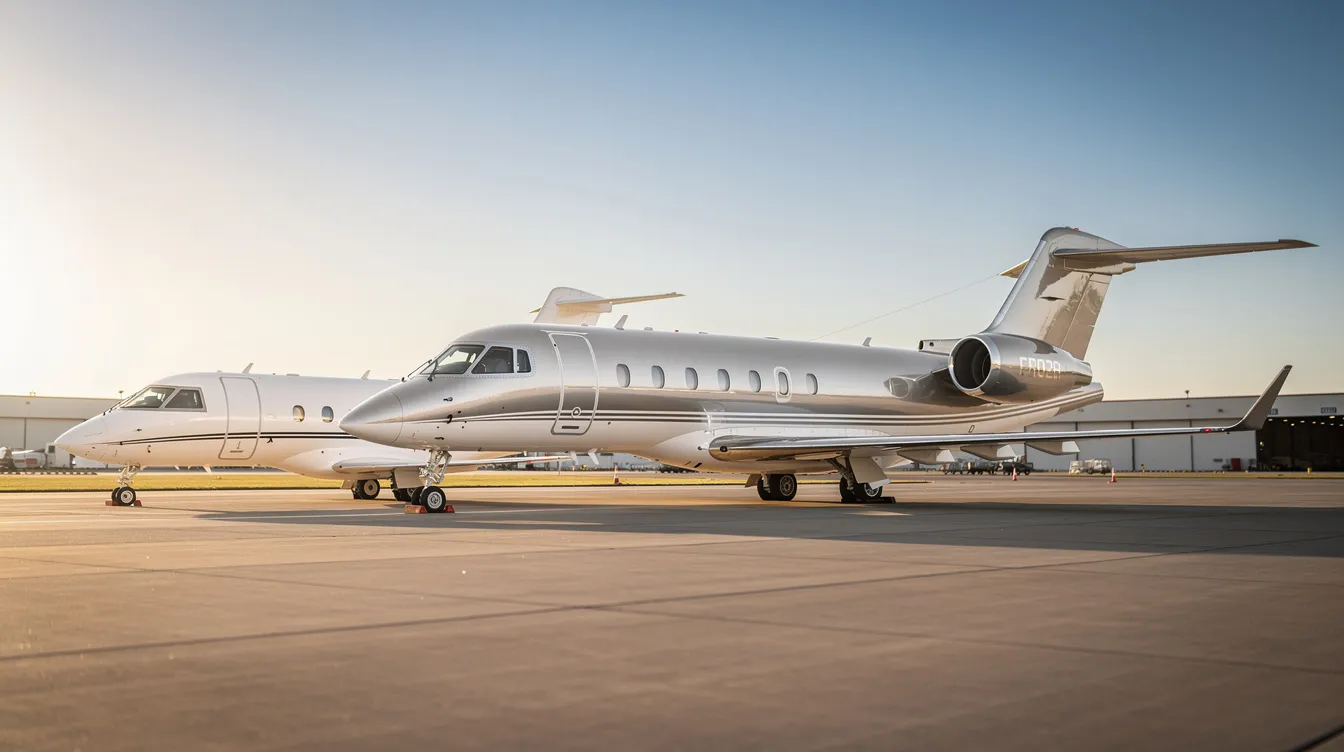
The purchase price is only the beginning. Private jet ownership costs range from $1 million to $75 million at acquisition, and long-term aircraft owners must plan for financing, depreciation, and recurring operating costs that can dwarf the initial purchase price over time.
Used light jets: approximately $3–7 million depending on age, configuration, and maintenance history
Newer midsize jets: around $8–18 million; super midsize jets and newer aircraft models with advanced avionics can reach $25–60 million+
Large or ultra-long-range jets (new): often $60–120 million+; customization—such as a new interior, bespoke galleys, or connectivity suites—can increase aircraft price by millions
For a broader view of current pricing, this private jet price list provides model-by-model comparisons.
Fixed costs must be paid regardless of flight time. They include crew salaries, insurance, hangar fees, management fees, annual inspections, and depreciation. Depreciation is a major cost that is often overlooked in aircraft ownership. Private jets experience depreciation as they lose value over time, and while tax codes in some jurisdictions allow owners to offset this through accelerated depreciation schedules, the economic reality is that the aircraft remains a depreciating asset on the balance sheet.
Variable costs scale with usage: fuel, maintenance reserves, engine reserves, landing fees, navigation charges, catering, and crew expenses for overnights. Fuel typically accounts for 25–35% of total operating costs. Fuel costs for private jets range from $1,000 to $4,000 per hour depending on aircraft size and fuel burn rate. At current prices of roughly $6.50/gallon for Jet-A in the U.S., a midsize jet burning 200–250 gallons per hour costs approximately $1,300–$1,625 per flight hour in fuel alone. Newer aircraft with improved fuel efficiency can meaningfully reduce this line item over time.
Owning a business jet can cost $500,000 to over $1.2 million annually for a light jet at moderate utilization. For a midsize jet flown 300 hours per year, the numbers look roughly like this:
Cost Category | Estimated Annual Range |
|---|---|
Fixed (crew, insurance, hangar, management, training) | $550,000 – $850,000 |
Variable (fuel, maintenance, handling, landing fees) at ~300 hrs | $1,350,000 – $2,100,000 |
Total Annual Operating Cost | $1,900,000 – $3,000,000 |
Effective Cost Per Flight Hour | $6,500 – $10,000 |
This does not include acquisition financing or depreciation. At lower utilization—say 100 hours—the same fixed costs are spread over fewer hours, driving per-hour cost well above charter rates. |
For travelers who fly 25–150 hours per year, fractional ownership offers a middle path between the high capital commitment of full ownership and the trip-by-trip uncertainty of on-demand charter. Fractional ownership allows multiple parties to share aircraft costs, and owners pay for a share of the aircraft's purchase price—typically ranging from 1/16 to 1/2 of an aircraft. In return, fractional owners receive a set number of flight hours annually, with scheduling, maintenance, and compliance handled by the management company, and a clear framework of fractional jet ownership terms and concepts that govern how those benefits are delivered.
Through its Equity Fleet program, BlackJet Fractional Jet Ownership enables clients to purchase an equity share in a light, midsize, or large jet. Owners receive guaranteed annual flight hours, predictable hourly rates, and full aircraft management. The provider handles crew staffing, maintenance tracking, insurance, and regulatory compliance—allowing the private owner to fly without managing their own fleet of staff and vendors.
For clients not ready for an equity share, the Reserve Fleet offers flexible, pay-as-you-go access without ownership costs. This model delivers consistent service, safety oversight, and availability while avoiding the capital commitment of fractional ownership. It suits occasional travelers or those supplementing a fractional share during periods of high seasonal demand.
Cost Element | Light Jet | Midsize Jet | Large Jet |
|---|---|---|---|
Initial share purchase | $500,000–$800,000 | $800,000–$1.5 million | $1.8 million–$3 million+ |
Monthly management fees | $8,000–$12,000 | $12,000–$16,000 | $16,000–$22,000 |
Occupied hourly rates | $2,800–$3,800 | $3,500–$5,000 | $5,500–$8,000 |
Additional costs | Catering, de-icing, peak day surcharges, international handling fees, and, in some programs, repositioning of floating fleet aircraft | Catering, de-icing, peak day surcharges, international handling fees, and, in some programs, repositioning of floating fleet aircraft | Catering, de-icing, peak day surcharges, international handling fees, and, in some programs, repositioning of floating fleet aircraft |
Item | Year 1 Cost | Subsequent Years |
|---|---|---|
Share acquisition | $600,000 | - |
Monthly management ($10,000 × 12) | $120,000 | $120,000 |
Occupied hours (50 hrs × $3,200) | $160,000 | $160,000 |
Total | ~$880,000 | ~$280,000 |
Chartering the same 50 hours at $3,500/hr would cost roughly $175,000–$200,000 per year before surcharges, so it pays to compare fractional jet ownership vs. membership programs when deciding which model best matches your flying pattern. The fractional model has a higher first-year cost due to the share purchase, but in years two and beyond, the annual cost drops significantly—and the owner holds an equity position. Fractional ownership allows sharing costs among multiple owners, spreading both the financial and operational burden, and can be evaluated as a fractional jet ownership investment with specific benefits and considerations.
Understanding each line item helps aircraft owners and fractional shareholders avoid hidden costs and manage budgets more effectively. Here are the major categories.
Crew salaries add significantly to private jet operating costs. In the United States, a captain on a midsize jet earns $120,000–$200,000+ per year; first officers earn $80,000–$140,000. Flight attendants on large jets add another $60,000–$100,000. Recurrent simulator training for each pilot runs $15,000–$25,000 annually. Crew expenses for overnights, per diems, and repositioning further increase this line item.
Ongoing maintenance can cost hundreds of thousands annually. Scheduled inspections follow manufacturer intervals; unscheduled repairs arise from wear and component failures. Engine reserves—set aside per flight hour for eventual overhaul—run $300–$800/hr for midsize jets and $1,000+/hr for heavy jets. Maintenance costs can range significantly based on inspections and repairs, and older aircraft with lower purchase prices often carry higher maintenance bills. Aircraft management companies help with maintenance tracking and compliance, ensuring nothing is missed.
Fuel costs for private jets range from $1,000 to $4,000 per hour depending on aircraft size and fuel burn rate. Fuel typically accounts for 25–35% of total operating costs. At current prices of roughly $6.50/gallon for Jet-A in the U.S., a midsize jet burning 200–250 gallons per hour costs approximately $1,300–$1,625 per flight hour in fuel alone. Newer aircraft with improved fuel efficiency can meaningfully reduce this line item over time.
Hangar fees vary based on location and aircraft size—a hangar at a busy airport like Van Nuys or Teterboro costs substantially more than one at a smaller regional field. Insurance costs vary based on the jet's value and usage, with hull and liability premiums scaling for larger, more expensive aircraft. Management fees paid to a professional operator typically run $3,000–$8,000/month but cover scheduling, regulatory compliance, and ADS-B transponder and avionics upkeep, all of which are laid out in a detailed aircraft fractional ownership sample contract. Providers like BlackJet Fractional Jet Ownership centralize all of these responsibilities, giving fractional owners predictable monthly management fees that are defined by essential fractional ownership contract terms.
Business jet cost is not uniform worldwide. Taxes, fuel prices, regulatory fees, and airport infrastructure differ dramatically across North America, Europe, the Middle East, and Asia-Pacific. These differences can significantly impact the total cost of any given trip.
The U.S. benefits from competitive fuel pricing, a dense network of over 5,000 airports with business aviation facilities, and relatively low navigation charges for domestic private flights. This makes the United States one of the most cost-effective markets in the world for private aviation. Popular airports like Van Nuys in Los Angeles and Teterboro near New York offer extensive FBO services, though their hangar and ramp fees reflect high demand.
Operating across different regions introduces higher navigation charges, expensive ground handling, and limited airport slots. European flights incur significant overflight and approach fees. Routes to the Middle East, Asia-Pacific, or South America may require additional crew rest arrangements, international handling, customs fees, and sometimes permits that add thousands to each trip. For large jets, these surcharges are amplified by aircraft-size-based fee structures.
New York to Miami (light jet, ~2.5 hrs): Domestic U.S. fees are modest; total cost roughly $8,000–$12,000 including landing fees and taxes.
London to Nice (light jet, ~2 hrs): Similar flight time, but European navigation charges, higher fuel prices, and VAT considerations can push the total 20–30% above a comparable U.S. domestic trip.
Dubai to Riyadh (midsize jet, ~2 hrs): Overflight permits, international handling, and limited FBO competition can add $3,000–$5,000+ in additional fees beyond base hourly rates.
Working with an experienced advisor or fractional provider for cross-border flying helps anticipate these regional cost variables and avoid surprise surcharges on the final invoice.
The best solution depends on annual flight hours, route profile, and financial goals, as well as an understanding of the best fractional jet ownership programs available to investors. There is no one-size-fits-all answer in the jet business—but clear thresholds emerge when the numbers are laid out.
Under ~25 hours/year: On-demand charter or empty leg flights typically offer the best value. Fixed overhead from any ownership structure is hard to justify.
25–150 hours/year: Fractional ownership or jet card memberships often deliver the lowest overall cost when accounting for guaranteed availability, consistent aircraft quality, and shared fixed costs.
Above ~200–300 hours/year: Owning a business jet is cost-effective for those flying 150 to 200 hours per year or more, as the high fixed costs are diluted across enough hours to compete with—or beat—charter and fractional rates.
Model | Estimated Annual Cost |
|---|---|
Charter (75 hrs × ~ $3,500/hr + fees) | $300,000 – $400,000 |
Fractional share (Year 2+, after acquisition) | $260,000 – $320,000 |
Full ownership (75 hrs on a $5M airplane) | $600,000 – $800,000+ |
At 75 hours per year, full ownership is expensive because fixed costs are spread too thin. Charter works but offers no equity position, no guaranteed availability, and no aircraft consistency. Fractional ownership hits a balance for frequent flyers in that mid-utilization band. |
Qualitative benefits also matter: guaranteed aircraft availability even during peak periods, consistency in the plane you fly, and potential tax advantages and implications for fractional jet owners available in some jurisdictions. Programs like BlackJet's Equity Fleet also remove the management burden entirely—no dealing with crew hiring, insurance renewals, or regulatory filings as a private owner would.
Anyone evaluating these options should model their last 12–24 months of travel—number of trips, routes, group size—and request a personalized analysis from BlackJet Fractional Jet Ownership to identify the most efficient structure.
Rather than reacting trip by trip, companies and families with predictable travel patterns benefit from building a medium-term aviation plan. This is especially true in a market where newer aircraft models, evolving fuel costs, and regulatory shifts can change the calculus year to year.
Estimate annual flight hours based on historical travel data and anticipated growth.
List primary city pairs and regions—domestic U.S., transatlantic, intra-Asia, or routes to South America.
Define preferred aircraft size based on typical passenger count and flight distance requirements.
Identify peak travel seasons and whether seasonal demand spikes require backup access.
Build comparison scenarios for charter, jet cards, fractional ownership, and full ownership over five years, including residual values, fuel cost trends, and crew expenses.
Include contingencies for regulatory changes—such as potential carbon taxes or sustainable aviation fuel mandates—and for newer aircraft entering the market with improved fuel efficiency that may affect both operating costs and residual values. Jet card programs offer predetermined hourly access to aircraft and can serve as a bridge solution while evaluating longer-term commitments.
BlackJet Fractional Jet Ownership can model these scenarios, source specific private aircraft types, and design blended solutions—such as partial fractional ownership plus Reserve Fleet access for overflow demand—tailored to each client's evolving needs.

The following FAQs address common, practical cost questions and provide direct answers based on 2024–2026 market conditions. Use these as a starting point, and reach out to a specialist like BlackJet Fractional Jet Ownership for a tailored cost analysis based on your actual flight profile.
A typical used light jet flown approximately 200 hours annually in the United States might have total operating costs in the range of $700,000–$1.1 million per year in 2026, depending on crew salaries, hangar location, and maintenance program choices. This does not include financing costs or depreciation. Lower utilization—under 150 hours—will increase the effective cost per flight hour significantly, and owners should also account for essential liability and insurance coverage in fractional jet ownership when comparing structures. For many owners at the 200-hour level, fractional ownership of light jets can offer similar access with lower capital outlay and shared fixed costs.
Many advertised hourly rates exclude additional fees such as de-icing, international handling, overnight crew expenses, and government taxes or segment fees. Always request a fully itemized quote for each trip or fractional program, clearly separating base hourly rates from variable surcharges and airport-specific charges. Reputable providers will disclose these details upfront, reducing the risk of surprise costs on the final invoice.
In most fractional ownership programs, including those offered by BlackJet Fractional Jet Ownership, scheduled maintenance and unscheduled repairs are organized by the management company—not by each individual owner. Management companies handle maintenance and scheduling for owners, and the cost is usually built into monthly management fees and hourly rates, spreading risk and expense across the ownership pool. This gives owners predictable budgeting and minimizes operational disruption when the primary private aircraft is down for service.
Many fractional and membership programs provide access to a range of aircraft categories, allowing clients to select a light jet for a short domestic hop and a larger airplane for long-range or high-passenger missions. Some programs apply interchange ratios or different hourly rates when switching sizes, and these should be reviewed carefully before signing an agreement. BlackJet Fractional Jet Ownership can help structure access so clients match the jet category to each trip while maintaining overall cost-effectiveness.
Build a simple model that estimates total annual cost over 3–5 years for each option, including acquisition, financing, operating costs, and any anticipated tax benefits. Use a consistent assumption for annual flight hours and average flight distance, then calculate cost per occupied hour for charter, fractional ownership, and full ownership, keeping in mind how the total cost of fractional jet ownership is structured and what your long-term plans are, including whether you may eventually sell your fractional jet ownership share. Request a personalized side-by-side analysis from BlackJet Fractional Jet Ownership using your real travel history and preferred aircraft type to make an informed decision.
Business jet cost depends on aircraft size, usage patterns, and the choice between charter, fractional ownership, and full ownership. There is no single right answer—but there is a right fit for most serious travelers willing to analyze their actual needs rather than rely on assumptions.
For many high-net-worth individuals and companies flying 25–150 flight hours per year, fractional aircraft ownership and flexible membership programs deliver a balance of cost efficiency, predictability, and convenience that neither pure charter nor full ownership can match. The key is modeling your specific travel profile against real numbers—not industry averages alone.
Ready to find the structure that fits your travel life? Visit FractionalJetOwnership.com to request a customized cost comparison and learn more about BlackJet Fractional Jet Ownership's Equity Fleet and Reserve Fleet solutions. Smart private aviation planning is not about chasing luxury—it is about gaining control over your time, your budget, and the way you fly.
