August 9, 2026
Private jet charter cost is one of the most searched-and most misunderstood-topics in private aviation. Hourly rates tell only part of the story, and the gap between a quoted rate and the final invoice catches many first-time flyers off guard. Here are the numbers and decisions that matter most in 2026:
Private jet charter costs range from $1,800 to $18,000 per hour, with turboprops starting around $2,000 per hour and ultra-long-range jets exceeding $12,000 per hour.
The total trip cost is not just the hourly rate. Travelers also pay applicable taxes (including a 7.5% U.S. federal excise tax), airport fees, crew logistics, fuel surcharges, repositioning charges, and short leg fees that can add 20–40% on top of the base price.
Charter services provide access to over 50,000 aircraft worldwide, offering flexibility to choose different aircraft for each trip.
On-demand charter is usually most economical below roughly 75–100 flight hours per year, while fractional jet ownership or membership programs like BlackJet Fractional Jet Ownership become more cost-effective around 25–150 hours annually.
Fractional ownership offers benefits such as guaranteed availability, flexibility, and potential tax advantages associated with private aviation, while chartering avoids maintenance and crew costs linked to ownership; understanding fractional jet ownership terminology and concepts helps travelers evaluate these tradeoffs more confidently.
Private jet ownership can cost millions upfront, excluding ongoing operational expenses such as crew salaries, maintenance, and hangar fees.
Using nearby airports can improve aircraft availability and reduce pricing, especially during peak demand periods like holidays and major events.
Consider two trips. A corporate executive needs a 2-hour hop from Dallas to Houston on a light jet for a same-day meeting, while a family of six is planning a week in London, departing New York on a heavy jet. The cost of charter jet travel for each private jet flight can differ by more than $100,000, and total private jet rental cost in 2026 typically starts around $1,800 per hour for smaller aircraft and can exceed $18,000 per hour for long-range jets before taxes, fees, and surcharges add another 20% to 40%.
Private jet charter prices are driven by aircraft type, flight distance, routing complexity, and how frequently the traveler flies each year. For high-frequency travelers and corporations logging roughly 25 to 150 flight hours annually, understanding the full cost structure up front helps avoid budget surprises and makes it easier to decide when on-demand charter is the better fit and when a more predictable access model makes sense.
BlackJet Fractional Jet Ownership serves as a trusted advisor in private aviation, helping clients compare what it costs to charter a private aircraft with jet cards and fractional ownership, while noting that chartering avoids ownership expenses such as maintenance and crew costs and preserves the flexibility to choose different aircraft for each trip, and also guiding existing owners when selling a fractional jet ownership share as their travel needs evolve. The sections below break down hourly rate ranges by aircraft type, common hidden fees and taxes, real-world route examples, cost drivers, ways to reduce spend without compromising safety, and the point at which fractional aircraft ownership can beat pure charter pricing, especially since full private jet ownership can cost millions before operating expenses.
Before diving into trip-level details, here is a quick rule of thumb for private jet hourly rate ranges in 2026. In practice, private jet rental prices are usually quoted by aircraft category and billable flight hours for U.S. domestic private jet charter services on reputable Part 135 operators, and they do not include federal excise tax or airport-specific charges.
Aircraft Category | Approximate 2026 Hourly Rate (USD) | Typical Passengers |
|---|---|---|
Turboprops & very light jets | $2,000–$3,500 | 4–6 |
Light jets | $1,800–$3,300 | 5–7 |
Midsize jets | $3,200–$4,400 | 7–8 |
Super-midsize jets | $6,000–$9,000 | 8–10 |
Heavy / ultra-long-range jets | $5,400–$18,000+ | 10–16 |
Charter jet costs in this 2026 guide range from about $1,200 to $10,000 per hour on the lower and mid tiers, while ultra-large jets can run $12,000 to $18,000 per hour for intercontinental missions; more broadly across the market, prices for private jet charters can range from roughly $1,500 to $23,000+ per hour. For a deeper look at types of private jets and prices, BlackJet maintains updated category breakdowns.
One important note: a private jet charter quote covers the entire aircraft, not a per-seat price. The same cost can be split across several passengers, which often brings the per-person economics closer to-or below-commercial business class on certain routes.
The most common mistake in private jet pricing is multiplying the hourly rate by estimated flight time and treating that as the budget. The final cost is almost always higher.
The base hourly rate covers aircraft time and crew members, but the full private jet rental cost can rise by roughly 20% to 40% once taxes, airport fees, crew logistics, and surcharges are added. A "headline" quote of $6,000 per hour on a super-midsize jet can realistically translate into a $35,000–$45,000 invoice for a 5-hour-each-way round trip once all line items are added.
Here are the main cost buckets that build toward the final cost on a typical charter invoice:
Aircraft & crew time - base hourly rate multiplied by total billable flight hours
Taxes & regulatory fees - 7.5% Federal Excise Tax on domestic flights, per-passenger segment fees, international fees ranging from $500 to $5,000
Airport and FBO fees - Airport Landing Fees, which range from $100 to $1,500 per flight depending on the airport and size of the aircraft, as well as charges for ramp access and ground handling services
Crew logistics - overnight expenses of $200 to $600 per crew member when the trip requires overnight stays
Fuel surcharges - added when market jet fuel prices increase
Repositioning and short leg fees - fees apply when aircraft must return empty or offset fuel burn during take-off
Extras - add-ons like catering, ground transportation, deicing, Wi-Fi, and concierge services that can range from standard refreshments to gourmet options at additional cost
Charter invoices are based on billable flight time, which often exceeds the simple "wheels up to wheels down" duration that travelers expect.
Billable flight time typically includes in-air time, taxi time on the ground, and repositioning legs where the aircraft must fly empty to reach or depart from the client's airports. Aircraft positioning fees may apply if the jet needs to relocate from its home base to your departure point, and these ferry flights are passed through to the client.
Most operators also require daily minimums—commonly 2 billable hours per day for smaller jets and 3 or more hours for larger aircraft. That means a one-hour hop could be billed as 2 hours due to the daily minimum plus an additional repositioning leg, bringing the billable flight hour total well above actual airborne time. A two-hour flight can cost between $8,000 and $37,000 depending on aircraft size and these structural billing factors.
Beyond hourly rates, several structural factors drive private jet rental costs. Understanding them allows smarter itinerary planning and more accurate budgeting.
Aircraft type and age - newer, longer-range aircraft cost more to operate, insure, and maintain.
Flight distance - longer flights require larger fuel loads and incur higher costs.
Airport choice and slot availability - major hubs like Teterboro or Aspen carry premium landing fees and limited availability.
Aircraft positioning requirements - if no suitable aircraft is already near your departure point, you absorb the empty ferry leg.
Seasonal and peak-demand timing - ski season, holidays, and major events create surge pricing.
International versus domestic flights - international trips require overflight permits, customs handling, and additional crew logistics.
A charter company weighs all these factors when pricing a specific trip, and experienced advisors can often adjust aircraft selection, departure date, or departure times to save thousands of dollars.
Turboprops and light jets are the most common choice for 2–6 passengers on regional U.S. routes of up to about 2–3 hours per leg. They are ideal for short-haul flights between regional airports where commercial airlines offer limited or inconvenient schedules.
Turboprop charters start at around $2,000 per hour for models like the Pilatus PC-12 or King Air 200. Light jets typically cost between $1,800 and $3,300 per hour, covering aircraft such as the Embraer Phenom 300 or Citation CJ3+. For more detail, see BlackJet's guide on how much it costs to charter a small plane and turboprop charter rates.
As a concrete example: a light jet charter from Los Angeles (VNY) to Aspen (ASE) covers roughly 2 hours of flight time. A round-trip charter on an Embraer Phenom 300 during ski season might fall in the range of $18,000–$24,000 depending on departure date, deicing requirements, and positioning. On very short legs, fixed fees like landing, ramp, and short-leg surcharges can make the effective cost per billable flight hour appear higher than the quoted base rate.
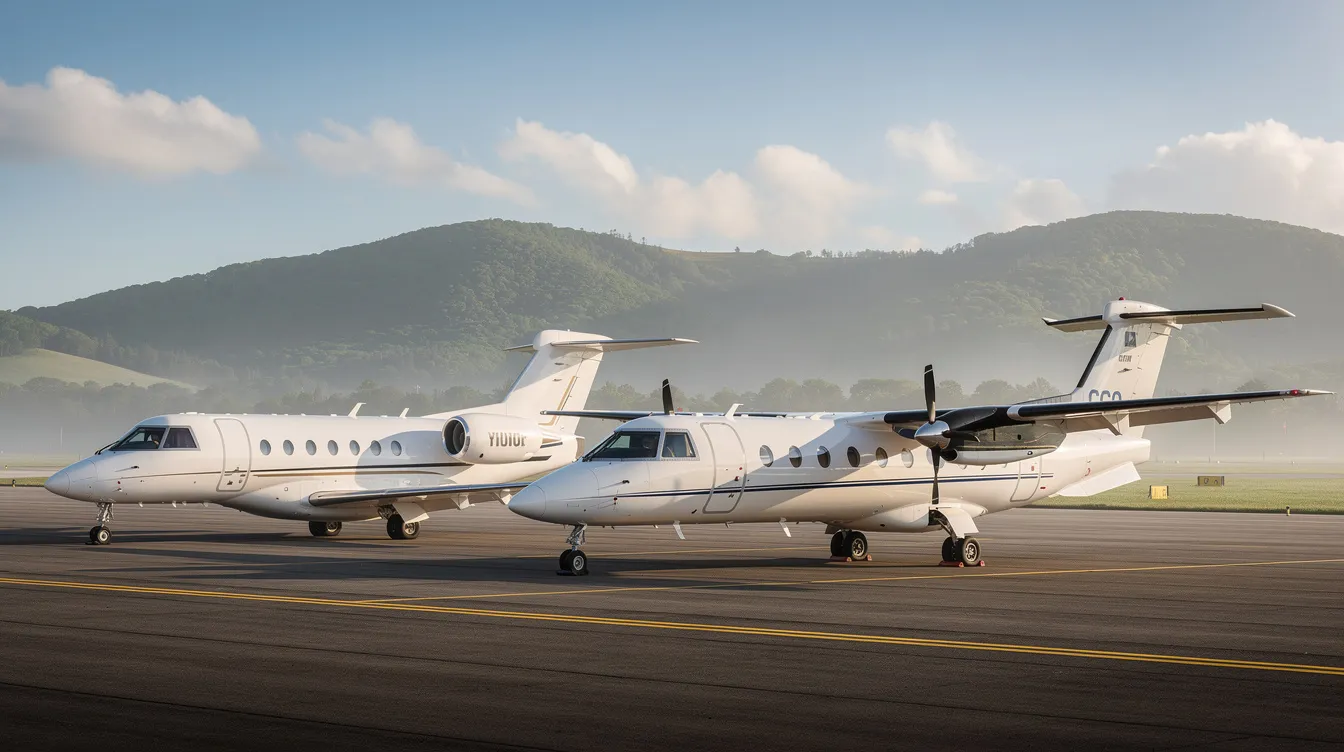
Midsize and super-midsize jets are popular for cross-country U.S. private flights because they offer stand-up cabins, longer maximum range, and substantially more baggage capacity than light aircraft. For executives and families flying 4–8 passengers on regular domestic flights, these categories hit a sweet spot between speed, cabin comfort, and operational costs.
Midsize jets like the Citation XLS+ or Hawker 800XP often fall between $3,200 and $4,400 per flight hour. Super-midsize jets—think the Challenger 300/350 or Gulfstream G280—commonly run $6,000–$9,000 per hour.
For a specific trip example: New York (TEB) to Los Angeles (VNY) nonstop on a super-midsize jet covers roughly 5–5.5 hours of flight time. A round-trip private jet charter cost on this route in 2026 likely falls around $50,000–$70,000 depending on exact aircraft type, schedule, and positioning.
Heavy and ultra-long-range jets serve larger groups of 10–16 passengers or long-haul flights such as New York to London or Los Angeles to Honolulu. These larger aircraft carry a higher base private jet cost but deliver intercontinental range, full-size galleys, lie-flat seating, and the elevated privacy that board-level and family travel demands.
Heavy jet charters can cost between $5,500 and $12,000 per hour on domestic routes. Heavy jets can cost up to $10,000 per hour for standard long-range models, while ultra-large jets can cost between $12,000 and $18,000 per hour for nonstop transcontinental or transatlantic missions on aircraft like the Gulfstream G650ER or Bombardier Global 7500.
As a concrete long-haul example: a heavy jet charter from New York (TEB) to London (Luton or Farnborough) covers approximately 7 hours of flight time. A Gulfstream G450 charter on this route can cost in the region of $80,000–$110,000 round trip, excluding optional concierge services.
Reputable private jet charter services present itemized quotes, but travelers still need to understand which line items are standard and which are optional add-ons.
Typically included in the core charter price:
Exclusive use of the entire aircraft
Pilots and crew members
Standard fuel for the planned route
Basic cabin snacks and beverages
Routine landing fees and handling fees at planned airports
Standard insurance coverage
Often not included or billed separately:
Upgraded catering or premium alcohol
In-flight Wi-Fi charges on certain aircraft
Ground transportation at origin or destination
Deicing during winter operations
Hangar storage during storms or extended ground time
Last-minute itinerary changes or additional services
Clients should always confirm whether federal excise tax, segment fees, and international fees are already baked into the quote or listed separately. A transparent pricing structure—where every line item is visible—makes it far easier to compare quotes across operators.
Many first-time flyers underestimate secondary charges, which can add 10–25% or more on top of the base private jet cost. Understanding these line items prevents budget surprises.
A 7.5% federal excise tax applies to all domestic flights under Part 135 charter, calculated on the total amount paid for air transportation (IRS air transportation guidelines).
A per-passenger segment fee of approximately $5.30 applies for each takeoff-and-landing segment on U.S. domestic routes.
International fees can range from $500 to $5,000 or more depending on overflight permits, customs handling, and destination country charges.
Landing fees vary from $100 to $1,500 per flight, depending on the size of the aircraft and the airport.
Ramp and handling fees can cost between $100 and $500 at most FBOs.
Crew overnight expenses add $200 to $600 per crew member when the trip requires an overnight stay at the destination.
Fuel surcharges may apply when jet fuel prices spike above baseline levels used in the original quote.
Deicing charges in winter can range from $1,500 for a light jet to $15,000 or more for a large cabin jet.
Savvy planning—such as choosing a nearby secondary airport with lower fees or adjusting travel dates away from peak demand—can meaningfully reduce these charges.
To make the numbers concrete, consider a popular route: a 3-day same-aircraft round trip from New York (TEB) to Miami (OPF) for 6 passengers on a super-midsize jet.
Here is how the major line items build toward the total:
Aircraft time: approximately 2.5–3 hours each way at an assumed hourly rate of $7,500, covering roughly 5–6 billable flight hours round trip. Aircraft and crew cost: approximately $37,500–$45,000.
Federal excise tax: 7.5% of the aircraft charge adds roughly $2,800–$3,375.
Segment fees: approximately $5.30 per passenger per segment × 6 passengers × 2 segments = roughly $64.
Landing and ramp fees at TEB and OPF: approximately $800–$1,200 combined.
Crew overnights: 2 nights in Miami for 2 pilots at $400 per night = approximately $1,600.
Catering: estimated $500–$1,500 depending on meal service.
The realistic 2026 total range for this trip falls between $45,000 and $55,000. Flying midweek instead of Friday evening, choosing a departure date outside holiday peaks, or selecting a midsize jet instead of super-midsize could push the charter flight cost toward the lower end. Premium departure date timing and last-minute booking push it higher.
Beyond one-off private jet charters, frequent flyers often compare jet card programs and fractional aircraft ownership to control long-term private jet cost. The right structure depends on how many flight hours a traveler logs annually and how much pricing predictability they need, and comparing fractional jet ownership vs membership programs clarifies which model fits different usage patterns.
On-demand charter economics:
Maximum flexibility—each trip is separately bookable with no long-term commitment.
Chartering avoids maintenance and crew costs associated with ownership.
Chartering offers flexibility in aircraft choice for each trip, matching aircraft size to mission needs.
Charter services provide access to over 50,000 aircraft worldwide.
However, travelers face variable hourly rate changes, repositioning charges, and peak-day surcharges that make budgeting unpredictable.
Chartering is cost-effective for those flying less than 150 hours annually.
Fractional ownership economics:
Programs like BlackJet Fractional Jet Ownership provide guaranteed access, predictable hourly rates, and potential tax benefits associated with private aviation.
A share purchase represents a depreciable asset for qualifying business use.
Monthly management fees accrue regardless of usage, which means the model rewards consistent flying.
Frequent flyers may find chartering more cost-effective than ownership below 25 hours per year, but fractional becomes the more efficient alternative around 25–150 annual flight hours.
For a detailed comparison, BlackJet's overview of what fractional jet ownership is explains how share structures work in practice.
BlackJet serves clients who are currently relying on private jet rental or jet cards but are beginning to fly often enough that ownership economics become attractive. For these travelers, a clear view of the total cost of fractional jet ownership is essential. The company offers two models designed for different usage levels.
Reserve Fleet: A flexible, pay-as-you-go solution that provides access to curated private aircraft without the full ownership burden, similar in spirit to floating fleet options in fractional ownership that emphasize flexibility and optimized fleet utilization. This model works well for clients currently chartering 25–75 hours per year who want more predictable pricing and additional services without a capital commitment.
Equity Fleet: Fractional aircraft ownership that provides an actual share in a private jet, priority access, customized aircraft type selection, and potential tax benefits for qualifying U.S. business use. This model is designed for travelers consistently flying 75–150+ hours annually who value operational control and long-term cost efficiency.
BlackJet runs detailed flight hour analyses, comparing expected charter spend over 3–5 years versus fractional ownership costs—helping both individuals and corporations choose the most cost-effective path through private aviation. The analysis can incorporate fractional jet ownership financing structures, fuel prices, repositioning patterns, seasonal demand, and the client's specific trip details to deliver a clear financial comparison.
Outright private jet ownership makes financial sense only at very high usage levels. Owning a private jet can cost millions upfront before factoring in crew salaries, insurance, maintenance, and hangar fees—expenses that persist whether the aircraft flies or sits idle. Full ownership typically breaks even around 200–300+ flight hours per year.
Fractional jet ownership, however, can become efficient far earlier. Travelers weighing this option should understand the full cost structure of fractional jet ownership before committing capital. Here is a rough framework:
Below ~25 hours/year: Pure on-demand private jet charters or a jet card program usually make the most sense. Capital exposure is minimal, and per-trip flexibility outweighs the benefits of ownership.
25–150 hours/year: Fractional ownership or membership programs like BlackJet begin to reduce average cost per flight hour and improve access reliability. Fixed costs spread across more hours, and guaranteed availability eliminates last-minute surge pricing.
150–300+ hours/year: A combination of fractional aircraft ownership and supplemental charter or card programs is often used by corporations to balance availability across fleet mix and remote destinations.
Consider a company flying executives monthly between Chicago and San Francisco on midsize jets. At roughly 100 annual hours, the cumulative charter spend—including repositioning, peak surcharges, and fuel surcharges—often exceeds the total cost of a fractional share with its predictable occupied hourly rate; for many such users, a structure similar to 1/8th fractional jet ownership around 100 hours per year can align well with their travel profile.
Cost savings in private aviation should never come from cutting safety corners or bypassing reputable charter company standards. The goal is smarter planning, not cheaper operators.
Practical strategies that reduce the cost to charter without sacrificing quality:
Fly midweek or off-peak times—weekend and holiday pricing carries meaningful premiums.
Use secondary airports—regional airports near major hubs often have lower landing fees and handling charges than facilities like Teterboro or Van Nuys.
Choose the smallest suitable aircraft—flying private on a light jet when a heavy jet is unnecessary saves thousands per hour.
Consolidate trips—fewer, longer legs with multiple meetings reduce repositioning and daily minimums.
Book round trips—same-aircraft returns eliminate the repositioning penalty of two separate one-way charter flights.
Monitor empty legs—when schedule flexibility allows, empty-leg air charter can discount costs by 30–60%.
Working with experienced advisors at firms like BlackJet Fractional Jet Ownership helps compare quotes, verify operator credentials (Part 135 authorization, ARGUS or Wyvern safety ratings), and select the most fuel efficiency–optimized aircraft for each mission. Transparent pricing and itemized quotes make it easier to question unnecessary extras that inflate private jet charter cost.
Private jet travel is almost always more expensive than commercial first or business class on a pure ticket-price basis. But many clients view flying private as a productivity and time-saving investment rather than a travel expense.
A typical U.S. cross-country commercial first-class ticket runs $1,500–$3,500 per person. A private jet charter on the same route—say, New York to Los Angeles—might cost $40,000–$60,000 for up to 8 passengers, bringing the per-seat cost to $5,000–$7,500 per person.
The qualitative advantages often tip the calculation for executives and deal teams:
Door-to-door time savings of 2–4 hours per trip via private terminal access and shorter security processes
Ability to use smaller airports closer to final destinations, eliminating layovers and reducing ground transportation time
Complete privacy for sensitive meetings, calls, or document review
Flexible departure times that adapt to the traveler's schedule rather than an airline's
Fewer overnight stays when same-day round trips become feasible
For companies with multiple travelers and high billable hour values, these productivity gains can offset the higher direct private jet cost—especially when combined with the predictability of fractional jet ownership.
The lowest quote is not always the best value if it sacrifices safety, reliability, or service. Evaluating a charter company or long-term aviation partner requires looking beyond the hourly rate.
Key evaluation criteria:
FAA Part 135 certification and current operational authority
Independent safety ratings from organizations like ARGUS or Wyvern
Aircraft age, maintenance history, and fleet standards
Transparent, itemized pricing with no hidden surcharges
24/7 operations support and a global network of handling partners
Clear policies around cancellations, diversions, and peak-day pricing
For frequent travelers, working with a long-term partner like BlackJet Fractional Jet Ownership simplifies the booking process, standardizes the cabin experience, and provides a consistent cost structure across trips. Understanding fractional jet ownership as an investment, with its benefits and considerations, also helps these travelers decide how deeply to commit to a particular program. A well-structured relationship reduces last-minute stress—especially for time-sensitive corporate travel or family trips to remote destinations where a reliable jet charter cost estimator and dedicated advisory team make a measurable difference.
Understanding private jet cost—hourly rates, total trip pricing, taxes, and fees—enables smarter decisions between ad-hoc private charters, jet cards, and fractional aircraft ownership. The right model depends on annual flight hours, schedule predictability, and how much pricing certainty matters.
Travelers currently chartering 25 or more hours per year should consider requesting a personalized flight usage analysis from BlackJet Fractional Jet Ownership, while a charter flight cost calculator can offer a quick preliminary estimate before a deeper advisory review. In parallel, reviewing the top fractional jet ownership programs for smart investors can provide useful benchmarks. This analysis compares long-term cost scenarios across charter, jet card, and equity fleet structures—using your actual routes, preferred aircraft size, and travel patterns.
Ready to explore the smarter way to fly private? Visit FractionalJetOwnership.com to explore Reserve Fleet and Equity Fleet options, or schedule a consultation with BlackJet's advisory team. Aligning your private aviation strategy with business goals, lifestyle needs, and budget discipline is not just possible—it is exactly what a well-structured program is designed to deliver.

While some private flights can be arranged within 3–6 hours, booking 7–14 days in advance for domestic trips and 2–4 weeks for international flights or heavy jet charter missions typically yields better aircraft availability and more competitive pricing. During peak periods such as Thanksgiving, Christmas, New Year, or major events like the Super Bowl, booking even earlier is advisable to avoid surge pricing and limited availability of your preferred aircraft type.
Standard private jet charter flights are priced for exclusive use of the aircraft, and most operators do not sell individual seats. However, travelers can share the cost internally with colleagues, friends, or family they invite on the same flight. Some third-party platforms offer seat-sharing or shuttle-style private flights, but these remove the full privacy and scheduling control that define a traditional private jet charter. For a deeper look at shared economics, BlackJet's guide to private jet sharing cost covers the main options.
Weather, air traffic control holds, and operational delays can affect flight time and costs. Reputable charter agreements specify how additional billable flight time, crew expenses, or airport charges are handled in these situations. Clients should review their contract for policies on diversions, extended ground holds, and overnight delays before their next trip, and ask their charter company or BlackJet advisor to clarify any gray areas before the departure date.
In the United States, some portion of private jet travel may be tax-deductible for qualified business use, but the rules are complex and depend on factors like passenger mix, trip purpose, and aircraft ownership structure. Readers should consult a qualified aviation tax professional or CPA and review the tax implications specific to fractional jet owners. BlackJet Fractional Jet Ownership can work alongside these advisors to structure equity fleet arrangements that may support eligible tax treatment, including potential accelerated depreciation on fractional shares, while also helping clients interpret essential fractional jet ownership contract terms before they sign and review a representative aircraft fractional ownership sample contract with their legal team.
In colder regions, deicing is often mandatory for safe operations and can add anywhere from roughly $1,500 on a light aircraft to $15,000 or more on a large cabin jet per event, depending on aircraft size and local rates. Travelers should factor potential deicing charges into winter trip budgets and, when possible, consider hangar storage or flexible departure windows to reduce the likelihood of multiple deicing events on a single journey.
Understanding the full scope of private jet charter costs—from hourly rates to taxes, fees, and surcharges—is essential for making informed decisions about private aviation. While on-demand charter offers unmatched flexibility and avoids ownership burdens, frequent flyers benefit from exploring fractional jet ownership options like BlackJet Fractional Jet Ownership, which provide predictable pricing, guaranteed availability, and potential tax advantages. By carefully considering aircraft type, flight distance, timing, and airport choices, travelers can optimize their private jet spend without compromising safety or service quality.
Whether you are a first-time charter client or a seasoned private aviation user, partnering with an experienced advisor ensures transparent pricing and tailored solutions that align with your travel needs and budget. Ready to explore the smarter, more cost-effective way to fly private? Visit FractionalJetOwnership.com to learn more about Reserve Fleet and Equity Fleet options or schedule a consultation with BlackJet’s expert team today.
