August 9, 2026
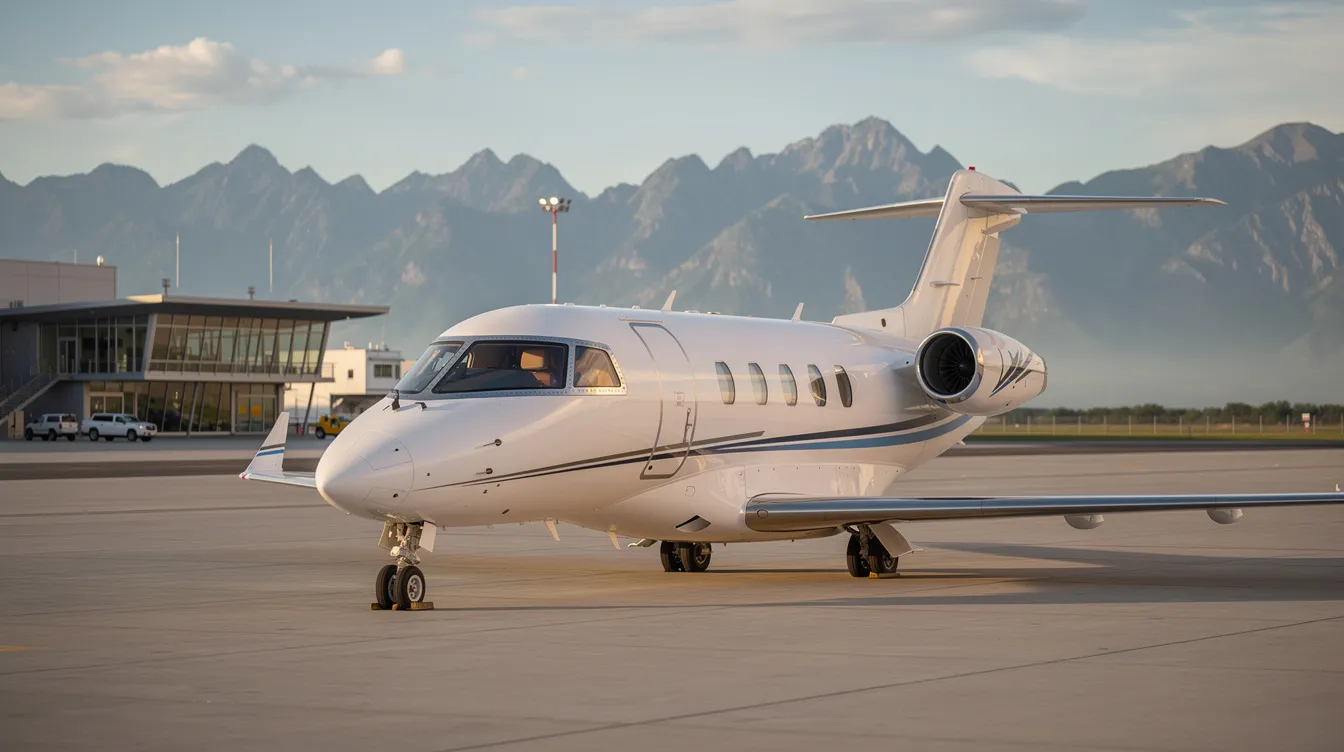
The Embraer Phenom 300/300E is the world's best-selling light jet, with more than half of recent light jet deliveries attributed to this family and over 900 aircraft in operation globally.
Maximum range sits at 2,010 to 2,055 nautical miles under NBAA IFR reserves, with a maximum cruising speed of 464 knots (approximately 521 mph) and a ceiling of 45,000 feet.
Takeoff distance is approximately 3,209 feet and landing distance about 2,212 feet at sea level, granting access to hundreds of smaller regional airports across the United States.
A real-world mission profile of 6–7 passengers yields 1,800+ nm of practical range at high-speed cruise, covering routes like New York–Dallas or Chicago–Denver nonstop.
For users flying 25–150 hours per year, fractional jet ownership programs like BlackJet make the Phenom 300's performance accessible without full ownership overhead.
The Embraer Phenom 300 is the most delivered business jet in its class, holding commanding light jet market share year after year since production began. Its first flight took place on April 29, 2008, with entry into service in 2009, and production continues through the mid-2020s. This article breaks down the Phenom 300 performance specs that matter most-speed, range, runway capability, cabin comfort-and explains how they translate into practical missions for executives and business owners across the United States. BlackJet Fractional Jet Ownership helps clients evaluate whether the Phenom 300's capabilities match their travel patterns compared to midsize or super-midsize alternatives.
The name "Phenom 300" now spans several variants: the original Phenom 300, the upgraded 300E (introduced 2018), and the forthcoming 300EV. The Embraer Phenom 300 is classified as a super-light business jet, certified for single-pilot operations, and the cabin can typically accommodate 6 to 9 passengers depending on interior configuration.
More than 900 aircraft have been delivered worldwide, making it the dominant force in light jet deliveries for over a decade.
The aircraft features two Pratt & Whitney Canada PW535E engines, with later variants receiving the higher-thrust PW535E1; thrust rating per engine ranges from 3,360 to 3,478 lbf
The 300E brought cabin redesigns, Garmin G3000-based avionics, improved range and speed, and safety features like ROAAS and autothrottle.
Early models cruise near Mach 0.78; newer 300E variants reach Mach 0.80 with improved payload and range
Performance for a business aircraft comes down to three questions: how far can it fly, how fast does it get there, and at what altitude? The Phenom 300 performance specs answer all three decisively.
Speed: Long-range cruise sits around 383 KTAS. High-speed cruise reaches approximately 464 knots (521 mph), with a maximum operating speed of Mach 0.80 on the latest Phenom 300E variants.
Range: Normal or full-seats range is around 1,811 nm with 4–6 passengers. The Phenom 300 has a range of 2,010 nautical miles under NBAA IFR reserves with five occupants, and the maximum range extends to approximately 2,055 nm on upgraded 300E versions. Payload, headwinds, and routing directly affect usable distance on any given flight.
Altitude: Service ceiling is 45,000 feet (13,716 m), delivering fuel efficiency, smoother air, weather avoidance, and ATC routing flexibility. The cabin maintains a low pressurized altitude of approximately 6,600 feet at maximum cruising altitude, reducing passenger fatigue.
Climb: The rate of climb for all engines is 3,335 feet per minute, getting passengers above weather quickly.
The jet's operational metrics provide high-speed cruise capability, short-field access, and high-altitude flight performance that places it at the top of the light jet class and within reach of some midsize jets on specific missions.
For fractional jet owners flying 25–150 hours per year, this performance covers nonstop missions like New York–Dallas, Los Angeles–Chicago, or Miami–Nassau without upgrading to a larger, more expensive aircraft, making it important to understand how fractional jet ownership compares to membership programs for this usage profile.
Runway capability determines how close a private jet can get you to your actual destination. Shorter required distances mean access to regional fields near downtown areas, vacation homes, and secondary business hubs.
Takeoff distance required is 3,209 feet (978 m) at maximum ramp weight of 18,078 pounds and a max takeoff weight of 17,968 pounds, at sea level under standard conditions-competitive with or better than most aircraft in the light jet segment.
Landing distance required is 2,212 feet (674 m), supported by effective braking systems and wing span design optimized for short-field operation.
Real-world factors-elevation, temperature, runway slope, wet or contaminated surfaces-lengthen these figures. Providers like BlackJet calculate exact performance data before every trip.
This short-field capability lets Phenom 300 users access a wider airport network, including fields like Teterboro (TEB), Aspen (ASE), and hundreds of smaller regional strips that heavier jets cannot use, reducing total door-to-door travel time significantly.
Performance is not just about speed and range. The cabin determines whether passengers arrive ready to work or need recovery time.
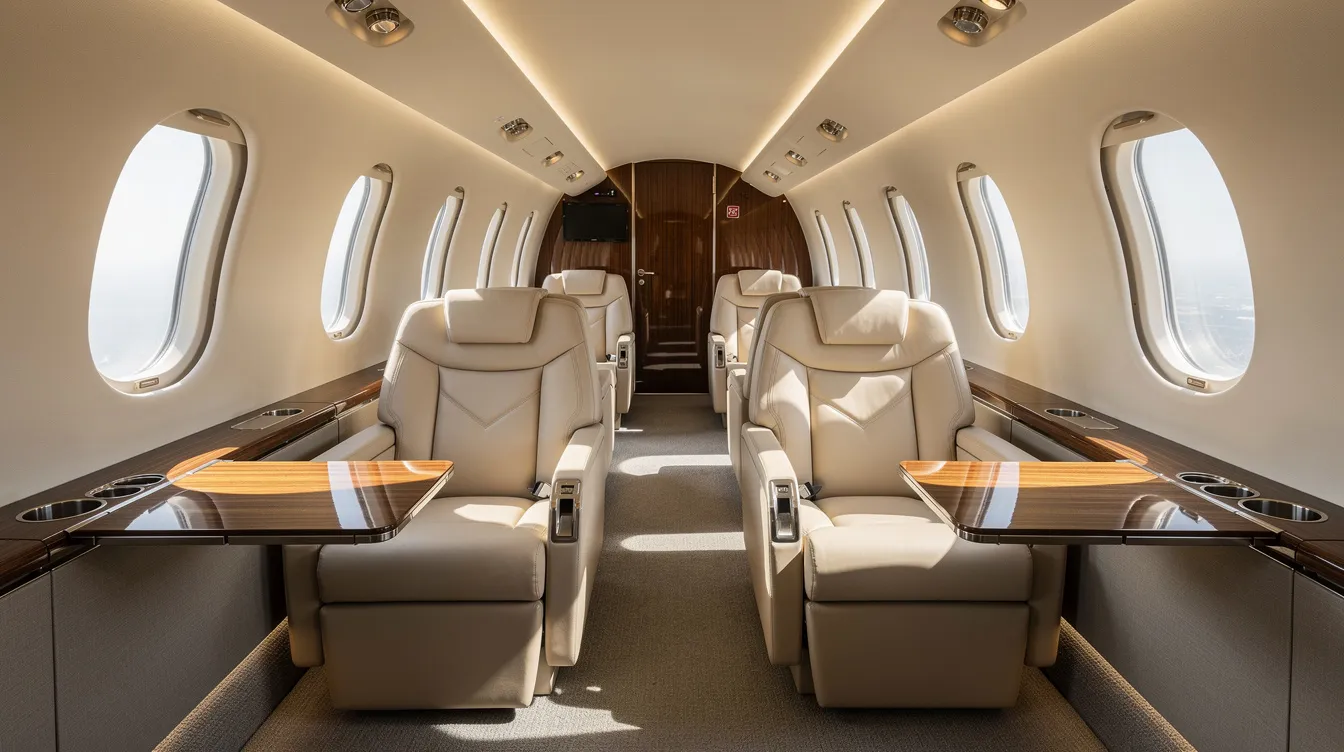
Cabin dimensions: length about 17 ft 2 in (5.2 m), width about 5 ft 1 in, height about 4 ft 11 in, with a total cabin volume around 324 cubic feet-the largest cabin volume in its class.
Typical seating: club-four configuration plus additional forward or rear seats, with a belted lavatory option. Six to nine passengers travel in comfortable conditions on 2–3 hour legs, with seats that accommodate productive work or rest.
Total baggage volume ranges from 84 to 85 cubic feet across external and internal compartments-enough to hold luggage, golf clubs, garment bags, and carry-ons for a full board of passengers.
The aircraft has a low cabin altitude of 6,600 feet at 45,000 feet, reducing fatigue compared to many older light jets and keeping executives sharper upon arrival.
Modern 300E features include the largest windows in class, low noise levels, optional LEO connectivity for in-flight productivity, and intuitive lighting and environmental controls.
Today's Embraer Phenom 300E pairs strong performance with an advanced cockpit that enhances safety for crew and passengers alike. Advanced avionics include the Prodigy Touch flight deck based on the Garmin G3000, featuring synthetic vision, integrated flight management, and advanced autopilot modes. Earlier Phenom 300 models used the Garmin G1000.
Key safety enhancements include the Runway Overrun Awareness and Alerting System (ROAAS)-a first in business aviation-plus autobrake and emergency descent mode on newer 300E models. The forthcoming Phenom 300EV adds Garmin Emergency Autoland, capable of fully automated landing in the event of pilot incapacitation, making it the largest business jet equipped with this system and among the safest private jets flying today.
These systems reduce pilot workload, fully support single-pilot operations with a single certified crew member, and strengthen dispatch reliability-qualities that fractional jet ownership programs and corporate flight departments particularly value for standardized training and predictable operation across their fleets.
The Phenom 300's performance-to-cost ratio is a primary reason it dominates the market. Here is a subject worth careful evaluation for anyone considering ownership or a share.
Cost Category | Annual / Per-Hour Figure |
|---|---|
Hourly variable cost | ~$2,315.24 per flight hour |
Annual fixed costs (crew, hangar, insurance, training) | $477,865 |
Annual variable costs (fuel, maintenance, engine programs) | $694,572 |
Total annual cost of operation (~300 hours) | $1,784,937 |
Typical purchase price (sale range) | $6,500,000 – $18,000,000 |
Fuel consumption in cruise runs approximately 157 to 169 gallons per hour at long-range settings and 169 to 179 gallons per hour at higher speed profiles. Maximum payload ranges from 2,416 to 2,636 pounds across variants.
For those flying 25–150 hours per year, fractional aircraft ownership through programs like BlackJet lets clients access Phenom 300 performance without carrying the full fixed cost burden-often a more efficient form of access than charter or whole ownership for this usage level, especially when structured with fractional jet ownership financing options that align capital outlay with expected flying hours.
How do these specifications translate into actual itineraries? Decision-makers should map their most frequent routes and passenger loads against the Phenom 300's performance envelope. The Embraer Phenom 300 is designed for high-frequency business travel across regional and medium-haul distances.
Typical nonstop routes with a normal passenger load include New York (TEB) to Miami (OPF), Chicago (MDW) to Denver (APA), and Los Angeles (VNY) to Dallas (DAL)-all well within the aircraft's comfortable range.
Longer missions that may require payload or fuel trade-offs include New York to Aspen, Los Angeles to Chicago in strong winter headwinds, and U.S. East Coast to Central America or London-bound positioning legs that would need a tech stop.
Ideal user profiles: executive teams shuttling between regional offices, entrepreneurs visiting client sites across the U.S., or families taking 2–3 hour leisure flights on weekends.
BlackJet Fractional Jet Ownership can analyze a prospect's top 10–20 yearly routes and confirm whether a Phenom 300 share, a mixed fleet solution, or a larger jet better fits their range, payload, and comfort needs, drawing on insights from leading fractional jet ownership programs across the market.

Below are common questions from prospective owners and fractional program participants, many of whom are still learning key fractional jet ownership terminology and concepts.
The Phenom 300 is optimized for trips in the 1.5–3.0 hour range and can handle many 4+ hour legs with careful fuel and payload planning. However, very long missions or frequent coast-to-coast travel with full passengers may be better served by a midsize or super-midsize jet. BlackJet advisors typically review a client's top routes, seasonal weather patterns, and passenger loads to determine whether Phenom 300 performance is sufficient or if stepping up in size improves reliability and comfort.
On a per-hour basis, whole ownership can be cheaper than ad-hoc charter when flying 200–300+ hours per year. For 25–150 hours, fractional jet ownership or membership often offers lower effective cost and risk. Charter pricing is usually all-inclusive per trip, while Phenom 300 ownership involves fixed and variable costs spread over expected annual hours-something BlackJet can model in a side-by-side comparison that also weighs fractional jet ownership as an investment rather than purely an operating expense.
With takeoff distances around 3,200 feet and landing distances around 2,200 feet at standard conditions, the Phenom 300 can use many regional and executive airports that airliners cannot. Performance at hot-and-high airports or very short fields depends on runway length, elevation, obstacles, and weight, so BlackJet or the operating flight department always validates airport suitability before scheduling a flight.
The Phenom 300 is known for strong dispatch reliability and Embraer's robust support network. All jets require scheduled inspections and occasional unscheduled maintenance, which can ground a specific tail number temporarily. In a well-structured fractional program, clients typically receive a guaranteed aircraft of similar size and performance during maintenance events, minimizing disruption to travel plans, provided the underlying fractional ownership contract terms clearly spell out maintenance and substitution provisions.
Start with an analysis of annual flight hours, average passenger count, typical city pair distances, and any outlier missions such as transcontinental or international flights. BlackJet Fractional Jet Ownership offers consultations where advisors model different fleet and share scenarios, and readers can contact BlackJet advisors for a consultation to see where Phenom 300 performance is ideal and when right-sizing to a larger aircraft creates better long-term value, while also planning for the tax implications of fractional jet ownership on business and personal use.
Ready to explore the smarter way to fly private? Visit FractionalJetOwnership.com to learn how fractional ownership can transform your travel experience.
The Embraer Phenom 300’s blend of maximum speed, impressive range, short-field performance, and advanced technology makes it a standout in the super-light jet category. Powered by reliable Pratt & Whitney engines and equipped with cutting-edge avionics, it offers a balance of efficiency, comfort, and operational flexibility suited to a wide range of business and personal travel needs. For high-net-worth individuals and corporations flying 25–150 hours annually, fractional jet ownership through BlackJet unlocks access to these performance benefits without the full financial and logistical burden of sole ownership. This model delivers predictable availability, lower overall costs, and the convenience of private aviation tailored to your schedule. To explore how a Phenom 300 share or alternative fractional ownership options can elevate your travel experience, contact BlackJet Fractional Jet Ownership today.
Ready to explore the smarter way to fly private? Visit FractionalJetOwnership.com to learn how fractional ownership can transform your travel experience.
