August 23, 2026
Choosing the right private jet starts with one deceptively simple question: how many seats do you actually need? The answer shapes everything from hourly costs to cabin comfort to the aircraft category that makes sense for your travel patterns. This guide breaks down seating capacity across every jet category, explains the regulations behind common seat limits, and shows how to match passenger count to mission—whether that means a quick two-person hop or a 14-person transatlantic board retreat.
Most private jets seat between 4 and 19 passengers. That range covers jets, while turboprop aircraft are a separate short-haul private aircraft option with different seating and performance profiles; a handful of executive airliners push beyond 30 seats, but the vast majority of private aircraft used for charter and fractional operations stay within the 4–19 range. Under FAA Part 135 regulations in the United States, private jets operated for hire are generally capped at 19 passenger seats before triggering more complex commercial operations requirements.
Seating Capacity by Jet Category:
Very light jets: 2–4 seats (some certified up to 6)
Light jets: 4–8 seats
Midsize / super light jets: 6–9 seats
Super mid-size jets: 8–12 seats
Heavy jets and long-range jets: 10–16+ seats
Ultra long-range jets and executive airliners: 14–19 seats typical; VIP airliners can accommodate 25 to 50+ passengers with luxurious customizations
Private jet seating often ranges from a compact 4-seat layout to nearly 20 seats, and most private flights involve parties of 4–6 people even on larger aircraft. BlackJet Fractional Jet Ownership helps clients flying 25–150 hours per year select the right seating capacity that balances cost efficiency, range, and comfort—rather than simply defaulting to the largest cabin available.
Picture a four-person executive team flying two hours from Dallas to Denver for an afternoon meeting. Now picture a 12-person board retreat traveling coast-to-coast with overnight bags, presentation equipment, and the need for a quiet workspace aloft. Both groups need a private jet, but the right private jet means entirely different things for each mission.
A jet's maximum seating capacity can differ significantly from its comfortable seating capacity. In real-world private jet travel, average passenger loads are often 4–6 people, even on aircraft certified for 10–14, particularly across U.S. and European business routes where productivity, privacy, and ample space take priority over filling every seat.
Understanding passenger capacity is one of the first decisions in private aviation planning because it drives:
Which jet category fits your group size and mission range
How much cabin space is available for luggage, work, and rest
The total cost per flight hour and the cost per passenger
Whether the aircraft provides the right balance of range and comfort
BlackJet Fractional Jet Ownership serves as a private aviation advisor, helping individuals and corporate flight departments optimize aircraft selection across its Reserve and Equity fleet programs, while its fractional jet ownership glossary of key terms helps prospective owners understand the terminology behind these decisions.
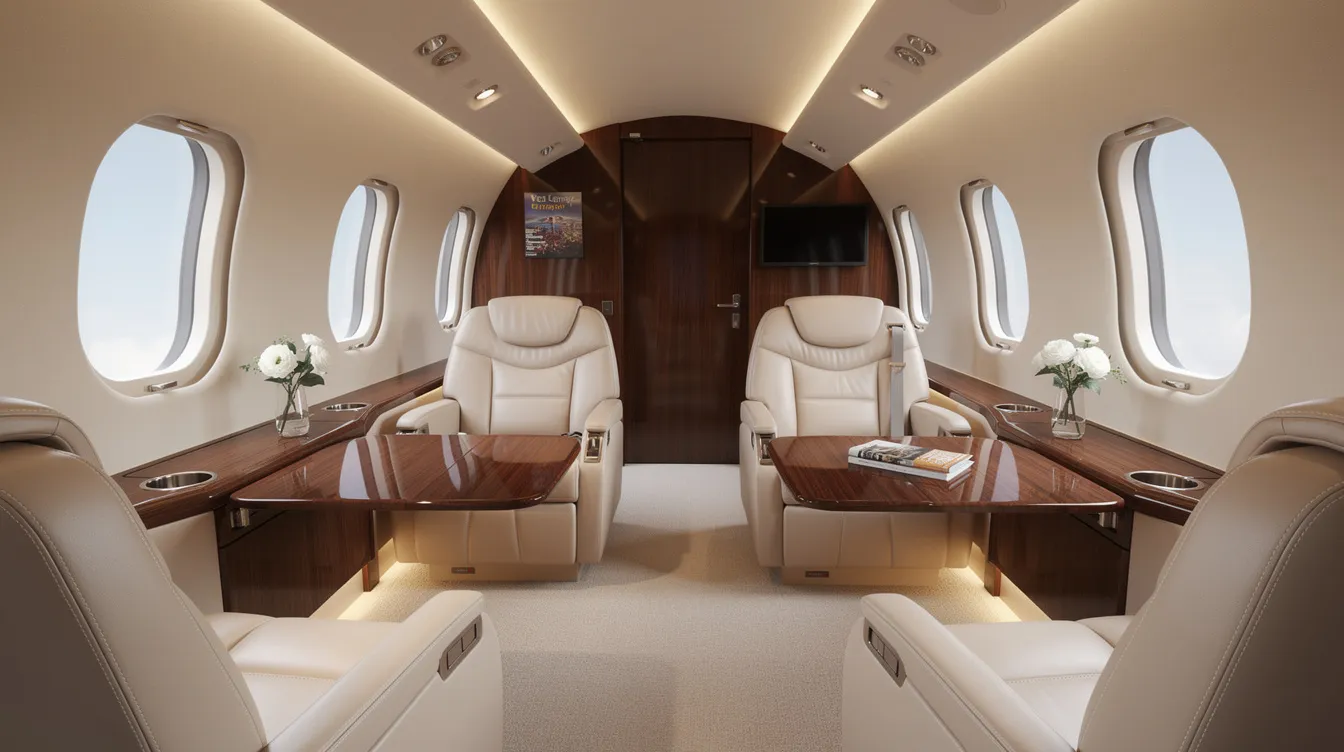
Seating capacity in private aviation is not a single number. It refers to the number of certified, belted seats approved for passengers in the aircraft cabin, excluding pilots and jump seats. But that certified number rarely tells the full story.
There are three ways to think about how many seats matter on a given flight:
Certified (legal) capacity: The maximum number of FAA- or EASA-approved belted seats installed in the cabin. This is the hard limit for passenger count. Notably, the "belted lavatory" can count as an extra seat in some aircraft, adding one position to the official total.
Practical capacity: The number of passengers who can fly comfortably for a 3–6-hour mission with baggage, working space, and freedom of movement. A jet certified for 12 may be ideal for 8–9 on longer flights due to baggage needs and elbow room.
Sleeping capacity: On long-range jets and ultra-long-range jets, lie-flat beds, convertible divans, and dedicated berths allow passengers to rest overnight. Large-cabin jets can provide sleeping arrangements for fewer than their total available seats—a Bombardier Challenger configured for 12 seats, for example, may offer 6 sleeping positions.
Layout variations—club seating, divans, conference tables—and other aircraft features can affect seating capacity even for identical models. Two jets with the same type certificate may feel dramatically different depending on how the interior was configured by the owner or operator.
Private jets are grouped into categories largely by size, range, and seating capacity. BlackJet sources across these classes in both Reserve and Equity fleets. Passenger jets can range from simple club arrangements to complex multi-zone designs, and cabins of private jets can vary widely based on layout configurations.
Seats: 2–6
Range: sub-1,000 nm
Very light jets represent the entry point of private jet travel. Models like the Embraer Phenom 100 and HondaJet typically offer 2–4 comfortable seats plus 1–2 pilot positions. Very light jets seat 4 to 6 passengers in compact cabins and are popular for short-haul flights under 1,000 nautical miles.
Seating: Very light jets are typically configured with a single 4-place club and extra seats, though comfort is best with 2–4 passengers
Cabin: Compact, with limited or no enclosed lavatory and small baggage compartments
Flight range: Sub-1,000 nm, ideal for routes like Los Angeles–Las Vegas or New York–Washington, D.C.
Ideal use: Solo executives, couples, or very small teams on short regional flights
VLJs offer a cost-efficiency advantage for low passenger loads on short routes. However, they are rarely featured in BlackJet's fractional equity programs for clients needing 25–150 hours per year, because the limited flexible seating arrangements and narrow cabin space make them less practical for varied mission profiles. When most flights involve more than four passengers or longer distances, sizing up to a light or midsize jet delivers better value.
Seats: 4–8
Range: 1,500–2,000 nm
Light jets are among the most common private jets for business travel. They carry 4–8 passengers with ranges of around 1,500–2,000 nautical miles, making them well-suited for regional flights across the United States and Europe.
Seating: Light jets typically seat 4-8 passengers in club-four layouts with additional forward-facing seats
Cabin: Enclosed lavatory, enough baggage space for carry-on plus one checked bag per passenger, and more cabin space than VLJs
Models: The Embraer Phenom 300/300E is commonly configured for 7–8 seats, while smaller light jets like the Cessna Citation CJ3 and CJ4 typically offer 6–7 passenger seats
Ideal missions: 4–6 people flying routes like New York–Chicago, Dallas–Denver, or Atlanta–Miami for 2–3-hour legs
For many BlackJet Reserve Fleet users, light jets balance cost efficiency with comfort on scheduled flights within a region. When the typical group exceeds six people or flight duration stretches past three hours, moving up to a midsize jet or super mid delivers noticeably more room and quieter cabins.
Seats: 6–9
Range: 2,000–2,500 nm
Midsize and "super light" jets bridge the gap between compact, smaller light jets and the larger super midsize jets. They typically seat 6–9 passengers and introduce features that make medium-range flights far more productive.
Seating: Midsize jets typically feature a 4-place club section with additional seating options, accommodating 7–9 passengers. Midsize and super-midsize jets seat 7 to 10 passengers with flexible seating.
Cabin: Partial or full stand-up cabin height, improved baggage volume, layouts mixing club seating with divans or a small conference table
Models: The Cessna Citation XLS+ represents the midsize segment well, while super-light jets such as the Learjet 45XR deliver similar passenger capacity with slightly different cabin geometries. Range sits around 2,000–2,500 nm.
Ideal missions: Regional or short transcontinental flights (Boston–Miami, Toronto–Dallas) for 5–8 passengers needing ample room, a quieter aircraft cabin, and space for business meetings
Many fractional jet ownership clients gravitate to this segment because it offers a noticeable comfort upgrade over light jets without the operating cost jump of heavy jets. For these travelers, understanding the total cost of fractional jet ownership is as important as evaluating cabin comfort. The stand-up cabin and spacious cabin environments make a meaningful difference on longer flights of four or more hours.
Seats: 8–12
Range: 3,000–3,600 nm
Super mid-size jets occupy a sweet spot in private aviation. Models like the Bombardier Challenger 350, Gulfstream G280, and Embraer Praetor 600 typically offer 8–12 seats in a true stand-up cabin with spacious cabins and full amenities.
Seating: Super mid-size jets can seat 8–10 passengers comfortably in executive layouts, with configurations that can accommodate up to eight passengers in premium comfort or stretch to 12 in higher-density arrangements
Cabin: Club-four pairs, additional forward-facing seats, one or two divans convertible to lie-flat beds, a full galley, and a large lavatory with enhanced amenities
Range: 3,000–3,600 nm enables nonstop New York–Los Angeles or London–Dubai flights
Ideal missions: Groups of 8–10 on coast-to-coast flights, families traveling with luggage, or corporate teams needing conference-style seating and a productive workspace
Many BlackJet Equity Fleet owners favor super mid-size jets for combining long-range capability, strong baggage and cargo capacity, and competitive hourly costs per seat. For a closer look at what a 10-seater jet offers, this category consistently delivers the best balance of capability and cost for frequent travelers.
Seats: 10–16+
Range: 4,000–5,500 nm
Heavy jets and larger jets in this class are wide-cabin, multi-zone private aircraft built for longer flights and higher-comfort missions.
Seating: Heavy/large cabin jets typically seat 10 to 19 passengers for long-haul flights. Heavy jets can have multiple independent zones accommodating up to 19 passengers, though operators often cap bookings at 12–14 for service quality. Large jets can accommodate 10–19 passengers in typical layouts.
Cabin: Stand-up cabin height over 6 feet, multiple zones for work, dining, and rest, advanced entertainment systems, and ample space for seating arrangements that include divans and conference groupings
Models: The Bombardier Challenger 604/605, Dassault Falcon 2000/7X series, and Gulfstream G450/G550 are common choices, typically configured with 12–14 passenger seats
Range: 4,000–5,500+ nm for 15-passenger missions or smaller groups on intercontinental routes
Maximizing passenger seats can reduce luggage capacity or range available, so aircraft operators and charter operators often leave a few seats unfilled to preserve baggage room and fuel reserves for specific aircraft model performance. On overnight legs, many of these jets convert to sleeping configurations, making them practical for red-eye transatlantic travel.
Seats: 12–19 (ultra-long-range jets), 19–50+ (executive airliners)
Range: 6,000–7,700 nm (ultra-long-range jets)
Ultra-long-range jets like the Bombardier Global 6000/7500 and Gulfstream G650/G700 can fly 6,000–7,700+ nautical miles nonstop. The Gulfstream G700 can accommodate up to 19 passengers, while the Global 7500 is certified for 19 but commonly configured for 13–14 in executive layouts with 8 sleeping positions; these aircraft provide multiple living zones and premium onboard amenities in addition to seat count.
Seating and sleeping: Typical seating for 12–16 passengers with sleeping for 6–8 in lie-flat beds and convertible divans. Many large jets provide private bedrooms with fine linens for overnight missions.
Executive airliners: VIP airliners like the Airbus ACJ319 and Boeing BBJ can be configured for 20 to 30+ seats, often with private suites, conference rooms, and multiple lavatories. VIP airliners can accommodate more than 20 passengers with luxury features. Business jets in the largest configurations can carry 20 to over 75 passengers depending on layout, especially when operated as part of floating fleet options in fractional ownership. The Embraer ERJ-135 seats 30 passengers in standard configuration.
Cabin features: Private jets often include spacious bathrooms with showers; onboard Wi-Fi is typically available on larger private jets; and the best private jets in this class offer multiple independent living zones.
For commercial aviation-derived airframes, cabin layouts range from 20-seat ultra-luxury to 50-seat high-density, but most private configurations emphasize space per passenger rather than maximum seating capacity. BlackJet and similar fractional operators focus on ultra-long-range business jets rather than full airliner conversions, because operating complexity and cost structure for 25–150-hour-per-year users make larger aircraft impractical as a primary platform.
Beyond approximately 19 seats, aircraft fall into a different regulatory and economic category than standard business jets, which is why the industry treats that number as a practical ceiling for most private jet charter and fractional operations.
Two jets with the same official seat count can feel very different depending on cabin layout. The arrangement of seats, tables, and amenities determines how the aircraft cabin functions for a given mission.
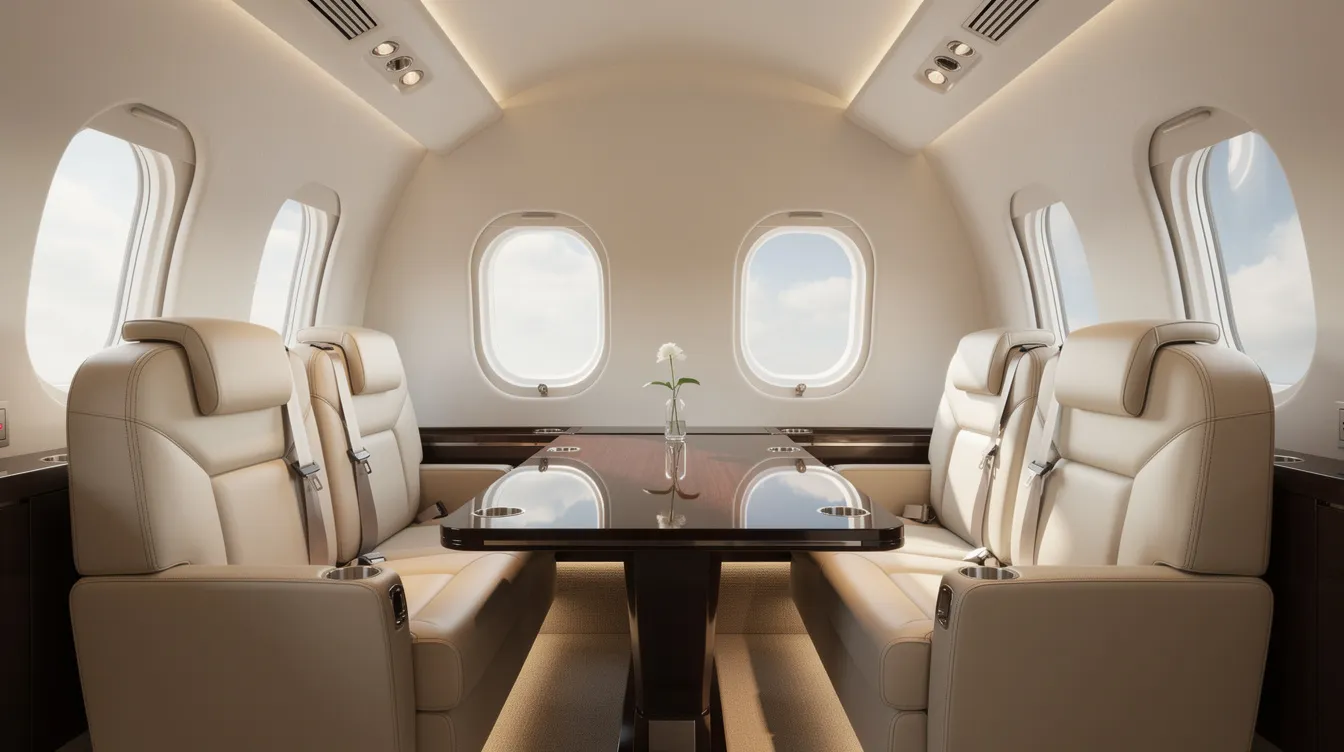
Club seating: Four seats facing each other around a table—ideal for business meetings or dining, but limits aisle movement when all four positions are occupied
Forward-facing rows: Maximize passenger count but reduce the conversational, open feel that makes private jets offer a different experience from commercial flights
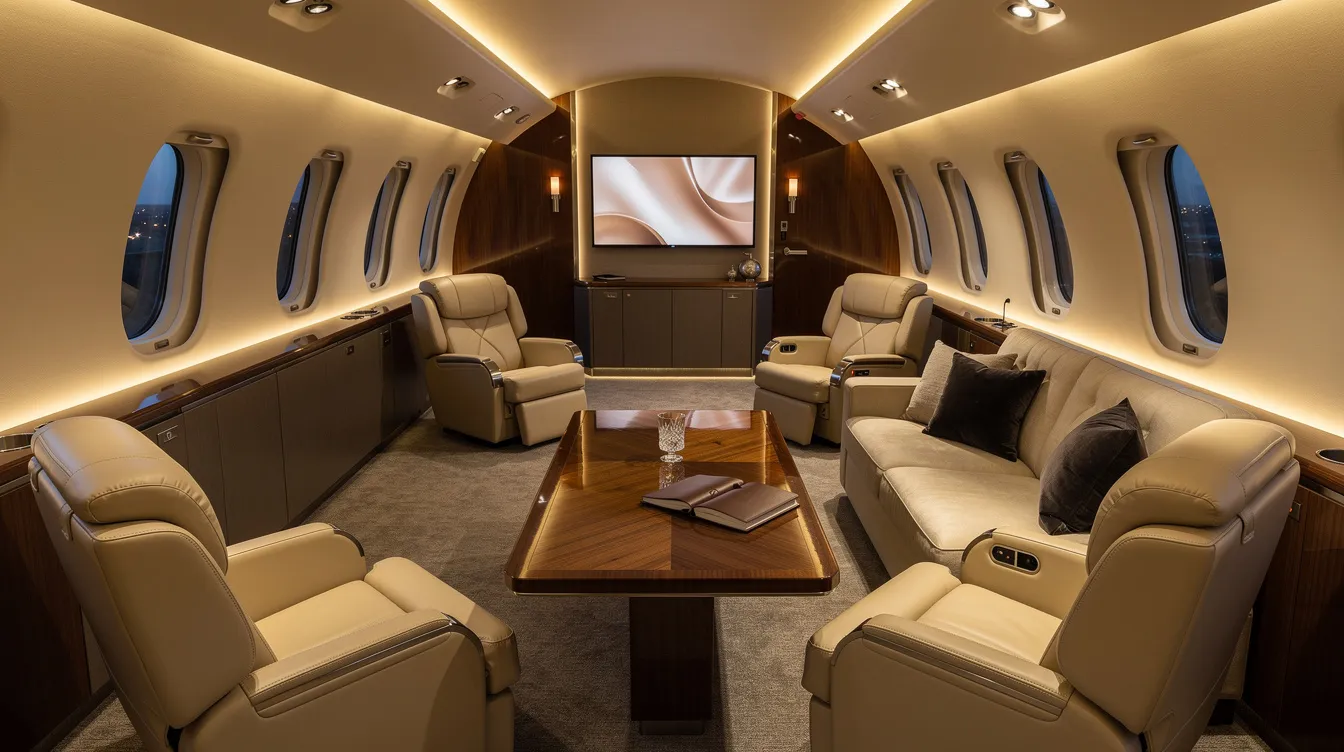
Divans and conference tables: Replace 2–3 individual seats with a sofa-style bench or a meeting surface, reducing seat count but creating more versatile space
Private jet seating configurations can include club seating and dining tables in the same cabin, and configurations can include mixed seating arrangements based on purpose—work up front, lounge in the aft section
Private jet seat configurations are not structured in rigid commercial rows, which is why the same fuselage can accommodate 8 or 12, depending on the owner's priorities
Owners may remove seats or replace them with storage, entertainment units, or extended divans, reducing official seating to enhance the onboard experience. Private jets often include spacious bathrooms with showers on larger aircraft, which consume cabin volume that could otherwise hold seats. As a concrete example, a Bombardier Challenger with 12 certified seats is often marketed as ideal for 8–10 passengers with a conference group up front and a lounge area aft—demonstrating how spacious cabin environments and flexible seating arrangements reshape what the numbers mean in practice.
The number 19 appears frequently in private jet specifications because it marks a critical regulatory boundary. In the United States, FAA Part 135 regulations govern on-demand charter and fractional operations for aircraft with 19 or fewer passenger seats. Exceeding that threshold moves the aircraft into commercial operations territory with stringent safety regulations, additional flight attendants, more emergency equipment, and significantly higher operating costs.
Nine seats are another breakpoint: jets with more than 9 passenger seats trigger additional exit seating and cabin crew requirements under Part 135, and these regulatory thresholds should be reflected clearly in fractional jet ownership contract terms.
Jets with more than 19 seats generally fall under Part 121 or equivalent rules, requiring airline-level crew scheduling, maintenance programs, safety infrastructure, and appropriately structured liability coverage for fractional jet owners.
Weight-and-balance calculations, runway performance, and weather conditions can require leaving one or more seats empty on a particular day for safety margins, regardless of certified maximum
Even fractional jet ownership programs like BlackJet's Equity Fleet respect these regulatory thresholds when configuring aircraft for clients, ensuring every aircraft provides predictable operations without commercial aviation complexity
Choosing the right private jet requires assessing group size and luggage needs alongside these regulatory realities. Most air charter service providers and aircraft operators design their fleets to stay comfortably within the 19-seat boundary.
Seating capacity directly affects cost efficiency on every flight. Fixed costs—crew salaries, insurance, maintenance reserves—remain relatively constant whether the aircraft carries 2 or 10 passengers. The more seats filled, the lower the effective cost per passenger.
Flying 8 people on a super mid-size jet at $4,500 per hour costs roughly $562 per passenger per hour; the same group split across two light jets might cost $3,000–$3,500 each, totaling far more
Oversizing creates the opposite problem: a heavy jet carrying 2 passengers on a short hop is less efficient than a light or midsize jet for the same route
Chartering a 30-seat aircraft costs $5,000–$8,000 per hour, making it impractical for groups that don't approach that passenger load
Fuel surcharges can add $600 to $900 per hour on top of base charter rates, and crew overnight fees range from $200 to $400 per crew member
Landing fees vary based on the airport authority and aircraft size, further penalizing unnecessarily large aircraft
Booking 60–90 days in advance ensures better pricing for charters and improves aircraft availability
Fractional jet ownership allows clients to choose an aircraft size aligned with their most common group size, improving long-term cost predictability. Understanding the complete cost of fractional jet ownership helps ensure that aircraft size and budget stay in balance over time. Rather than paying for a heavy jet every trip, BlackJet clients can match their typical passenger load to the ideal aircraft and avoid paying for empty cabin space flight after flight.
Selecting the right private jet starts with honest answers about how many people typically travel together, how far they go, and what they bring.
Use this guide to match your group size and mission to the right jet category:
2–4 Passengers (Regional Flights):
Very light jets or smaller light jets
4–6 Passengers (2–3 Hour Legs):
Light jets or lower midsize jet options
6–8 Passengers (Coast-to-Coast Routes):
Midsize to super midsize jets
8–12 Passengers (Cross-Country or Oceanic):
Super mid-size jets or heavy jets
12–16+ Passengers (Intercontinental Missions):
Ultra-long-range jets or executive airliners
Ideal for very light jets or smaller light jets, especially for short regional flights.
Best suited for light jets or lower midsize jet options, perfect for 2–3-hour legs.
Midsize to super midsize jets are optimal for coast-to-coast routes, offering more space and comfort.
Super mid-size jets or heavy jets are recommended for cross-country or oceanic flights, providing ample room and amenities.
Ultra-long-range jets or executive airliners are necessary for larger groups on intercontinental missions, ensuring comfort and range.
Group composition matters as much as passenger count. Families with children may need more flexible seating arrangements and luggage room, while executives might prioritize a conference table and quiet work zones for business meetings. Equipment-heavy trips—golf outings, ski vacations, trade shows—can push clients into a larger aircraft even with a modest group size, because cargo capacity becomes the limiting factor.
BlackJet advisors analyze historical travel patterns—routes, group sizes, frequency, and flight duration—to recommend the specific aircraft model and jet category within Reserve or Equity fleet programs, a process that mirrors how you would evaluate fractional jet ownership as an investment. For example, 8 executives traveling from New York to San Francisco regularly would likely be matched to a super mid-size jet with 9–10 seats and a conference layout, rather than a light jet that would be cramped or a heavy jet that would waste budget.
The difference between private jet seating and commercial flights goes far beyond seat count. A 14-seat heavy jet might offer similar cabin length to a small regional airliner configured with 40–60 seats—but the space per passenger is incomparable.
Private jets eliminate middle seats entirely and use club seating for face-to-face conversations, not rigid rows
Seat rotation and recline in a private aircraft far exceed anything available in commercial aviation, first or business class
Private jets often feature gourmet dining options tailored to passenger preferences, with meal service, catering, and ground transportation coordinated before departure
Advanced entertainment systems are common in private jets, along with onboard Wi-Fi on larger aircraft
For corporate trips, the ability to hold confidential meetings in a 10-seat cabin is more valuable than any seat in a commercial premium cabin
Total travel time—including boarding, security, and ground transportation—is often 2–4 hours shorter per trip compared to scheduled flights on commercial carriers
The privacy, productivity, and time savings make even a smaller private jet competitive with the best commercial offerings for frequent business travelers.
How a traveler accesses private jets changes how they should think about seating capacity.
Fractional jet ownership (like BlackJet's Equity Fleet) involves selecting a jet size that best matches the owner's usual seating needs over the year. Rather than picking a different aircraft every trip, owners invest in a share of a specific aircraft model and fly it consistently—building familiarity and predictability, supported by tailored fractional jet ownership financing options.
On-demand charter or charter flight bookings let clients choose a different charter jet each time based on passenger count, route, baggage needs, and aircraft availability. This flexibility comes at the cost of less pricing predictability and variable cabin quality, which is why many travelers review the top fractional jet ownership programs before committing to a long-term access model.
Jet card programs and private jet memberships fall in between, offering fixed hourly rates on a specific jet category but without the equity position or guaranteed access of fractional jet ownership versus membership programs.
BlackJet's Reserve Fleet option provides a flexible, pay-as-you-go model that still uses professional fleet planning to match private jet seating and mission requirements—an ideal bridge for clients whose group size varies significantly trip to trip.
For executives flying 25–150 hours annually, treating seating capacity as a strategic component of long-term access planning—not just a one-off charter service decision—leads to better outcomes in cost, comfort, and aircraft availability. Evaluating options such as 1/8 fractional jet ownership structures alongside other share sizes can refine that strategy. You can compare fractional jet ownership programs to see how each model aligns with different usage patterns.
This FAQ addresses common questions about how many seats private jets have and how capacity works in practice.
No. Only certified, permanently installed belted seats may be used for revenue passengers. Adding seats requires FAA certification and an approved modification—it cannot be done informally.
Yes. Children require their own certified seat and an approved restraint system. Only infants under very specific regulatory provisions may be held on a lap, and even then, rules vary by operator and jurisdiction.
"Sleeps" refers to lie-flat beds, convertible divans, or dedicated berth positions available for overnight rest. Not every seat converts to a bed, so sleeping capacity is always lower than total seating capacity, and how you classify trips as business or personal can affect tax implications for fractional jet owners.
Minor adjustments—repositioning a table, choosing different seat cushions—may be allowed within the certified interior. Major changes like removing or repositioning seats require maintenance work and re-certification, so they are not practical on a trip-by-trip basis and must be addressed in an aircraft fractional ownership sample contract.
Passing the 9-seat or 19-seat regulatory thresholds adds requirements for flight attendants, additional emergency exits, safety equipment, and sometimes a different operational certificate entirely. Most charter operators and fractional programs keep aircraft under these limits for exactly this reason, and these factors also influence how and when owners sell a fractional jet ownership share.
Maximum takeoff weight determines how much payload—passengers, luggage, and fuel combined—a jet can carry on a given departure. A full passenger load may require reducing baggage or fuel, which can shorten the flight range. Aircraft operators calculate this for every departure to accommodate additional fuel or passengers safely.
Most private/business jets carry about 4 to 16 passengers, with the standard private jet charter operating range of 4–19 seats. The best choice balances seating capacity, range, cabin comfort, and cost efficiency for the traveler's real-world missions—not just the maximum number of bodies that can physically fit in the cabin.
Focusing only on maximum seating capacity can lead to overspending on an oversized aircraft or sacrificing comfort on a jet that's too cramped. Cabin layout, baggage needs, flight duration, and passenger load all matter just as much as the raw seat count.
For travelers flying 25–150 hours per year, fractional jet ownership offers a way to lock in the right aircraft size for recurring needs:
BlackJet's Equity Fleet provides fractional ownership of a specific aircraft matched to your typical group size and routes
BlackJet's Reserve Fleet delivers flexible, on-demand access across light jets, super mid-size jets, heavy jets, and ultra-long-range jets
Both programs eliminate the guesswork of one-off charter decisions and deliver predictable cost, guaranteed aircraft availability, and consistent cabin quality
Ready to align your private jet seating with your travel strategy? Visit FractionalJetOwnership.com to request a consultation and compare Reserve Fleet and Equity Fleet options tailored to your group size and routes.
