July 7, 2026
Private planes can fly anywhere from about 1,000 nautical miles in smaller turboprops to more than 7,500 nautical miles in ultra-long-range jets on a single tank of fuel, translating to roughly two-hour regional hops or 15-hour intercontinental nonstop flights depending on the aircraft. For high-frequency travelers and corporations flying about 25 to 150 hours a year, that spread matters when deciding whether a light jet, midsize aircraft, or long-range cabin best fits typical routes without paying for more range than they will actually use.
This guide is for business travelers, corporate flight departments, and individuals considering private aviation options. Knowing how far private planes can fly helps you choose the right aircraft for your travel needs and budget.
This guide breaks down private jet range by aircraft category, the main factors that change how far a plane can fly, common route examples, tactics operators use to maximize range, and how private aircraft compare with commercial airliners. It also shows how BlackJet fractional ownership helps align aircraft capability with real travel patterns so you can choose more predictable, flexible access without the cost and complexity of full ownership or ad-hoc charter.
How far can private jets fly? The short answer: most private jets can fly approximately 7,000–7,700 nautical miles at the top end and as few as 1,000 nautical miles at the entry level, depending on aircraft category and conditions. Flight time ranges from about two hours on a light jet shuttle to 15–16 hours aboard an ultra-long-range cabin.
Here are the typical range bands by category, a quick way to compare the range of private jets across categories:
Aircraft Category | Typical Range (nm) | Approx. Statute Miles | Flight Time |
|---|---|---|---|
Turboprops | 1,000–1,300 nm | 1,150–1,500 mi | 2–3 hrs |
Very Light Jets / Light Jets | 1,000–1,800 nm | 1,150–2,100 mi | 2–4 hrs |
Midsize Jets | 1,740–2,600 nm | 2,000–3,000 mi | 3–5 hrs |
Super Mid-Size Jets | 2,600–3,300 nm | 3,000–3,800 mi | 4–7 hrs |
Large / Long Range Jets | 3,500–5,200 nm | 4,000–6,000 mi | 6–10 hrs |
Ultra Long Range Jets | 7,000–7,700+ nm | 8,000–8,860 mi | 12–16 hrs |
For context, many widebody commercial airliners like the Boeing 787 or Airbus A350 are rated around 6,000–8,500 nautical miles, and these figures help compare different aircraft side by side. The longest-range private jets can fly 7,700 nautical miles, which means top business jets now rival or exceed many commercial aircraft on range alone. The Bombardier Global 7500 can cover approximately 7,700 miles nonstop under ideal conditions, while the Gulfstream G650ER has a range of 7,500 nautical miles—enough for routes like New York to Hong Kong or Los Angeles to Sydney.
BlackJet Fractional Jet Ownership helps clients match these capabilities to their real travel needs. The Reserve Fleet covers shorter hops of one to three hours, while the Equity Fleet provides predictable access to long-range private jets for transcontinental and intercontinental missions.
Key factors influencing flight distance include aircraft weight and fuel capacity. Larger planes have larger fuel capacities, influencing their maximum range. Private jet range is not simply about how big the fuel tank is. It is an interplay of design, loading, weather conditions, and operational decisions.
Manufacturers' published maximum range figures assume ideal conditions: standard atmospheric temperatures, no headwind, limited payload, and required fuel reserves. In practice, real-world usable distances are often 5–15% shorter. Fractional and managed fleets like BlackJet's use detailed performance data and dispatch planning to safely maximize practical range for each mission.
Different private planes—turboprops, very light jets, light jets, midsize, super midsize jets, large cabin, and ultra-long-range—are engineered for distinct mission profiles. A Pilatus PC-12 turboprop is optimized for regional efficiency on shorter runways, while a Bombardier Global 7500 is built to cross oceans nonstop. Larger wings, higher fuel capacity, and more powerful engines extend an aircraft's range but increase weight and operating cost.
Cabin pressurization and structural limits also influence maximum altitude, which in turn affects fuel economy. Aircraft certified for 51,000 feet can cruise in thinner air where drag is significantly lower than at 35,000 feet—a ceiling many commercial airliners share.
There is an important distinction between fuel capacity—how much fuel a jet can carry—and fuel efficiency—how effectively that fuel converts into distance. Smaller jets may carry a few thousand pounds of fuel, while larger jets typically have greater fuel capacity (30,000+ pounds in some long-range models), directly influencing their maximum range. Larger planes have larger fuel tanks, but carrying more fuel also adds weight.
Modern winglets, supercritical wing designs, and high-bypass turbofan engines improve fuel efficiency and extend the range of private jets without increasing tank size. Flying at optimal long-range cruise speed—often slightly below maximum Mach—saves fuel and can add hundreds of nautical miles to the available distance versus pushing the throttles to maximum cruise.
Payload directly impacts a jet's range; heavier loads reduce distance. Every extra passenger and bag adds weight that displaces fuel the aircraft could otherwise carry. Heavy payloads require more thrust and reduce range due to increased fuel consumption, compounding the effect.
Consider this example: a super midsize jet might manage New York to Los Angeles nonstop with four to six passengers but needs a fuel stop with nine passengers plus golf bags. BlackJet's planning team models payload versus range early when advising fractional owners on aircraft selection and trip feasibility, ensuring no surprises on departure day.
Flying at higher altitudes increases fuel efficiency and range. Private planes often cruise higher than commercial airliners—between 41,000 and 51,000 feet—where thinner air reduces drag, and the engines burn less fuel per mile. Step climbs, where the aircraft ascends to higher altitudes as fuel burns off and weight decreases, are a standard technique on long distance flights.
Cruise speed affects fuel consumption; slower speeds are more fuel efficient. For example, reducing from Mach 0.90 to Mach 0.85 in a long-range jet may add up to an hour of endurance. Pilots and dispatch balance time savings versus fuel burn based on mission priorities—sometimes arriving 20 minutes later means eliminating a fuel stop entirely.
Weather conditions can significantly affect private jet range. Strong headwinds can reduce the distance a plane can fly—westbound transatlantic legs against winter jet streams may lose 500–700 nautical miles of effective range compared to eastbound tailwinds that extend it. Hot temperatures reduce air density and fuel efficiency, particularly at lower-altitude departure airports. High humidity can decrease aircraft performance but is less critical than temperature.
Aircraft often do not fly in a straight path due to routing and air traffic control mandates. Storm avoidance, airspace restrictions, and air traffic reroutes add distance. An ultra long range jet's theoretical 7,700 nm capability might shrink to roughly 7,000 nm facing strong winter headwinds over the North Atlantic. Professional flight planning—like what BlackJet provides—evaluates multiple route options and higher altitudes to preserve range and on-time arrival.
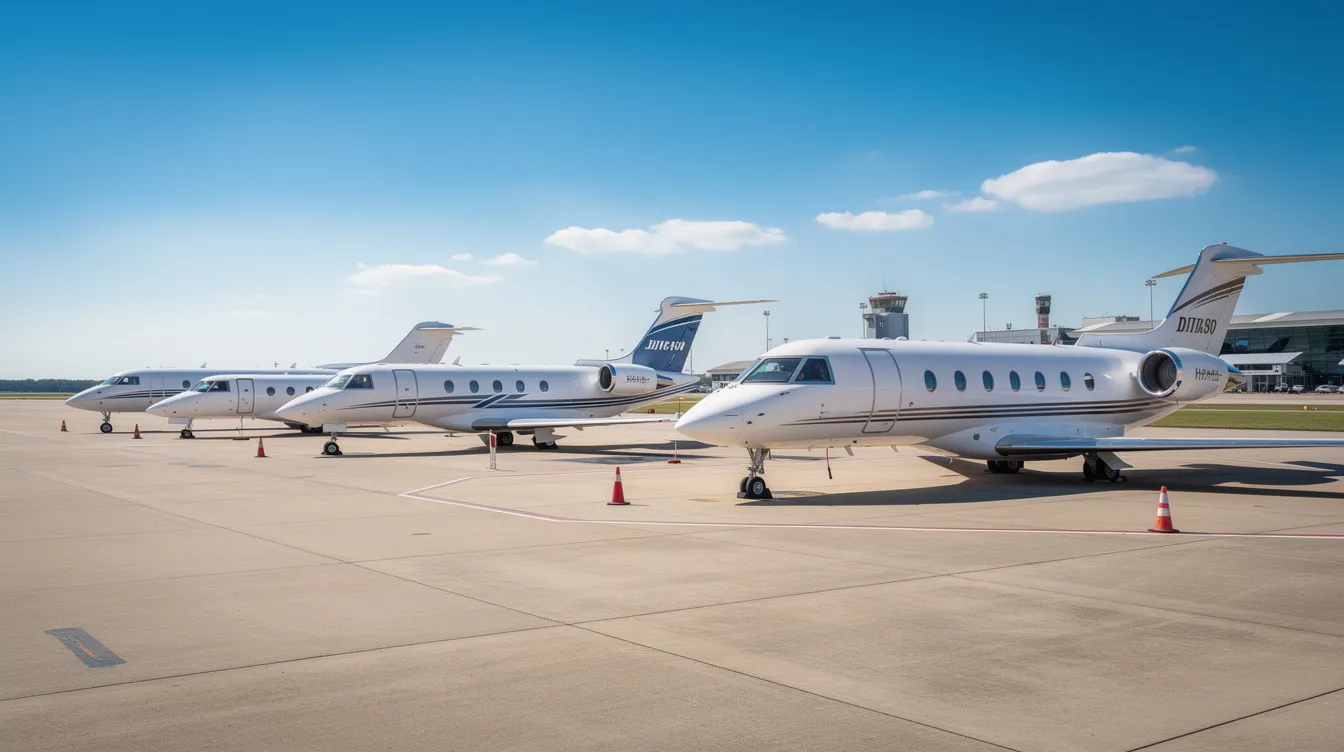
Rather than memorizing spec sheets for every model, it helps to think in categories. Below is a table summarizing typical planning ranges, passenger counts, and sample nonstop routes for each class under average passenger loads and standard weather.
Aircraft Category | Typical Range (nm) | Typical Passengers | Sample Nonstop Routes |
|---|---|---|---|
Turboprops (e.g., PC-12, King Air 350i) | 1,000–1,300 | 4–8 | Los Angeles–Aspen, Dallas–Nashville, London–Geneva |
Very Light/Light Jets (e.g., Phenom 100EV, Citation CJ3+, Learjet 75) | 1,000–1,800 | 2–6 | New York–Miami, Chicago–Denver, LA–Seattle |
Midsize Jets (e.g., Citation XLS+, Hawker 800XP) | 1,740–2,600 | 6–8 | New York–Dallas, LA–Chicago, Toronto–Cancún, London–Marrakesh |
Super Mid-Size Jets (e.g., Challenger 350, G280, Citation Longitude) | 2,600–3,300 | 8–10 | New York–LA, Miami–Seattle, London–Dubai |
Large/Long Range Jets (e.g., G450, Falcon 900LX) | 3,500–5,200 | 10–14 | New York–London, LA–Honolulu, Dubai–London |
Ultra Long Range Jets (e.g., Global 7500, G650ER/G700) | 7,000–7,700+ | 12–19 | New York–Hong Kong, LA–Sydney, London–Buenos Aires, Dubai–New York |
Turboprops are efficient, slower aircraft suited for one- to three-hour regional hops and smaller runways. Their typical range is about 1,000–1,300 nautical miles on a single tank. Sample nonstop routes include Los Angeles to Aspen, Dallas to Nashville, or London to Geneva. For travelers flying 25–75 hours per year on short North American routes, turboprops offer a cost-effective fractional option.
Very light jets typically fly up to 1,200 to 1,600 miles without refueling, making them ideal for two to four passengers on shorter business or leisure trips. Light jets typically fly 1,000 to 2,000 nautical miles and can travel nonstop for about 1,500 to 2,500 miles, covering routes like New York to Miami, Chicago to Denver, or Los Angeles to Seattle. Their high fuel efficiency and lower hourly costs make them attractive for frequent short-haul flyers in BlackJet's Reserve Fleet programs.
Midsize jets balance cabin comfort, speed, and range for six to eight passengers. Midsize jets usually offer a range of 2,000 to 3,000 nautical miles, while in statute miles, mid-size jets usually have a range of 2,500 to 3,500 miles. That covers routes like New York to Dallas, Los Angeles to Chicago, Toronto to Cancún, or London to Marrakesh. Cabin amenities often include standing headroom, an enclosed lavatory, and a work-friendly layout suited for business travelers.
Super mid-size jets hit a sweet spot for eight to ten passengers, combining near-large-jet range with lower operating costs. Super mid-size jets can cover distances of 3,500 to 4,500 miles, or roughly 2,600–3,300 nautical miles nonstop under typical conditions. The Gulfstream G280, for instance, reaches 3,600 nm with four passengers under NBAA IFR reserves.
Concrete city pairs include New York to Los Angeles, Miami to Seattle, or London to Dubai. This category is popular in fractional aircraft ownership for corporations needing frequent coast-to-coast and North America–Caribbean flights.
Large cabin jets add wide, stand-up cabins, more luggage space, and true intercontinental capability for 10–14 passengers. Large jets typically have ranges exceeding 4,000 miles, with long range jets that can exceed 6,000 nautical miles and connect continents with nonstop flights. Sample routes: New York to London, Los Angeles to Honolulu, or Dubai to London.
These business jets are often used by multinational firms and families who regularly cross oceans. Their range compares favorably to many commercial widebody aircraft on similar routes, with none of the connection hassles.
Ultra-long-range jets are designed for intercontinental flights and can exceed 7,000 nautical miles—the pinnacle of what range private jets can achieve. The Bombardier Global 7500 holds the title with up to approximately 7,700 nm and up to 16 hours of flight time under ideal conditions. The Gulfstream G650ER follows closely at around 7,500 nm. Long-range jets can fly approximately 7,700 nautical miles nonstop, and long-range jets can fly nonstop over thousands of nautical miles.
Sample one-leg routes: New York to Hong Kong, Los Angeles to Sydney, London to Buenos Aires, or Dubai to New York. Cabin zoning—dedicated bedroom, office, and dining area—supports true "boardroom-to-bedroom" schedules for BlackJet's most demanding clients.
Real-world nonstop ranges are always planned conservatively for safety, fuel reserves, and contingencies. Here is how common routes match up to aircraft categories:
Route | Distance (nm) | Minimum Category for Nonstop |
|---|---|---|
New York → Los Angeles | ~2,150 nm | Super midsize jet |
New York → London | ~3,000 nm | Super midsize/large cabin jet |
London → Dubai | ~3,000 nm | Super midsize/large cabin jet |
Los Angeles → Sydney | ~6,500 nm | Ultra-long-range jet |
New York → Hong Kong | ~7,000 nm | Ultra-long-range jet |
Nonstop flights reach the destination without any stops, while direct flights may touch down but don't require changing planes. Direct flights still offer a one-ticket ride despite stops.
It is worth understanding that nonstop flights reach the destination without any stops, while direct flights may touch down but don't require changing planes. Direct flights still offer a one-ticket ride despite stops. Nonstop flights are ideal for time-sensitive itineraries, and private jet travelers who prioritize eliminating stops should match their flight time needs to the right aircraft category.
True ultra long haul legs over 14–15 hours generally require ultra long range jets or VIP airliner configurations. BlackJet's operations team performs route-specific analysis rather than relying on brochure numbers when scheduling long missions.
Occasional fuel stops are normal on long missions and usually far less disruptive than airline connections. A typical fuel stop adds about 45–60 minutes: 20–40 minutes of refueling plus taxi and climb-out. During the stop, passengers can stretch, use private airports' facilities, make calls, or refresh catering, especially when they are flying within flexible floating fleet fractional ownership structures.
A light jet flying private from New York to Los Angeles might add a single fuel stop in the Midwest yet still beat commercial door-to-door timing thanks to departures from private terminals with no security lines. Fuel stops are strategic opportunities, not deal-breakers—especially when using smaller aircraft to keep ownership or membership costs manageable for an efficient journey.
How far can private planes fly compared with commercial airliners? Many widebody commercial airlines operate aircraft with ranges of roughly 6,000–8,500 nautical miles, while ultra-long-range private jets sit in the 7,000–7,700+ nm band. VIP airliner variants (like Boeing Business Jet configurations) can exceed even that.
The meaningful difference is not just flight range—it is access. Private jets carry fewer passengers, enabling tailored routes, point-to-point service, and access to thousands of private airports that commercial traffic never reaches. For most business and personal missions under 10 hours, modern long range business jets provide range comparable to or better than scheduled airlines, with dramatically less time lost to connections, security, and commercial traffic congestion.
Mission profile—not headline range—should drive aircraft selection. Here is a framework:
Use Case Framework:
Regional executives (1–2-hour legs): Light jets or turboprops handle routes like New York to Toronto or Dallas to Houston. Low hourly costs and access to smaller runways add flexibility.
US- or Europe-based firms (3–5-hour legs): Midsize or super-midsize jets cover Chicago to San José (Costa Rica) or London to Istanbul nonstop with room for a productive cabin.
Transatlantic-heavy users (6–8-hour legs): Large cabin and long-range jets handle New York to London or Miami to Paris with impressive range and full in-flight productivity.
Global operations (10–15+ hour legs): Ultra-long-range jets serve Los Angeles to Shanghai or Dubai to New York, where nonstop capability is mission-critical.
Fractional jet ownership allows clients to align their chosen aircraft share—and its long-range capabilities—with actual annual travel patterns, avoiding overbuying capability they rarely use, especially once they understand key fractional jet ownership terms and concepts.
Owners cannot change the hard limits of design and fuel capacity, but operators can improve effective range through smarter planning. BlackJet and similar operators apply these tactics behind the scenes for every long-range fractional and membership private flight.
Carefully managing passenger count, baggage, and optional equipment keeps weight down and range up. For marginal nonstop legs, limiting oversized cargo or redistributing more passengers between multiple aircraft in a fleet can make the difference. On some ultra-long missions, operators may recommend leaving one or two seats to carry fewer passengers to achieve true nonstop capability.
Advanced flight planning tools analyze winds, temperatures, and restricted airspace to find the most fuel-efficient routing. Sometimes a slightly longer ground track with stronger tailwinds actually reduces total flight time and fuel burn. Step climbs to higher altitudes as the aircraft gets lighter are standard for improving fuel efficiency on long legs. Strategic flight planning can optimize fuel-efficient routes and shave meaningful time off long-haul flights.
Flying slightly slower than maximum cruise speed—at long-range cruise settings—can add several hundred nautical miles of range. Reducing Mach from 0.90 to 0.85 in a larger aircraft may extend endurance by up to an hour without increasing fuel consumption. Clients prioritizing nonstop capability over shaving 20 minutes off arrival should discuss preferred speed profiles with their operator. Regular maintenance also improves a jet's operational efficiency, keeping engines and airframes performing at their designed fuel economy.

BlackJet Fractional Jet Ownership specializes in matching clients with aircraft whose range profiles fit real-world travel demands. The two primary models serve different needs:
Equity Fleet: Fractional aircraft ownership with predictable access to specific long-range jets. Ideal for clients who need guaranteed nonstop coverage of core routes year-round.
Reserve Fleet: Flexible pay-as-you-go hours without full ownership costs. Well suited for travelers whose long-haul routes are occasional rather than weekly.
BlackJet helps clients analyze historic flight data—typical stage length, frequency of transcontinental or intercontinental trips, passenger capacity requirements—to right-size aircraft range and share size and decide between fractional jet ownership and membership programs. Corporate users often select super mid-size or long-range jets in the Equity Fleet to cover routes like New York to San Francisco or London to Dubai nonstop year-round.
Additional benefits include potential tax advantages for fractional jet owners in the United States and professional aircraft management, including maintenance programs that keep fuel efficiency and range performance optimized. For a deeper comparison of top fractional programs, BlackJet's advisory team can walk through the specifics.
What is your average leg length in hours and miles?
How often do you cross an ocean?
What is your typical passenger count and baggage volume?
Which departure airports do you use most?
How often is absolute nonstop capability—versus one efficient fuel stop—truly mission-critical?
Sometimes a slightly shorter-range aircraft plus an occasional fuel stop is more economical than buying into ultra-long-range capability you use twice a year. Decision-makers should speak with an aviation advisor at BlackJet to model scenarios (e.g., 50 hours per year on a super midsize versus 75 hours on a midsize) and see the impact on range, flexibility, budget, and available fractional jet ownership financing options.
Modern long-range business jets rival top widebodies. The Bombardier Global 7500 covers approximately 7,700 nm, while a Boeing 787 ranges from roughly 6,000–7,500 nm depending on variant. For most routes, private jet travel offers comparable or superior nonstop capability.
Yes. Super midsize and large cabin jets reliably handle New York to London or Miami to Paris. Transpacific routes like Los Angeles to Sydney require ultra-long-range jets. A private jet charter on these routes eliminates layovers entirely.
The Bombardier Global 7500 holds the record among purpose-built business jets at 7,700 nautical miles. VIP airliner conversions like the Boeing Business Jet 777X can exceed that. Among widely available models, the significant range of the Gulfstream G650ER at 7,500 nm makes it one of the most capable aircraft for long-haul routes.
Not necessarily. While long-range jets eliminate most fuel stops, smaller jets may make efficient technical stops that still save total travel time compared to commercial alternatives with connections. The jet's capabilities and the specific route determine whether a fuel stop is needed.
Brochure figures assume ideal operational factors—standard temperatures, no headwind, light payload. Real-world planning applies conservative margins for safety and regulatory fuel reserves. Operators like BlackJet plan with these margins built in, so clients know exactly how far private jets can fly on any given day.
How far a private plane can fly depends on matching aircraft category, fuel capacity, fuel efficiency, and mission planning to the traveler's actual needs. For most high-net-worth individuals and corporations, the right super midsize, long range, or ultra long range jet connects their most important city pairs nonstop for the majority of the year.
Think in terms of mission profiles rather than headline maximum range alone when evaluating private aviation options. A well-matched aircraft share delivers both the flight distance you need and the cost discipline you expect—without paying for capability that sits idle.
Ready to find the right range for your travel patterns? Visit FractionalJetOwnership.com to schedule a consultation and learn how BlackJet Fractional Jet Ownership can structure a fractional or membership program tailored to your long-distance travel requirements.
