June 24, 2026
Private jet prices can range from $50 million to $500 million or more, depending on whether the aircraft started life as a commercial airliner or rolled off the line as a purpose-built business jet. But who actually buys these planes, and is outright ownership the best way to access the skies? This guide breaks down the most expensive private planes in 2026, what drives their staggering costs, and why fractional aircraft ownership is emerging as the smarter path for most serious travelers.
The most expensive private plane in 2026 remains the U.S. presidential Boeing 747-200B (Air Force One), valued at around $660 million when specialized systems are included. The most expensive aircraft in strictly private hands is a custom Airbus A380 modified for roughly $600 million for Saudi prince Al Waleed bin Talal.
The purchase price is only the starting point. Boeing Business Jets and Airbus corporate jets can add $100–200 million in bespoke interiors, and widebody VIP aircraft require $8–12 million per year to operate.
Ultra-long-range business jets like the Bombardier Global 8000, Bombardier Global 7500, Gulfstream G700, and Dassault Falcon 10X deliver intercontinental range and exceptional comfort at far lower ownership costs.
Luxury private aviation encompasses fractional ownership and shared-use programs. BlackJet Fractional Jet Ownership provides access to modern, expensive jets without tying up $50–$500 million in a single aircraft. Fractional ownership suits travelers needing 25–150 flight hours annually.
The rest of this article compares headline-grabbing mega jets with practical high-end business jets and shows how fractional aircraft ownership can replicate the experience more efficiently.
Air Force One, currently based on two Boeing 747-200B airframes designated VC-25A, is widely cited as the most expensive plane operating as a VIP aircraft anywhere in the world. Each airframe carries a unit cost of approximately $325 million before factoring in hardened communications, an anti-missile system, EMP protection, and medical suites. Once those classified modifications are included, the per-aircraft program value is often estimated at $660 million or more. Air Force One costs $660 million under this expanded accounting.
While Air Force One is technically a state aircraft operated by the U.S. Air Force rather than a private jet, it is consistently ranked as the most expensive aircraft in VIP service because of its unique security and communications mission. The ongoing VC-25B replacement program, based on the Boeing 747‑8 airframe, has a forecast budget approaching $5.7 billion for two aircraft through fiscal year 2031, pushing the effective per-unit cost well above $600 million after conversion.
For strictly private ownership, the most expensive individual completion is the custom Airbus A380 commissioned by Saudi prince Al Waleed bin Talal of Kingdom Holding. The aircraft was initially purchased as a green airframe for approximately $400 million, with VIP interior work pushing the total to an estimated $600 million. The Airbus A380 was modified for $600 million, earning it the nickname "flying palace." Reports indicate plans for four private guest rooms, a prayer room designed to face Mecca, children's playrooms, a Turkish bath, and even a built-in garage for a diamond-encrusted Rolls-Royce. The exact price remains partially unconfirmed, and some sources note the aircraft was never fully delivered in its planned VIP configuration.
It is worth noting that base list prices for widebody airliners-Airbus A380, Boeing 747‑8, Airbus ACJ350, Boeing 787‑8-are just the starting point. Interior completion, security, and technology can add $100 million or more to any of these platforms.
Below is a walk-through of the current top tier of the most expensive private jets and VIP aircraft in 2026. Major luxury private jets are often based on converted commercial airliners, and private jet prices reflect both the green airframe and the bespoke work layered on top. Massive cabin space in luxury private jets may exceed 3,000 square feet in the largest widebody conversions.
Airbus A380 Private/VIP - The A380 project for Al Waleed represents the most expensive jet in private aviation history at approximately $600 million all-in. The cabin accommodated a lavish interior with private bedrooms, a dining room, a cinema room, and a conference room across two full decks. Typical ownership profile: a royal private jet or sovereign wealth principal from the Middle East, with this luxury jet tailored for an individual buyer.
Boeing 747‑8 VIP - The Boeing 747- 8 VIP carries a green airframe list price of roughly $367 million. The Boeing 747-8 VIP has nearly 4,600 square feet of cabin space. Add $100–150 million for VIP interiors, and the total reaches $450–520 million. Boeing Business Jets provide massive customizable spaces for private offices, a master bedroom, and a full galley. Owners are typically heads of state or the richest people in the world, though it can also be configured for a private owner.
Airbus ACJ350 XWB - Green airframe cost starts around $326 million. The Airbus ACJ350 costs $326 million before completion. The Airbus ACJ350 XWB offers over 2,800 square feet of usable cabin space, with VIP completion pushing totals to $400–500 million. Typical buyers include sovereign flight departments and ultra-high-net-worth families.
Boeing 787‑8 BBJ - The Boeing 787-8 BBJ is priced at $324.6 million in a standard Boeing BBJ configuration. Premium interiors and mission systems bring all-in costs to the mid-$300 million range. A practical choice for governments and corporations needing a balance of range, comfort, and operating efficiency compared to other planes.
Boeing 747‑430 (Sultan of Brunei) - Reported at roughly $220–230 million with an exceptionally lavish interior featuring gold-finished fixtures and bespoke cabinetry throughout. This expensive plane sits among the most famous royal aircraft ever commissioned.
Airbus A340‑300 (Alisher Usmanov) - Cited at $238 million base with rumors of $350–500 million after VIP completion, making it one of the most expensive private jets for sale in its era.
Airbus ACJ319neo / ACJ320neo Family - Around $100–120 million, including a typical corporate interior, these are the entry point for narrowbody VIP airliners and the most common "big-cabin" choice among corporate flight departments.
These are ultra-rare, bespoke aircraft-one-off builds or very small fleets used as flying residences or diplomatic platforms. Very few private jet owners actually buy or operate them because of the extreme annual running costs.
The distinction between converted airliners and clean-sheet business jets is critical. Purpose-built aircraft dominate the global private aviation market because they offer intercontinental capability without the operational overhead of a widebody. Ultra-long-range jets can fly intercontinental routes exceeding 7,500 nautical miles, covering virtually any city pair nonstop. These longer-range jets represent the real-world top tier for corporate and personal air travel.
Bombardier Global 8000 - Priced around $80 million and equipped with the industry's fastest cruise speed at Mach 0.94 and a range of 8,000 nautical miles. The Bombardier Global 8000 maintains a cabin altitude of just 2,900 feet-the lowest cabin altitude in production. A four-zone cabin suits global CEOs and family offices who need to fly nonstop between continents.
Bombardier Global 7500 - Approximately $75–80 million new, with four true living zones, zero-gravity Nuage seats, and a range of roughly 7,700 nautical miles. The Bombardier Global Express lineage positions this aircraft as a favorite among frequent international business travelers.
Gulfstream G700 - Listed at $75–85 million depending on outfitting. The Gulfstream G700 features up to five distinct cabin zones, a cabin length of 56 feet, and a range of about 7,750 nautical miles. Annual operating costs for a Gulfstream G700 are $3–4 million. Typical users: Fortune 100 executives and tech founders. Learn more about the G700 through fractional ownership.
Dassault Falcon 10X - Projected around $75 million, offering the widest cross-section in business aviation, large windows, and French-designed interiors. The Dassault Falcon tri-jet heritage also gives the 10X exceptional short-field performance.
Gulfstream G650ER - Around $70 million with approximately 7,500 nautical miles of range. Iconic status among billionaires and heads of state. See a full breakdown of the Gulfstream G650 price.
Dassault Falcon 8X and Falcon 7X - Approximately $60–65 million and $50–55 million, respectively- have a tri-jet design with shorter runway performance for accessing challenging airports.
Embraer Lineage 1000E - Around $50 million, based on the Embraer 190, with up to 1,600 square feet of cabin space across five zones. The Embraer lineage appeals to private owners who want airliner-size volume in a purpose-built platform.
Most BlackJet Fractional Jet Ownership clients fly on this category of aircraft-Global series, Bombardier Challenger models, Falcons, and high-end Gulfstreams-through fractional or membership-style access rather than acquiring whole aircraft outright, similar in spirit to other top fractional jet ownership programs in the market.
The sticker price on a Boeing business jet or Airbus corporate jet is only the beginning. Customization of private planes can add high costs, and several factors compound to create nine-figure totals.
Base Airframe Cost - Widebody platforms range from $225 million (Boeing 787-8) to $400 million (Airbus A380). Top business jets start around $50 million and reach $80 million or more when fully equipped. Private planes are expensive due to high acquisition costs and specialized crew requirements.
Interior Completion - VIP completions at leading houses easily cost $80–150 million for widebodies. Interior customization on widebody jets can exceed $50 million even for modest configurations. Custom interiors can include high-cost materials and bespoke designs-marble, hardwood, gold detailing, and custom cabinetry. Customization features in private jets can include master bedrooms and conference rooms.
Technology and Security - Specialized technology and safety features significantly increase the cost of private planes. For head-of-state jets, hardened structures, encrypted communications, anti-missile system integration, and medical suites can add hundreds of millions of dollars in specialized equipment. The VC-25B bridge aircraft alone requires an estimated $400 million just for modification.
Engine and Certification Costs - Engine costs significantly affect private jet pricing due to specialized maintenance requirements. Additional engineering for custom floor plans, gyms, Turkish bath installations, showers, and multi-deck layouts triggers stress analysis and regulatory approvals that extend timelines by two to four years.
Opportunity Cost - Tying $300–600 million into one aircraft carries a meaningful financial weight compared with fractional jet ownership or reserve-style access programs.
Beyond acquisition, ongoing costs often surprise even wealthy buyers. Ownership of private jets incurs high operational expenses without sharing costs with commercial flights. Private jets require ongoing expenses for maintenance, crew, and fuel year after year.
Fixed Annual Costs include crew salaries, training, hangarage, insurance, and regulatory compliance. Annual fixed costs for widebody jets can reach $8–12 million. For ultra-long-range business jets like the Global 7500, G700, or Falcon 10X, annual costs run $3–4 million when flown 300–500 hours per year.
Variable Operating Costs cover fuel, landing fees, catering, and ground support. Fuel burn for a Boeing 747-8 VIP or Airbus A380 dwarfs that of a Dassault Falcon or Bombardier Global. A transatlantic flight on a Global 8000 costs $50,000–70,000 in direct operating expenses. Charter rates for ultra-long-range jets run $12,500–$18,500 per hour in 2026.
Maintenance and Upgrades - Heavy checks and avionics upgrades (ADS-B, Ka-band connectivity, cabin refurbishments) add further unpredictable costs, particularly for large airliners with complex airframes.
While a Boeing 747-8 VIP may be the most expensive private plane to own and operate, ultra-long-range business jets offer roughly 80–90% of the comfort at a fraction of the annual cost. Private jet ownership is economical above 400–500 flight hours annually; below that threshold, many corporations and family offices now view full ownership as inefficient compared to flexible access solutions and instead evaluate fractional jet ownership as an investment in predictable access and cost control.
The ultra-rare, nine-figure aircraft that dominate headlines are owned by a narrow segment of the world's population. These expensive private jets serve very specific missions, and for those accessing them through shared structures, understanding liability coverage in fractional jet ownership is critical to managing legal and financial risk.
Heads of State - Air Force One and similar presidential aircraft function as flying command centers with security, communications, and range requirements that justify a cost upwards of half a billion dollars. These are the most expensive jets in government service.
Royal Families - The Saudi royal family and Bruneian royals operate customized Airbus A380S, Boeing 747-400/747-8 VIP fleets, and Airbus A340 aircraft. Middle East royal households also maintain fleets of practical business jets-Gulfstream, Dassault Falcon, and Bombardier Global Express models-for shorter regional missions.
Global Billionaires - Some of the richest people in the world have famously operated Boeing 757s, 767s, and 747s with lavish interiors. Many have gradually shifted toward more efficient types like the Gulfstream G650ER, Bombardier Global 7500, and Embraer Lineage for flexibility and access to smaller airports. Even the Gulfstream III, valued at $125 million in VIP configurations for certain historic owners, has been eclipsed by modern alternatives.
Technology and Finance Leaders - Tech founders and private equity executives typically opt for purpose-built ultra-long-range business jets, balancing image, performance, and cost rather than operating widebody airliners.
Entertainment and Sports - High-profile entertainers and team owners prefer luxurious private jets in the large-cabin business jet category-Gulfstream G650ER, Bombardier Challenger, Dassault Falcon 7X/8X-with personalized interiors but not necessarily the most expensive aircraft.
Throughout, the majority of real-world private aviation movements are flown by smaller, high-efficiency business jets. Structures like fractional jet ownership make top-tier business jets accessible without buying a $70 million airplane outright.
What justifies paying $60–80 million for a business jet is the cabin environment, comfort, wellness, and productivity at 45,000 feet. Luxury jets often include state-of-the-art communication and safety systems as standard.
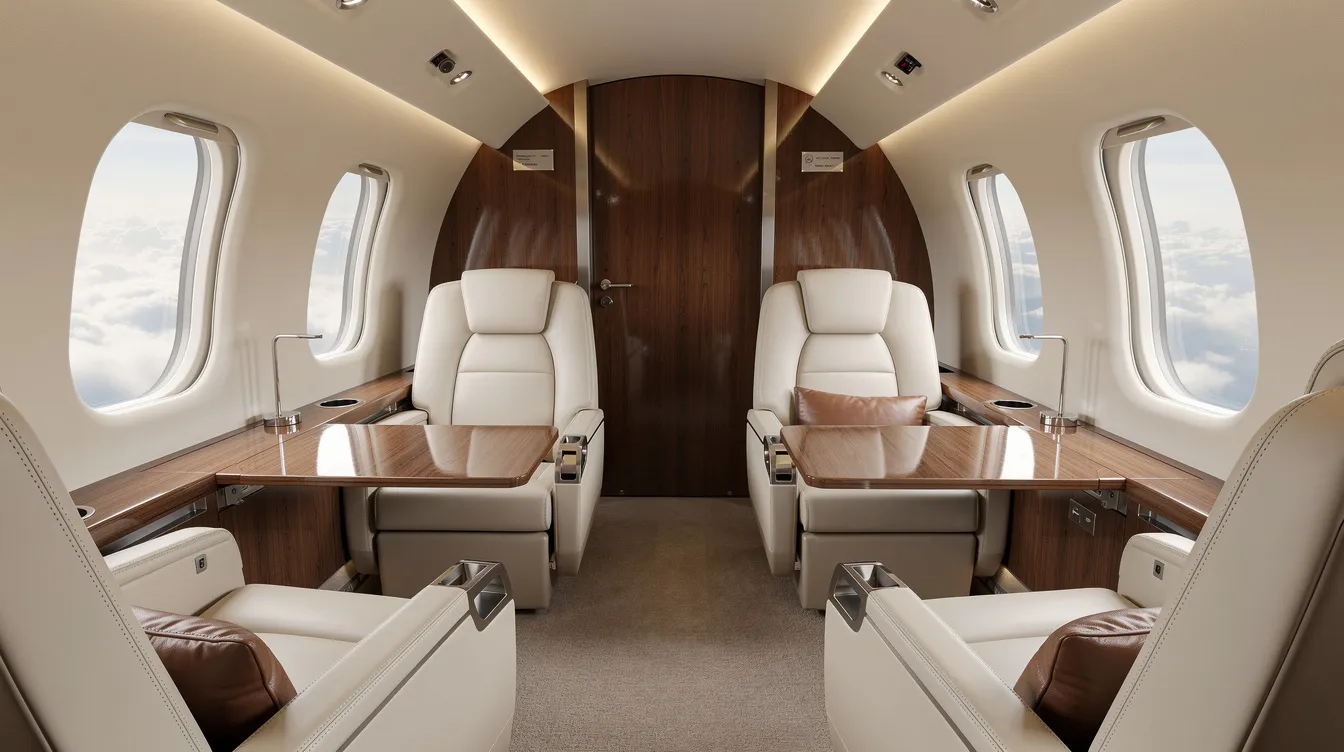
Cabin Layout and Volume - Four- and five-zone layouts in the Bombardier Global 7500/8000, Gulfstream G700, Dassault Falcon 10X, and Embraer Lineage deliver dedicated master bedrooms with fixed beds, shower-equipped lavatories, private offices, a dining area, and a full galley. The cabin space in these jets rivals a small apartment.
Cabin Altitude and Air Quality - The lowest cabin altitude in production is around 2,900 feet on the Global 8000, reducing jet lag and improving hydration on long flights. These are the attributes that matter most to frequent flyers seeking ultimate luxury through performance rather than ornamentation.
Lighting and Noise - Circadian lighting systems adjust to destination time zones. Noise levels in the quietest business jets fall below 50 dB, comparable to a quiet living room, making productive work and restful sleep genuinely possible in flight.
Connectivity and Technology - Ka-band and emerging Starlink-type connectivity provide video conferencing, VPN, and streaming across oceans. Integrated cabin management systems control shades, temperature, lighting, and entertainment via smartphones.
Design and Materials - Hand-stitched leathers, stone countertops, carbon-fiber accents, and bespoke furniture create an aesthetic similar to a penthouse or superyacht.
Operational Performance - Short-field capability on Dassault Falcon jets and crosswind performance allow access to secondary airports closer to city centers, a practical advantage over large VIP airliners.
BlackJet Fractional Jet Ownership typically sources aircraft with many of these attributes, especially in its Equity Fleet, so clients experience ultra-luxury business jets without full ownership, while certain programs also leverage floating fleet options in fractional ownership to increase availability and efficiency.
Rather than asking "How do I buy the most expensive private plane?" many sophisticated travelers ask a different question: "How do I get the capabilities of a top-tier business jet without the full cost, risk, and logistics?" Fractional ownership allows shared access to private jets, and fractional jet ownership reduces hassle compared to full aircraft ownership by standardizing concepts like ownership shares, hourly allotments, and management fees.
Equity Fleet (Fractional Jet Ownership) - A client purchases a share in a specific aircraft type (e.g., Bombardier Challenger, Global, or comparable large-cabin business jets). Equity Fleet offers fractional ownership with tax benefits, including potential U.S. depreciation advantages (consult a tax professional and review the broader tax implications for fractional jet owners). Clients enjoy the capabilities of an expensive jet range, cabin comfort, connectivity, with costs aligned to actual usage.
Reserve Fleet (Membership / Pay-as-You-Go Hours) - Reserve Fleet provides flexible pay-as-you-go hours. No equity purchase required; clients buy blocks of hours with guaranteed access to a curated fleet at transparent hourly rates. Ideal for those testing private aviation or avoiding long-term balance-sheet commitments.
Key advantages versus whole ownership—and understanding the total cost of fractional jet ownership:
No need to invest $30–80 million (or more) in a single business jet
No responsibility for crew hiring, training, hangar negotiations, or complex maintenance
Predictable hourly pricing with BlackJet handling repositioning and regulatory compliance
Fractional ownership offers greater predictability in aircraft type and availability, and potential tax benefits, than occasional charter, while jet membership programs emphasize flexibility and lower upfront commitments. Jet card programs and membership work best for flexible travelers who still want guaranteed service levels. Explore how fractional ownership compares to charter for a detailed breakdown.
This section serves as a decision guide for executives, family offices, and HNW individuals who fly regularly but may not need a bespoke A380 or 747-8 VIP.
Owning a Large VIP Airliner (747-8, A380, ACJ350, BBJ 787-8) - Advantages include unmatched space, prestige, and full design control. Drawbacks: extreme capital outlay, limited airport options, $8–12 million annual fixed costs. Best suited for heads of state or individuals flying large entourages globally.
Owning a Top-Tier Business Jet (Global 8000, G700, Falcon 10X, Global 7500) - Advantages include intercontinental range, relatively lower operating costs, and access to smaller airports. Drawbacks: $60–80 million purchase price, $3–4 million annual fixed costs. Best suited for corporations and individuals flying 400–500 hours per year. Learn more about the types of private jets and prices.
Fractional Jet Ownership or Membership (BlackJet Models) - Advantages: access to modern business jets with a fraction of the capital, no aircraft management burden, and clear visibility into the total cost of fractional jet ownership. Drawbacks: no exclusive paint or full-time control of a single tail number. Best suited for clients flying about 25–150 hours per year.
Consider a U.S.-based CEO flying 80 hours per year between New York, Los Angeles, and Europe-they are usually better served by a fractional share in a Global 7500 or Challenger via BlackJet than buying a $75 million jet. A family office with multiple principals traveling globally might combine an Equity Fleet share with Reserve Fleet hours to adapt to variable schedules.
The most expensive private plane is rarely the optimal solution. Effective private aviation is about fitting aircraft capability and access model to actual travel patterns.
These frequently asked questions address topics not fully covered above, especially around costs, accessibility, and fractional ownership, including key contract terms in fractional jet ownership that new buyers should understand, as well as how a well-drafted aircraft fractional ownership sample contract structures rights, responsibilities, and risk sharing among co-owners.
Air Force One, currently based on the Boeing 747-200B with VC-25B 747-8 successors in development, is consistently cited as the most expensive VIP aircraft, with per-aircraft program costs estimated at Air Force One, currently based on the Boeing 747-200B with VC-25B 747-8 successors in development, is consistently cited as the most expensive VIP aircraft, with per-aircraft program costs estimated at around $660 million or more.
Aircraft Model | Estimated Purchase Price (million dollars) | VIP Interior & Customization Cost (million dollars) | Total Estimated Cost (million dollars) | Cabin Space (square feet) | Typical Owner Type |
|---|---|---|---|---|---|
Air Force One (Boeing 747-200B) | 325 | 335 | 660 | ~4,000 | U.S. Government (President) |
Airbus A380 VIP | 400 | 200 | 600 | ~5,000 | Saudi Royal Family |
Boeing 747-8 VIP | 367 | 100-150 | 450-520 | ~4,600 | Heads of State / Ultra-HNWIs |
Airbus ACJ350 XWB | 326 | 74-174 | 400-500 | ~2,800 | Sovereign Flight Departments |
Boeing 787-8 BBJ | 324.6 | 25-75 | 350-400 | ~2,400 | Governments / Corporations |
around $660 million or more. However, it is not a private jet in the commercial sense; it is operated by the U.S. Air Force for the President and functions as an ultra-secure flying office and residence. For strictly private ownership, the most expensive individual completion remains the custom Airbus A380 built for a Saudi royal family member.
In theory, individuals or corporations can acquire used Airbus A380S or Boeing 747-8s and convert them to VIP use, but the market is extremely limited, and completion slots are scarce. The cost of stripping and refitting a used widebody to VIP standard can still exceed $150–200 million on top of acquisition and may take several years. Most buyers now choose purpose-built long-range business jets-Global 7500, G700, Falcon 10X-for a better balance of economics and airport access.
Ultra-long-range business jets (Global 7500/8000, G700, Falcon 10X) often cost $3–4 million per year in combined fixed and variable expenses when flown around 400–500 hours annually. Costs include crew, hangarage, maintenance programs, insurance, and fuel. Widebody VIP aircraft can easily double or triple those figures. BlackJet can help clients model these costs versus fractional jet ownership or Reserve membership using their actual travel patterns, including guidance on fractional jet ownership financing where appropriate.
A Boeing Business Jet (BBJ) refers to Boeing airliner platforms (737, 757, 767, 787, 747-8) configured as corporate or VIP aircraft with custom interiors. A typical business jet, such as a Bombardier Challenger, Global Express, Gulfstream, or Dassault Falcon, is designed from the ground up for private aviation with smaller cabins but much lower operating costs and better access to smaller airports. Many high-profile owners operate both types: BBJs for large delegations and business jets for day-to-day air travel.
Fractional aircraft ownership through a provider like BlackJet requires a fraction of the capital outlay (you buy a share, not the whole jet), includes professional aircraft management, crew, and scheduling, and delivers predictable access to a modern fleet of business jets at a cost aligned with 25–150 annual flight hours. Full ownership makes the owner responsible for acquisition, financing, staffing, hangarage, maintenance, and remarketing, which only makes sense above certain usage thresholds. Visit FractionalJetOwnership.com to explore whether a share in a Bombardier Global, Challenger, Dassault Falcon, or similar jet fits your travel profile, and how to exit or sell your fractional jet ownership share if your needs change.
The most expensive private planes in the world are remarkable feats of engineering, but most discerning travelers are better served by efficient, well-managed access to top-tier business jets. Evaluate your annual flight hours, typical routes (domestic U.S., transatlantic, transpacific), and cabin preferences before committing hundreds of millions to a single airframe.
BlackJet can source Bombardier Global, Bombardier Challenger, Dassault Falcon, and comparable aircraft tailored to your profile-without requiring investment in an Airbus A380 or Boeing 747- 8BlackJet can source Bombardier Global, Bombardier Challenger, Dassault Falcon, and comparable aircraft tailored to your profile-without requiring investment in an Airbus A380 or Boeing 747-8 VIP. These major luxury private jets are often based on converted commercial airliners, providing massive customizable spaces for luxury interiors. For example, the Boeing 747-8 VIP offers nearly 4,600 square feet of cabin space, while the Airbus ACJ350 XWB provides over 2,800 square feet of usable cabin space. Customization features in private jets can include master bedrooms, conference rooms, and bespoke designs using high-cost materials. Luxury jets also integrate state-of-the-art communication and safety systems, contributing to the high costs of ownership.
Private jet prices range widely, from $50 million for purpose-built business jets to $500 million or more for extensively customized widebody aircraft like the Airbus A380, which was modified for approximately $600 million and includes unique features such as a Turkish bath with gold-plated finishes. Ultra-long-range jets such as the Bombardier Global 8000 maintain a cabin altitude as low as 2,900 feet, enhancing passenger comfort on intercontinental routes exceeding 7,500 nautical miles. The Gulfstream G700 stands out with up to five distinct cabin zones and annual operating costs between £3-4 million, while annual fixed costs for widebody jets can reach £8-12 million.
Ownership of private jets entails high operational expenses, including specialized crew, maintenance, and fuel, with engine costs significantly impacting pricing due to stringent maintenance requirements. A transatlantic flight on a Global 8000 can cost between £50,000 and £70,000 in direct operating expenses. Interior customization on widebody jets can exceed £50 million, reflecting the extensive investment in luxury and technology. Private jet ownership typically becomes economical above 400-500 flight hours annually.
For many travelers, fractional ownership presents a smarter alternative, especially once they understand the complete cost of fractional jet ownership compared with full ownership and charter. BlackJet's Equity Fleet offers fractional ownership with priority access and potential tax benefits for jet share owners, ideal for those flying 25–150 hours per year. The Reserve Fleet provides flexible pay-as-you-go hours without ownership costs, allowing clients to enjoy luxury private aviation with greater financial and operational flexibility. Fractional ownership combines access to ultra-luxury aircraft with reduced capital commitment, making it a practical solution for discerning travelers seeking the benefits of private jet ownership without the full burden of cost and management; for example, 1/8th fractional jet ownership can provide around 100 hours of annual flight time for frequent travelers. VIP. BlackJet serves both U.S.-based and international clients who need reliable access to business jets across North America and key global markets.
Ready to explore the smarter way to fly private? Visit FractionalJetOwnership.com to access guides on fractional jet ownership, private aviation cost breakdowns, and to schedule a confidential consultation.
