July 11, 2026
The choice between whole aircraft ownership and fractional ownership comes down to four numbers you can measure: how many hours you fly, how much control you need over the asset, how much financial risk you can absorb, and how fast you might want to exit. This guide treats the decision like a capital allocation problem, not a brochure comparison. You get a cost framework, a control and risk scorecard, a reproducible break-even method, and a contract-first checklist you can use on your first call with any provider. Fractional ownership, jet cards, private jet charter, and whole aircraft ownership each win under different conditions, and the goal here is to show you exactly when.
Written by the FractionalJetOwnership.com advisory team and reviewed by aviation ownership and finance advisors. Last reviewed Jul 11, 2026.
FractionalJetOwnership.com is an independent educational resource, not a fractional program seller. We issue no rankings and no endorsements, and we do not provide individualized financial, legal, or tax advice. Provider examples appear for context only. Verify every figure against provider contracts and disclosures.
Start with your annual flight hours. If you fly under about 25 hours a year, on-demand private jet charter usually wins since you pay per trip with no capital tied up. Between roughly 25 and 75 hours, a jet card or a small fractional share becomes worth modeling. Past 75 hours, fractional ownership starts to spread its fixed costs efficiently. Above 200 hours, price whole aircraft ownership against a quarter share and see which structure your utilization actually rewards.
Charter is usually the lowest-commitment way to fly private since you pay per trip with no capital tied up. Fractional ownership adds an up-front share purchase plus monthly management fees and an occupied hourly rate, so it tends to win only when you fly enough hours each year to spread those fixed costs.
Fractional jet ownership is a shared ownership model where multiple owners each purchase a percentage interest in a private aircraft and receive a fixed number of annual flight hours proportional to their share size. Common shares run 1/16, 1/8, and 1/4, mapping to roughly 50, 100, and 200 annual flight hours, with contracts that commonly run three to five years. Our explainer on fractional ownership basics covers the mechanics in depth.
Here is how the four access models line up:
Private jet charter is trip-by-trip booking at market pricing, no capital, highest flexibility.
Jet card is prepaid or subscription access with no equity, typically a higher per-hour rate than a fractional contract, yet often cheaper at low annual hours since it carries no monthly management fees.
Fractional ownership gives you a share size with fixed annual hours and contract-driven access; costs stack as acquisition plus monthly plus occupied hourly rate.
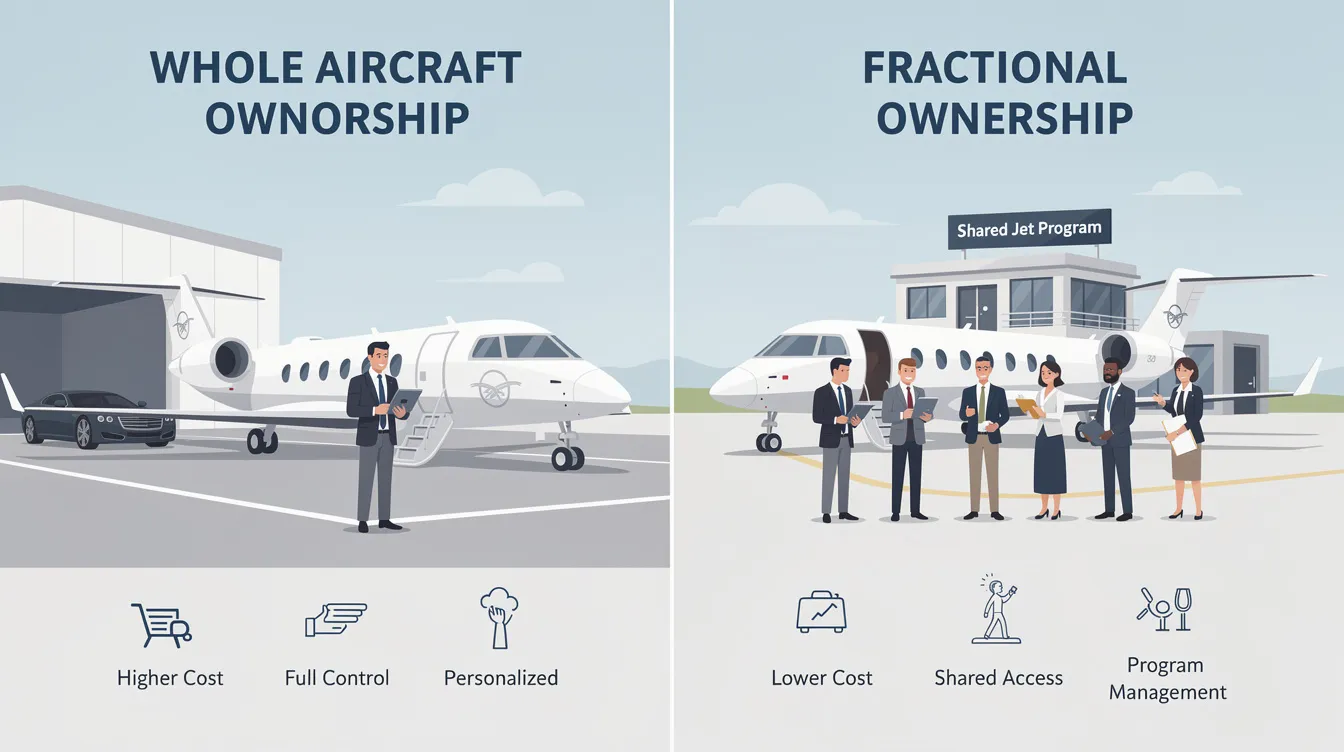
Whole aircraft ownership means 100% ownership, maximum control, and full exposure to depreciation and operating complexity.
Model | Up-front capital | Fixed monthly fees | Variable per-hour fees | Availability | Tail control | Exit/liquidity risk |
|---|---|---|---|---|---|---|
Charter | None | None | Per-trip market price | Market-driven | None | None |
Jet card | Prepaid deposit | None | Fixed/semi-fixed hourly | Contracted, peak rules apply | None | Low (unused funds) |
Fractional | Share purchase | Monthly management fee | Occupied hourly rate | Guaranteed window, 8 to 24 hr notice | Type/class, not your tail | Contract-driven, formula resale |
Whole ownership | Full aircraft price | Crew, hangar, insurance, management | Direct operating cost | Your aircraft, maintenance permitting | Full | Full market exposure |
Providers you will meet include Jettly, BlackJet, Magellan Jets, and Airshare, operating under FAA rules such as Part 91K for fractional programs and Part 135 for charter. If you do not want capital lock-up and multi-year terms, start with charter or a jet card; if you want contract-backed access and fly enough hours to use what you buy, fractional ownership can be the middle ground between pay-as-you-go and whole ownership.
If you only remember one thing, remember that charter and jet cards buy access, and fractional and whole ownership buy a position in an asset. That distinction drives the contract terms, the residual value exposure, and the exit rules.
Fractional jet ownership means buying a percentage share of an aircraft or aircraft category, with that share setting your annual hours, up-front capital, and ongoing costs. Programs may be aircraft-specific (tied to one model for consistency) or category-based (access across similar aircraft for availability).
Whole aircraft ownership means purchasing 100% of an aircraft and taking full responsibility for its operation, staffing, maintenance, and configuration, with complete control over the timing and method of sale.
Private jet charter is trip-by-trip booking with no ownership, priced on market availability, aircraft type, routing, and timing. Charter commonly runs under FAA Part 135. Readers new to this model can start with our plain-English charter definition.
Jet card is a prepaid or subscription program offering fixed or semi-fixed hourly rates, no equity, no resale exposure, and no monthly management fees. On a per-hour basis a jet card often costs more than a fractional contracted rate, yet at low annual hours the all-in number can be lower.
An occupied hour is a billable flight hour during which passengers are onboard; many fractional programs bill occupied time rather than total aircraft positioning time, but extras and minimums vary by contract.
Fleet interchange means you may not fly the exact tail you have an interest in; access is to an aircraft type or performance class within the fleet.
Term | Plain-English meaning |
|---|---|
Occupied hourly rate | The per-hour charge billed when passengers are onboard. |
Monthly management fees | Fixed recurring charges for crew, insurance, hangar, and admin, paid whether you fly or not. |
Block hours | Pre-allocated flight hours tied to your share size. |
Interchange hours | Time deducted from your account when you fly a different category than your share. |
Part 91K | The FAA rule set governing fractional ownership operations. |
Part 135 | The FAA rule set governing on-demand charter operations. |
Business aviation sits inside a well-measured industry, drawing on FAA, state, and NASA surveys, and the sector supports roughly one million jobs, per the NBAA Fact Book. The biggest practical difference is this: charter and jet cards buy access, and fractional and whole ownership buy an ownership position, with contract terms, residual value exposure, and exit rules that can matter as much as the hourly rate. Our aviation terms glossary defines the rest.
Ignore the headline hourly rate until you know which bucket a fee lives in. The FAA organizes aircraft economics into fixed versus variable operating costs in its operating cost guidance, and that split is the cleanest way to compare all four access models.
Most fractional ownership costs fall into three buckets: an up-front share acquisition cost, fixed monthly management fees, and a variable occupied hourly rate billed only when passengers are onboard. The acquisition cost buys your equity share. The monthly fee covers crew, training, insurance, hangar, and administration. The occupied hourly rate covers fuel, routine maintenance, and parts and engine reserves. Extras such as de-icing, international landing and handling fees, peak-day premiums, fuel surcharges, and certain taxes may be billed on top of any quoted "all-in" rate.
A monthly management fee is a fixed recurring charge in a fractional program that helps cover indirect operating costs such as crew staffing, training, insurance, hangar, dispatch, and administration, payable whether you fly or not. That single line item drives most of the break-even math, which is why our management fee guide walks through what belongs inside it.
Whole aircraft ownership carries a longer list: acquisition or financing, depreciation, crew salaries and benefits, maintenance, insurance, hangar, dispatch and management, training, and cabin upgrades. You either run a flight department or hire a management company to do it. Our breakdown of private jet operating cost details each line.
Charter pricing usually bundles aircraft, crew, and standard fees into a trip price, with add-ons for repositioning, overnights, de-icing, catering, international handling, and taxes. A jet card prepays hours at fixed or semi-fixed rates, skips the monthly management fee, and still may apply surcharges and peak-day rules. A domestic Federal Excise Tax of 7.5% applies to many taxable private flights, and confirming whether the Federal Excise Tax is quoted separately is part of comparing any proposal honestly.
"The biggest mistake buyers make is comparing private aviation based on the advertised hourly rate alone. Whether you're evaluating charter, fractional ownership, or whole aircraft ownership, it's the total cost structure, including capital, monthly fees, utilization, and exit value, that ultimately determines which option creates the best long-term value."
- Justin Crabbe, CEO
Cost bucket | Whole ownership | Fractional | Jet card | Charter |
|---|---|---|---|---|
Up-front | Full aircraft price | Share acquisition cost | Prepaid deposit | None |
Fixed monthly | Crew, hangar, insurance | Monthly management fees | None | None |
Variable hourly | Direct operating cost | Occupied hourly rate | Card hourly rate | Trip price per hour |
Per-trip extras | Fuel, fees, taxes | De-icing, peak, intl, taxes | Surcharges, peak rules | Repositioning, overnight, taxes |
Lifecycle/exit | Full market resale | Formula-based resale | Refund of unused funds | None |
For directional 2026 context, the layered-cost analysis published by Jettly illustrates how acquisition, monthly, and hourly figures stack, and how the real number sits well above any single brochure rate. Fractional ownership looks predictable on a per-hour quote, but the total cost is driven by how many hours you actually fly since monthly management fees and depreciation do not stop when you stay on the ground.
When you say you want control, do you mean schedule control, cabin control, crew control, or resale control? Each model answers those differently, and the day-to-day reality matters more than the marketing.
Scheduling. Fractional programs typically offer guaranteed access windows with 8 to 24 hours' notice, depending on terms. Charter availability is market-driven, so short-notice trips can be harder to source at peak times. Whole ownership puts the aircraft at your disposal, though crew duty limits and maintenance windows still apply. BlackJet publishes response-time commitments as one way providers express these notice policies.
Aircraft consistency. Fleet interchange means your fractional access is to an aircraft type or performance class within a provider's fleet, not a guaranteed specific tail number, so the cabin experience can be consistent without being the exact aircraft you partly own.
Customization. Whole ownership lets you configure the cabin. Fractional programs standardize cabins across a fleet, trading personalization for availability.
Operational workload. Whole ownership requires management, in-house or outsourced. Fractional bundles management into the program. Charter and jet cards offload operations entirely. Our guide to how it works maps the scheduling and interchange mechanics behind these claims. Providers like Airshare and Magellan Jets position their offers around exactly these trade-offs.
Control lever | Charter | Jet card | Fractional | Whole |
|---|---|---|---|---|
Scheduling flexibility | Med | Med | High (contract window) | High |
Cabin/customization | Low | Low | Low to Med | High |
Tail consistency | Low | Low | Med (interchange) | High |
Crew consistency | Low | Low | Med | High |
Charter the aircraft out | N/A | N/A | No | Yes |
Control of resale timing | N/A | N/A | Low | High |
Whole ownership gives you the most control over the asset, but fractional ownership often gives you the most predictable access without needing to run a flight department. Peak periods add nuance: many fractional structures prioritize owners over charter clients, though peak-day rules and usage caps can still apply during extreme demand.
The biggest surprises in private aviation are usually contractual, not mechanical. Five risks deserve attention before you sign a multi-year agreement or wire funds for an aircraft.
Capital lock-up. Fractional ownership ties up up-front capital under a fixed term, with exit often available only at maturity and early exits subject to penalties. Capital recovery can be delayed by resale queues and settlement timelines.
Depreciation and residual value. Whole ownership carries full market exposure. Fractional exit value is usually calculated from a provider-defined depreciation schedule rather than open-market pricing, and owners may recover less than their original capital contribution. Industry breakdowns show fractional shares can shed a material portion of value across a multi-year term, a pattern our page on depreciation explained unpacks with real numbers.
Cost escalation. Most fractional contracts include escalation clauses tied to fuel adjustments, labor and training costs, insurance premium changes, and scheduled annual escalators. Over a five-year term those escalators compound.
Availability risk. Charter is market-driven. Fractional access is contractual but subject to peak-day rules. Whole ownership depends on your maintenance downtime and crew availability.
Usage mismatch. Buying too large a share wastes fixed costs on unused access; buying too small forces premium overage hours or frequent upgrades.
Exit friction is the practical difficulty of getting out of an aviation commitment, meaning how long it takes, what fees apply, and whether you can choose your timing, separate from the headline resale price. In fractional ownership, the hardest risk to budget is the exit: the resale price is usually formula-driven and the timing can depend on provider processes and buyer demand, so fractional ownership should not be treated as a liquid investment. Large operators like Jettly and BlackJet, and boutique programs such as Magellan Jets, each define their own buyback and term structures, so read them side by side using our contract checklist.
Risk | Whole | Fractional | Jet card | Charter | Mitigation |
|---|---|---|---|---|---|
Depreciation exposure | Full | Formula-based | None | None | Model low/base/high exit value |
Liquidity/exit timing | You control | Provider queue | Refund unused | N/A | Request buyback terms in writing |
Cost escalation | Direct | Contract escalators | Rate hikes | Market swings | Cap or forecast escalators |
Availability/peak days | Maintenance-limited | Peak caps | Peak rules | Market-driven | Check peak-day calendar |
Provider/program risk | Low | Med | Med | Med | Review financial stability |
Mission mismatch | Med | High | Low | Low | Match category to trip profile |
Reduce every model to one comparable figure: five-year all-in cost divided by total occupied hours. The steps below produce an effective cost per hour you can compare directly, and our charter estimator helps you gather the charter side of the equation.
Convert every model to a five-year total. Add all costs, subtract expected recovery, then divide by five years of occupied hours.
Fractional. (Acquisition cost minus estimated exit value) + (monthly fees x 60) + (occupied hourly rate x hours) + estimated extras and taxes.
Whole ownership. Acquisition or financing + (annual fixed operating costs x 5) + (variable direct operating costs x hours) minus resale proceeds.
Charter and jet card. All-in hourly or trip cost x hours, with realistic repositioning and overnight assumptions.
Break-even hours are the annual occupied flight hours at which the five-year all-in cost per hour of two access models becomes roughly equal after including fixed fees, variable charges, and expected depreciation or exit value. The FAA frames utilization and capacity as the foundation of aircraft economics in its capacity and utilization guidance, which is another way of saying hours-per-year drive the answer.
What moves the break-even: stage length, trip frequency, peak-day travel, interchange multipliers, international flying, and how closely your missions match your owned category. Using directional 2026 inputs from published cost ranges, a typical crossover from jet card to fractional lands somewhere near 50 to 75 occupied hours a year, then shifts as fees and depreciation assumptions change.
"Private aviation should be evaluated like any other capital allocation decision. The smartest buyers don't ask which program is the cheapest, they ask which structure delivers the lowest all-in cost while providing the flexibility, availability, and operational control their business or family actually requires."
- Justin Crabbe, CEO
Annual hours | Charter | Jet card | Fractional | Whole | Notes |
|---|---|---|---|---|---|
Under 25 | Best fit | Possible | Rarely | No | Fixed fees dominate ownership |
25 to 75 | Good | Best fit | Crossover zone | No | Share size decides value |
75 to 150 | Costly | Costly | Best fit | Possible | Spread monthly fees efficiently |
150 to 250 | Costly | Costly | Strong (1/4) | Competitive | Model both carefully |
250+ | Costly | Costly | Approaches whole | Best fit | Control favors ownership |
Break-even is rarely one number. It is a range that shifts with monthly fees, depreciation assumptions, and how often you trigger peak-day or interchange premiums. Fractional ownership often makes financial sense at moderate utilization, but whole aircraft ownership typically becomes competitive only at high annual hours, since the owner can spread fixed staffing and ownership costs across more flights and controls the timing and method of sale.
These scenarios are illustrative only. Pricing and terms vary by provider, aircraft type, and region. Use the calculator below to model your own numbers.
Scenario A, 30 hours a year. Charter or a jet card usually wins. At 30 hours, fixed monthly management fees dominate the fractional math, so the effective cost per hour balloons. For fractional to win here, you would need very high per-trip charter pricing on your routes, a strong need for guaranteed short-notice access, or a plan to grow hours quickly.
Scenario B, 75 hours a year. This is the crossover zone. Share size (1/16 versus 1/8), peak-day behavior, and mission consistency decide the outcome. Unused hours inflate your effective cost, so a slightly smaller share plus occasional overage or charter can beat an oversized share.
Scenario C, 200 hours a year. A 1/4 fractional share can approach whole aircraft ownership economics. Whole ownership may still win on customization, control, and heavy utilization, though it is not automatic; you take on full depreciation and operational responsibility in exchange.
Usage mismatch is the risk that you buy too many fractional hours, and overpay fixed fees for unused access, or too few, and end up paying premium rates for overage hours or frequent upgrades. Share-to-hours norms from BlackJet anchor these scenarios: 1/16 near 50 hours, 1/8 near 100, and 1/4 near 200.
Scenario | Model | Up-front | Fixed annual | Per hour | Effective $/occupied hour |
|---|---|---|---|---|---|
A (30 hrs) | Jet card | Deposit | None | Card rate | Lowest all-in |
A (30 hrs) | Fractional 1/16 | Share | Management fees | Occupied rate | Inflated by fixed fees |
B (75 hrs) | Fractional 1/8 | Share | Management fees | Occupied rate | Competitive if fully used |
B (75 hrs) | Jet card | Deposit | None | Card rate | Close, rate-dependent |
C (200 hrs) | Fractional 1/4 | Share | Management fees | Occupied rate | Approaches whole |
C (200 hrs) | Whole | Aircraft | Crew, hangar, insurance | Direct op cost | Efficient at high use |
The break-even question is not just how many hours you fly. It is how consistently your trips match the aircraft category you are buying, and how often you pay peak-day or upgrade premiums. Layered cost ranges from published 2026 analyses reinforce why fractional ownership fees look modest per hour yet add up across a full term.
Work the decision as a short tree. Start with annual hours, then stage length, then peak-day frequency, then passenger and cabin needs. Each answer narrows both share size and aircraft category.
A fractional share size is the percentage interest you buy, such as 1/16, 1/8, or 1/4, which determines your annual block hours, up-front capital commitment, and your share of fixed program costs.
1/16 share, near 50 hours a year. Entry-level ownership with the lowest capital requirement. Main risk: underutilization plus fixed fees.
1/8 share, near 100 hours a year. A balanced option. Plan for variability by confirming the overage hour price and short-notice rules. Our page on the 1/8 share explained covers the trade-offs.
1/4 share, near 200 hours a year. High utilization, priority access, and a lower effective cost per hour that starts to rival whole ownership.
Many programs let you scale over time by buying additional shares, reducing your share, or transitioning aircraft categories, subject to contract terms. Match the aircraft to the mission first: light jets for short regional hops under three hours, midsize and super-midsize for transcontinental trips, large-cabin and ultra-long-range for intercontinental flying. Booking notice commonly falls in the 8 to 24 hour window.
"Fractional ownership isn't simply about flying more affordably, it's about matching the right ownership structure to your actual travel patterns. The investors who see the greatest value are those who understand their annual utilization, booking habits, and mission profile before signing a multi-year agreement."
- Justin Crabbe, CEO
Share | Typical annual hours | Best-fit utilization | Trade-offs | Surprises to avoid |
|---|---|---|---|---|
1/16 | ~50 | Occasional flyer | Low capital, low hours | Fixed fees on unused hours |
1/8 | ~100 | Regular flyer | Balanced capital and access | Overage rate on peak days |
1/4 | ~200 | Heavy flyer | Priority access, higher capital | Compare against whole ownership |
If you are consistently near 50 hours a year, a 1/16 share can be a logical entry point; if you regularly exceed 100 hours, model whether a 1/4 share or even whole ownership is more efficient over five years.
There is no single best fractional program, only the best fit for your mission and risk tolerance. Providers fall into three broad types: large legacy operators with fleet scale, boutique and mid-sized firms with service customization, and asset-light or managed-fleet structures built for flexibility. Names you will encounter include Jettly, BlackJet, Magellan Jets, and Airshare, listed here as examples, not endorsements.
Compare structure, not branding. Check the access guarantee and notice window, peak-day rules, interchange rules and multipliers, exactly what the hourly rate includes, fuel surcharge mechanics, management fee escalators, contract term length, and the exit or buyback formula and timing.
Ten questions for your first call:
What is the guaranteed notice window, and how many peak days apply per year?
What does the occupied hourly rate include, and what is billed separately?
How are monthly management fees escalated each year?
What is the overage hour price above my allocation?
How do interchange hours work across categories?
What is the exact exit or buyback formula?
How long has capital recovery taken for recent exits?
Is my share aircraft-specific or category-based?
How is the Federal Excise Tax quoted on my flights?
What happens to my hours if I cancel or reschedule?
An interchange multiplier is the extra fractional time you may be charged when you fly a different aircraft category than the one tied to your share, so one hour in a larger jet may deduct more than one hour from your account depending on the program. Paramount Business Jets discusses this conversion concept, and figures vary by program. Provider-stated terms, such as those Magellan Jets publishes, should be read as their own terms rather than universal norms. For a common brand starting point, review our NetJets cost details and a survey of NetJets alternatives.
Criterion | Jettly | BlackJet | Magellan Jets | Airshare | Any provider |
|---|---|---|---|---|---|
Notice window | Check contract | Check contract | Check contract | Check contract | Check contract |
Share sizes | Check contract | From 1/16 | Check contract | Check contract | Confirm hours |
Interchange rules | Check contract | Check contract | Check contract | Check contract | Request matrix |
Exit formula | Check contract | Check contract | Check contract | Check contract | Get in writing |
When comparing fractional providers, the hourly rate is the least informative number until you also compare management fees, escalation clauses, peak-day rules, interchange multipliers, and the exit formula.
Try your numbers. The on-page calculator turns your trip data into a five-year comparison, and here is what you get:
Five-year total cost by model, plus effective cost per occupied hour.
Break-even hours between charter and fractional, and between fractional and whole ownership.
A downloadable CSV and a printable one-page decision summary.
Inputs include annual occupied hours, aircraft category, share size, monthly management fees, occupied hourly rate, estimated extras, expected depreciation or exit value, and peak-day percentage. Every input is editable, and the model publishes the same formula shown above. All-in cost is the total five-year cost of access after adding fixed fees, variable flight charges, and expected depreciation or exit value, rather than focusing on a single hourly rate. This is an educational model built on the FractionalJetOwnership.com structure-over-branding methodology, not real-time pricing. A break-even calculator is only useful if it publishes its assumptions, so this model lets you change fees, depreciation, and peak-day behavior and see how quickly the right answer moves. For the deeper argument, read fractional vs whole ownership.
Model | 5-year total | Effective $/hour | Biggest cost driver |
|---|---|---|---|
Charter | Generated | Generated | Per-trip pricing |
Jet card | Generated | Generated | Card hourly rate |
Fractional | Generated | Generated | Monthly management fees |
Whole | Generated | Generated | Fixed ownership costs |
Before you buy a share or a jet, run these eight steps. Decision-grade means you can explain the choice with numbers and contract terms, not just preferences, so you can defend it to stakeholders and revisit it as your travel changes.
Step | What to do | What you learn | Common mistake |
|---|---|---|---|
1 | Pull last 12 months of trips | Real hours and routes | Guessing from memory |
2 | Log passengers and stage length | Right aircraft category | Over-sizing the cabin |
3 | Track booking lead time | Notice needs | Ignoring short-notice trips |
4 | Run the calculator conservatively | All-in cost range | Best-case exit value |
5 | Request full fee schedules | Hidden extras | Trusting the headline rate |
6 | Review term and escalators | Long-term exposure | Skipping the fine print |
7 | Decide tail-specific vs category | Consistency vs access | Assuming your exact tail |
8 | Compare exit and buyback terms | Liquidity timing | Treating it as liquid |
If you are on the fence, start with charter or a jet card and validate your usage before committing capital. An aircraft leasing arrangement can also sit between fractional and whole ownership for control versus commitment. Broader industry context lives in the NBAA Fact Book. The safest way to avoid overpaying is to treat private aviation like capacity planning: measure your real hours and lead times first, then pick the ownership or access model that matches them.
A jet card buys prepaid access with no equity and no resale risk, and fractional ownership buys an ownership share with monthly management fees, an occupied hourly rate, and contract-driven exit terms. The three practical splits are cost structure (fixed fees versus pure pay-per-hour), availability guarantees (both contracted, though terms differ), and asset or liquidity risk (fractional carries residual value exposure, a jet card does not). Buyers often see Part 91K on fractional paperwork and Part 135 on charter and card programs, a distinction Magellan Jets discusses in detail.
Fractional ownership often starts to pencil out when you fly enough hours to spread monthly management fees across your trips, but the crossover depends on aircraft category, contract terms, and how many peak-day or upgrade premiums you trigger. Industry discussions place the jet-card-to-fractional crossover near 50 to 75 occupied hours a year, though your own inputs move that line. Run the calculator above with conservative assumptions before you commit.
Monthly management fees are fixed charges that cover indirect operating costs like crew staffing, training, insurance, hangar, dispatch, and administration, payable whether you fly or not. What is included versus billed as an extra varies by contract, and de-icing, international handling, and peak-day premiums frequently sit outside them. That fixed monthly cost is the main reason low-hour flyers often prefer charter or a jet card.
An occupied hourly rate is the per-hour charge billed when passengers are onboard, commonly intended to cover fuel and direct operating items like routine maintenance and reserves. Certain taxes and trip-specific fees may still be billed separately, so confirm what the quote excludes. BlackJet publicly describes these occupied hourly rate components on its fractional program page.
If you exceed your allocated fractional hours, you typically pay for additional hours at program-defined rates that can be higher than your contracted rate, especially during peak periods. Overage pricing and rules vary by contract and aircraft category. Request the overage schedule and peak-day calendar in writing before you sign.
Fractional ownership can look cheaper on a contracted hourly rate, but it can be more expensive than charter if you don't fly enough to justify the up-front capital and monthly management fees. Compare the all-in five-year number, not the headline rate. The layered cost breakdown from Jettly shows how many charges hide beneath a single quoted figure.
Whole aircraft ownership usually becomes more financially competitive at higher annual hours, especially if you can run the aircraft efficiently and keep it well utilized. You gain full control over configuration and resale timing in exchange for full depreciation exposure and operational responsibility. Tie the choice back to the break-even framework and test it against a 1/4 share.
Compare fractional providers by structure: access guarantees, peak-day rules, interchange multipliers, fee transparency, contract term, and exit formula, before you compare branding. The hourly rate alone rarely predicts your five-year all-in cost. Use the seven-point comparison built into the provider matrix section above and validate each answer against the actual contract.
The right answer is the one your hours and contract terms support, not the one with the lowest sticker rate. Charter and jet cards win at low utilization and maximum flexibility. Fractional ownership earns its keep at moderate, consistent hours. Whole aircraft ownership pulls ahead at high utilization when you want full control of the asset and its sale. Model all four on a five-year all-in basis, pressure-test the exit terms, and match the aircraft category to your real missions.
Use the Break-Even Calculator to run your own numbers, then request a structure-first comparison checklist. FractionalJetOwnership.com is the independent resource built to sanity-check any proposal before you commit capital, so you can walk into provider calls with a decision-grade view of cost, control, and risk.
FAA 2023 General Aviation and Part 135 Activity Survey - context on how Part 135 activity is measured and reported.
FAA Aircraft Capacity and Utilization - utilization framing behind break-even math.
FAA Aircraft Operating Costs - fixed versus variable cost framework.
NBAA Business Aviation Fact Book - industry context and employment data.
BlackJet, Fractional Ownership - share sizes, cost components, and response-time descriptions.
Jettly, Fractional Jet Ownership Cost Breakdown - illustrative 2026 ranges and layered cost discussion.
