
July 22, 2026
What does it take for a midsize jet to dominate its segment for over a decade? For the Cessna Citation Latitude, the answer is a rare combination of coast-to-coast range, a stand-up cabin that rivals larger aircraft, and operating economics that make fractional ownership genuinely practical.
Since deliveries began in August 2015, the Cessna Citation Latitude has established itself as one of the best-selling midsize business jet platforms in production. With a maximum range of 2,700 nm, a flat floor cabin that seats up to nine, and balanced runway performance, the aircraft serves corporate flight departments and private owners across North America, Europe, and beyond.
BlackJet Fractional Jet Ownership provides access to aircraft in the Citation family-including the Citation Latitude-through fractional aircraft ownership and flexible jet membership programs, rather than selling whole aircraft, and prospective owners can benefit from a clear fractional jet ownership glossary of key terms when evaluating their options. Whether a client needs 25 or 150 flight hours per year, BlackJet structures programs around actual travel patterns.
The numbers tell the story quickly: a cruise speed around 446 knots (approximately 826 km h), a service ceiling of 45,000 ft 13,716 m, a takeoff field length near 3,580 ft, and comfortable seating for up to nine passengers. These specs open access to hundreds of smaller U.S. and international airports that larger jets simply cannot reach.
For travelers whose missions regularly exceed 3,000 nautical miles, the larger Citation Longitude-a super-midsize platform with roughly 3,500 nm range and space for up to 12 passengers-offers a step up. This article will clarify when each aircraft makes sense.
One of the Latitude's standout advantages is its class-leading baggage compartment, offering generous baggage capacity that makes it the preferred choice for midsize teams and families on two- to four-hour legs across the United States and Europe. It is an excellent choice for those who value cabin space without super-midsize operating costs.
The rest of this article covers three pillars: performance and comfort (range, baggage, cabin), technology (Garmin G5000, flight deck, ADS-B), and how fractional jet ownership with BlackJet can be a smarter alternative to buying a whole Cessna Citation Latitude for those evaluating fractional jet ownership as an investment.
A note on terminology: The phrase "citation latitude" carries a distinct meaning in academia. In scholarly contexts, citation latitude refers to the degree of freedom an author has in academic writing. Citation latitude allows authors discretion in deciding which studies to cite, and citation latitude may be used informally to mean the flexibility or discretion in citations. Authors determine the extent of citation needed to support a claim, and citing a range of evidence reduces bias and strengthens academic arguments. However, citation latitude can introduce selection bias or misrepresentation of sources if abused, and excessive citation latitude can lead to misrepresentation and bias. Proper citation helps avoid plagiarism and maintains academic integrity, while citation styles require different formats depending on discipline or publication. Academic citation links research to established studies and shows it is backed by evidence. Citation latitude influences scholarly communication and affects research visibility, and citation latitude affects how evidence is presented in scholarly writing. This article, however, focuses entirely on the Cessna Citation Latitude-the midsize business jet manufactured by Textron Aviation.

The Citation Latitude aircraft is engineered around a mission-critical sweet spot: enough range to fly nonstop across the continental United States, enough speed to keep travel times competitive, and enough runway flexibility to reach airports that larger jets cannot.
The Citation Latitude has a range of 2,700 nautical miles under NBAA IFR reserves with four passengers-sufficient for high-demand itineraries that define modern business travel:
Coast-to-coast U.S.: Los Angeles to New York, San Francisco to Miami, Seattle to Washington, D.C.
Intra-Europe: London to Athens, Paris to Istanbul, Geneva to Dubai under favorable payload conditions
Regional Asia-Pacific: Sydney to Bali, Tokyo to Manila
Payload and weather caveats apply on every long-range mission. The aircraft's max takeoff weight is 30,800 lb, and full-fuel payload drops to approximately 1,000 lb-meaning maximum-range flights with a full cabin require careful flight planning around passenger count and luggage weight.
It is powered by two Pratt & Whitney PW306D1 turbofan engines, with each engine producing 5,907 pounds of thrust. Those twin Pratt powerplants deliver a maximum speed of roughly 446 knots in cruise-translating to roughly 826 km h-competitive with anything in the midsize segment and surpassing midsize expectations for fuel efficiency.
The takeoff field length required is 3,580 ft 1,091 m at maximum takeoff weight, sea level, standard atmosphere. Landing distance is approximately 2,480 ft 756 m. This performance opens access to secondary airports closer to business districts or vacation properties-Teterboro instead of JFK, Santa Monica instead of LAX, Aspen instead of Denver-saving fractional ownership clients significant door-to-door time.
For landing performance information and departure planning at specific airports, operators and pilots reference performance charts that account for temperature, elevation, and runway surface conditions.
The Citation Longitude extends the mission envelope with a 3,500 nm range and cruise speeds near 483 knots-better suited for trips like New York or Geneva to Dubai, Miami to Santiago, or other segments that exceed the Latitude's reach. But the Longitude requires approximately 4,810 ft for takeoff, limiting some airport options.
For executives operating at altitude up to 45,000 ft, both aircraft fly above most commercial traffic and weather en route, providing smoother rides that allow passengers to work or rest between back-to-back meetings. The difference is mission length, not ride quality.
BlackJet helps clients map their typical 25–150 annual flight hours and recommends whether a midsize Citation Latitude or a super-midsize Citation Longitude delivers the more efficient flight profile, including whether a 1/8 fractional jet ownership structure with roughly 100 hours per year is the right fit. For high-frequency domestic travelers, the Latitude often wins on cost per hour at a midsize price point. For clients consistently flying long trips exceeding 3,000 nm, the Longitude earns its premium.

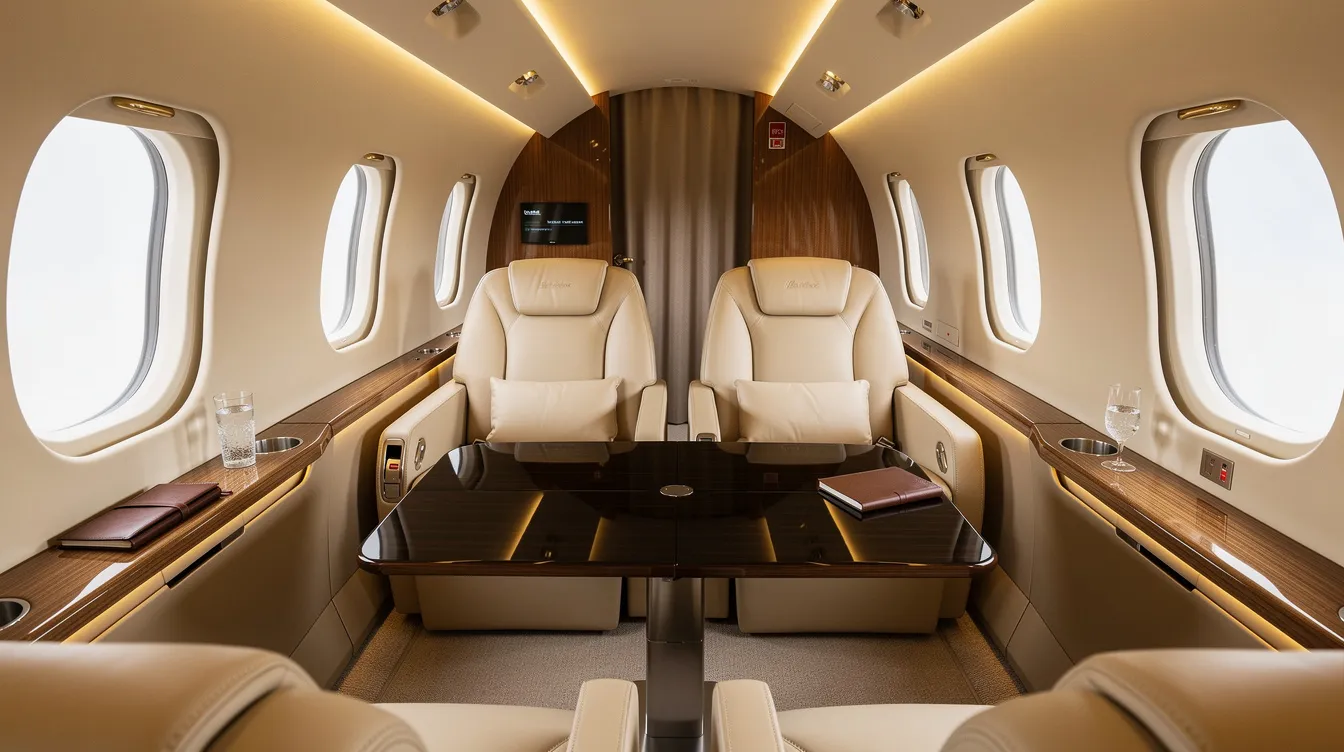
The Citation Latitude's spacious cabin measures 21.9 feet long and 6.4 feet wide, with a 6-foot stand-up cabin height. It features a cabin volume of 587 cubic feet-dimensions that feel closer to super-midsize comfort while operating at midsize cost. The flat floor runs the full length of the cabin, eliminating the step-downs common in older midsize designs and creating a refined space that passengers notice immediately.
The Citation Latitude accommodates up to 9 passengers comfortably, and the cabin features reclining executive seats arranged in configurations suited to both business and leisure travel.
The automatic entry system is one of the aircraft's signature touches, and when paired with floating fleet options in fractional ownership, it helps ensure that busy executives consistently board similar, familiar aircraft even when tail numbers change. Push-button operation allows passengers to board without manual stair deployment-easing the process for older travelers, families with children, and executives carrying laptops or briefcases. On tight turnarounds between city pairs, this feature saves several minutes per departure, which compounds across a full year of flying.
The Latitude's baggage compartment is where this aircraft genuinely separates from competitors. It offers 127 cubic feet of baggage storage space with a weight capacity of approximately 1,245 lb- a class-leading baggage compartment among midsize jets.
In practical terms, this baggage capacity translates to:
Multiple full-size roller suitcases for a four- to six-person team
Garment bags, presentation equipment, and sample cases
Skis, golf clubs, or other oversized sporting gear for long trips
Personal luggage for multi-day itineraries without compression or compromise
Few competing midsize platforms match this volume, and it is one of the primary reasons the Latitude has been turning heads in fractional fleets since its introduction, especially for clients comparing top fractional jet ownership programs across the market.
Typical fractional fleet configurations include a double-club arrangement for four passengers (two facing pairs), additional forward or aft seats, an optional small divan, and an enclosed rear lavatory. This layout supports everything from executive meetings-with facing seats for discussion-to family travel where the whole team can spread out.
Most fractional and managed-fleet Latitude aircraft come equipped with Wi-Fi, power outlets at every seat, USB charging, and LED cabin management systems. Between U.S. hubs like New York, Miami, and Houston, passengers can treat the cabin as an airborne office, arriving at their destination feeling refreshed and prepared.
Consider a leadership team flying from Chicago to Austin: four executives, a full set of presentation gear, checked product samples, and personal luggage. The Latitude's generous baggage compartment stows everything below deck, the cabin layout seats the team in facing pairs for a strategy session, and Wi-Fi keeps everyone connected en route. Maximum comfort, zero compromise-delivered at midsize operating economics.
The Citation Latitude's Garmin G5000 avionics suite is central to the aircraft's safety, operational efficiency, and long-term fleet value. The garmin g5000 flight deck is built around three large-format 14-inch glass displays-each serving as either a primary flight display or multifunction display, and each able to function independently in the event of a system failure.
Four touchscreen controllers give pilots intuitive access to the integrated flight management system, covering everything from takeoff performance calculations to en-route navigation and arrival sequencing. This revolutionary system consolidates what previously required multiple standalone units into a unified cockpit environment.
Synthetic vision technology overlays terrain, obstacles, and flight-path data onto the primary flight display, giving crews a clear picture of the environment even in instrument meteorological conditions. Combined with Garmin's StormOptix volumetric weather radar-included as standard equipment on production aircraft-the system provides real-time storm-cell analysis that helps pilots route around turbulence.
These tools add intelligent innovation to every phase of flight and provide pilots with the situational awareness needed for a reliable and efficient flight, particularly on busy corridors such as Boston to Washington, D.C., or San Francisco to Seattle.
The aircraft is ads b Out compliant, broadcasting precise satellite-based position data to air traffic control and nearby aircraft. This capability has been mandatory in most controlled U.S. airspace since January 2020, and the Latitude's NextGen-capable architecture ensures long-term compatibility with evolving air traffic management systems.
The aircraft's robust navigation capabilities extend to extensive navigation database coverage, communications systems for datalink and voice, and compliance with CPDLC requirements for oceanic and international operations. Together, these systems support efficient flight operations across increasingly complex airspace.
When equipped with LinxUs-type central diagnostic monitoring, the Latitude continuously tracks system health across airframe and engine parameters, complementing robust liability and insurance coverage in fractional ownership that protects both operators and share owners. Data downloads occur after landing via Wi-Fi or in flight via satellite, allowing maintenance teams to address issues proactively. For fractional owners, this translates directly to higher dispatch reliability and fewer unscheduled groundings, which is especially important when you are also managing fractional jet ownership financing arrangements and want predictable utilization of your share.
For landing performance information and departure data, the G5000 system calculates field-length requirements in real time, adjusting for temperature, pressure altitude, and aircraft weight.
BlackJet partners with operators who prioritize modern avionics, rigorous pilot training, and proactive maintenance programs. The result: fewer delays, predictable schedules, and the peace of mind that comes from flying on an aircraft where every system is monitored, updated, and maintained to the highest standards.

Many prospective owners weigh the Cessna Citation Latitude against the larger Citation Longitude, and BlackJet Fractional Jet Ownership helps clients match the right business jet to their actual travel patterns rather than aspirational ones.
Specification | Citation Latitude | Citation Longitude |
|---|---|---|
Range (4 pax, NBAA IFR) | 2,700 nm | ~3,500 nm |
Max Cruise Speed | ~446 knots | ~483 knots |
Cabin Length | ~21.9 ft | ~25.2 ft |
Baggage Volume | 127 cu ft | ~112 cu ft |
Takeoff Distance (MTOW) | 3,580 ft | ~4,810 ft |
Typical Passengers | Up to 9 | Up to 12 |
The Longitude received its FAA certification in 2019, and first deliveries followed shortly after, giving buyers another data point when comparing the overall cost of fractional jet ownership between midsize and super-midsize platforms. Its further advanced airframe design incorporates lightweight composite materials in areas such as the nose radome and control surfaces, building on lessons from the Latitude's development. Both aircraft share the same cruciform tail lineage and similar cabin width and height, but the Longitude stretches the fuselage and adds range.
For travelers whose mission profile centers on frequent domestic U.S. flights, North American business hubs, and Caribbean or Mexico trips, the Latitude delivers the required range at lower hourly cost. Its shorter field performance lets pilots operate into airports the Longitude simply cannot reach, and its class-leading baggage volume handles more gear per trip than the larger jet.
Clients who regularly fly Los Angeles to New York or Geneva to Dubai with full passenger loads, or who need nonstop capability for transatlantic segments, will find the Longitude's 3,500 nm range and additional cabin length worth the premium.
BlackJet structures private aviation access through two primary programs, detailed on the fractional jet ownership page, and helps clients model the total cost of fractional jet ownership before committing to a specific structure:
Equity Fleet: Fractional aircraft ownership shares in midsize or super-midsize jets, with potential tax advantages for fractional jet owners (including depreciation benefits), predictable monthly costs, guaranteed availability, and clear contract terms often based on a detailed aircraft fractional ownership sample contract. This model suits clients flying 50–150 hours per year who want the benefits of ownership without the full burden.
Reserve Fleet: A flexible membership-style program that functions like a jet card-pay-as-you-go access without capital commitment, ideal for clients flying 25–75 hours annually or those exploring private aviation for the first time.
A new Citation Latitude costs approximately $19.5 million, while used Citation Latitude models typically range from $10 million to $16 million depending on year, hours, and interior condition. Annual fixed costs for operating a Citation Latitude are approximately $453,767; variable hourly operating costs run about $2,222 per hour; and total annual operating costs can reach around $2 million when factoring in crew, insurance, hangar, and maintenance.
Fractional ownership spreads these fixed costs across multiple owners while still delivering predictable, on-demand access, and owners retain the option of selling a fractional jet ownership share if their travel needs or capital priorities change over time. For the 25–150 hour-per-year traveler, the economics are difficult to argue against.
The Citation Latitude offers a maximum range of 2,700 nautical miles under NBAA IFR reserves with four passengers, making it ideal for coast-to-coast U.S. flights and many international routes within Europe and Asia-Pacific.
This midsize jet comfortably seats up to nine passengers in a spacious cabin with a flat floor and 6-foot stand-up height, providing ample room for both business and leisure travel.
Annual fixed operating costs average around $453,767, with variable hourly costs approximately $2,222. Total annual operating expenses can reach about $2 million, excluding the purchase price.
Fractional ownership spreads fixed costs among multiple owners, offers guaranteed availability, potential tax advantages, and provides predictable monthly expenses, making private jet access more efficient and cost-effective for those flying 25–150 hours annually.
The aircraft is equipped with the Garmin G5000 avionics suite, featuring three 14-inch touchscreen displays, synthetic vision technology, real-time diagnostics, and ADS-B Out compliance for enhanced situational awareness and NextGen airspace readiness.
While the Latitude excels in cost efficiency, runway flexibility, and baggage capacity for midsize missions, the Longitude offers extended range (approximately 3,500 nm), higher cruise speeds, and larger cabin space suited for longer intercontinental flights.
Whether your missions center on Los Angeles to New York or span from New York or Geneva to Dubai, the Citation Latitude remains one of the most capable and efficient platforms in midsize private aviation. It is an aircraft that continues to earn its reputation through practical performance, not marketing promises.
Ready to explore the smarter way to fly private? Visit FractionalJetOwnership.com to request a personalized consultation on fractional aircraft ownership, mission analysis, and the most efficient way to access a modern, Garmin G5000-equipped business jet. BlackJet's advisory team can help determine whether a midsize Citation Latitude, a super-midsize Citation Longitude, or a flexible Reserve Fleet membership is the right fit for your travel profile.
